Sebastian Vettel Penalized: Unpacking the British Grand Prix Collision with Max Verstappen
Sebastian Vettel, a four-time Formula 1 world champion, found himself under the spotlight at the British Grand Prix, not for a podium finish, but for a controversial incident involving Red Bull’s Max Verstappen. Following a detailed investigation, race stewards issued Vettel two penalty points on his Super Licence for causing a collision with Verstappen, significantly impacting both drivers’ races and raising questions about driver conduct and the fierce competition at the pinnacle of motorsport.
The Pivotal British Grand Prix Incident at Vale
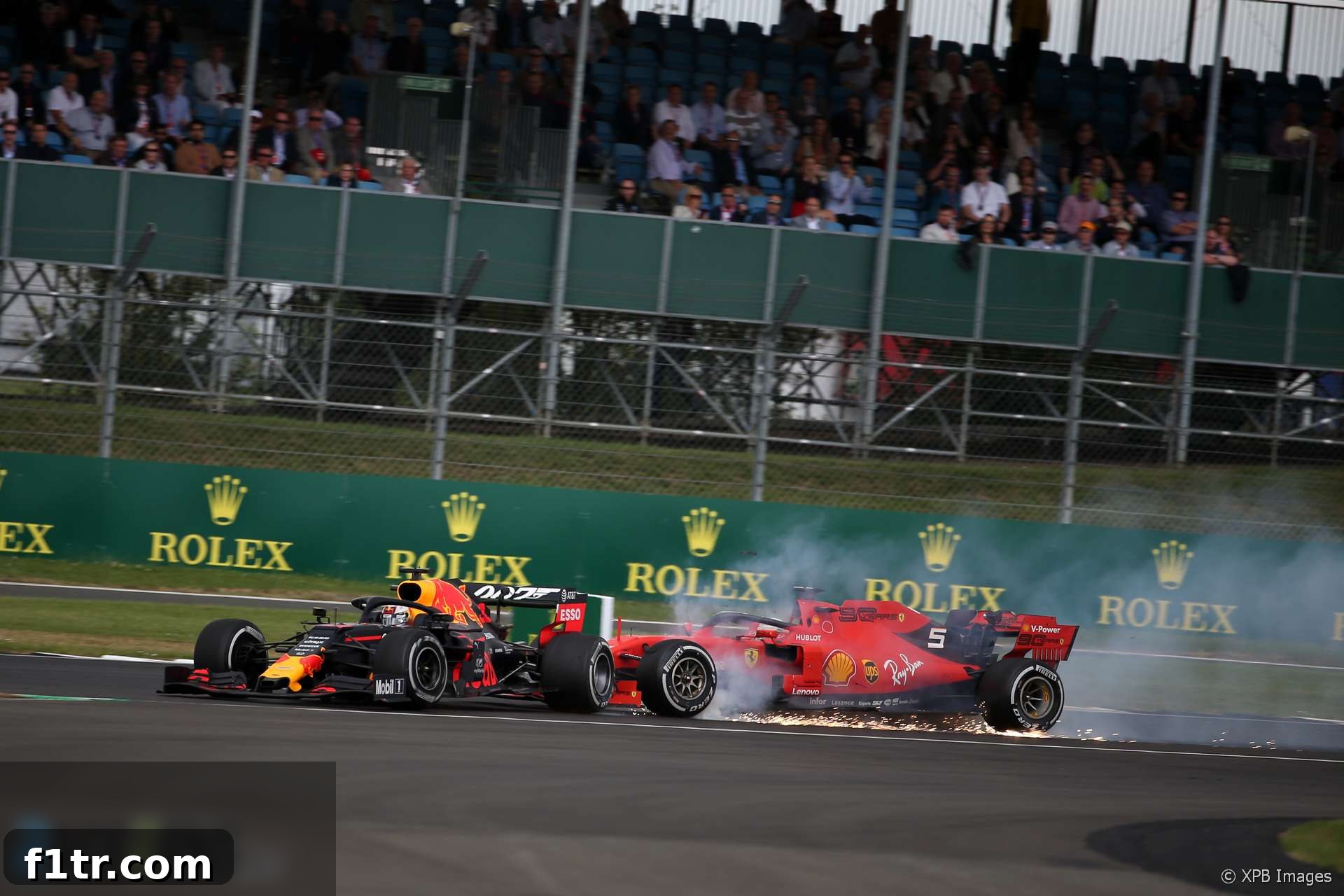
The dramatic incident unfolded during a critical phase of the British Grand Prix at Silverstone. Max Verstappen, known for his aggressive and uncompromising racing style, had just executed a daring and successful overtake on Sebastian Vettel’s Ferrari. The Red Bull driver surged past Vettel, setting up what promised to be an exciting battle for position. However, as the two cars approached the challenging Vale corner, a crucial left-hander known for its heavy braking zone, disaster struck.
Vettel, seemingly misjudging his braking point or the closing speed, locked his wheels under heavy braking. His Ferrari veered into the rear of Verstappen’s Red Bull, sending both cars spinning and off track. The impact was significant, causing considerable damage to both vehicles. It was a heart-stopping moment for fans and a frustrating one for both teams, as valuable race time and potential points were instantly lost.
Despite the damage, the resilient Verstappen managed to recover and, against the odds, clawed his way back through the field to secure a commendable fifth-place finish. His ability to salvage such a strong result after a significant incident highlighted his skill and determination. Vettel, on the other hand, was less fortunate. After pitting for repairs and receiving a 10-second time penalty for his role in the collision, he was ultimately classified in 16th position, a disappointing outcome for a driver of his caliber and for the Scuderia Ferrari team vying for championship contention.
Stewards’ Verdict: Unpacking the Blame
Immediately after the race, the incident was placed under investigation by the FIA race stewards, a standard procedure for any on-track collision. The stewards, comprising experienced officials Garry Connelly, Felix Holter, Vitantonio Liuzzi, and Dennis Carter, conducted a thorough review of all available evidence. This included telemetry data, onboard camera footage from both cars, CCTV angles, and witness accounts.
Their findings were unequivocal. The stewards concluded that Sebastian Vettel was “wholly to blame for the incident.” Their official statement detailed their observations: “The stewards reviewed the video evidence which showed car five [Vettel] locked wheels under braking and collided with the rear of car 33 [Verstappen].” This simple yet definitive statement underlined the clear nature of the infraction. The lock-up under braking, combined with the subsequent impact, left little room for interpretation regarding the cause of the collision. It was deemed a driver error on Vettel’s part, leading directly to the contact.
The severity of the decision reflected the FIA’s commitment to maintaining safe and fair racing standards. In Formula 1, drivers are expected to demonstrate excellent car control and spatial awareness, especially when battling for position. Misjudging braking points, particularly when another car is directly ahead, is a fundamental error that can have serious consequences, as evidenced by this incident.
The FIA Penalty Point System Explained
Beyond the immediate time penalty during the race, the stewards also imposed two penalty points on Sebastian Vettel’s Super Licence. This system, introduced by the FIA to deter repeat dangerous driving and ensure driver accountability, accumulates points for various infractions throughout a 12-month period. Each point serves as a warning, and a driver accumulating 12 points within this rolling period faces an automatic one-race ban.
Following this incident at Silverstone, Vettel’s total penalty points rose to six. This places him precisely halfway towards the threshold for a race ban, a significant concern for any top-tier driver and their team. For a driver of Vettel’s experience and stature, reaching six points is a rare occurrence and highlights the seriousness with which this particular incident was viewed. It serves as a stark reminder of the fine line between aggressive racing and reckless driving, and the consequences of crossing that line.
The penalty point system is designed to provide a consistent framework for sanctioning drivers, ensuring fairness across the grid. It acts as a preventative measure, encouraging drivers to exercise greater caution and judgment, particularly after receiving prior penalties. For fans, understanding this system adds another layer of intrigue to the championship battle, as a driver’s discipline can directly impact their participation in future races.
Reactions from Race Control and Beyond
FIA race director Michael Masi provided further insight into the stewards’ decision, indicating a clear consensus on Vettel’s culpability. “I think from the footage and everything they relied upon it was all clear for everyone to see that Max went in there and Sebastian, it looks as though he misjudged it. I don’t think there was any doubting from what I saw,” Masi stated.
Masi’s comments underscored the transparency and objective nature of the stewards’ review process. In the high-stakes environment of Formula 1, where every millisecond and millimeter counts, subjective interpretations can often lead to debate. However, in this instance, the evidence presented through various angles and data streams left little room for alternative explanations. The visual evidence of Vettel’s locked wheels and the subsequent impact was compelling and conclusive.
The incident sparked considerable discussion among pundits, former drivers, and fans alike. Many agreed with the stewards’ decision, citing the clear error in judgment from Vettel. Others debated the pressures drivers face in tight racing situations, where split-second decisions can have profound consequences. Regardless of individual opinions, the incident served as a potent example of how even the most experienced drivers can make mistakes under immense pressure, and how swiftly those mistakes are penalized in modern Formula 1.
Implications for Sebastian Vettel’s Season
The British Grand Prix incident was more than just a single race setback for Sebastian Vettel; it became another challenging chapter in what was proving to be a difficult season. The accumulation of six penalty points added an extra layer of pressure, as any further incidents could push him closer to a mandatory race ban, which would be a severe blow to his championship aspirations and the team’s performance.
For Ferrari, the incident was also a missed opportunity to score crucial points and consolidate their position in the Constructors’ Championship. The constant battle for supremacy against Mercedes and other top teams means that every point lost, and every penalty incurred, can have significant repercussions. Vettel’s reputation as a highly competitive, yet sometimes fiery, driver was once again under scrutiny, with calls for greater consistency and fewer unforced errors.
The incident also highlighted the fierce competition between drivers of different generations. Max Verstappen, representing the new guard, consistently pushes the limits with aggressive yet often controlled driving. Vettel, a seasoned veteran, has faced increasing pressure to adapt and maintain his edge. This collision at Silverstone epitomized the intensity of their rivalry and the fine margins that define success and failure in Formula 1.
The British Grand Prix: A Race of Drama and Decisions
The British Grand Prix is renowned for its iconic circuit, passionate fans, and often unpredictable racing. This particular edition added another memorable chapter to its storied history, not least due to the Vettel-Verstappen collision. While the focus quickly turned to the controversy, the race itself was a thrilling spectacle, full of overtakes, strategic battles, and impressive performances.
Ultimately, the stewards’ decision regarding Vettel and Verstappen was a testament to the meticulous and impartial nature of Formula 1 governance. Their role is to ensure fair play and safety, even when it means penalizing a superstar driver. The incident, and the subsequent penalties, served as a powerful reminder that in Formula 1, no driver is above the rules, and every action on track carries a potential consequence.
As the season progressed, the memory of this collision, and Vettel’s accumulating penalty points, remained a talking point. It underscored the importance of discipline, precision, and respect for fellow competitors, all essential ingredients for success in the exhilarating world of Formula 1.
Don’t miss anything new from RaceFans
Follow RaceFans on social media for the latest updates:
- Join RaceFans on Facebook
- Follow RaceFans on Twitter
- Get daily email updates from RaceFans
More on the 2019 F1 Season
Explore additional articles and insights from the thrilling 2019 Formula 1 season:
- Crying in the Melbourne car park at 2019 grand prix was my career low – Ocon
- McLaren Racing reports reduced £71 million loss in 2019
- Kvyat: Hockenheim podium last year was “my biggest achievement” so far
- How the FIA’s new encrypted fuel flow meter targets Ferrari’s suspected ‘aliasing’ trick
- “He smashed my office door”: 23 must-see moments from ‘Drive to Survive’ season two
Browse all 2019 F1 season articles