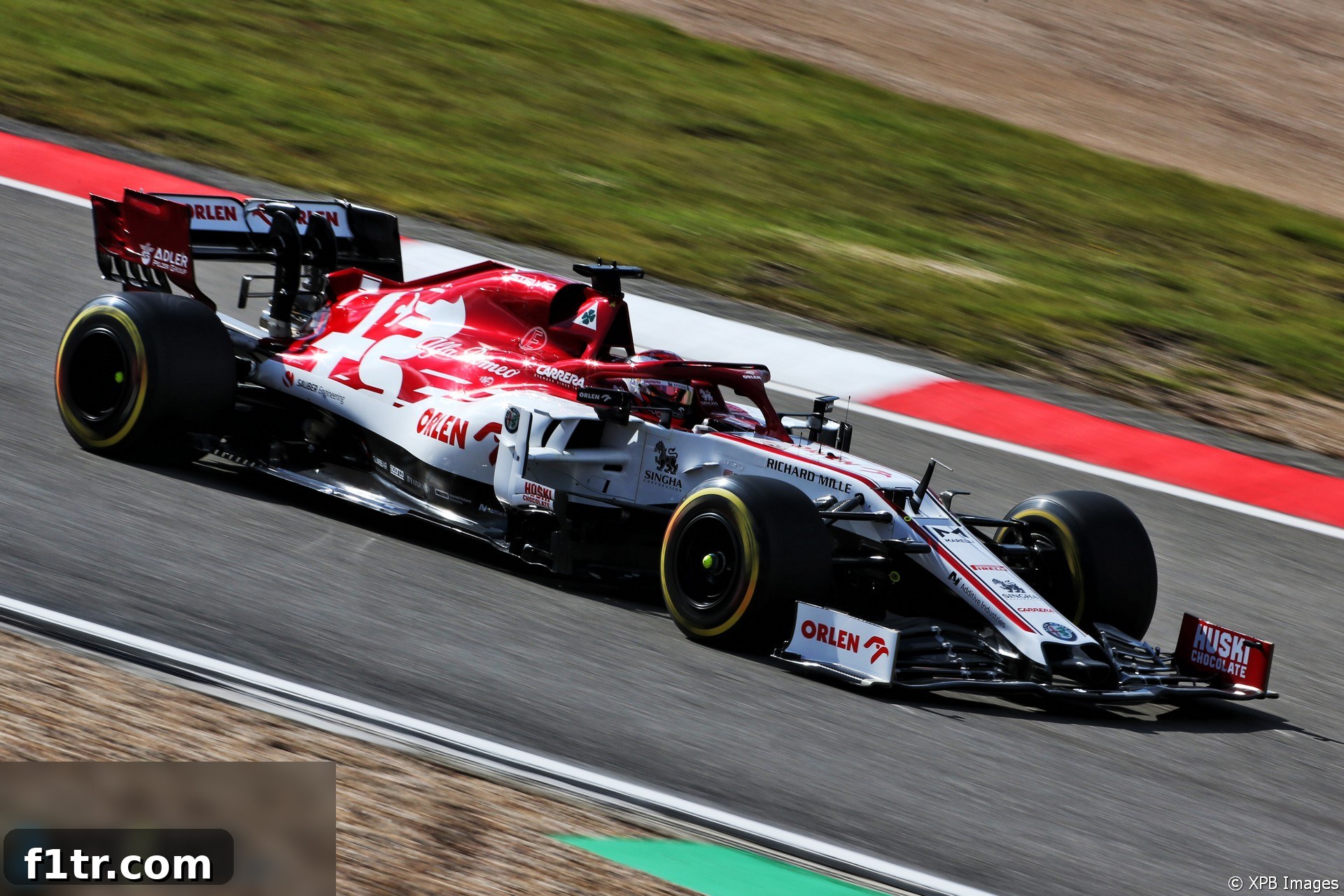
Kimi Raikkonen Receives Penalty Points for Collision with George Russell at Eifel Grand Prix
Kimi Raikkonen, the seasoned Finn behind the wheel of the Alfa Romeo, was recently handed two penalty points on his Super Licence following an incident with Williams driver George Russell during the 2020 Eifel Grand Prix. This decision by the race stewards adds to the “Iceman’s” tally, bringing his total to four penalty points, a development that garnered significant discussion within the Formula 1 community.
Advert | Become a Supporter & go ad-free
A Detailed Look at the Nürburgring Incident
The collision unfolded during the early stages of the Eifel Grand Prix at the iconic Nürburgring circuit. Both Kimi Raikkonen and George Russell were locked in a fierce battle for position as they approached Turn 1, a challenging left-hander known for its heavy braking zone. Raikkonen, driving his Alfa Romeo C39, experienced a lock-up on his front-right tyre as he attempted to navigate the apex. This momentary loss of control caused his car to slide wide, making unavoidable contact with Russell’s Williams FW43.
The impact was significant enough to lift Russell’s car momentarily into the air, showcasing the sheer forces involved in such high-speed collisions. While Russell initially managed to limp his car back to the pits, the damage sustained, particularly a puncture, proved terminal, forcing him to retire from the race. This was a particularly frustrating outcome for the young British driver, who was consistently pushing the limits in an uncompetitive car, often battling to make it out of the lower positions.
The conditions at the Nürburgring that weekend were notably challenging, with colder temperatures than typical Formula 1 races, which often contributes to issues like tyre warm-up and potential lock-ups. Drivers frequently faced a delicate balance between pushing hard for grip and risking mistakes. This context, while not excusing the incident, provides a fuller picture of the environment in which the collision occurred.
The Stewards’ Ruling and F1 Penalty Points System
Following a thorough review of the incident, including telemetry data and video evidence, the race stewards concluded that Raikkonen was primarily responsible for the collision. Their official ruling stated: “car seven locked up the front right tyre and touched car 63, causing an avoidable collision and retirement of car 63.” This verdict highlights that while racing incidents are a common occurrence, the stewards deemed this particular contact to be preventable.
The imposition of two penalty points on Raikkonen’s Super Licence is a standard disciplinary measure in Formula 1. The Super Licence penalty points system is designed to ensure driver safety and fair play throughout the season. Each driver accumulates points for various infractions, ranging from avoidable collisions to unsafe releases from the pits. These points remain on a driver’s licence for a rolling 12-month period.
The implications of this system can be severe. If a driver accumulates 12 penalty points within a 12-month timeframe, they face an automatic one-race ban. For Kimi Raikkonen, these two points brought his season total to four, placing him a third of the way towards a potential suspension. While four points is not immediately alarming for a veteran driver like Raikkonen, it serves as a crucial reminder to maintain vigilance and clean racing standards in subsequent events. For a driver like Raikkonen, known for his clean racing and extensive experience, such an accumulation is relatively rare and underscores the severity of the stewards’ assessment of the Nürburgring incident.
George Russell’s Candid Reaction
Despite the frustration of an early retirement, George Russell demonstrated remarkable sportsmanship and understanding when addressing the incident. Speaking after the race, Russell described Raikkonen’s error as a “minor mistake” and one that is “easily done” in the demanding world of Formula 1. He offered an insightful explanation into the dynamics that often lead to such incidents.
“In a Formula 1 car, especially when you’re following, it’s so easy to have a small lock-up and that obviously was the reasoning why he locked up, went wide, oversteered and went into me,” Russell explained. This perspective from a fellow competitor, particularly one directly affected by the incident, offers a nuanced view, acknowledging the fine margins and immense pressures F1 drivers operate under.
Russell further emphasized his lack of animosity, stating, “So no hard feelings. It’s racing but it’s obviously frustrating from my side.” This mature response is characteristic of Russell, who has consistently shown composure and professionalism throughout his career, even when faced with setbacks. His words underline the competitive spirit inherent in motorsport, where drivers push to their limits, sometimes resulting in contact, yet maintain mutual respect.
Kimi Raikkonen: The “Iceman” and a Career of Clean Racing
Kimi Raikkonen, a veteran of the sport and the 2007 Formula 1 World Champion, is widely respected for his unique personality, blistering speed, and generally clean racing style. Throughout his illustrious career, which has spanned over two decades, Raikkonen has been involved in relatively few major incidents that have led to penalties, making this particular ruling at the Eifel Grand Prix somewhat out of character for the “Iceman.”
Competing with Alfa Romeo, a team typically fighting in the midfield or at the back of the grid, often means drivers are constantly on the edge, pushing their machinery to extract every ounce of performance. These circumstances can sometimes lead to more frequent and intense battles for position, increasing the probability of close calls and occasional contact. Raikkonen’s experience allows him to navigate these situations with precision, but even the most seasoned drivers can fall victim to a momentary lapse or unexpected track conditions, as was seen at Nürburgring’s Turn 1.
The Wider Context of the 2020 Eifel Grand Prix
The 2020 Eifel Grand Prix marked Formula 1’s return to the legendary Nürburgring for the first time since 2013, a highly anticipated event. The race weekend was plagued by challenging weather conditions, including cold temperatures and misty mornings, which even led to the cancellation of Friday’s practice sessions. These conditions undoubtedly added another layer of complexity for all teams and drivers, impacting tyre performance and overall grip levels.
Beyond the Raikkonen-Russell incident, the Eifel Grand Prix was a race of historical significance. Lewis Hamilton secured his 91st career victory, equalling Michael Schumacher’s long-standing record, a monumental achievement that dominated headlines. Daniel Ricciardo also made a memorable return to the podium, securing Renault’s first top-three finish in nine years. These narratives highlight that while every incident carries weight, it occurs within a larger tapestry of a dynamic and unpredictable race weekend.
The incident between Raikkonen and Russell, therefore, serves as a microcosm of the intense competition that defines Formula 1. Even as major milestones are achieved and new records set, the fierce battles throughout the field ensure that every corner, every overtaking attempt, carries risk and reward.
Advert | Become a RaceFans supporter andgo ad-free
Implications for Future Races and Driver Conduct
The two penalty points levied against Kimi Raikkonen for the Eifel Grand Prix incident are not just a slap on the wrist; they are a tangible reminder of the standards of conduct expected from Formula 1 drivers. While Raikkonen’s four points are still far from the twelve-point threshold for a race ban, they serve as a marker that any further infringements will bring him closer to potentially missing a Grand Prix. This factor subtly influences a driver’s decision-making in future close-quarter racing scenarios.
For George Russell and Williams, while the immediate frustration of retirement was palpable, such incidents are part and parcel of the learning curve in Formula 1. Russell’s measured response indicates a focus on the bigger picture and the understanding that mistakes can happen. For a team like Williams, fighting tooth and nail to climb up the constructors’ standings, every lost opportunity for track time and potential points is a blow, regardless of the cause.
The stewards’ consistent application of the penalty points system reinforces the importance of driver responsibility. It underscores the fine line between aggressive, hard racing — which is celebrated — and reckless or avoidable contact, which is penalized. This balance is crucial for maintaining both the spectacle and the safety of Formula 1. As the season progressed, drivers remained acutely aware of their penalty point tallies, adding another layer of strategic consideration to their on-track duels.
Conclusion: A Race Incident, A Penalty, and Continued Respect
The collision between Kimi Raikkonen and George Russell at the 2020 Eifel Grand Prix, resulting in two penalty points for Raikkonen and Russell’s retirement, stands as a clear example of the high-stakes, high-speed nature of Formula 1. While unfortunate for both drivers, particularly Russell who was forced out of the race, the incident was adjudicated swiftly by the stewards, who identified it as an avoidable collision. Raikkonen’s accumulation of four penalty points serves as a reminder of the stringent disciplinary measures in place to ensure fair and safe competition.
Despite the competitive intensity, Russell’s gracious and understanding reaction highlights the underlying respect between drivers in the paddock. These types of incidents are inherent to motorsport, where fractions of a second and minuscule errors can have significant consequences. As Formula 1 continues to push the boundaries of technology and human skill, the balance between aggressive racing and responsible conduct remains a constant challenge for all participants. The Eifel Grand Prix incident, though a minor footnote in the grand scheme of the season, provided valuable insights into driver conduct, the application of sporting regulations, and the enduring spirit of competitive racing.
2020 Eifel Grand Prix
- Renault “not scared of anywhere” in remaining races
- Bottas “needs a miracle” to overturn Hamilton’s 69-point lead
- 2020 Eifel Grand Prix Star Performers
- Leclerc sees ‘quite a few positives’ in Ferrari’s Nurburgring weekend
- Mercedes relied on DAS “more than ever” at cold Nurburgring
Browse all 2020 Eifel Grand Prix articles