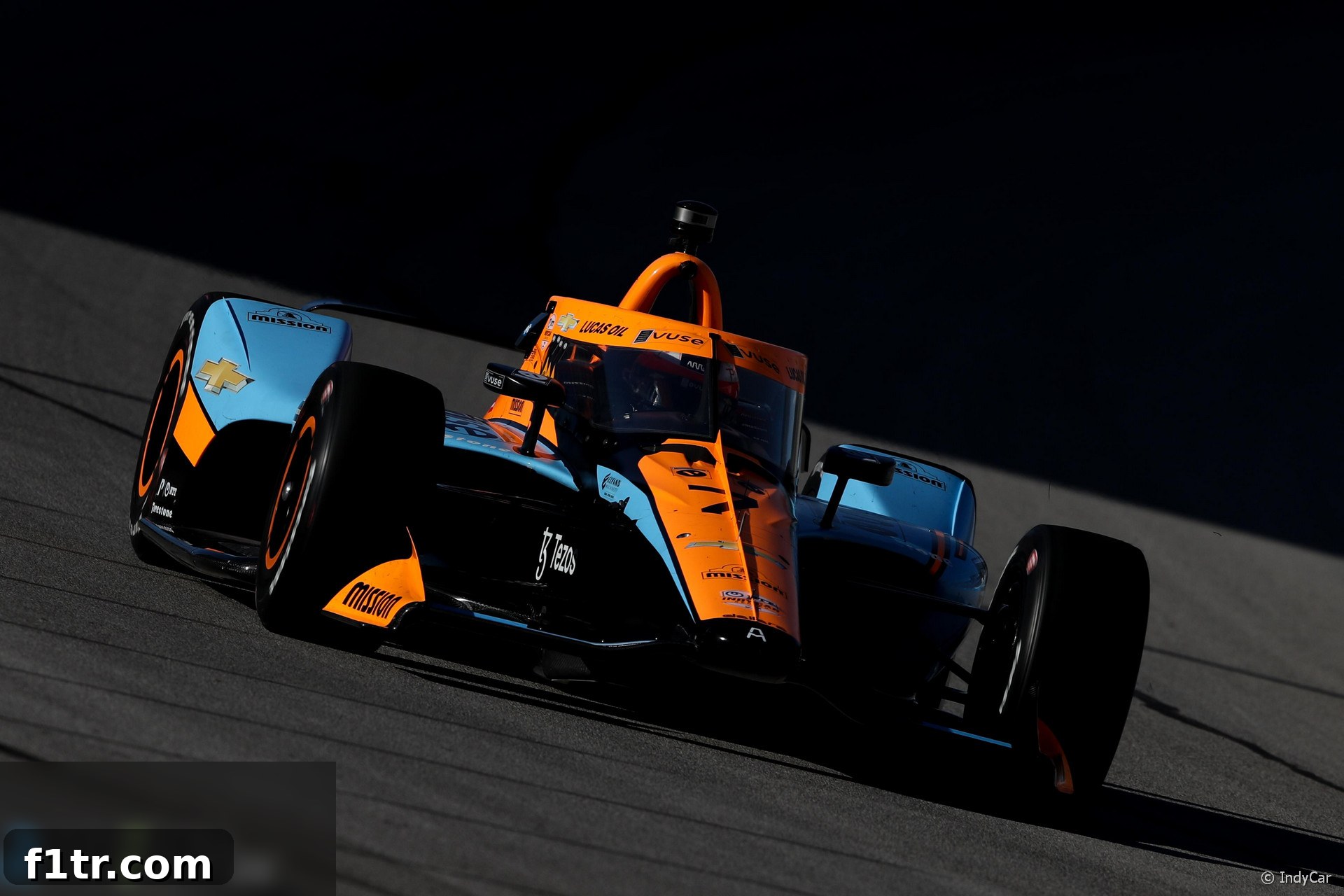
After a challenging start to the Formula 1 season for the McLaren team, marked by a dismal qualifying performance in Bahrain, the McLaren SP IndyCar squad found reason to celebrate as Felix Rosenqvist delivered a sensational pole position at Texas Motor Speedway. This remarkable achievement not only brought a much-needed morale boost to the wider McLaren racing family but also underscored the intense competitiveness and unpredictable nature of the NTT IndyCar Series, particularly on its high-speed oval circuits.
Rosenqvist’s triumphant qualifying run ended a three-year wait for an IndyCar pole position for the Swedish driver, marking a significant personal milestone. His McLaren SP Dallara-Chevrolet car proved to be the fastest machine on the superspeedway, putting him at the very front of the grid for Sunday’s highly anticipated race. This performance was not just about raw speed but also about precision, courage, and perfect execution under pressure, reflecting the demanding skills required for oval racing.
A Deep Dive into IndyCar’s Single-Car Qualifying Format at Texas
The unique single-car qualifying format employed at Texas Motor Speedway adds an extra layer of tension and spectacle to the event. Unlike road courses where multiple cars are on track simultaneously, each driver faces the immense challenge of the 1.5-mile superspeedway alone, with their fate determined by the average speed across two high-stakes flying laps. This format demands absolute focus and a flawless run, as there’s no opportunity to correct a mistake or benefit from another car’s slipstream.
Rosenqvist, who was 11th in the queue of 27 cars to qualify based on the current championship standings, laid down an astonishing two-lap average speed of 355.842 kilometers per hour (221.110 miles per hour). This blistering pace immediately set a high benchmark, but the real test began as he waited for the remaining 16 drivers to complete their runs. The track conditions, a critical factor in any form of motorsport, began to evolve, with the ambient and track temperatures steadily rising throughout the session. As the surface heated up, grip levels diminished, making it progressively harder for later qualifiers to match or exceed Rosenqvist’s early benchmark.
Rosenqvist’s Masterful Performance and the Fight for Pole
Despite competitive runs from seasoned oval veterans like Takuma Sato and emerging stars such as Scott McLaughlin, Rosenqvist’s early pace held strong. The tension was palpable as each subsequent driver pushed their limits, yet none could dethrone the McLaren SP entry. This pole position marked Felix Rosenqvist’s second career IndyCar Series pole, but more importantly, it was his first ever on an oval circuit – a testament to his growing confidence and skill in this specialized form of racing. His ability to deliver such a commanding performance after a considerable wait for pole position speaks volumes about his resilience and determination.
The battle for the front row was incredibly tight, highlighting the minute differences that separate the best in IndyCar. Scott McLaughlin, who has been on a remarkable trajectory since his debut, qualified second with an equally impressive two-lap average of 355.820 kph (221.096 mph). McLaughlin, who only three weeks prior celebrated his maiden IndyCar victory on the challenging streets of St. Petersburg, Florida, continued to showcase his exceptional talent. The narrow margin between Rosenqvist and McLaughlin ensured an all-Chevrolet front row for Sunday’s 248-lap race, setting the stage for an intense manufacturer battle right from the green flag.
The Contenders: A Glimpse at the Top Ten Qualifiers
The qualifying results presented a formidable lineup of talent behind the front row, promising an exhilarating contest. Takuma Sato, known for his aggressive racing style and prowess on ovals, secured the third starting spot as the fastest Honda-powered driver. His experience and strategic acumen will make him a force to be reckoned with. Alongside him, in fourth position, was Team Penske’s Will Power, a consistent championship contender whose methodical approach and speed always keep him in contention.
Scott Dixon, who clinched victory in one of the doubleheader races at Texas just last year, will start from fifth. The veteran Chip Ganassi Racing driver is renowned for his race craft and ability to manage tires, making him a perennial threat on any oval. Lining up next to him in sixth was the reigning Indianapolis 500 champion, Hélio Castroneves. Castroneves, a legend of oval racing with four Indy 500 wins, brings unparalleled experience and an innate understanding of these circuits.
The top ten was rounded out by a mix of established stars and rising talents. Josef Newgarden, another strong contender from Team Penske, qualified seventh, ahead of Rinus VeeKay in eighth, who continues to impress with his raw speed for Ed Carpenter Racing. Colton Herta, a young American sensation from Andretti Autosport, secured ninth, while Pato O’Ward, Rosenqvist’s McLaren SP teammate and winner of the second Texas race in last year’s doubleheader, completed the top ten. McLaren SP’s strong showing with two cars in the top ten underlines their growing strength and potential for success this season.
Rookies, Veterans, and Teams Facing Challenges
Beyond the leading pack, several notable drivers faced different challenges and achieved various milestones. Romain Grosjean, making his first start on an IndyCar superspeedway, qualified a respectable 13th. His journey from Formula 1 to IndyCar, particularly his adaptation to the unique demands of oval racing, is a compelling narrative for fans. Fellow sophomore driver Jimmie Johnson, the NASCAR legend continuing his transition to open-wheel racing, qualified 18th. Johnson’s ongoing learning curve on these high-speed ovals remains a point of interest, showcasing the stark differences between stock car and IndyCar machinery.
The fastest IndyCar rookie in the field was Devlin DeFrancesco, who secured 17th position, starting ahead of Johnson. DeFrancesco’s performance offers a glimpse into the future talent pool of the series. Meanwhile, veterans like Ed Carpenter and JR Hildebrand, making their first appearances of the season, qualified 21st and 26th respectively. Their re-entry into the series always brings a blend of experience and excitement.
Not all teams had a smooth qualifying session. The Rahal Letterman Lanigan Racing (RLL) team, in particular, struggled for grip across their qualifying runs. Jack Harvey could only manage 24th, rookie Christian Lundgaard 25th, and Graham Rahal finished 27th and last in the order. Their difficulties underscore the fine margins in IndyCar and the constant pursuit of optimal setup, which can be elusive even for established teams. These struggles will undoubtedly lead to intensive analysis and strategy adjustments for the race itself, as starting deep in the field on an oval presents a significant hurdle.
Anticipating the Texas 375: What to Expect
The NTT IndyCar Series race at Texas Motor Speedway, officially known as the Texas 375, is set to go green on Sunday at 16:40 GMT. This event is typically one of the most thrilling on the calendar, known for its high speeds, multi-groove racing, and strategic complexities. Texas Motor Speedway is a unique oval, often described as a ‘tweener’—it’s not quite a short oval, nor a full super-speedway like Indianapolis, which means it demands a blend of different driving techniques and car setups. Tire degradation, fuel strategy, and pit stop execution will be paramount factors in determining the outcome.
With Felix Rosenqvist on pole, he holds the crucial advantage of clean air at the start, but maintaining that lead over 248 laps will require masterful car control and precise strategy. The close qualifying times suggest that overtaking will be plentiful, and the draft will play a significant role. Drivers starting further back, like the RLL cars, will need to be aggressive and capitalize on every opportunity to move through the field. The race promises high-speed drama, intense wheel-to-wheel battles, and unpredictable twists, characteristic of IndyCar oval events.
Fans can anticipate an action-packed race where veteran cunning will clash with youthful exuberance. The performance of both Chevrolet and Honda engines will be under scrutiny, especially after the all-Chevrolet front row. The Texas Motor Speedway has a history of delivering memorable finishes, and with such a competitive grid, the 2022 edition is poised to add another thrilling chapter to that legacy.
| Position | Car | Driver | Team | Engine |
|---|---|---|---|---|
| 1 | 7 | Felix Rosenqvist | McLaren SP | Chevrolet |
| 2 | 3 | Scott McLaughlin | Penske | Chevrolet |
| 3 | 51 | Takuma Sato | Coyne/RWR | Honda |
| 4 | 12 | Will Power | Penske | Chevrolet |
| 5 | 9 | Scott Dixon | Ganassi | Honda |
| 6 | 6 | Helio Castroneves | Meyer Shank | Honda |
| 7 | 2 | Josef Newgarden | Penske | Chevrolet |
| 8 | 21 | Rinus VeeKay | Carpenter | Chevrolet |
| 9 | 26 | Colton Herta | Andretti | Honda |
| 10 | 5 | Pato O’Ward | McLaren SP | Chevrolet |
| 11 | 10 | Alex Palou | Ganassi | Honda |
| 12 | 27 | Alexander Rossi | Andretti | Honda |
| 13 | 28 | Romain Grosjean | Andretti | Honda |
| 14 | 8 | Marcus Ericsson | Ganassi | Honda |
| 15 | 60 | Simon Pagenaud | Meyer Shank | Honda |
| 16 | 20 | Conor Daly | Carpenter | Chevrolet |
| 17 | 29 | Devlin DeFrancesco | Andretti Steinbrenner | Honda |
| 18 | 48 | Jimmie Johnson | Ganassi | Honda |
| 19 | 18 | David Malukas | Coyne/HMD | Honda |
| 20 | 77 | Callum Ilott | Juncos Hollinger | Chevrolet |
| 21 | 33 | Ed Carpenter | Carpenter | Chevrolet |
| 22 | 4 | Dalton Kellett | Foyt | Chevrolet |
| 23 | 14 | Kyle Kirkwood | Foyt | Chevrolet |
| 24 | 45 | Jack Harvey | RLL | Honda |
| 25 | 30 | Christian Lundgaard | RLL | Honda |
| 26 | 11 | JR Hildebrand | Foyt | Chevrolet |
| 27 | 15 | Graham Rahal | RLL | Honda |
Further IndyCar Insights
- IndyCar driver McLaughlin cleared of injury after crashing through barrier at Barber
- Schumacher says his IndyCar feels like ‘an F2 car, just with better tyres’
- IndyCar “way faster than Formula 1” in some corners, says Grosjean
- FIA to award more F1 superlicence points to IndyCar drivers from 2026
- Schumacher to race full-time in IndyCar with RLL in 2026
Browse all IndyCar articles