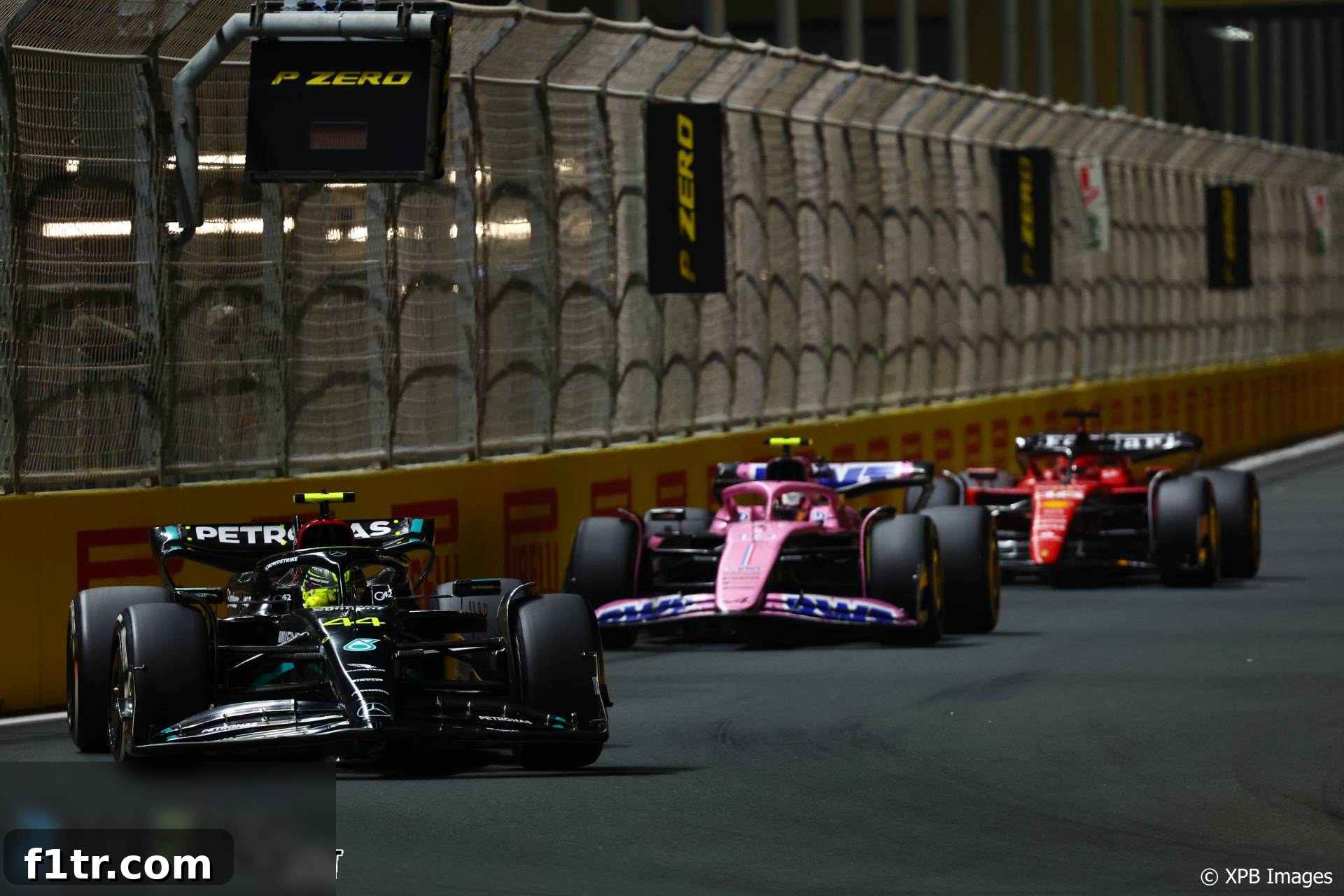
The 2023 Formula 1 Saudi Arabian Grand Prix proved to be a weekend of contrasting fortunes for the Mercedes-AMG Petronas F1 Team, particularly for seven-time World Champion Lewis Hamilton. Finishing fifth, just behind his teammate George Russell, Hamilton openly admitted to making an incorrect “50-50 choice” regarding his car’s setup. This decision ultimately compromised his race pace and prevented him from maximizing his potential on the challenging Jeddah Corniche Circuit, highlighting the razor-thin margins that define success and struggle at the pinnacle of motorsport.
The high-speed, street circuit nature of Jeddah demands an incredibly precise car setup, balancing outright pace with tyre management and stability through its numerous fast corners. Drivers and engineers often face difficult compromises when dialling in their machinery, and the Saudi Arabian Grand Prix often amplifies these challenges. Heading into the race, Mercedes was keen to build on their performance from the season opener, seeking to close the gap to front-runners and demonstrate the progress of their W14 challenger. For Hamilton, starting seventh on the grid, four places behind Russell who qualified in third, the task was already an uphill one, compounded by his strategic decision to start on the hard compound tyres – a unique choice among the top ten starters.
Hamilton’s Strategic Gamble and Race Day Realities
Hamilton’s decision to commence the race on the hard tyres was a calculated gamble, aimed at extending his first stint and potentially gaining an advantage later in the race if a Safety Car or Virtual Safety Car period emerged at an opportune moment. However, this strategy inherently meant a slower start compared to those on medium tyres, requiring him to manage the initial phase carefully. While he made progress through the field, navigating the early chaos, the distinct setup he had chosen began to manifest its impact on his overall performance.
The race saw a Safety Car period early on, which often provides an ideal window for tyre changes. While many opted to pit, Hamilton remained out, sticking to his original plan. This allowed him to climb up the order. Following the Safety Car restart, he demonstrated his race craft by successfully passing Carlos Sainz Jnr, moving into a solid fifth position. Yet, despite his best efforts, he found himself unable to match the sustained pace of his teammate, George Russell, finishing a full five seconds adrift at the chequered flag. This gap, in the intensely competitive world of Formula 1, spoke volumes about the underlying differences in their car’s characteristics.
The “50-50 Choice”: A Deep Dive into Setup Discrepancies
Post-race, Hamilton was candid about the factors that he believed hindered his performance. “The strategy just didn’t really work out for me,” he confessed, “The set-up was a bit off.” This frank admission pointed directly to the root cause of his struggles: a car setup that simply didn’t provide him with the optimal balance and performance window. In Formula 1, a car’s setup involves intricate adjustments to numerous parameters, including suspension stiffness, ride height, aerodynamic wing angles, differential settings, and brake bias. These choices significantly influence how the car behaves through corners, how it performs on straights, and crucially, how it manages tyre degradation. Even minor discrepancies can lead to significant performance differences.
Hamilton elaborated on the specific nature of this setup divergence from Russell’s car. “It’s just there was like a 50/50 choice – I chose one way, he chose another,” Hamilton explained. This practice of splitting setup approaches between teammates is not uncommon in Formula 1. Teams often do this, especially in the early stages of a season or at a new circuit, to gather more data, understand different car characteristics, and hedge against the uncertainty of choosing a single optimal setup. It allows them to cover more bases and learn faster about the car’s potential across various configurations. However, it also carries the inherent risk that one driver’s setup might prove significantly less effective than the other’s, as was the case for Hamilton in Jeddah.
What makes Hamilton’s comment particularly telling is his reflection: “More often than not, the way he went is the wrong one, but it just happened to work. I could only match his pace rather than be quicker this weekend.” This suggests that, historically, Hamilton’s setup choices or preferred direction might have yielded better results within the team. The implication is that on this specific occasion, a rare instance occurred where Russell’s experimental direction paid off handsomely. The frustration for Hamilton was evident; he felt limited to simply matching Russell’s pace, unable to extract the extra performance needed to challenge further up the grid. This scenario underscores the critical importance of setup decisions, especially when a team is still refining its understanding of a new car and trying to unlock its full potential. The margin between a correct and incorrect choice can be the difference between a podium finish and a mid-pack result.
Russell’s Podium and the Alonso Penalty Twist
While Hamilton grappled with his setup, George Russell enjoyed a more fruitful weekend, initially finishing fourth on the track. His contrasting setup choice and strategy, which included starting on the medium tyres, proved to be more effective for the conditions and the W14’s characteristics. However, the race had one final twist that further elevated Russell’s result and narrowly affected Hamilton’s. Post-race, Fernando Alonso, who had originally finished third, was handed a 10-second time penalty. This penalty was issued after his Aston Martin team were deemed to have incorrectly served an earlier five-second penalty during his first pit stop, specifically for touching the car too early while the penalty was being served. This unusual situation promoted Russell to a well-deserved third place on the podium, marking a significant points haul for Mercedes.
For Hamilton, Alonso’s penalty had a bittersweet effect. While it directly benefited his teammate, it meant he finished just two-tenths of a second behind Alonso in the revised classification. Had his setup been more optimal, or his race pace marginally quicker, this small gap could have seen him also gain a position. Nevertheless, from a team perspective, securing a podium with Russell and a strong fifth place with Hamilton yielded valuable points, demonstrating Mercedes’ intent to fight their way back to the front despite the early-season challenges with the W14’s performance window.
Become a RaceFans supporter andgo ad-free
Lessons Learned and the Road Ahead for Mercedes
Despite the personal disappointment over his setup choice, Hamilton remained pragmatic and focused on the positives for the team. “I feel we got some great points as a team,” he told Sky after the race. “George got third, which was amazing.” He acknowledged his own progress, moving from seventh to fifth, seeing it as a step forward. “I went forwards, which is always the hope – that you at least go forwards, one foot in front of the other. So I’m really grateful to have come through from seventh to fifth.”
The experience at Jeddah served as a crucial learning curve for both Hamilton and Mercedes. It underscored the importance of nailing the car setup and understanding the nuances of the W14 across different circuits and conditions. Hamilton’s resolve was clear, indicating a determination to work closely with his engineers to prevent a recurrence of such a setup disparity. “So lots to work on, but there are positives to take away from it,” he affirmed. “But I’ll work hard to make sure that two are in a better place next time.”
The dynamic between Hamilton and Russell, particularly when one driver finds a more optimal window for the car, provides valuable data for the team’s development trajectory. Mercedes engineers would meticulously analyze the data from both cars, comparing their performance metrics, tyre degradation, and driver feedback to understand precisely why Russell’s setup worked better and how that knowledge could be applied across the garage for future races. This iterative process of learning, adapting, and refining is central to success in Formula 1.
Conclusion: The Fine Margins of F1 Excellence
Lewis Hamilton’s performance at the 2023 Saudi Arabian Grand Prix perfectly encapsulated the high-stakes world of Formula 1, where a single “50-50 choice” can dramatically alter a race outcome. His candid admission about a suboptimal car setup, contrasting with his teammate’s success, highlighted the intricate balance between driver intuition, engineering decisions, and strategic gambles. While he secured valuable points and demonstrated his ability to make progress through the field, the experience served as a potent reminder that even a seven-time World Champion is susceptible to the fine margins that dictate performance at the elite level.
For Mercedes, the race provided both a podium finish and clear areas for improvement. The lessons learned from the diverging setup philosophies of their two drivers would undoubtedly inform their development efforts for the remainder of the season. As the team continued its pursuit of Red Bull, ensuring that both Hamilton and Russell consistently have cars capable of challenging at the front remained a paramount objective. The Jeddah race, therefore, was not just about the points scored, but about the critical insights gained, propelling Mercedes forward in their continuous quest for excellence in the ever-evolving landscape of Formula 1.
2023 Saudi Arabian Grand Prix Related Articles
- “Total transparency” needed over Ben Sulayem allegations – Russell
- FIA president Ben Sulayem under investigation for interfering in F1 race – report
- Two races, no points: How 2023 compares to McLaren’s worst starts to a season
- Don’t complain about Red Bull dominating F1, they deserve it – Sainz
- Alfa Romeo identify “massive debris” which ruined Bottas’ race
Browse all 2023 Saudi Arabian Grand Prix articles