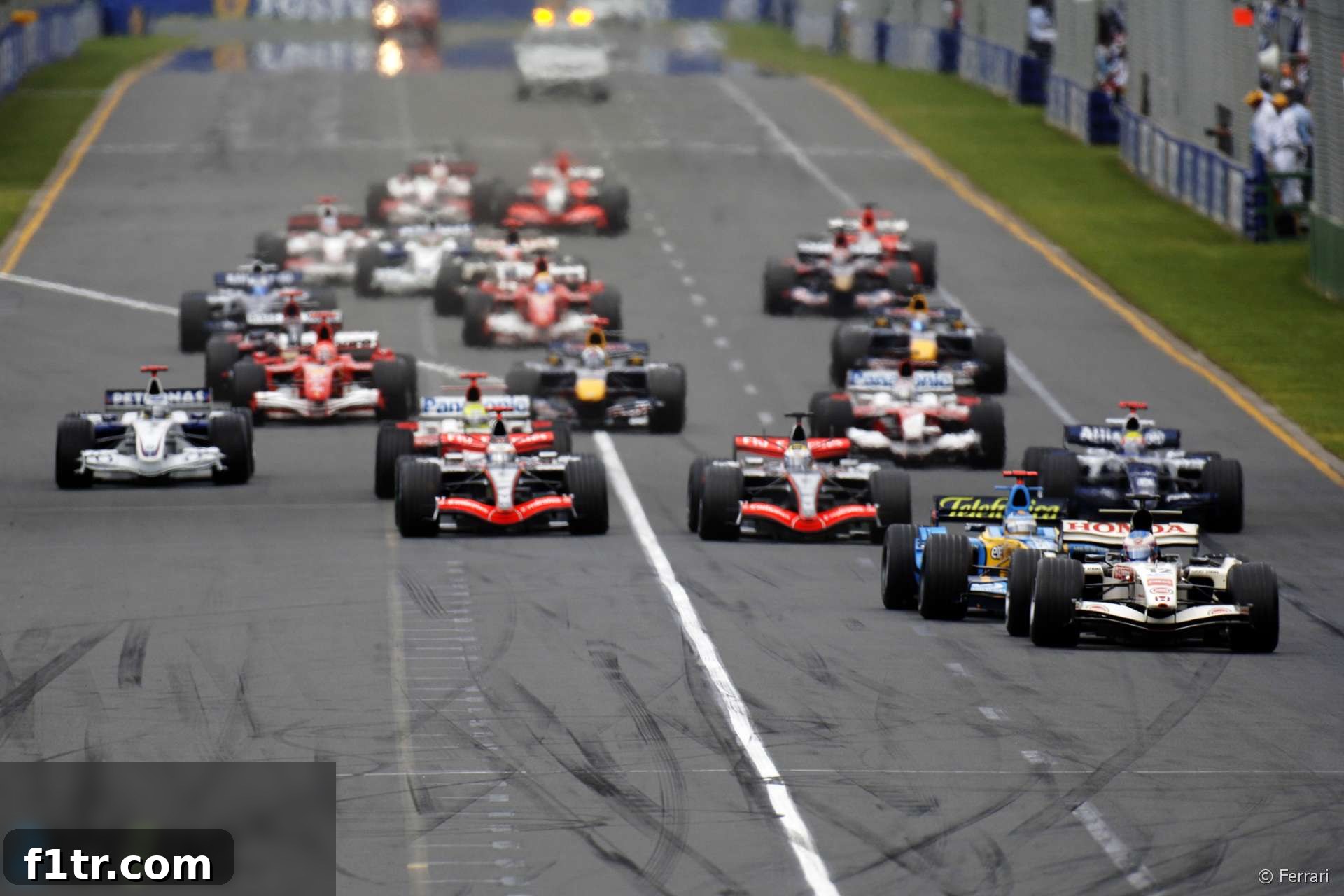
In a race that encapsulated the unpredictable spirit of Formula 1, Fernando Alonso delivered a masterful performance at the Australian Grand Prix, asserting his championship credentials while the competition around him descended into a spectacular display of chaos and attrition. The streets of Melbourne witnessed an event fraught with drama, multiple safety car deployments, and high-profile retirements, including motorsport legends Michael Schumacher and Juan Pablo Montoya, alongside a heartbroken Jenson Button.
The weekend had started with great promise for Jenson Button. On Saturday, he defied expectations by clinching a stunning pole position for Honda, running on a seemingly aggressive fuel load that hinted at an audacious race strategy. Button successfully converted this advantage into the early race lead, looking set to dictate the pace. His efforts were inadvertently aided by Giancarlo Fisichella, who had qualified an impressive second but stalled on the grid before the formation lap, triggering a complete race restart. This pivotal moment proved to be a lifeline for Juan Pablo Montoya, the McLaren driver having spun on the approach to the grid moments earlier, an incident that would have typically relegated him to the very back. The restart offered him a precious second chance, a fortunate turn of events that foreshadowed a day where luck would play a significant, often cruel, hand for many.
As the lights went out for the official restart, Alonso, starting from third, immediately went on the offensive, chasing Button into Turn Three. The Briton, renowned for his smooth driving, cannily defended his position, expertly pinning the aggressive Renault driver to the outside of the track. Further back, the two McLaren drivers, Montoya and Kimi Räikkönen, engaged in a fierce but fair battle, reminiscent of their intense rivalry in Malaysia, demonstrating exhilarating car control on the ragged edge of adhesion.
However, the early laps were far from clean for everyone. Felipe Massa’s race was brought to an abrupt and spectacular end when he misjudged his braking, slamming into the rear of Nico Rosberg’s Williams. The collision sent Massa’s Ferrari into the barriers, forcing both drivers into early retirement and prompting the first safety car deployment of the day. This incident, while dramatic, was just a precursor to the succession of interruptions that would define the race. Jarno Trulli also found himself out of contention after a tangle with David Coulthard, though the experienced Scot managed to continue, albeit with some damage.
On a cool, autumnal day, the Honda’s limitations in coping with lower temperatures were starkly exposed. Alonso, seizing the opportunity at the first restart on Lap Three, executed a decisive overtake on Button, immediately opening up a commanding 2.7-second lead. As Alonso pulled away, Button found himself battling hard to fend off the charging Räikkönen. Behind them, Montoya demonstrated his recovery pace, swiftly climbing from sixth to dispatch Ralf Schumacher’s Toyota and then making a fine move on Mark Webber’s Williams-Cosworth, who himself had earlier pulled off an impressive maneuver on Schumacher.
No sooner had the race settled into a rhythm than the safety car boards were displayed once more. This time, the culprit was Christian Klien, who appeared to lose control of his Red Bull-Ferrari under heavy braking, resulting in a significant impact with the barriers. The second intervention brought the field together again, creating another opportunity for those behind Alonso.
At the subsequent restart, Räikkönen mirrored Alonso’s earlier move on Button, snatching second place despite running perilously close to the track limits at Turn One. However, it quickly became apparent that even the Flying Finn, in his McLaren-Mercedes, had no answer for Alonso’s blistering pace and superior car control.
Further back, Michael Schumacher was enduring a torrid afternoon. Starting from an uncharacteristic tenth position, he was struggling to make significant progress. Running a heavier fuel load, he became vulnerable, falling victim to a brilliantly audacious pass by Vitantonio Liuzzi in the Toro Rosso-Cosworth. While Schumacher languished, circulating at a pedestrian 1m 32s, Alonso and Räikkönen were consistently lapping in the 1m 27s bracket, highlighting the seven-time champion’s unexpected lack of pace.
Giancarlo Fisichella, recovering steadily from his back-of-the-grid start, was making commendable progress. He found himself on Schumacher’s tail after skillfully passing Scott Speed at Ascari, showcasing his potential to climb through the field. However, his charge, like many others, would eventually be disrupted by the strategic intricacies of the pit stops.
The first round of scheduled pit stops commenced with Montoya diving into the pits on Lap 18, followed by Button and Fisichella on the very next lap. Although Button managed to emerge from his stop ahead of Montoya, the Columbian’s hotter tires allowed him to effortlessly breeze past the Briton at Turn Two, a crucial gain in track position.
Alonso pitted on Lap 20, with Räikkönen following suit on Lap 21. The reigning champion’s dominant advantage, however, was substantial enough to ensure he rejoined the track well clear of the Finn, maintaining his comfortable lead. Meanwhile, Ralf Schumacher, who had pitted on the same lap as Button, received an unwelcome call to return to the pits for a penalty, having exceeded the pit lane speed limit, compounding a difficult race for the Toyota driver.
This sequence of events briefly elevated home hero Mark Webber into an unexpected lead. For a fleeting moment, the Australian faithful dared to dream, wondering just how much fuel his Williams carried and how long he could sustain his improbable position. Tragically, their hopes were dashed as the car dramatically ground to a halt with an apparent mechanical failure. This marked yet another devastating double retirement for the struggling Williams team, mirroring their earlier misfortune with Rosberg.
As Michael Schumacher approached his delayed first pit stop, a dramatic surge in pace saw him finally find his rhythm. He pitted on Lap 26, alongside Nick Heidfeld in the BMW, rejoining the race in sixth and fourth positions respectively. Heidfeld’s teammate, Jacques Villeneuve, had battled his way up to seventh and was the only front-runner yet to make his initial stop, employing an alternative strategy.
Now, with fresh tires and a lighter fuel load, Schumacher unleashed the formidable pace for which he was famous, becoming the fastest man on the circuit. He began to relentlessly reel in Button, carving an incredible seven seconds off the Honda driver’s lead in just three laps up to Lap 29. Montoya, too, was aggressively closing on his teammate Räikkönen, who was struggling with a damaged front wing endplate. The Columbian took a substantial 3.6 seconds from Räikkönen between Laps 29 and 31, threatening to overtake him.
Montoya’s charge seemed to falter momentarily when he ran wide out of the final turn on Lap 32. However, the true drama unfolded moments later when Michael Schumacher, pushing to his absolute limit, came around the very same corner. He ran even wider, hit a bump on the grass, and in a shocking incident, slammed violently into the barrier opposite the pit lane. This dramatic exit prompted the third appearance of the safety car, driven by Bernd Mayländer, who had now led more laps than Jenson Button had completed in the lead. The extended safety car period triggered a flurry of activity in the pit lane as most drivers seized the opportunity for their second pit stops.
McLaren made a controversial decision during this safety car period, opting to replace Räikkönen’s damaged front wing. This choice proved problematic, as Montoya was queued directly behind, impatiently waiting for his own fuel stop. Given the inherent risks of such a mid-race component change under pressure, it was perhaps unsurprising that McLaren encountered difficulties during Räikkönen’s stop, causing further delays and significant inconvenience for Montoya, potentially compromising his race.
As the safety car finally peeled off into the pits, Fernando Alonso once again held the lead, with Nick Heidfeld in second. Crucially, Alonso enjoyed the luxury of two lapped Midland-Toyotas acting as a protective buffer between himself and the German. Behind them, the order was Räikkönen, Button, Ralf Schumacher, Montoya, and Fisichella, all jostling for position.
At the restart, Heidfeld was quickly overtaken by both Räikkönen and Ralf Schumacher, highlighting the intensity of the midfield battles. However, the leaders had barely completed half a lap before Mayländer was forced to deploy his Mercedes safety car yet again. Vitantonio Liuzzi, whose strong run had been a highlight, ended his race dramatically in the barriers on the exit of Turn Two. This sudden intervention caused considerable consternation among the drivers, as some, like Button, slowed down before others, leading to widespread confusion and dispute over the exact running order and potential penalties.
At the fourth and final restart, Alonso maintained his strategic advantage, still benefiting from a handy Midland F1 car acting as a buffer between himself and the persistent Kimi Räikkönen. With clear air ahead, the reigning world champion wasted no time in re-establishing his dominance. After just a single lap, Alonso had stretched his lead to a comfortable five seconds and continued to expand this margin at an impressive rate of approximately one second per lap, leaving his rivals in his wake.
Montoya, despite his earlier pit stop woes, was making a determined charge, steadily catching Ralf Schumacher. However, on Lap 46, disaster struck for the McLaren driver. He once again ran wide at the final corner, but this time, the McLaren-Mercedes twitched wildly, its rear light flashing on and off ominously, before the car shuddered to a complete halt. A visibly perplexed Montoya climbed from his cockpit, his race frustratingly over. Another high-profile retirement added to the day’s staggering casualty list.
On Lap 49, Alonso unleashed a sudden burst of speed, setting a remarkable one-off lap time of 1m 26.1s. This electrifying display was widely interpreted as a psychological tactic, perhaps aimed at breaking Räikkönen’s spirit, or possibly as a pointed message to his teammate, Giancarlo Fisichella, who was languishing in sixth place behind Button.
Indeed, Fisichella had already received stern words from the pit wall, with engineer Alan Permayne chiding him for lapping some two seconds slower than Alonso. The pressure intensified when team principal Flavio Briatore himself dialled into the Italian’s frequency, delivering an impassioned ear-bashing and a direct demand to chase down Jenson Button. Fisichella responded, pushing Button relentlessly for every millimetre of track for the remaining laps, adding another layer of intense drama to the closing stages.
The victory, despite the pervasive chaos that had unfolded throughout the Australian Grand Prix, came as no surprise. Fernando Alonso’s commanding performance was a testament to his exceptional skill and the Renault team’s robust strategy. The race’s tumultuous nature, while captivating, ultimately served to underscore just how significantly faster and more in control Alonso was compared to his opposition at every critical juncture.
However, the drama refused to subside until the very end. As Jenson Button neared the finish line on the final lap, thick plumes of smoke began to pour from the rear of his Honda V8, quickly escalating into bright, terrifying flames as he rounded the final corner. Fisichella narrowly avoided spinning on Button’s oil, a testament to the treacherous conditions. In a cruel twist of fate, as the Briton valiantly pulled up just short of the finish line, car after car streamed past him, pushing him out of every points-paying position. It was a heart-wrenching end to what had promised to be a triumphant day, encapsulating the sheer unpredictability and brutal nature of Formula 1.
Formula 1
- F1 returning to India soon after 2027 sounds like wishful thinking
- Verstappen loathes F1’s new generation of cars – but what do his rivals reckon?
- The ‘throwback weekend’ is back in fashion. But it’s a flawed concept – especially for F1
- Is Formula 1’s double race cancellation a blessing in disguise?
- Todt admits Schumacher crashed on purpose – but did it really cost him two titles?
Browse all Formula 1 articles