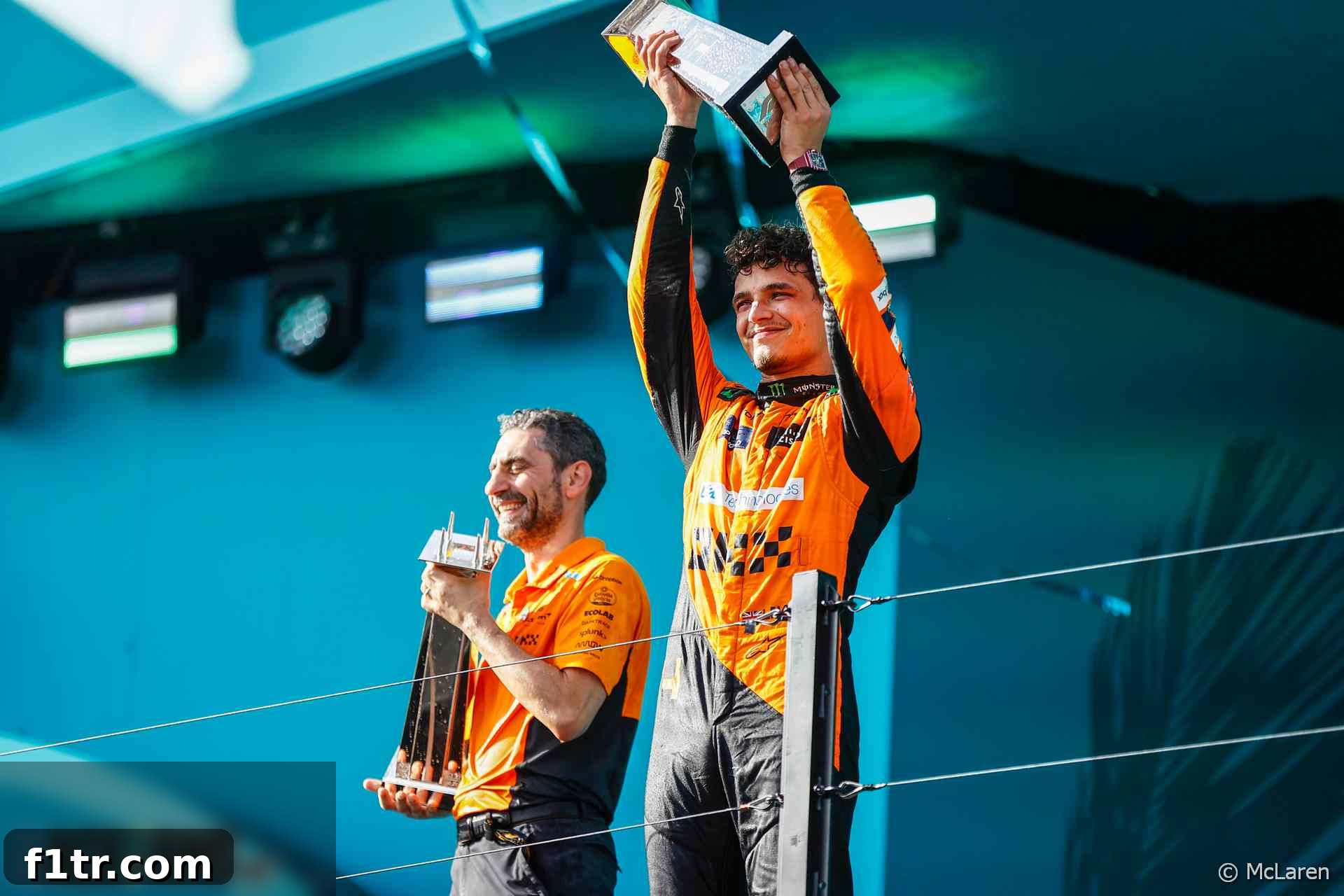
In a momentous occasion for Formula 1, Lando Norris ended a remarkable 110-race wait for his maiden Grand Prix victory at the recent Miami Grand Prix. The triumph was not just a personal milestone for the young Briton but also a significant chapter in McLaren’s storied history, sparking widespread excitement and setting the stage for a thrilling season ahead.
Norris’s breakthrough victory has been a long time coming, filled with tantalizing near-misses and consistent podium finishes that cemented his reputation as one of the sport’s brightest talents. The pressure of claiming that elusive first win mounted with each passing Grand Prix, making his achievement in Miami all the more meaningful. This victory places him among a select group of drivers who have endured a lengthy wait before tasting the ultimate success in Formula 1.
Lando Norris’s Path to Grand Prix Glory
Lando Norris’s journey to his first Grand Prix win spans 110 races, a testament to his perseverance and raw talent. This places him in a unique position in the annals of Formula 1, as only seven drivers in the sport’s extensive history have waited longer for their inaugural victory. Notably, two of these drivers are among his current rivals on the grid, highlighting the intense competition at the pinnacle of motorsport.
His 110-race tenure without a win mirrors that of Giancarlo Fisichella, who also broke his duck at his 110th attempt. However, the context surrounding these achievements differs significantly. Fisichella’s victory in the 2003 Brazilian Grand Prix came in his eighth season, a reflection of a much shorter F1 calendar two decades ago. In contrast, Norris achieved his milestone in just his sixth season, demonstrating the accelerated pace and expanded schedule of modern Formula 1.
Fisichella’s 2003 win in Brazil was shrouded in controversy and delay. Initially credited to Kimi Raikkonen, one of Norris’s illustrious predecessors at McLaren, the victory was eventually awarded to Fisichella several days later. The FIA acknowledged an incorrect interpretation of its rules regarding race stoppages, underscoring the complexities and drama that often accompany Grand Prix racing. Norris’s win, thankfully, was far more straightforward and universally celebrated, solidifying his place as a Grand Prix winner without such post-race complications.
The Long Road to Victory: Drivers Who Waited
Norris’s victory prevented him from joining the undesirable list of drivers with the most starts without ever winning a Grand Prix. However, his achievement shines a spotlight on those who still feature prominently on the list of longest waits. The table below details the drivers who endured the most Grand Prix starts before finally reaching the top step of the podium, a true reflection of dedication and resilience in a fiercely competitive sport.
Most Starts Before First Grand Prix Win
| Rank | Driver | First Win | Start No. |
|---|---|---|---|
| 1 | Sergio Perez | 2020 Sakhir Grand Prix | 190 |
| 2 | Carlos Sainz Jnr | 2022 British Grand Prix | 150 |
| 3 | Mark Webber | 2009 German Grand Prix | 130 |
| 4 | Rubens Barrichello | 2000 German Grand Prix | 124 |
| 5 | Jarno Trulli | 2004 Monaco Grand Prix | 117 |
| 6 | Jenson Button | 2006 Hungarian Grand Prix | 113 |
| 7 | Nico Rosberg | 2012 Chinese Grand Prix | 111 |
| =8 | Giancarlo Fisichella | 2003 Brazilian Grand Prix | 110 |
| =8 | Lando Norris | 2024 Miami Grand Prix | 110 |
| 10 | Mika Hakkinen | 1997 European Grand Prix | 96 |
Most Starts Without a Grand Prix Win
| Rank | Driver | Starts |
|---|---|---|
| 1 | Nico Hulkenberg | 209 |
| 2 | Andrea de Cesaris | 208 |
| 3 | Nick Heidfeld | 183 |
| 4 | Romain Grosjean | 179 |
| 5 | Kevin Magnussen | 169 |
| 6 | Martin Brundle | 158 |
| 7 | Lance Stroll | 149 |
| 8 | Derek Warwick | 146 |
| 9 | Jean-Pierre Jarier | 134 |
| 10 | Eddie Cheever | 132 |
Following Norris’s triumph, Nico Hulkenberg now stands alone at the top of the table for most Grand Prix starts without a win. With an impressive 209 starts to his name, Hulkenberg’s career is a testament to consistency and raw speed, yet that elusive top step has always evaded him. His upcoming return to Sauber, which is set to transition into the Audi works team, offers a tantalizing prospect for the veteran German. Could this new chapter provide him with the opportunity to finally join Norris in the exclusive club of Grand Prix winners?
The stories of drivers like Sergio Perez, Carlos Sainz Jnr, and Mark Webber, all of whom patiently waited for over 100 races, serve as a powerful reminder of the determination required to succeed in Formula 1. Perez’s dramatic win at the 2020 Sakhir Grand Prix after 190 starts, and Sainz’s 2022 British Grand Prix victory on his 150th attempt, exemplify the incredible narratives woven into the fabric of the sport.
Beyond the First Victory: Breaking Records and Setting New Benchmarks
Lando Norris’s victory in Miami wasn’t just about finally winning; it also saw him relinquish his position as the driver with the most podium finishes without ever winning a Grand Prix. With 15 podiums under his belt prior to Miami, he consistently proved his capability to compete at the sharp end of the grid. That distinction now returns to Nick Heidfeld, who holds the record with 13 podium finishes without a victory.
Norris’s win marks him as the 114th driver in history to win a round of the FIA Formula 1 World Championship, a remarkable achievement that etches his name into the sport’s illustrious records. Furthermore, he becomes the 21st British driver to claim a Grand Prix victory, continuing a proud legacy of British excellence in motorsport. The last British driver to achieve their first Grand Prix victory was George Russell at Interlagos in 2022, underscoring the consistent stream of talent emerging from the UK.
For McLaren, Norris’s success brought their total Grand Prix victories to 184. This places them firmly as the second most successful team in terms of wins, trailing only the legendary Ferrari by 60 victories. However, this was only McLaren’s second win in the last 13 seasons, highlighting the team’s challenging period and the significance of this triumph in their resurgence. Lando Norris is now the fourth different driver in a row to win a race for McLaren, following in the footsteps of giants like Lewis Hamilton (USA 2012), Jenson Button (Brazil 2012), and Daniel Ricciardo (Italy 2021). This diverse list of winners speaks to McLaren’s enduring capability to attract and nurture top-tier talent, and Norris’s win signals a potential return to consistent winning ways for the Woking-based outfit.
The Miami Grand Prix: A Race of Intriguing Statistics
The Miami Grand Prix delivered a host of fascinating statistics and records, even beyond Norris’s historic win.
Verstappen’s Uncharacteristic Performance and Pole Streak
The Miami Grand Prix represented a relatively rare instance of Max Verstappen failing to win a Grand Prix, an event that momentarily halted his relentless march through the record books. This missed opportunity meant he was unable to surpass Lewis Hamilton’s career win rate. With Verstappen currently on 30.36% and Hamilton slightly ahead at 30.47%, this record remains hotly contested and could well shift at the upcoming Imola Grand Prix if the Red Bull driver secures another victory there.
Despite not winning the main race, Verstappen dominated the sprint event, securing victory. By also finishing second in the Grand Prix, he achieved the unusual feat of scoring the most points of any driver across the entire race weekend without actually winning the main Grand Prix. This peculiar scenario harks back to 1957, when Stirling Moss and Tony Brooks shared victory in the British Grand Prix, each scoring four points, while Luigi Musso’s solo drive to second place earned him six points. Such occurrences are exceptionally rare in modern Formula 1, underscoring the unique dynamics of the Miami weekend.
Verstappen continued his impressive streak of Grand Prix pole positions in Miami, securing his seventh consecutive pole and his sixth since the beginning of the current season. This phenomenal run positions him to potentially equal two significant records at the next Grand Prix: Most consecutive pole positions, a record currently held by the legendary Ayrton Senna, and most consecutive pole positions from the start of a season, a benchmark set by Alain Prost. These are towering achievements that underscore Verstappen’s unparalleled qualifying prowess.
McLaren’s Dual Threat and Other Driver Performances
Both McLaren drivers showcased their capabilities by taking turns in the lead during the Miami Grand Prix. Oscar Piastri became the fifth different driver to lead a lap this year, marking the second time in his young career that he has headed the field, his first instance being at Monza last year. Piastri also secured the fastest lap of the race, the third of his career. However, similar to his fastest lap at Monza last year, he failed to score the bonus point as he did not finish within the top 10. He did manage to secure the bonus point when achieving the fastest lap at Las Vegas, where he finished tenth.
While Verstappen has dominated the lead laps this season, commanding 224 out of 331 laps so far, his Red Bull teammate Sergio Perez has yet to lead a single lap. Perez has now gone a full year without a Grand Prix victory, a stark contrast to Verstappen’s impressive tally of 21 wins during the same period. This highlights a significant performance gap within the championship-winning team.
Lewis Hamilton recorded his best result of the season in Miami, a sixth-place finish, signaling a slow but steady improvement for Mercedes. In the midfield, Daniel Ricciardo scored his first points of the season with an impressive fourth-place finish in the sprint race, showcasing his enduring talent. Combined with Yuki Tsunoda’s seventh-place finish in the Grand Prix, the RB team (formerly AlphaTauri) secured a total of 12 points. This marks their best points haul at a single event since the 2021 Abu Dhabi Grand Prix, an encouraging sign for the team’s aspirations.
Williams, Haas, and Penalties
Amid much speculation surrounding his future, Logan Sargeant finally out-qualified his teammate for the first time in his 28-race career. This notable achievement occurred during qualifying for the sprint race, offering a moment of personal triumph for the American driver. However, normal service was resumed in qualifying for the main Grand Prix, where Alexander Albon once again held the upper hand.
The race also saw Kevin Magnussen endure a particularly challenging weekend. The Haas driver accumulated no fewer than six penalties across the single race weekend, an unusual distinction. Four of these were for track limits infringements during the sprint race. He was subsequently penalized for a collision with Alexander Albon during the Grand Prix and later for failing to change tires during a pit stop under Safety Car conditions. Magnussen’s weekend served as a cautionary tale of how easily regulations can be breached in the heat of competition.
Over to you
Have you spotted any other interesting stats and facts from the Miami Grand Prix? Share them in the comments.
Become a RaceFans Supporter
RaceFans is run thanks in part to the generous support of its readers. By contributing £1 per month or £12 per year (or the same in whichever currency you use) you can help cover the costs of creating, hosting and developing RaceFans today and in the future.
Become a RaceFans Supporter today and browse the site ad-free. Sign up or find out more via the links below:
- Become a RaceFans Supporter
- RaceFans Supporter FAQ
2024 Miami Grand Prix Related Articles
- McLaren had superior pace before Verstappen’s damage in Miami – Norris
- Sainz ‘struggles to understand’ why he got penalty when Perez didn’t
- Alonso’s unusual brake problem and more unheard Miami team radio
- McLaren’s Miami upgrade success points to even stronger form in coming races
- Norris expects more wins this year and believes “100%” in 2025 title bid
Browse all 2024 Miami Grand Prix articles