Miami Grand Prix Safety: Examining the Controversy Over Barrier Choices
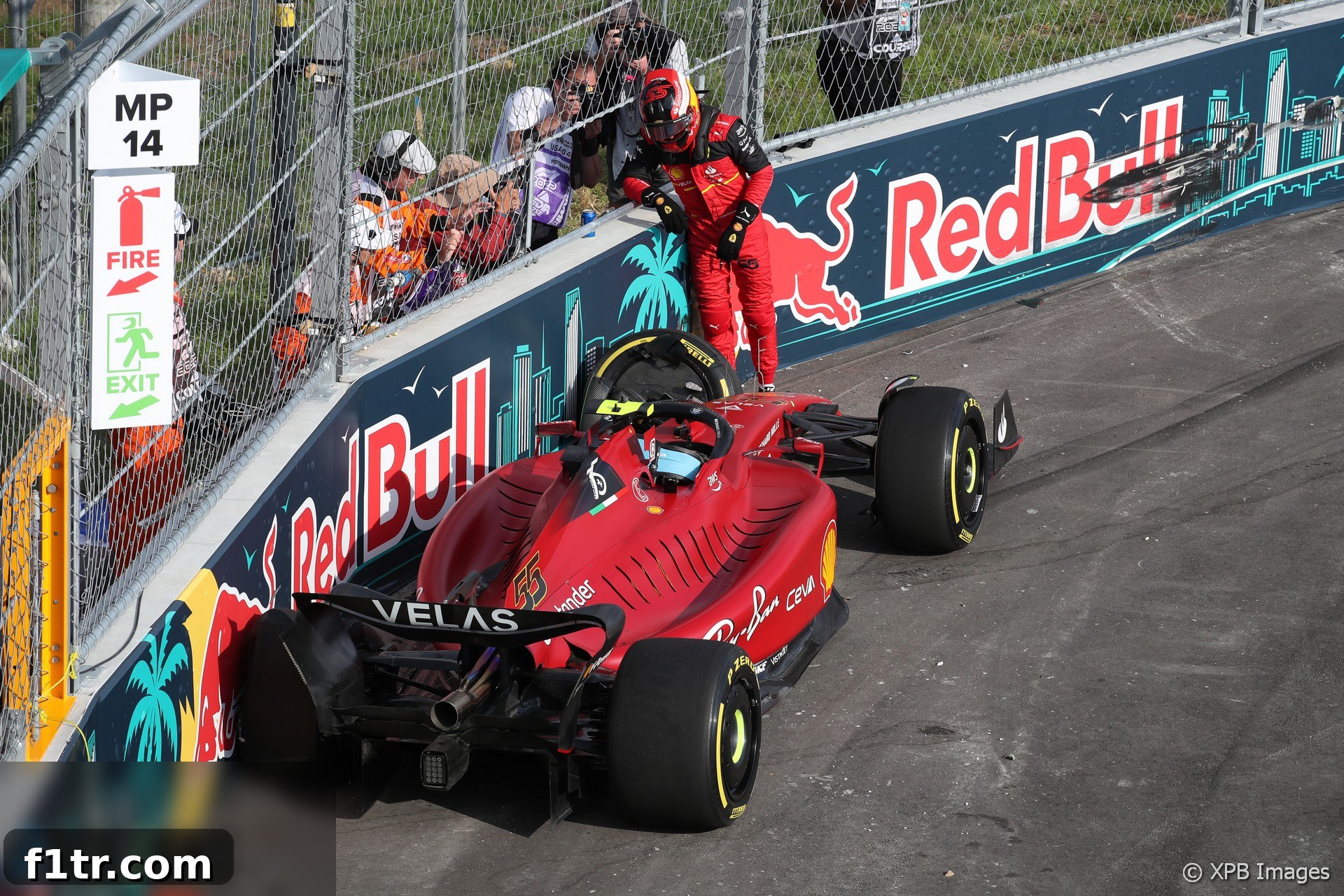
The inaugural Miami International Autodrome hosted thrilling Formula 1 action, but it also ignited a critical debate surrounding track safety, specifically concerning the type of barriers used at the challenging chicane. A heavy crash involving Carlos Sainz Jnr during Friday practice prompted immediate calls from drivers for enhanced safety measures, advocating for the installation of impact-absorbing TecPro barriers at the corner.
Advert | Become a Supporter & go ad-free
The severity of Sainz’s impact raised immediate concerns among the paddock. Sebastian Vettel, the veteran Aston Martin driver, was among the first to voice his apprehension. “It will always damage the car when you go off,” Vettel commented, emphasizing the inherent risks of motorsport. “But the question is, where you’re landing, whether there’s concrete or TecPro. I don’t know what can be done overnight when I think when we come back, it’s important to look at all the places and see whether you can improve.” His statement highlighted the fundamental difference between rigid concrete barriers and the deformable TecPro systems designed to absorb significant energy during an impact.
The Critical Difference: TecPro vs. Concrete Barriers in F1 Safety
The core of the safety debate revolves around the fundamental differences between TecPro and concrete barriers. TecPro barriers are modular, deformable structures crafted from high-density polyethylene and filled with foam, specifically engineered to absorb kinetic energy upon impact. This absorption significantly reduces the deceleration forces experienced by a driver and their car, thereby mitigating injuries and structural damage. In contrast, concrete barriers are rigid, designed primarily to prevent a car from leaving the track altogether. While effective at containment, their unforgiving nature means that all impact energy is transferred back into the vehicle and driver, resulting in incredibly high G-forces and substantial damage.
Despite the growing calls for change, the run-off area at the Miami chicane remained unaltered for Saturday’s sessions. This decision had dire consequences when Esteban Ocon suffered an alarming 51G impact at the very same stretch of concrete barrier. To put this into perspective, the force involved was comparable to Max Verstappen’s devastating crash at Silverstone’s considerably quicker Copse corner last year, a notoriously high-speed section of track. The fact that a chicane, typically a slower corner, could produce such a high-G impact immediately heightened concerns about the suitability of the barrier.
Miraculously, and testament to the strength of modern F1 chassis and safety equipment, Ocon, like Sainz, was declared fit to race. However, the toll on his body was evident; he later admitted he was only at “50% physically” due to the brutal hit he sustained. These two heavy incidents, occurring within a day of each other, intensified the demands for TecPro barriers to be implemented, underscoring the vital role these deformable structures play in modern Formula 1 safety. Developed in close collaboration with the FIA Institute, TecPro barriers are now widely adopted across F1 tracks globally, setting a benchmark for impact protection.
The Design Perspective: Why Concrete? Simulations and Logistical Realities
Despite the drivers’ vocal concerns, track designers and barrier manufacturers offered a different perspective rooted in extensive pre-race simulations. Jochen Braunwarth, the director of motorsport at barrier makers Geobrugg, provided insight into the decision-making process. He revealed that pre-race simulations of likely crash scenarios at that specific point on the circuit had concluded that a concrete barrier was, in fact, the most suitable solution. This conclusion was reached primarily due to the predicted angles of impact.
Braunwarth elaborated on the engineering rationale: “Usually the areas where you have a very shallow impact angle the idea is, as with a guardrail or a concrete block barrier on a highway, to bounce off and then slide along.” This principle applies where cars are expected to graze or slide along the barrier rather than hit it head-on. He continued, “As soon as that impact angle is reaching a certain angle, you need to put a TecPro barrier, you need to put something. And this simulation, which was done at the FIA, was suggesting that the impact angle there is a very shallow angle which didn’t make it necessary for the FIA to put in any TecPro.” This highlights the complex interplay between track geometry, anticipated crash dynamics, and barrier selection, all governed by rigorous FIA safety protocols.
Geobrugg, primarily a manufacturer of high-grade mesh barriers, advises on the deployment of their FIA grade one-homologated systems but does not make the final decisions on barrier placement. That responsibility falls to the circuit operators and the FIA. Braunwarth further noted that the absence of significant incidents at Turn 14 during the main Grand Prix races, including support categories like Porsche Carrera Cup and W Series, seemed to support the findings of the initial simulations. He questioned whether every mistake made by a driver necessitates a redesign of the circuit, prompting a reflection on driver accountability versus track design shortcomings. This perspective underscores the challenge of balancing proactive safety enhancements with the realities of human error in high-speed racing.
Advert | Become a RaceFans supporter andgo ad-free
Operational Challenges: The Unique Demands of a Street Circuit
Beyond the technical simulations, circuit operators at the Miami International Autodrome faced unique logistical hurdles, particularly concerning the design and placement of barriers around the chicane. Braunwarth pointed out a critical operational requirement: “There were three areas of the circuit which had to be opened every night. Every time you cross the turnpike area and you cross that area in Turn 14.” This temporary nature, characteristic of many street circuits, meant that sections of the track needed to be dismantled and reassembled daily to allow normal traffic flow on public access roads.
“It was necessary to open every evening and close every morning to allow cars to drive on that access road,” Braunwarth explained. This practical constraint presented a significant challenge for barrier choice. While highly effective in absorbing impact, TecPro barriers are more complex and time-consuming to install and reposition compared to concrete blocks. The necessity of daily reconfigurations would have added substantial operational complexity and cost, potentially impacting the feasibility of the event itself. This illustrates the often unseen compromises made in balancing optimal safety design with the immense logistical demands of hosting a Formula 1 street race.
Driver Advocacy vs. Engineering Realities: A Continuing Dialogue
Despite the explanations from track designers and manufacturers, the Formula 1 drivers’ representative body, the Grand Prix Drivers’ Association (GPDA), maintained a firm stance on the need for TecPro. GPDA director Alex Wurz articulated the drivers’ perspective, emphasizing preventative safety over reactive measures. “Strictly speaking we didn’t have an injury, so maybe you can say it [TecPro] is not necessary,” he told Reuters, acknowledging the lack of serious physical harm to Sainz and Ocon. However, he quickly countered, “but we want to say that if we had it, it would improve the situation. No research in the world can tell me it would have been a downside to put [TecPro down].” Wurz’s argument underscores the proactive philosophy of modern F1 safety – not waiting for a major injury before implementing improvements.
Alpine team principal Otmar Szafnauer echoed these concerns, particularly disturbed by the extent of damage sustained in Ocon’s crash. “The chassis itself is cracked,” Szafnauer revealed, highlighting the immense forces at play. “It’s a lot to crack a chassis. It had to be a huge spike in force there. When something doesn’t move, that’s what happens. You slow down very quickly, you get a massive spike of force in the chassis and it breaks.” This severe structural damage to a cutting-edge F1 chassis serves as a tangible indicator of the unforgiving nature of the concrete barrier impact.
Szafnauer joined the chorus of calls for the barrier to be changed ahead of next year’s race. “Hindsight’s a wonderful thing. I think if we look back the FIA too should have a review and my personal opinion is had we had a TecPro barrier there, it would have been safer.” He further elaborated on the crucial link between vehicle integrity and driver safety: “The FIA’s job isn’t to protect cars, but protecting cars and drivers are highly correlated. If the car is damaged, the driver can get damaged, too.” This statement perfectly encapsulates the intertwined nature of car and driver safety in Formula 1, arguing that a safer car environment inherently contributes to driver wellbeing.
Advert | Become a RaceFans supporter andgo ad-free
The Ongoing Evolution of Formula 1 Safety
The barrier debate at the Miami Grand Prix is a powerful reminder of Formula 1’s unwavering, yet complex, commitment to safety. While simulations and logistical constraints played a role in the initial barrier selection, the direct experiences and insights from drivers and team principals highlight the continuous need for review and adaptation. F1 has a long history of learning from incidents to improve safety standards, from the introduction of HANS devices to the halo, and barrier technology is no exception. The discussions around Miami’s chicane underscore the constant push-and-pull between maximizing driver protection and navigating the practicalities of circuit design, especially in the context of temporary street tracks.
Moving forward, the FIA will undoubtedly conduct a thorough review of the incidents and the suitability of the barriers at the Miami International Autodrome. This continuous evaluation process is vital for the sport’s integrity and for ensuring that every grand prix circuit meets the highest possible safety benchmarks. The Miami barrier debate serves as a crucial chapter in the ongoing narrative of Formula 1 safety, emphasizing that even with advanced simulations and engineering, the human element and real-world impact remain paramount in shaping the future of motorsport safety.
2022 Miami Grand Prix: Further Insights
- Why TecPro barriers weren’t used at Miami chicane where Sainz and Ocon crashed
- Miami’s track surface is ‘a safety issue and does not offer good racing’ – Russell
- Miami Grand Prix draws F1’s largest live US television audience
- Alpine complain they had no say over penalty which cost Alonso points
- Red Bull wary of Ferrari’s high-speed cornering strength in Barcelona
Browse all 2022 Miami Grand Prix articles