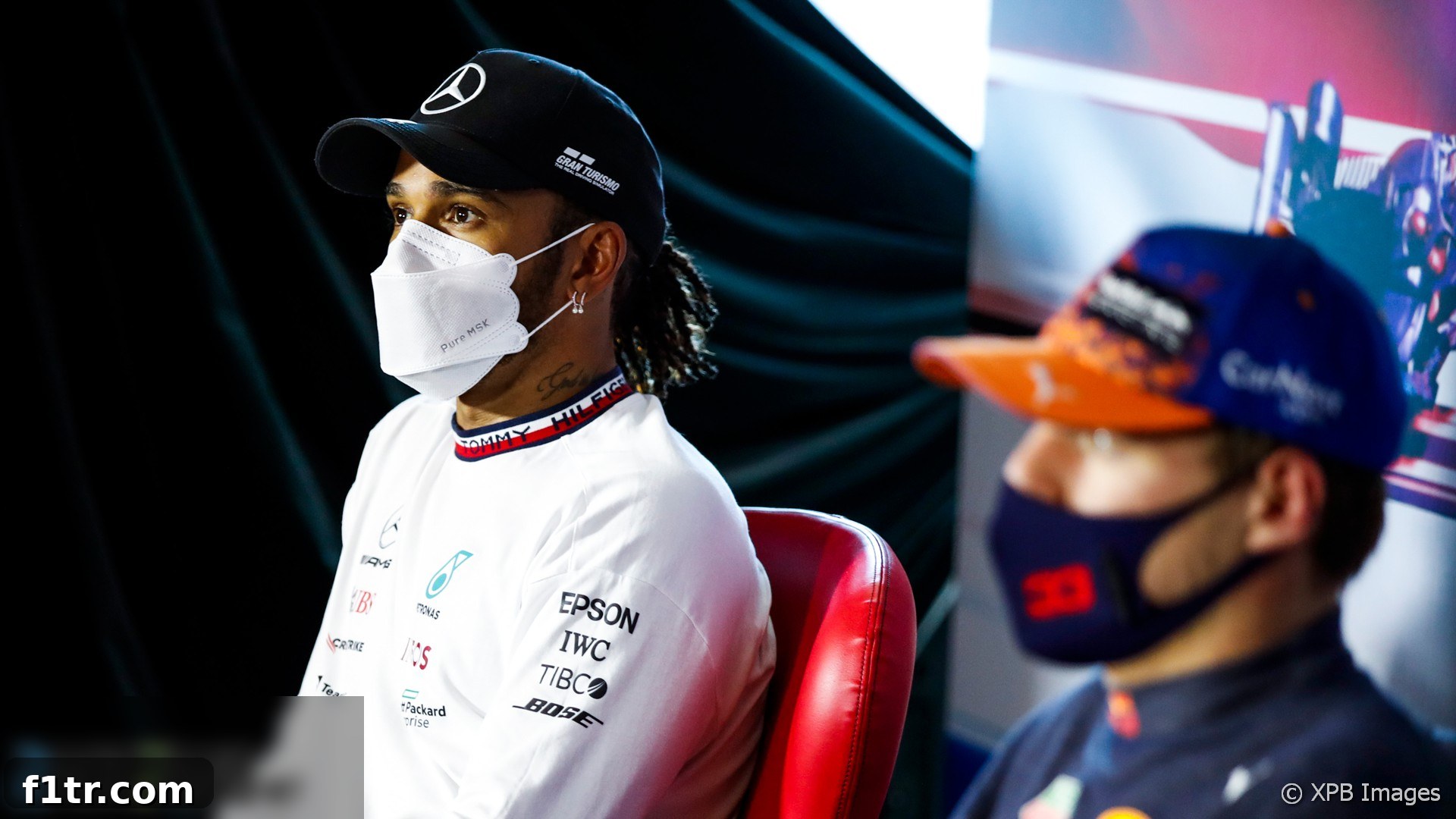
The intense rivalry between Lewis Hamilton and Max Verstappen has defined the Formula 1 season, escalating beyond mere on-track battles into a compelling psychological contest. In the aftermath of their latest collision, Hamilton offered a calculated assessment of his championship rival, reigniting the debate about experience, pressure, and the mindset required to clinch a world title.
The Veteran’s Stance: Hamilton’s View on Championship Pressure
Speaking nearly two weeks after the contentious incident at Monza, Lewis Hamilton, a driver with an unparalleled seven world championships and a quest for an eighth, weighed in on Max Verstappen’s performance under pressure. “We’re battling for a championship,” Hamilton stated, reflecting on his own career. “I remember what it was like battling for my first championship.”
Hamilton continued, drawing a clear parallel to his own journey: “Obviously I’m fighting in my tenth battle, something like that. But I remember what it was like and I know the pressures that come with it and the experience that goes with it so I can empathise with that.” His remarks, delivered when questioned about the likelihood of further clashes, carried an unmistakable implication: Verstappen’s perceived misjudgment at Monza, which resulted in their dual retirement, was a direct consequence of the immense pressure inherent in his inaugural Formula 1 world championship fight.
Pressed to elaborate on his assessment, Hamilton chose his words carefully but maintained his line of reasoning. “Obviously he won’t admit to it, I’m not going to make an assumption,” he added. “But I’m just saying I remember it was difficult, it was intense. I was going through a lot of different emotions, I didn’t always handle it the best.” This candid reflection positioned Hamilton as the seasoned veteran, offering a degree of understanding, yet simultaneously highlighting Verstappen’s perceived inexperience. “That’s to be expected, it’s a lot of pressure. You’re working in a big team, there’s a lot of self-expectation and pressure because the desire to win is huge. So I was just saying that I empathise and understand that.”
A Pattern of Avoidance and Implication
These sentiments from Hamilton were not entirely new, echoing statements made much earlier in the season. In fact, four months prior, on the cusp of the Monaco Grand Prix, Hamilton had articulated very similar thoughts. Just days before Monaco, in Spain, Hamilton had taken evasive action to avoid one of Verstappen’s characteristic, uncompromising first-corner maneuvers. A few weeks before that, a similar situation unfolded at Imola.
With the benefit of hindsight, knowing that the collisions at Silverstone and Monza lay ahead, Hamilton’s words from Monaco gain significant weight. “I think I’ve done well to avoid all the incidents so far,” he had said then. “We’ve got 19 more [races] to go and we could connect, hopefully not.” He went on to add, “The good thing, I think, there is a nice, balanced amount of respect between us. I think perhaps, as you know, he feels perhaps he has a lot to prove. I’m not necessarily in the same boat there.” This consistent narrative underscores Hamilton’s belief that his experience allows him to navigate perilous situations with greater wisdom, while Verstappen’s aggression stems from a drive to validate himself.
Hamilton’s argument is logically framed: in the crucible of a world championship fight, there is simply no substitute for experience, and no driver on the current grid possesses more of it than he does. He implicitly suggests that this wealth of experience provides him with a strategic advantage, allowing him to discern when to push and when to back off, a skill he suggests his younger rival is still honing. The consistent delivery of this message throughout the season paints a picture of a calculated psychological strategy, designed to place the onus of aggressive driving and potential mistakes squarely on Verstappen.
The Challenger’s Response: Verstappen’s Defiance
Unsurprisingly, Max Verstappen has consistently refused to concede this point. When RaceFans presented Hamilton’s experience argument to him back in August, his response was firm and unequivocal. Verstappen’s counter-narrative dismisses the significance of championship experience, focusing instead on the raw performance of the car and the inherent talent of the drivers.
“The only advantage you can really have, I think, is if you have a faster car,” stated the Red Bull driver. “In this sport it’s so dominant when you have a good car, there’s so many good drivers in the sport, but they don’t have the opportunity to fight at the front.” This perspective reframes the championship battle as primarily a function of machinery, rather than individual psychological fortitude or accumulated wisdom. Verstappen believes that once a driver reaches the elite level of Formula 1, the core competencies for fighting at the front are universal, irrespective of past titles.
He continued, “So if you have seven titles or one or zero I think at the end of the day when you spend a few years in F1, especially more towards the front, like top five, you know that you have to try and finish every race, you know that you have to score the most available points every single weekend.” For Verstappen, the fundamental objective remains the same for every driver at the sharp end of the grid: maximum performance and consistency. “All of us, we always try to do our best and race in the best possible way. So I don’t really see the advantage there.” This defiant stance highlights Verstappen’s belief in his own capabilities and his dismissal of any mental edge Hamilton might claim due to his illustrious past.
Performance Under Scrutiny: Zandvoort and Monza
While the theoretical debate rages on, the practical evidence of Verstappen buckling under pressure remains scarce. Indeed, his performances throughout the season offer compelling counter-arguments to Hamilton’s implications. A prime example is his triumph at his home race in Zandvoort. Under the immense weight of national expectation, with a partisan crowd roaring him on, Verstappen delivered an impeccable drive. While his teammate struggled to make an impact, Verstappen single-handedly fended off the combined efforts of both Mercedes drivers, executing a flawless race weekend without putting a wheel wrong. This performance was a powerful testament to his ability to thrive under the most intense scrutiny.
Furthermore, an examination of the Monza weekend itself, prior to their collision, complicates Hamilton’s narrative. Who appeared more under pressure that weekend? Verstappen, who was leading his key rival until a slow pit stop compromised his race strategy? Or Hamilton, who was notably out-qualified by his own teammate, Valtteri Bottas, lost three places at the start of the Saturday sprint race, and after gaining a position at the start of the Grand Prix, promptly lost it again at the second chicane? These events suggest that Hamilton, too, was grappling with significant challenges that weekend, undermining the idea that pressure was exclusively impacting Verstappen.
Given these contextual factors, it was hardly surprising that Verstappen’s response to Hamilton’s latest remarks about his capability under pressure was dripping with sarcasm. “I’m so nervous I can barely sleep,” he scoffed. “It’s so horrible to fight for a title. I really hate it.” This response not only dismissed Hamilton’s psychological gambit but also conveyed a profound sense of self-assurance and an eagerness for the challenge.
Beyond Experience: A Deep Dive into F1 Title Psychology
The psychological dimension of a Formula 1 championship battle is undeniable, but its manifestation is complex and highly individual. While Hamilton draws on his vast experience to suggest Verstappen’s vulnerability, it’s crucial to consider the nuances of a modern F1 career. There’s little doubt that a GP2-fresh Hamilton in 2007 faced immense pressure, contending with a double world champion teammate in Fernando Alonso and the formidable might of Ferrari during one of F1’s most turbulent seasons. He narrowly missed the title in his rookie year, demonstrating an extraordinary aptitude for pressure at a very young age.
Verstappen: More Than a Rookie
However, if the Hamilton of today presumes he is up against a callow rookie who is crumbling under pressure, he might be misjudging his championship rival significantly. While Verstappen may only be one year older than Hamilton was in that 2007 season, the context of their careers differs vastly. Verstappen embarked on his F1 journey at an exceptionally young age, accumulating extensive experience over many seasons. This weekend, he starts his 134th Grand Prix. He is far from a novice; he is a veteran in terms of race starts, having spent years at the sharp end of the grid, developing a reputation for aggressive yet often calculated driving.
His early entry into F1 and rapid progression mean that his learning curve was steep and accelerated. He has experienced the highs and lows of the sport, battled wheel-to-wheel with multiple rivals, and matured into a driver capable of consistent front-running performances. To categorize him as simply a “first-time title contender” without acknowledging his extensive F1 journey underestimates his proven mental fortitude and adaptability. The psychological game, while potent, needs to contend with the undeniable reality of Verstappen’s track record under varying conditions.
The Shifting Sands of Pressure: A Crucial Weekend Ahead
The immediate consequence of Max Verstappen’s error at Monza is a three-place grid penalty for the upcoming race. This penalty fundamentally shifts the dynamics and, ironically, places a different kind of pressure on Lewis Hamilton. Hamilton now knows, with almost certainty, that he should start ahead of his title rival. Logically, he also knows he should, therefore, finish ahead of Verstappen. Consequently, Hamilton knows that by Sunday evening, he should be back in the lead of the championship standings.
How’s that for pressure? The burden of expectation now rests firmly on the shoulders of the seven-time champion. He has been gifted a significant strategic advantage, and the world will be watching to see if he can convert it into a championship lead. This scenario transforms the narrative: instead of focusing solely on Verstappen’s perceived struggles with pressure, the spotlight will now illuminate Hamilton’s ability to capitalize on a golden opportunity. The psychological battle continues, with each strategic move and every on-track incident adding another layer to this enthralling championship fight. The upcoming race is not just about points; it’s about making that experience, which Hamilton so often references, truly count when it matters most.
2021 F1 season
- Masi ‘basically gifted the championship’ to Verstappen says 2021 FIA steward Sullivan
- Las Vegas race backers looking to extend F1 deal beyond 2025
- Why Mercedes put ‘a reminder of joy and pain’ on display in their factory lobby
- Verdict on error in GT race suggests Mercedes would have lost 2021 Abu Dhabi GP appeal
- Title ‘stolen’ from Mercedes made us ‘underdogs people cheer for’ – Wolff
Browse all 2021 F1 season articles