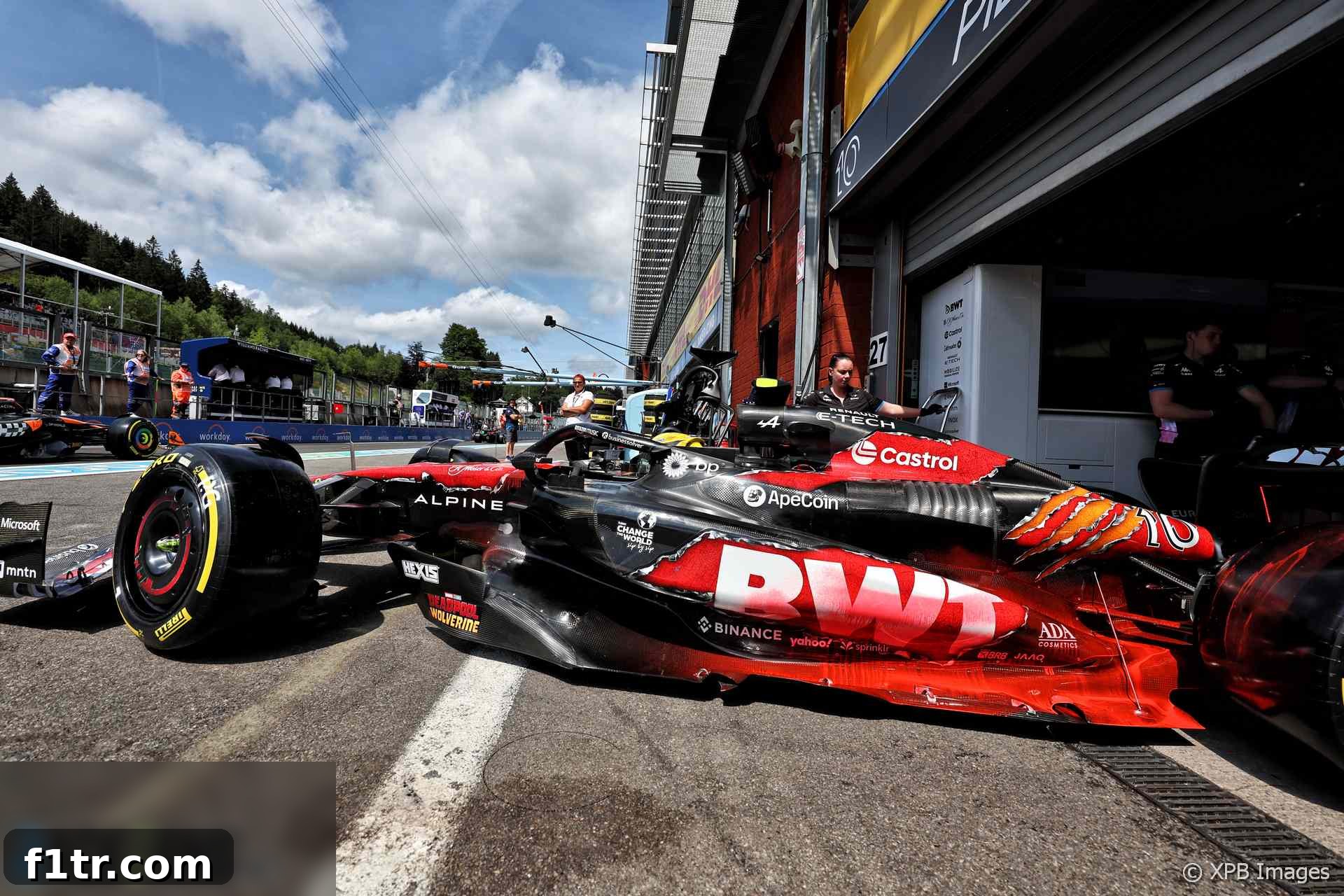
The confirmation of Formula 1’s groundbreaking new power unit regulations for 2026 by the FIA two years ago ignited a furious race among the championship’s manufacturers. This pivotal moment set the stage for a dramatic shift in strategy across the grid, as teams and engine suppliers began the immense task of designing and developing the next generation of F1 power units.
Alpine’s Strategic Re-evaluation: Charting a New Course for 2026 and Beyond
For Renault, a venerable name in Formula 1 history, the impending 2026 regulations presented what initially appeared to be a golden opportunity. It was a chance to definitively turn the page on a generation of engine rules—the V6 hybrid turbo era—that the French manufacturer candidly admits it failed to fully master. While Renault had previously celebrated immense success, notably sweeping the final championships of the V8 era in partnership with Red Bull Racing, the advent of the complex V6 hybrids in 2014 brought that era of dominance to an abrupt halt. This technological pivot proved challenging, leading to years of competitive struggle and, ultimately, the dissolution of their highly successful partnership with Red Bull, who subsequently found glory with Honda.
Following this period, Renault made a significant commitment by reviving its full works team, rebranding as Alpine, with aspirations of returning to the pinnacle of motorsport. However, despite their substantial investment and unwavering dedication, sustained success has largely eluded them in recent years. Aside from a solitary, memorable victory in Hungary three years ago, the team has found itself consistently battling in the midfield, grappling with both chassis and power unit performance.
The 2026 Power Unit Landscape: A Moment of Truth
In the lead-up to the 2026 regulations, Alpine team principal Bruno Famin actively lobbied the FIA for a concession. He sought a break from the power unit development freeze that was introduced two years prior, arguing that it would help narrow the performance gap between Renault’s engine and its rival designs. This request, however, was ultimately unsuccessful, leaving Alpine to contend with its existing power unit’s competitive disadvantages while simultaneously planning for the future. With that argument now settled, the full focus of the Enstone and Viry-Chatillon operations shifted entirely towards the upcoming 2026 regulations and their profound implications.
Praise for Viry-Chatillon’s Efforts: A Glimpse of Potential
Despite the competitive struggles of the current engine, Bruno Famin has been effusive in his praise for the dedicated work undertaken by Renault’s esteemed Viry-Chatillon engine division in preparation for the 2026 power unit. “The guys in Viry are making an amazing job,” Famin stated emphatically, acknowledging the monumental effort involved. He openly admitted the long-standing challenges: “We all know that since 2014, we don’t have the best engine in Viry, but it’s one of the engines which improved the most since 2014.” While conceding that they are “still not exactly at the top,” Famin highlighted that “the improvement has been very good.”
Looking specifically to the future, Famin expressed immense confidence in the work being done for the 2026 unit. “The job which is being done in Viry to prepare the 2026 engine is incredible,” he affirmed. “We fixed a very high target and I am confident that we can reach that target. The figures we have from the dyno are very good.” These statements painted a picture of a division working tirelessly, making significant strides, and on track to deliver a highly competitive power unit for the new regulatory cycle. This internal optimism makes the subsequent announcement all the more startling.
A Pivotal Strategic Shift: Alpine to Become a Customer Team
Against this backdrop of seemingly positive internal development and high aspirations for the 2026 engine, the French manufacturer has reportedly made a decision that has sent ripples through the Formula 1 paddock: it is poised to cease its in-house F1 engine development and, for the 2026 season and beyond, revert to customer team status. On the surface, this strategic U-turn appears almost incomprehensible, particularly to those familiar with the history of Formula 1 and the immense advantages often conferred by being a full manufacturer.
Many observers vividly recall the colossal advantage enjoyed by Mercedes when the current V6 hybrid turbo engine rules were introduced in 2014. Their unparalleled success was largely attributed to their ability to design and seamlessly integrate their own power unit with their chassis, creating a highly optimized and dominant package. Why, then, would any manufacturer willingly relinquish such a potentially game-changing advantage, an advantage that holds the power to elevate them to F1’s next dominant force? This fundamental question lies at the heart of Alpine’s controversial decision, prompting deeper scrutiny into their long-term vision and priorities.
Bruno Famin’s Elucidation: A Wider Brand Vision
Bruno Famin’s explanation for this radical strategic pivot moves beyond the immediate confines of Formula 1 engine performance and instead anchors the decision within a much broader, long-term vision for the Alpine brand itself. He articulated that the primary motivation behind this shift is the desire to redeploy the highly skilled and experienced staff from Viry-Chatillon’s F1 engine development division towards other critical projects. Specifically, these resources will be channeled into the development of Alpine’s rapidly expanding line-up of road cars. Crucially, Famin made it explicitly clear that this change in strategy would not result in any redundancies, emphasizing a commitment to the workforce.
“We have presented a project,” Famin elaborated, clarifying that “The project is not the power unit, the project is much bigger than that. It’s a transformation project at the level of the Alpine brand.” He detailed the ambitious growth trajectory of the Alpine brand: “The Alpine brand is developing, has a huge, huge project of development, with seven new models in the coming years with high-end technology. It’s very, very ambitious to build this new sporting brand and to make it known outside of France, everywhere in the world.”
The core of the proposal, presented to staff representatives in Viry-Chatillon, involves a direct reallocation of talent and expertise. “The project which has been presented at the beginning of the week to the staff representative in Viry-Chatillon is to reallocate the resources from one side to another, one side being the development of the Formula 1 power unit, which is being made in Viry, to dedicate those resources and skills to developing new technologies for the brand, for the new products of the brand.”
The Consequences and Strategic Benefits
The direct and inevitable consequence of this strategic transformation, if fully implemented, is that the Alpine F1 team will no longer design or build its own power units. Instead, it will enter into an agreement to acquire engines from a rival supplier. “One of the consequences of this project, if it’s accepted, would be then for Alpine F1 team to buy a power unit instead of developing its own power unit,” Famin confirmed. This approach, he suggested, would free up critical resources within the broader Alpine organization. “Then we’ll have more resources to develop the brand and a different power unit to race for the Formula 1 team.”
In essence, Alpine’s leadership believes that its engineering and financial resources can be utilized more effectively by concentrating Viry-Chatillon’s formidable technical capabilities on the advancement of its road car division. This allows the immense financial and intellectual burden of F1 engine development—a hugely complex and expensive undertaking—to be outsourced to another entity, thereby streamlining Alpine’s overall automotive strategy and accelerating its road car initiatives.
“We are at a very specific crossroads where the project for developing the Alpine brand is now very concrete, very clear,” Famin explained. “We know the resources needed for developing it.” This decision point has been amplified by external factors. “On the other hand, we know that for the 2026 car generation in Formula 1, now that the chassis regulations have been published a few weeks ago, it’s now that we have to decide. The guy designing the chassis needs to know with which PU they are going to use.” This confluence of internal brand development needs and external regulatory deadlines has made the decision both urgent and strategically critical for Alpine’s future in motorsport and as a global automotive brand.
Re-evaluating the Manufacturer Advantage in Modern F1
The immediate counter-argument to becoming a customer team is the perceived loss of potential competitive advantage from developing one’s own F1 engine. History is replete with examples of integrated manufacturer teams dominating the sport. However, Famin challenged this conventional wisdom, suggesting that the degree of advantage gained from in-house engine integration in modern Formula 1 is significantly less than in past seasons. He points to recent developments in the sport as supporting this view, citing McLaren’s impressive performance this year with Mercedes power units, often outperforming the factory Mercedes team itself.
“There is a bit of potential in developing the integration, but it’s quite theoretical at the end of the story,” Famin argued. He elaborated that the collaborative nature of contemporary F1 engine development has fundamentally altered the landscape. “Because now all the PU manufacturers are working very closely, very early in the project with the teams, and all the integrations are incredibly optimised.” He expressed confidence that customer teams receive highly optimized packages. “If we take a Ferrari or Mercedes engine, I’m quite convinced that all the integration, all the packaging will be already very, very good.” This perspective suggests a belief that the technical and performance gap between factory and customer engines has narrowed considerably, making the enormous investment in proprietary engine development less imperative for achieving competitiveness.
The Road Ahead: Implementation, Workforce, and Enduring F1 Commitment
The finalization of this monumental decision is expected within a matter of weeks. Alpine is meticulously navigating the process, particularly by adhering to France’s “strict” labor laws and ensuring full transparency with its workforce. “The process will take some weeks and it will be quite fast,” Famin predicted, underlining the commitment to due process. “We are following all the mandatory steps and there is no reason not to make it properly.”
A cornerstone of the proposed project, and a critical point of reassurance for employees, is the guarantee of continued employment. “A very important thing in the project which has been presented: every single employee will be offered a job. There is no redundancy at all,” Famin stressed. He acknowledged the inherent difficulties in such a significant organizational change, stating, “Alpine is doing everything to make… a very difficult moment as painless as possible. But we know it’s never easy, this kind of thing.” This humane approach underscores Alpine’s commitment to its highly skilled staff, seeking to transition their expertise rather than displace it.
Leadership Transition and Alpine’s Unwavering F1 Presence
This strategic announcement comes amidst another significant change within the Alpine F1 team: the confirmation that Bruno Famin himself will be replaced as team principal at the end of the month, just twelve months after he took over the role from Otmar Szafnauer. This leadership transition, combined with the profound shift in power unit strategy, has naturally prompted questions regarding the long-term future and stability of the Alpine F1 team. However, Famin vehemently insists that despite these changes, Alpine remains steadfastly committed to its participation in Formula 1.
“The Formula 1 project remains a key project for the Alpine brand,” he reiterated. “It’s thanks to Formula 1 that we want to develop the brand awareness globally.” Famin articulated that the core objective remains unchanged: “That remains, but the project is just reallocating the resources to develop the brand better always based on the pillar of motorsport and mainly Formula 1 to develop the awareness.” This perspective positions F1 not merely as a racing endeavor, but as an indispensable global marketing platform and a technological testbed that will continue to elevate the Alpine brand, albeit with a redefined operational model for its power unit supply.