Lewis Hamilton Hails Mercedes’ US GP Upgrade: A Glimmer of Hope for the Future
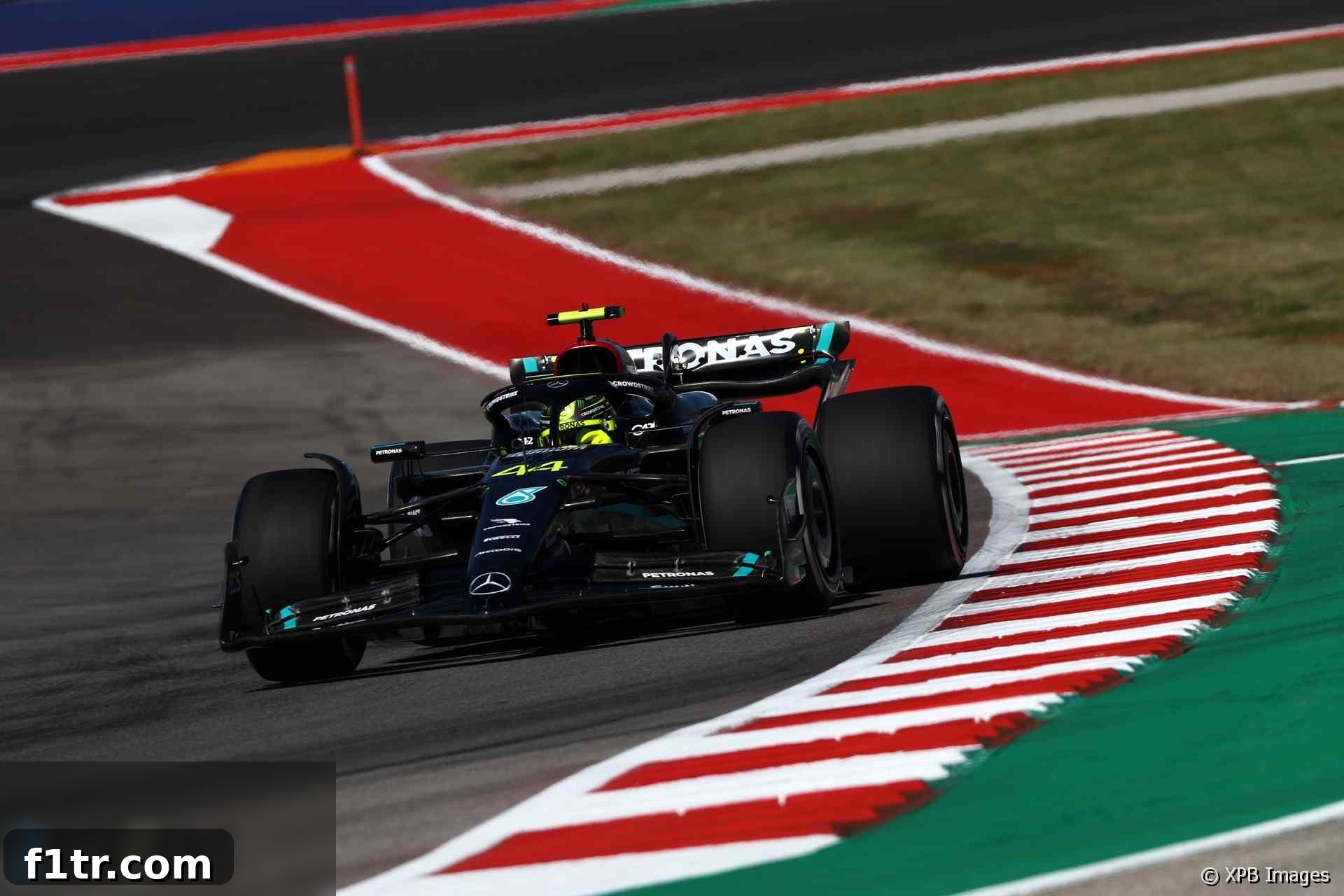
Formula 1 legend Lewis Hamilton has expressed significant optimism following Mercedes’ latest car upgrade introduced at the United States Grand Prix. In a stark contrast to previous modifications under the current technical regulations, Hamilton confirmed he could genuinely “feel the difference” the new components brought to the W14.
The highly anticipated revised floor, unveiled by the Brackley-based squad for the Circuit of the Americas event, represented a crucial step in Mercedes’ ongoing development battle. The team has been relentlessly striving to maintain pace with the remarkable gains demonstrated by rivals McLaren and Ferrari throughout the 2023 season, all while meticulously aligning their efforts with the ambitious development targets set for their 2024 challenger.
A Tangible Improvement: Hamilton’s Initial Reaction to the W14 Upgrade
After a stellar qualifying performance that saw him secure third position on the grid for Sunday’s main race, Hamilton shared his encouraging insights. While cautious about drawing definitive conclusions for next year – stating, “I don’t know really if it’s a signifier of anything for next year” – his immediate feeling was one of profound encouragement. The seven-time world champion emphasized the tangible impact of the new parts, a sensation that has often eluded him with prior upgrades.
“As we continue to experiment, we get more and more knowledge of where we’re going, where we’re seeing the flow of the car,” Hamilton explained, detailing the intricate process of understanding and optimizing the W14. He acknowledged that the floor itself might not appear “a huge amount different” to the untrained eye, underscoring that “there’s always hype with someone’s upgrade, but the rest of the car is exactly the same and there’s lots and lots of areas in which we can improve.” Yet, despite the subtle visual cues, the performance impact was undeniable for the driver.
This sentiment carries significant weight, given Mercedes’ well-documented struggles to adapt to the ground-effect regulations introduced in 2022. For Hamilton to declare, “But this is an improvement. This is one of the first upgrades that I’ve actually felt over the last two years,” speaks volumes about the frustration and persistent challenges the team has faced. It also highlights the palpable sense of relief and renewed hope that this particular upgrade has instilled within him. “So that’s a positive,” he concluded, adding a clear vision for future progress: “We just need two or three times of this step to put us in super-competitive mode, which I believe the guys can do.”
Qualifying Prowess and the Competitive Landscape at COTA
Hamilton’s strong qualifying result at COTA, where he finished a mere tenth of a second behind pole-sitter Charles Leclerc of Ferrari, further underscored the effectiveness of the updated W14. The session itself was a nail-biter, with Max Verstappen briefly topping the timesheets before his quickest lap was agonizingly deleted due to a track limits infringement, bumping him down the order and leaving the front row open for Mercedes and Ferrari to seize.
The tight margins at the pinnacle of Formula 1 demonstrate the constant evolution required to stay competitive. Hamilton’s ability to extract such performance from the updated W14 suggests a more harmonious relationship between driver and machine, something that has been a cornerstone of his success throughout his illustrious career. His description of the W14 feeling “just levelled up in pretty much everywhere” following the upgrade encapsulates a holistic improvement across various performance metrics, from cornering stability to overall balance and aerodynamic efficiency.
Mercedes’ Relentless Pursuit of Performance and the Road Ahead
The challenges Mercedes has faced since the advent of the new regulations in 2022 have been immense. From the initial “porpoising” issues to an ongoing struggle with finding the optimal aerodynamic window, the team has been in a constant state of evolution. This latest upgrade, particularly the revised floor, is a critical piece of the puzzle. The floor in ground-effect cars is arguably the most crucial aerodynamic component, generating the vast majority of downforce and significantly impacting the car’s stability and performance through corners.
Hamilton’s gratitude for the team’s efforts was evident: “I’m really grateful for the improvements that the team have made with the car. Everyone’s worked so hard to bring some upgrades and for us to be this close to McLaren and Ferrari and even the Red Bulls. I think it’s a showing of just how hard everyone’s worked.” This sentiment reflects not only the countless hours put in by engineers and designers back at the factory but also the unwavering dedication to close the gap to the front-running Red Bull and reclaim their position at the top.
The competitive landscape of the 2023 season has been incredibly dynamic. While Red Bull and Max Verstappen have largely dominated, teams like McLaren and Ferrari have shown impressive flashes of pace, particularly with their own significant upgrade packages. McLaren’s mid-season resurgence, for example, transformed them from midfield runners to consistent podium contenders, highlighting the impact strategic and effective development can have. For Mercedes to produce an upgrade that genuinely moves the needle and closes the gap to these rapidly improving rivals is a testament to their engineering prowess and resilience.
Implications for 2024 and Beyond
While the immediate focus remains on the current season, every upgrade introduced in the latter half of the year serves a dual purpose: improving current performance and providing invaluable data and insights for the design of the following year’s car. The fact that Hamilton could feel a tangible difference with this revised floor is particularly significant for the 2024 W15. It suggests that Mercedes might finally be unlocking a deeper understanding of the ground-effect philosophy, which has proven to be their Achilles’ heel for the past two seasons.
If the team can indeed replicate this “step” two or three more times, as Hamilton optimistically suggested, it would fundamentally alter their competitive standing and put them in a genuine position to challenge for victories and potentially even the championship in 2024. The data gathered from the US Grand Prix and subsequent races will be meticulously analyzed, feeding directly into the development cycle for the next-generation car. Mercedes’ long-term ambition is clear: to return to championship-winning form, and this positive feedback from their star driver is arguably the most encouraging sign they’ve received in a long time.
The journey back to the top of Formula 1 is a challenging one, paved with continuous innovation, relentless development, and the unwavering belief of every team member. Hamilton’s comments from the United States Grand Prix offer a beacon of hope, suggesting that Mercedes might finally be on the right track to fully unlock the potential of their current regulations car and lay a solid foundation for a stronger challenge in the seasons to come. The competitive intensity in Formula 1 demands constant evolution, and this latest upgrade from Mercedes demonstrates their enduring commitment to reach the pinnacle once more.
2023 United States Grand Prix
- US GP was Mercedes’ best race of 2023 despite disqualification – Wolff
- Singapore and Austin retirements cost me top 10 championship place – Ocon
- United States Grand Prix result unchanged as FIA rejects Haas’ call for review
- Sargeant admits he’s ‘struggled to use all the downforce at times’ in F1
- Mercedes’ Brazilian GP set-up was “conservative” after US GP disqualification
Browse all 2023 United States Grand Prix articles