Charles Leclerc Expresses Significant Doubts About Rivals Catching Red Bull Before 2026 F1 Regulations Shift
In a candid assessment of the current Formula 1 landscape, Charles Leclerc, Scuderia Ferrari’s star driver, has voiced profound concerns regarding the ability of any team to bridge the substantial performance gap to Red Bull Racing before the highly anticipated major regulatory overhaul in 2026. This sentiment reflects a growing apprehension within the paddock, particularly among teams vying for the championship, about the unprecedented level of dominance currently exhibited by the Milton Keynes-based squad.
Red Bull and their reigning world champion, Max Verstappen, have established an almost impenetrable stranglehold on the sport since the reintroduction of ground effect aerodynamics at the dawn of the 2022 season. Their remarkable performance trajectory has seen them secure victory in every single round of the 2023 season thus far, an astonishing feat that underscores their technical superiority. Furthermore, their record over the past twelve months is equally impressive, having conceded only a solitary race win to a rival team, cementing their status as the benchmark in modern Formula 1.
The Unprecedented Dominance of Red Bull Racing
The scale of Red Bull’s ascendancy cannot be overstated. Since the beginning of the 2022 season, the team has triumphed in an astonishing 29 out of 34 Grands Prix contested. This era of dominance harks back to some of the most commanding periods in F1 history, such as Mercedes’ hybrid era or Ferrari’s early 2000s reign with Michael Schumacher. The synergy between the Adrian Newey-designed RB19 (and its predecessor, the RB18) and Max Verstappen’s exceptional talent has created an almost insurmountable challenge for the competition.
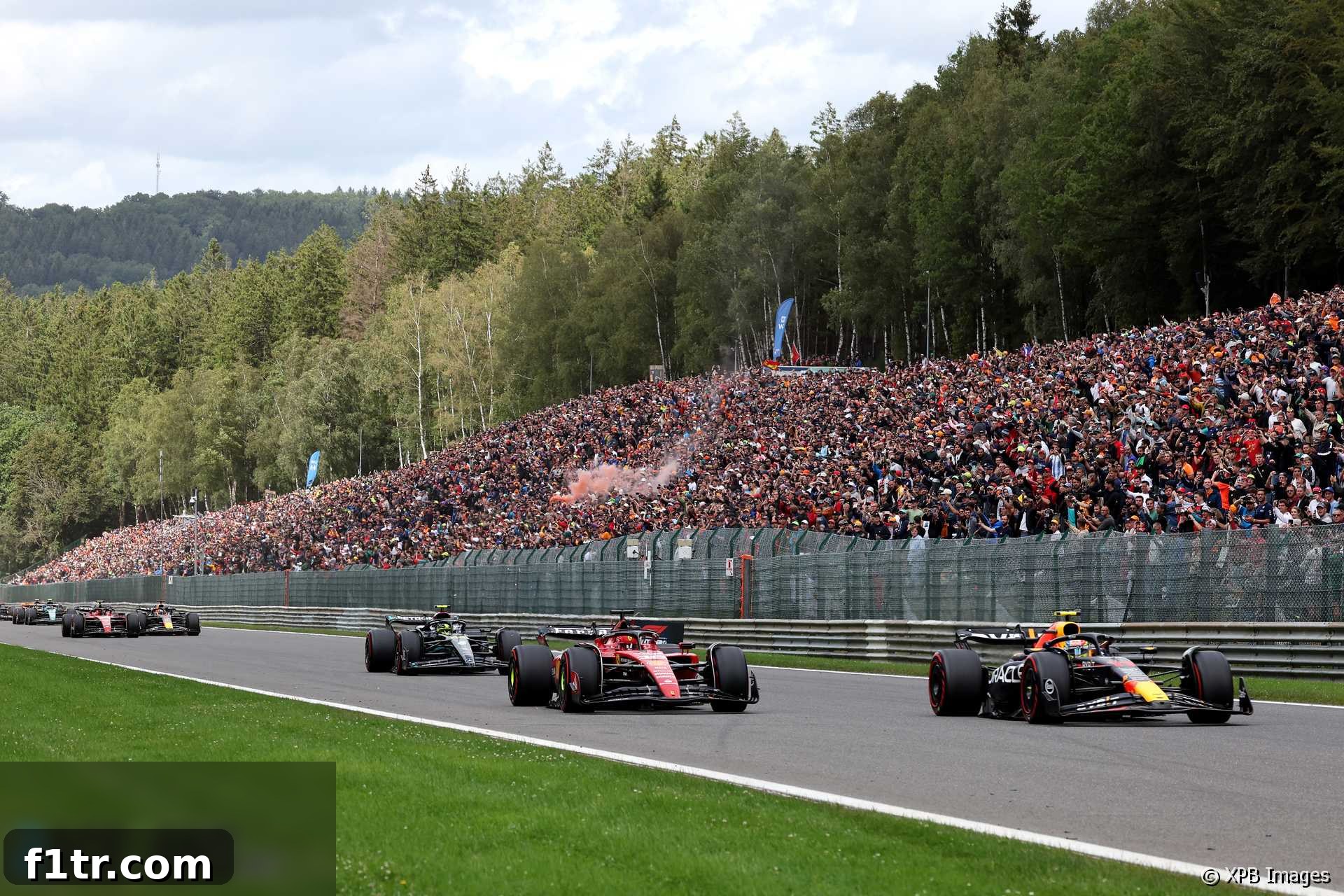
Leclerc and Ferrari found themselves as Red Bull’s closest challengers at the Belgian Grand Prix at Spa-Francorchamps before the customary summer break. However, even with a strong showing, Leclerc’s SF-23 ultimately finished over half a minute behind Verstappen, a stark illustration of the performance chasm that currently exists. This significant deficit on a track like Spa, renowned for its high-speed sections and demanding corners, amplified the frustration for Ferrari and other top teams aiming to compete for victories.
During an interview with RaceFans in Zandvoort, prior to the Dutch Grand Prix, Leclerc was directly asked about the prospects of Red Bull’s rivals closing the gap in the forthcoming seasons. His response was notably devoid of optimism, reflecting the challenging reality faced by the chasing pack.
“That’s what we are trying to work towards but, for sure, they have a really big margin,” Leclerc stated, acknowledging the monumental task ahead. His subsequent remark left little room for misinterpretation: “It’s going to be very, very difficult to catch them before the change of regulations.”
Ferrari’s Uphill Battle: Understanding the Performance Gap
Leclerc’s candid assessment highlights a critical distinction in Red Bull’s dominance compared to previous eras. While Ferrari and other teams, notably Mercedes and Aston Martin, have at times been able to challenge Red Bull in qualifying sessions – Leclerc himself secured pole position for the Azerbaijan Grand Prix earlier in the season – the true advantage of the Red Bull package becomes devastatingly clear on race day. This disparity is a central point of frustration and focus for Ferrari’s technical teams.
“It’s different than in the past in the way that in qualifying we are all much closer than what we have seen in the past,” Leclerc explained, dissecting the nuanced nature of the current competition. “Normally when we see a team dominating, it was qualifying and the race. But now, for some reason with Red Bull, it’s much more in the race than in qualifying – the gaps are much bigger in the race than in qualifying and that’s why we are all working towards our race pace, because Red Bull is just so far ahead.”
This observation points to Red Bull’s superior management of tires, exceptional aerodynamic stability in varying conditions, and an overall car balance that allows Verstappen to push consistently throughout a race stint without overstressing the tires or encountering significant degradation. For Ferrari, their car, while often possessing raw one-lap speed, struggles to maintain that performance over long runs, leading to tire wear issues and a lack of consistent pace that Red Bull effortlessly demonstrates.
The F1-75 and SF-23, Ferrari’s ground effect cars, have frequently been described as “sensitive” by both drivers and team personnel. This sensitivity implies that the car’s performance window is narrow, and even slight changes in track conditions, wind, or setup can dramatically impact its handling and pace. This characteristic makes optimizing the car for a full race distance incredibly challenging, especially when compared to the Red Bull, which appears to operate effectively across a wider range of parameters.
“There’s still a lot of work to do. We have some developments in the next few races that can help us do a step forward. But also with this car, we can have some unexpected surprise because they are such sensitive cars that a small change can have a big influence. And hopefully it will be the case for us,” Leclerc added, hinting at the high-stakes nature of development with these new-generation cars. A small breakthrough could yield significant rewards, but conversely, a minor misstep could have disproportionately negative consequences.
The Horizon: 2026 Regulation Changes as a Reset Button
The year 2026 looms large on the horizon as a potential inflection point for Formula 1. The upcoming regulatory changes are set to introduce a completely new power unit formula, featuring a significantly increased electrical component and the removal of the MGU-H, alongside revised aerodynamic rules that are expected to promote closer racing and potentially shake up the pecking order. For teams like Ferrari, these changes represent a genuine opportunity to reset the competitive landscape, rather than incrementally trying to catch a moving target with the current regulations.
Historical precedent often shows that major regulatory shifts lead to a reshuffling of the grid. Teams that correctly interpret the new rules and develop innovative solutions early on can gain a significant advantage, much like Brawn GP did in 2009 with the double diffuser or Mercedes at the start of the hybrid era in 2014. Leclerc’s focus on 2026 underscores the immense difficulty of closing the current gap under the existing framework, suggesting that a fundamental re-evaluation of car philosophy and design will be necessary to truly challenge Red Bull.
Ferrari’s Strategic Response: Recruitment and Long-Term Vision
In response to these challenges, Ferrari team principal Frederic Vasseur has publicly committed to an aggressive recruitment drive aimed at bolstering the technical division in Maranello. This strategic move is designed to inject fresh perspectives, diverse expertise, and additional horsepower into the team’s engineering efforts, all with the ultimate goal of improving performance.
Leclerc fully endorses this approach, recognizing the value of expanding the team’s intellectual capital. “We have already some really, really good engineers within the team,” he affirmed, acknowledging the existing talent pool. “I think new people will only help to have different points of view and help us grow even better.”
However, Leclerc also temper’s expectations by emphasizing that the impact of new personnel will not be immediate. Integrating new engineers, fostering collaboration, and allowing new ideas to translate into tangible car performance takes considerable time, especially within the complex and high-pressure environment of Formula 1. The development cycle for an F1 car is lengthy, and the full effect of new recruits might only be seen several seasons down the line.
“But then apart from all of this, obviously looking at the gap there is from Ferrari to Red Bull – on race days especially – this requires time,” Leclerc concluded. His statement is a stark reminder that while Ferrari is investing in its future, the immediate challenge of overcoming Red Bull’s dominance on Sundays is a long-term project that demands patience and sustained effort.
The Driver’s Perspective: Leclerc’s Ambition Amidst Frustration
For a driver of Charles Leclerc’s caliber, who joined Ferrari with the ambition of winning world championships, the current situation presents a unique blend of frustration and determination. While his individual performances, often characterized by breathtaking qualifying laps and courageous overtakes, continue to impress, the ultimate goal of consistent race wins and a title challenge remains elusive due to the car’s inherent limitations relative to Red Bull.
Leclerc’s comments reflect a pragmatic understanding of the sport’s competitive cycles. He knows that success in Formula 1 is not just about individual brilliance but also about having the best machinery. His continued commitment to Ferrari, even amidst these challenges, speaks volumes about his belief in the team’s potential and the long-term vision being implemented under Frederic Vasseur. However, the clock is ticking, and every season of Red Bull dominance makes the wait for a competitive Ferrari longer and more agonizing for both Leclerc and the Tifosi.
The broader F1 landscape also mirrors this sentiment. Teams like Mercedes and Aston Martin, despite their significant resources and past successes, are also struggling to consistently match Red Bull’s pace, particularly in race trim. This widespread difficulty underscores the monumental achievement of Red Bull’s engineering team and the genius of Adrian Newey in designing a car that so perfectly encapsulates the new ground effect regulations.
Conclusion: A Glimmer of Hope Beyond the Horizon
Charles Leclerc’s sober assessment of Ferrari’s chances against Red Bull before the 2026 regulation changes paints a challenging picture for the immediate future of Formula 1. While Ferrari continues to push for incremental gains and invests in its long-term technical strength, the sheer magnitude of Red Bull’s advantage, especially on race day, suggests that only a fundamental shift in regulations might truly level the playing field.
The upcoming developments in the SF-23 offer a glimmer of hope for some “unexpected surprises,” but the reality is that major changes in the competitive order are often catalyzed by new rulebooks. Until then, Leclerc, Ferrari, and the rest of the grid will continue their relentless pursuit, knowing that the ultimate opportunity to truly challenge for supremacy likely lies beyond the horizon of 2026.
Bringing the F1 News from the Source
RaceFans strives to bring its readers news directly from the key players in Formula 1. We are able to do this thanks in part to the generous backing of our RaceFans Supporters.
By contributing £1 per month or £12 per year (or the equivalent in other currencies) you can help cover the costs involved in producing original journalism: Travelling, writing, creating, hosting, contacting and developing.
We have been proudly supported by our readers for over 10 years. If you enjoy our independent coverage, please consider becoming a RaceFans Supporter today. As a bonus, all our Supporters can also browse the site ad-free. Sign up or find out more via the links below:
- Become a RaceFans Supporter
- RaceFans Supporter FAQ
More from the 2023 Dutch Grand Prix
- Azerbaijan GP defeat was key to record-equalling run of wins – Verstappen
- “Too early to say” if podium signals return to form for Aston Martin – Alonso
- Verstappen makes history with unbeaten hat-track in first home races
- Perez is ‘doing his job and will be our driver in 2024’, Horner insists
- Ferrari had the “sixth or seventh fastest car” at Zandvoort – Sainz
Browse all 2023 Dutch Grand Prix articles