McLaren’s Strategic Call: Lando Norris Justifies Australian GP Team Orders Amidst Backmarker Battle
In a move that sparked debate across the Formula 1 paddock, McLaren’s decision to temporarily halt the on-track battle between its star drivers, Lando Norris and Oscar Piastri, during the Australian Grand Prix has been staunchly defended by Norris. The British driver asserts that the team’s instruction, which forbade him and Piastri from racing each other for three critical laps, was entirely justified given the treacherous track conditions and the strategic challenges of navigating slower backmarkers.
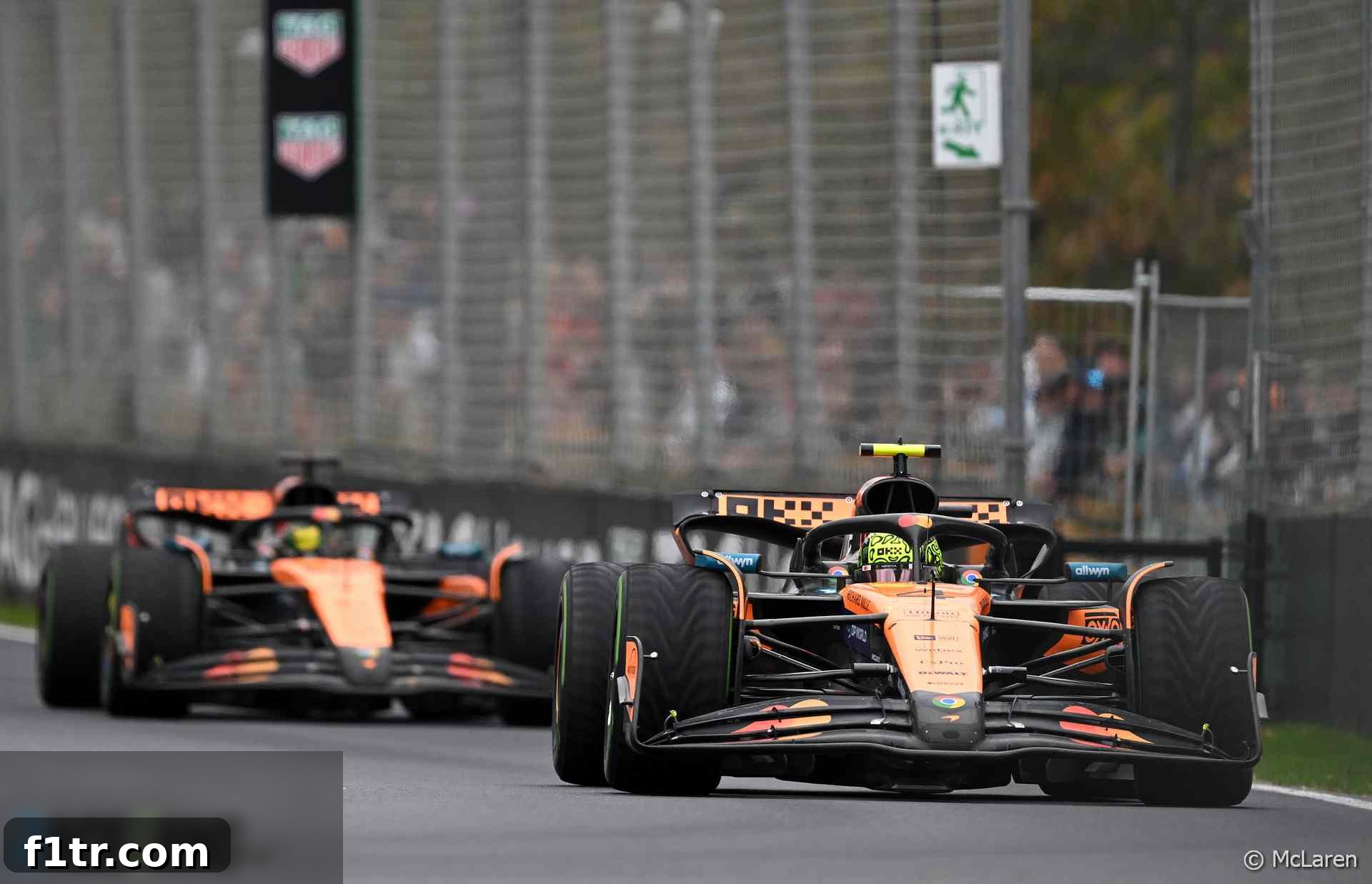
The incident unfolded between laps 29 and 32 of the race, a period where the McLaren duo were impressively running first and second, poised for a dominant result. As the team approached the Haas cars of Esteban Ocon and Oliver Bearman, who were due to be lapped, the instruction from the pit wall was clear. Piastri was told to “hold position” behind Norris, while Norris himself received the message, “don’t worry about Oscar for now,” as the team worked to “clear backmarkers and make the transition.”
The Tense Moments at Albert Park: Navigating Backmarkers Under Pressure
The Australian Grand Prix, often a test of skill and strategy, presented a unique challenge during this particular phase. While the track was largely dry, certain sections, particularly off the racing line, remained damp or outright wet. It was precisely these conditions that elevated the risk of an aggressive internal driver battle. Piastri had closed the gap to Norris to a mere six-tenths of a second, signaling his intent to challenge for the lead, when the decisive team order was issued. By the time the restriction was lifted, the gap had widened to 2.7 seconds, partially due to Piastri running wide in turn six while adhering to the team’s directive.
Lando Norris underscored the inherent dangers of attempting to race wheel-to-wheel while simultaneously dealing with blue flags and backmarkers, especially under the prevailing circuit conditions. “I didn’t really know about it because they said it to Oscar, not to me,” Norris explained, clarifying his initial unawareness of the specific order given to his teammate. “And it was literally just for two or three laps as we went through the backmarkers.” This brief pause in their internal duel, according to Norris, was a pragmatic and necessary safety measure to protect a potentially monumental team result.
Lando Norris’s Staunch Defense: Prioritizing Team Success and Driver Safety
Avoiding a Costly Mistake: The “Complete Idiots” Scenario
Norris did not mince words when articulating the potential consequences of ignoring the team’s strategic call. “It was risky conditions, and we’d look like complete idiots if we attempted to race and both ended up off the track, or worse, out of the race, when we had a great result in hand,” he stated emphatically. This candid assessment highlights the high stakes involved for McLaren, who were on course for a fantastic double-podium, or even a one-two finish. Such a result carries immense value in the Constructors’ Championship, and sacrificing it for a premature, high-risk internal battle would have been, in Norris’s view, an act of sheer folly.
The temporary nature of the order was also a key point for Norris. “It was just for a couple of laps that they asked us to hold position, and then he was free to race again.” This emphasizes that the team order was not a permanent restriction on their drivers’ ability to compete, but a targeted intervention for a specific, high-risk situation. It showcased a mature approach from McLaren, balancing the desire for competitive racing with the strategic imperative of securing maximum points for the team.
Navigating Risky Conditions and Off-Line Grip Challenges
The conditions at the Australian Grand Prix were a significant factor in McLaren’s decision. While the main racing line provided good grip, venturing off it, as is often necessary when lapping slower cars, could expose drivers to dramatically different surface conditions. “If you go off-line at that part of the race, you’re in the wall,” Norris commented, vividly illustrating the razor’s edge upon which F1 drivers operate. The presence of residual moisture or dirt off-line could easily compromise grip, leading to spins or collisions, thereby jeopardizing both cars and a stellar team performance.
Furthermore, Norris alluded to the differing strategies at play, even during this intense phase. “At that stage of the race, I was still [thinking] I need to get these tyres to last until lap 54 or whatever. I think Oscar was just pushing a bit more and trying to get past me. But it was all comfortable from my side.” This insight reveals the complex calculations drivers and teams are constantly making, from tire wear and fuel conservation to managing competitive pressures, all of which contribute to the broader strategic landscape of a Grand Prix.
Advert | Become a Supporter & go ad-free
Oscar Piastri’s Impatience and McLaren’s Communication Strategy
While Norris expressed understanding, Piastri’s radio messages conveyed a clear sense of impatience. After successfully passing the Haas drivers, the Australian rookie promptly asked his team, “Are we still holding?” He was initially told to “hold for now,” indicating a continued, albeit temporary, caution from the pit wall. However, the team revised the instruction on the very next lap, releasing Piastri to race once more. This demonstrates a dynamic and responsive approach by McLaren, with the team lifting the order as soon as they deemed the immediate threat had passed. The subsequent widening of the gap between the two drivers highlighted the effectiveness of the order in momentarily easing the pressure on Norris, allowing for a safer navigation of the backmarkers.
Both McLaren drivers had claimed the front row of the grid for the Australian Grand Prix, a remarkable achievement that set high expectations for their on-track performance. Ahead of the race, the team had confirmed their drivers were “free to race,” a sentiment Norris reiterated, clarifying that this policy was indeed in effect for the entire race, save for the brief “holding period” mandated during the backmarker phase. “We were free to race all the way up until that point and then there was just a holding period for a few laps,” he confirmed. “After that, it was back to normal. I think that’s all I really knew about it.” This reinforces that McLaren’s default position is to allow their drivers to compete, with strategic interventions reserved for critical moments that could compromise overall team success or safety.
McLaren’s Evolving Team Philosophy: Beyond Individual Glory
The “Free to Race” Mandate with Strategic Exceptions
The incident at Albert Park provides a clear example of McLaren’s evolving philosophy regarding team management and race strategy. While the Woking-based outfit generally promotes healthy competition between its drivers, exemplified by their “free to race” policy, they also demonstrate a pragmatic willingness to intervene when the larger team objective is at stake. The team’s primary concern during those few laps was not which driver crossed the line first, but ensuring both cars finished the race strongly and safely, maximizing the points haul for the Constructors’ Championship. This reflects a growing maturity in McLaren’s strategic thinking, learning from past experiences and adapting to the dynamic nature of Formula 1 racing.
Lessons from Past Seasons and Future Tactics
McLaren has, in previous seasons, faced scrutiny regarding its approach to team orders. There have been instances where some observers felt a more assertive strategic call could have optimized race outcomes. Norris hinted at these ongoing discussions, stating, “I’m sure we’ll talk about it more, we even had a little chat about it this morning.” This continuous review process underscores McLaren’s commitment to refining their tactics and striking the right balance between driver freedom and team imperative.
Norris succinctly captured the essence of the team’s decision: “But from the team’s perspective, it wasn’t about me or Oscar, it was about McLaren – we’re first and second, let’s not do anything silly when we don’t need to.” This statement perfectly encapsulates the collective mindset, where the success of the McLaren brand and its championship aspirations take precedence during critical junctures. The opportunity for Piastri to race Norris would inevitably arise again under less perilous circumstances, making a high-risk gamble during backmarker traffic an unnecessary indulgence.
Advert | Become a RaceFans supporter andgo ad-free
The Broader Context of Team Orders in Formula 1
Team orders have always been a contentious, yet often necessary, element of Formula 1. From the infamous “Multi 21” saga at Red Bull to Ferrari’s “Fernando is faster than you” radio message, and Mercedes’ complex management of Lewis Hamilton and Nico Rosberg, history is replete with examples of teams intervening in their drivers’ battles. These decisions are rarely popular with fans, who champion pure racing, but they are an undeniable aspect of a sport where constructors’ points and championships are paramount. Teams employ orders for various reasons, including managing tire wear, conserving fuel, protecting a car from damage, ensuring strategic pit stops, or, as in McLaren’s case, mitigating risk during hazardous track conditions or when navigating traffic.
The ethical debate around team orders often pits the spirit of competition against the pragmatic realities of multi-million-dollar racing operations. Ultimately, an F1 team is a collective entity, and its primary goal is to maximize its performance in the Constructors’ Championship, which brings significant financial and reputational rewards. Drivers, while individual athletes, are also key components of this larger machinery. McLaren’s move in Australia, therefore, aligns with a long-standing tradition of strategic pragmatism in Formula 1, albeit one that continues to spark discussion and analysis.
Looking Ahead: Driver Dynamics and Championship Aspirations
The Australian Grand Prix incident, while brief, offers a glimpse into the dynamic between Lando Norris and Oscar Piastri and McLaren’s operational strategy for the season ahead. Both drivers are incredibly talented and fiercely competitive, and their desire to outpace each other is a natural and healthy aspect of their relationship. However, the team’s intervention underscores the boundaries within which this competition is permitted to flourish. By clearly defining these parameters, McLaren aims to foster a competitive yet collaborative environment, where individual ambitions are balanced with collective success.
McLaren’s strong showing in Australia, with both cars demonstrating impressive pace and reliability, bodes well for their championship aspirations. Maintaining this momentum will require not only outstanding individual performances but also cohesive team strategy. The decision to temporarily halt the internal battle was a calculated risk-management move, designed to safeguard a valuable points haul. As the season progresses, McLaren will undoubtedly face more complex strategic decisions, but their early stance suggests a commitment to making pragmatic choices that prioritize the team’s overall success in the highly competitive world of Formula 1.
In conclusion, Lando Norris’s justification of McLaren’s team orders at the Australian Grand Prix highlights the intricate balance between driver ambition, team strategy, and safety in Formula 1. The brief directive was a shrewd tactical decision, aimed at preserving a strong team result in challenging conditions. It underlines McLaren’s commitment to evolving its approach, learning from experience, and making pragmatic choices that prioritize the collective strength and success of the team.