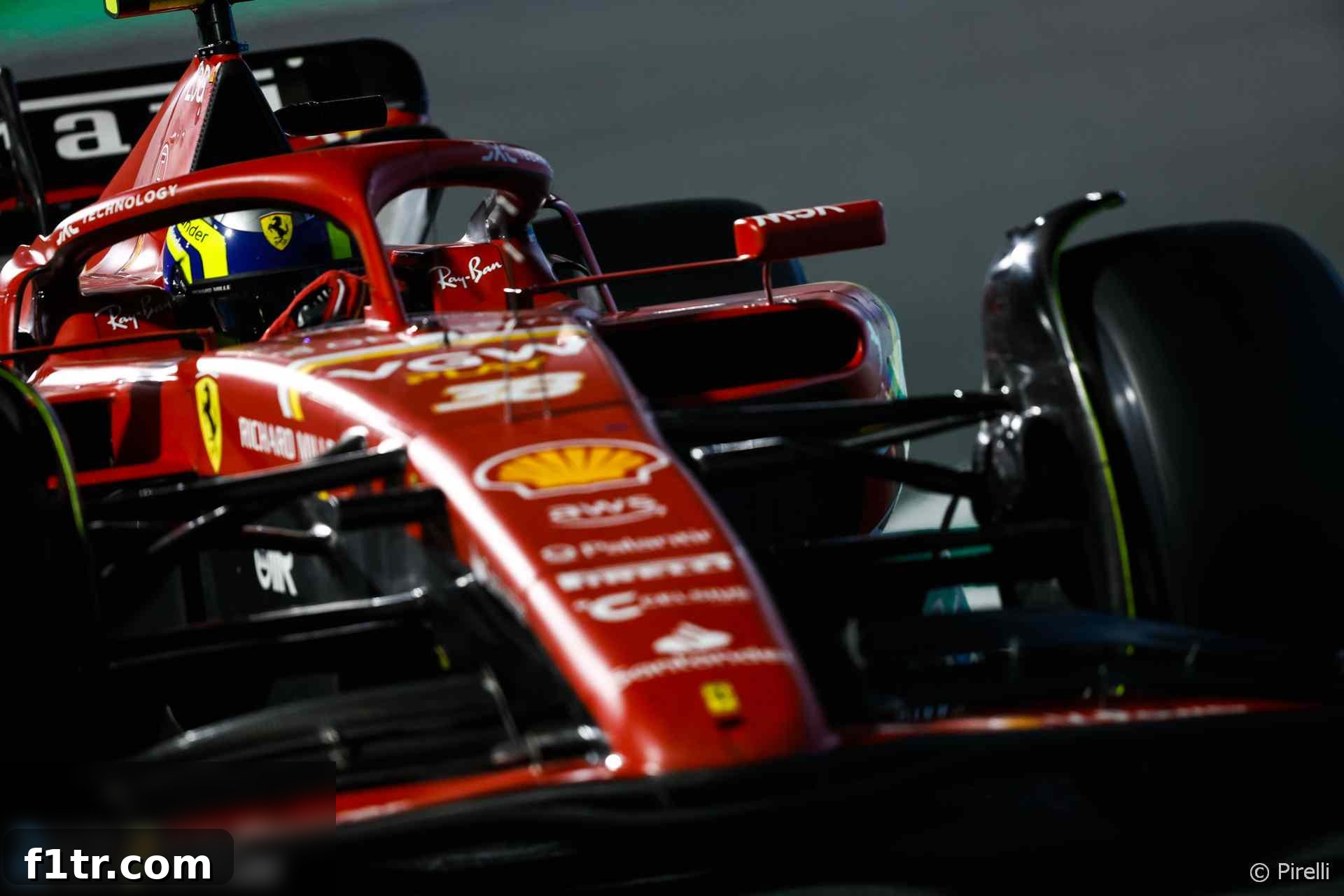
In a stunning and unexpected debut at the Jeddah Grand Prix, Oliver Bearman, standing in for the indisposed Carlos Sainz, defied expectations to secure an impressive seventh-place finish. The 18-year-old Briton not only scored points on his Formula 1 debut for the iconic Scuderia Ferrari but also showcased remarkable composure and raw talent, particularly when fending off seasoned champions like Lewis Hamilton and Lando Norris in the closing stages of the race.
Advert | Become a Supporter & go ad-free
Bearman’s journey to the grid was a whirlwind. Called up at the last minute following Sainz’s appendicitis diagnosis, he was thrust into the notoriously demanding Ferrari cockpit with minimal preparation on a circuit as challenging as Jeddah. From qualifying eleventh, narrowly missing Q3 by mere hundredths of a second, to his points-scoring finish, Bearman’s performance was a testament to his adaptability and innate racing prowess. He climbed four places from his starting position, a feat made even more impressive by the calibre of drivers he contended with.
Mastering the Tyre Strategy and Fending Off Veterans
The race presented several tactical puzzles, not least an early Safety Car period which forced Bearman to pivot his tyre strategy. Starting on soft tyres, the Safety Car prompted an early switch to hard compound tyres, which he then had to nurse for a significantly longer stint than originally planned. This unplanned endurance test became a crucial factor in the latter half of the race, setting the stage for one of the most compelling narratives of his debut.
With just 12 laps remaining, the pressure intensified dramatically. Lewis Hamilton and Lando Norris, both formidable competitors, emerged from the pits behind him on fresh, softer compound tyres. For any rookie, especially in a Ferrari, the sight of two multi-race winners closing in with a significant tyre advantage would be daunting. Bearman himself admitted his initial apprehension.
“I saw on the screen that they were pitting,” Bearman recounted to the official F1 channel. “I knew they were coming out, and I knew they would be on at least a medium or a soft, at least a faster tyre. I could see them on my dash coming quite quickly, but then the gap started to stabilise.” He openly confessed, “When they left the pits I basically accepted that they were going to come by at some point. Then at some point they started to slow down and then eventually stabilised. So it wasn’t that stressful.”
This calm acceptance and subsequent surprise at holding his ground highlight Bearman’s maturity beyond his years. The worn hard tyres under his Ferrari should, by conventional wisdom, have been no match for the grippier softs of his pursuers. However, Bearman’s precise driving, excellent tyre management, and intelligent defensive lines around the high-speed Jeddah Corniche Circuit proved to be an impenetrable barrier. He described the final laps as an unrelenting sprint: “That stint at the end on the hard, especially on the final laps when I had the guys on soft behind, it was flat-out. It was like quali lap after lap, which was really fun.” This sustained burst of qualifying-level pace under immense pressure underscored his potential and showcased his ability to extract every ounce of performance from his machinery, even on degraded tyres.
Advert | Become a RaceFans supporter andgo ad-free
A Learning Moment: The Battle with Nico Hulkenberg
While his defensive masterclass was a highlight, Bearman was candid about areas for improvement, particularly his battle with Nico Hulkenberg earlier in the race. After his pit stop, Bearman found himself stuck behind the seasoned Haas driver for several frustrating laps, despite being in a demonstrably faster car.
“I think I executed a good race. My only regret is that I was a bit inefficient trying to pass Nico,” Bearman admitted. “Because, honestly, I was in a faster car, and I should have overtaken him more quickly.” This candid self-assessment is characteristic of top athletes. Hulkenberg, known for his experience and astute race craft, skillfully used his car’s energy recovery system (ERS) to defend against Bearman’s advances.
Bearman elaborated on the challenge: “He used his experience well to use the battery in the right places and it took me a couple of shots. The problem is, when you drain the battery trying to overtake and you don’t get it done, you have to wait a couple of laps to recharge, and that lost me a lot of time to the guys ahead.” This insightful explanation reveals the intricate balance of energy management in modern F1 and highlights a valuable lesson learned by the young rookie. The time lost behind Hulkenberg impacted his ability to close the gap to the front runners, although he noted, “After that the gap [to the leaders] stayed pretty similar but I lost a bit of time there. But overall I was pretty happy.” This moment served as a crucial part of his steep learning curve, emphasizing the importance of patience and strategic energy deployment in wheel-to-wheel combat.
Advert | Become a RaceFans supporter andgo ad-free
Heeding Vasseur’s Advice: Bringing the Car Home
As the final laps dwindled, Bearman consciously eased off slightly, a decision influenced by the words of Ferrari team principal Frederic Vasseur. The Jeddah circuit is renowned for its high-speed corners and unforgiving close walls, leaving no margin for error. For a debutant, especially in a Ferrari, bringing the car back in one piece is paramount.
“That was a lot of pressure, of course, especially from Fred. The walls are close here and he wanted me to bring back the car with four wheels still on it,” Bearman explained. This directive underscored the trust placed in him and the immense responsibility of handling Ferrari’s precious machinery. In the very last laps, Bearman chose prudence over heroics. “In the last three laps I took a bit of more margin to the walls,” he confirmed, showcasing his mature understanding of the broader team objectives beyond personal glory. His ability to balance aggressive racing with calculated risk management speaks volumes about his potential as a future F1 driver.
The Physical Toll: Demands of an F1 Debut
Completing a full Grand Prix distance in a modern Formula 1 car is an immense physical challenge, even for the most seasoned drivers. For Bearman, whose seat fitting was a rushed affair, the physical discomfort was palpable after the race.
“It doesn’t feel good now, but those things you kind of have to adjust after you’ve driven in it,” he remarked. The bespoke nature of an F1 seat is critical for driver comfort, control, and endurance, and Bearman’s hurried fitting meant it wasn’t perfectly tailored for him. “I did the seat fit, it felt fine, but when you drive, especially on a track like this, I think I’ll feel it in the morning.”
Jeddah’s relentless series of high-speed corners and rapid changes of direction subject drivers to sustained, intense G-forces, particularly taxing on the neck, back, and shoulders. Bearman, being quite tall, faced additional challenges in fitting comfortably into the compact cockpit. “It was tough,” he added. “I’m quite tall so I struggle a little bit to fit perfectly in the car. My back hurts a little bit and especially my shoulders as well.” This raw admission highlights the extreme physical demands of Formula 1 and the incredible fitness levels required to compete at the pinnacle of motorsport, especially for a driver adapting to a new environment on such short notice.
Advert | Become a RaceFans supporter andgo ad-free
Become a RaceFans Supporter
RaceFans is run thanks in part to the generous support of its readers. By contributing £1 per month or £12 per year (or the same in whichever currency you use) you can help cover the costs of creating, hosting and developing RaceFans today and in the future.
Become a RaceFans Supporter today and browse the site ad-free. Sign up or find out more via the links below:
- Become a RaceFans Supporter
- RaceFans Supporter FAQ
A Star is Born: The Lasting Impact of Jeddah
Oliver Bearman’s F1 debut in Jeddah will undoubtedly be etched into the annals of motorsport history as one of the most remarkable rookie performances in recent memory. His seventh-place finish, securing six valuable points, was far beyond what many could have expected, especially given the circumstances. It demonstrated not just speed, but also exceptional race craft, mental resilience, and the ability to perform under the most intense pressure imaginable.
His performance earned him widespread acclaim from the paddock, with seasoned drivers and team principals alike praising his composure and talent. For Bearman, currently competing in Formula 2, this debut significantly boosts his Super License points tally, moving him closer to a permanent F1 seat. It has also firmly placed him in the conversation for future opportunities within the sport, reinforcing his status as one of Ferrari’s brightest young prospects.
Jeddah was more than just a race for Oliver Bearman; it was a powerful statement of intent. It showed the world that he possesses not only the speed but also the intelligence and mental fortitude required to thrive in Formula 1. While his physical discomfort after the race served as a reminder of the sport’s brutal demands, his smile and satisfaction in his achievement spoke volumes. This debut was a pivotal moment, perhaps the first chapter in what promises to be a very exciting career in Formula 1.
2024 Saudi Arabian Grand Prix
- Bearman’s 2024 Jeddah debut performance makes him ‘feel like an absolute idiot’
- Vowles being patient with Sargeant but expects to see “progress”
- “So I’ve got nothing to worry about?” – The best unheard team radio from Jeddah
- “Shock” of poor start to season showed need for change at Alpine – Famin
- “My tyres are dying”: Stroll’s short-lived struggle until he hit the wall
Browse all 2024 Saudi Arabian Grand Prix articles