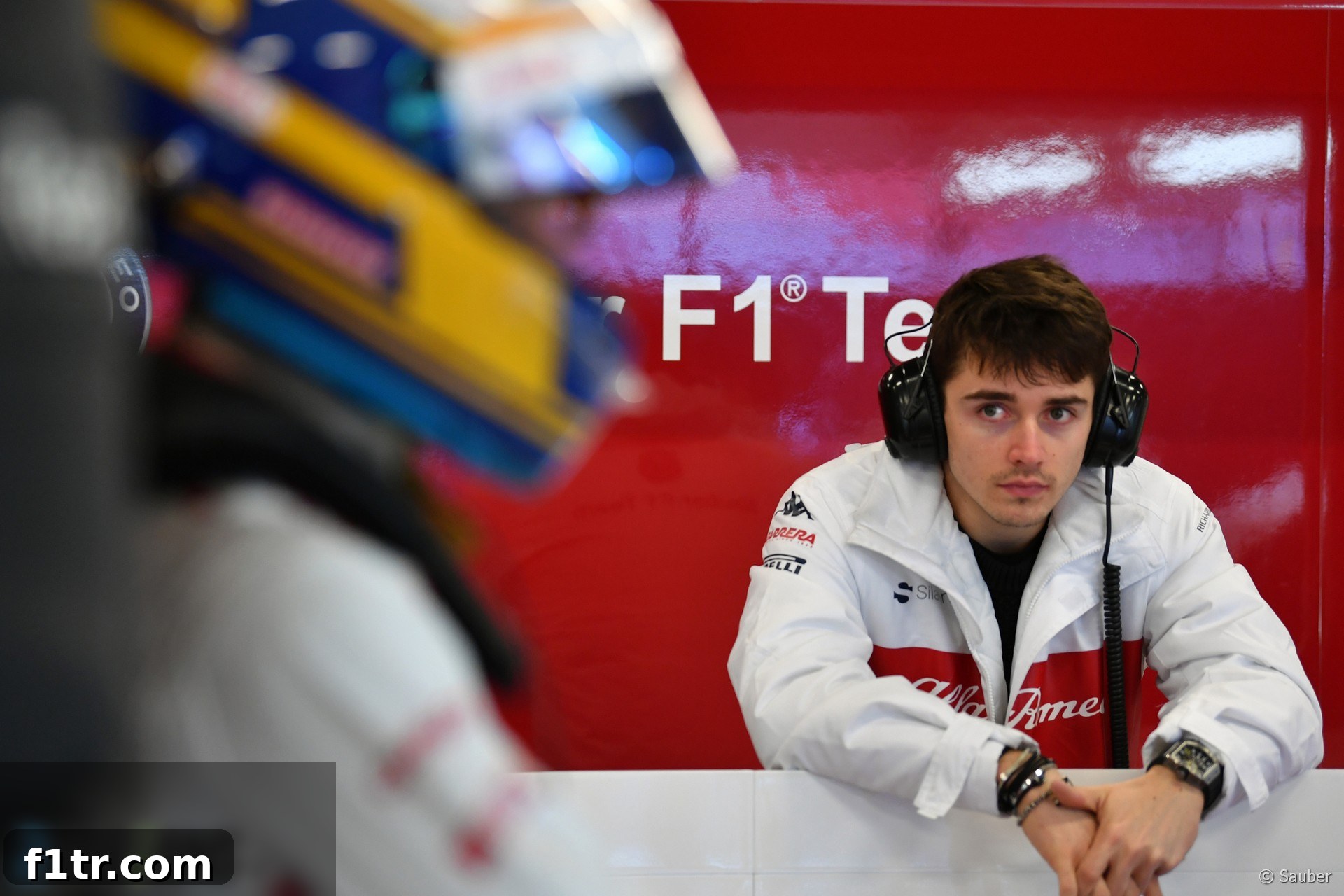
Leclerc vs. Ericsson: A Tale of Two Fortunes at Sauber in the 2018 F1 Season
The 2018 Formula 1 season presented a stark contrast in destinies for the two drivers representing the Sauber F1 team. While one was rapidly ascending the ranks of motorsport, securing a coveted seat at the sport’s most illustrious team, the other found himself at a career crossroads, ultimately moving on from Formula 1. This was the defining narrative of Charles Leclerc’s meteoric rise and Marcus Ericsson’s challenging final chapter in F1, a season that would reshape both their careers and Sauber’s trajectory.
For Marcus Ericsson, 2018 marked his fifth season in Formula 1, all of which were spent with Sauber following his initial stint at Caterham. Throughout his tenure at the Swiss outfit, Ericsson often found himself in the shadow of his teammates. In 2015, Felipe Nasr edged him out in points, and then in 2017, Pascal Wehrlein similarly outperformed him, particularly in qualifying. Despite Nasr and Wehrlein losing their drives after those seasons, Ericsson remained, often attributed to the significant financial backing he brought to the team, a crucial lifeline for Sauber during some of its most financially challenging years. However, this dynamic was about to undergo a radical shift with the arrival of a prodigious talent from the Ferrari Driver Academy.
Charles Leclerc’s Explosive Debut and Immediate Impact
The arrival of Charles Leclerc, the reigning 2017 Formula Two champion, brought a fresh wave of anticipation to Sauber. His reputation preceded him, but the transition from F2 to F1 is notoriously complex. Leclerc himself spoke openly about the intricate nature of adapting to a Formula 1 car, with its myriad buttons, advanced aerodynamics, and sophisticated hybrid power unit. Yet, his mastery of these challenges was astonishingly swift.
Initially, there were moments of intrigue. Ericsson, leveraging his greater experience with the team and the C37 car, managed to out-qualify Leclerc in the first two races of the season – Australia and Bahrain. These early results briefly sparked discussions about whether Leclerc’s immense hype might be premature. However, such whispers were quickly silenced. Leclerc swiftly adapted, and from the Chinese Grand Prix onwards, he established a clear dominance. Over the remaining nineteen rounds of the season, Ericsson would only manage to out-qualify his teammate on two further Saturdays, a testament to Leclerc’s rapid learning curve and inherent raw speed.
The Scale of Leclerc’s Performance Advantage
What truly set Leclerc apart was not just the frequency of his victories over Ericsson, but the sheer margin of his advantage. It became a common sight to see Leclerc out-qualify Ericsson by half a second or more, a significant gap in the ultra-competitive world of Formula 1. This consistent pace difference highlighted Leclerc’s exceptional talent, particularly his natural ability to extract maximum performance from the car, especially with the softer compounds of the Pirelli tyre range. Leclerc’s proficiency in tyre management and getting them into their optimal operating window was something Ericsson seldom managed to replicate, contributing significantly to the Monaco driver’s superior qualifying record.
Leclerc’s prowess wasn’t confined to Saturday qualifying sessions. More often than not, he translated his strong grid positions into impressive race performances. As the season progressed and the Sauber C37 car evolved, Leclerc became a regular contender for “best of the rest” honours, consistently battling with cars from more established mid-field teams like Haas and Force India. His ability to maintain strong pace, execute intelligent race strategies, and deliver crucial points finishes marked him as a future star.
Sauber’s Resurgence: Fueled by Leclerc’s Brilliance
The 2018 season saw Sauber emerge as arguably the most improved team on the grid in terms of outright performance. The C37 chassis, coupled with an upgraded Ferrari power unit, provided a much more competitive package than in previous years. However, despite this significant improvement, the team finished only eighth in the Constructors’ Championship standings. This position, behind a team (Force India/Racing Point) that only counted points from the latter half of the season, underscored a critical factor: the disparity in driver contributions.
Leclerc, in his rookie season, delivered an impressive 39 points for the team, demonstrating his extraordinary capability to maximize the car’s potential. In contrast, Ericsson, in his fifth year, managed to score just nine points. This considerable difference of 30 points between the two drivers was a primary reason why Sauber couldn’t climb higher in the championship standings. Leclerc’s points haul was often achieved through strategic brilliance and raw pace, frequently placing the Sauber C37 in positions few expected, turning potential top-ten finishes into tangible points.
The narrative of the season was clear: Leclerc was not just driving a car; he was elevating the entire team’s performance. His feedback was invaluable, his pace pushed the engineers, and his results inspired confidence. This synergy was pivotal in transforming Sauber from perennial backmarkers into a credible mid-field contender, setting the stage for its rebranded future as Alfa Romeo Racing.
Marcus Ericsson vs Charles Leclerc: 2018 Sauber Team Mates Performance Comparison
Season Summary and Key Statistics
The table below provides a comprehensive overview of the key performance metrics for Marcus Ericsson and Charles Leclerc during the 2018 F1 season, illustrating the clear performance differential between the two drivers.
| Driver | Points Scored | Best Race Finish | Q3 Appearances | Average Qualifying Position | DNFs | Race Finishes (Total) |
|---|---|---|---|---|---|---|
| Charles Leclerc | 39 | P6 (x2) | 10 | 13.6 | 3 | 18 |
| Marcus Ericsson | 9 | P9 (x2) | 4 | 16.1 | 5 | 16 |
Who Was Ahead? Race-by-Race Comparison
The table below details the races where Marcus Ericsson managed to qualify or finish ahead of Charles Leclerc, highlighting the rarity of such occurrences against his dominant rookie teammate.
| AUS | BAH | CHI | AZE | SPA | MON | CAN | FRA | AUT | GBR | GER | HUN | BEL | ITA | SIN | RUS | JAP | UNI | MEX | BRA | ABU | ||
| Marcus Ericsson | Q | X | X | X | X | |||||||||||||||||
| R | X | X |
The Future Trajectories: Ferrari and IndyCar
The 2018 season was a pivotal chapter for both drivers. For Charles Leclerc, his exceptional performances at Sauber were his audition for the biggest stage in Formula 1. His raw speed, mature race craft, and impressive adaptability convinced Ferrari to promote him to their works team for the 2019 season, replacing Kimi Räikkönen. This move propelled Leclerc into the spotlight as a likely championship contender, a testament to his talent and potential as a future F1 superstar.
For Marcus Ericsson, the season marked the end of his Formula 1 journey as a full-time driver. Despite his efforts and long-standing relationship with Sauber, the team opted for a fresh lineup in 2019. Ericsson transitioned to the NTT IndyCar Series, embarking on a new challenge in American open-wheel racing, while maintaining a reserve driver role with Sauber (now Alfa Romeo Racing) for a brief period. His departure underscored the ruthless nature of F1, where even experienced drivers can be replaced by rising stars when performance differences become undeniable.
In conclusion, the 2018 Sauber season will be remembered as the launching pad for Charles Leclerc’s illustrious F1 career. His battle against Marcus Ericsson was not just a team-mate rivalry; it was a clear demonstration of a generational talent making his mark, pushing boundaries, and setting new standards. It was a season that defined one driver’s future at the pinnacle of motorsport and marked a dignified transition for the other.
Further Reading: Dive Deeper into the 2018 F1 Season
To explore more insights and detailed analyses from the captivating 2018 Formula 1 season, check out these related articles:
- Pass masters: Who made F1’s biggest recovery drives of 2018?
- The complete RaceFans 2018 F1 season review
- Hamilton and Mercedes succeed in their toughest challenge yet
- Vettel’s errors thwart Ferrari title hopes
- Analysis: How F1 teams spent $2.2 billion in 2018
Browse all 2018 F1 season review articles