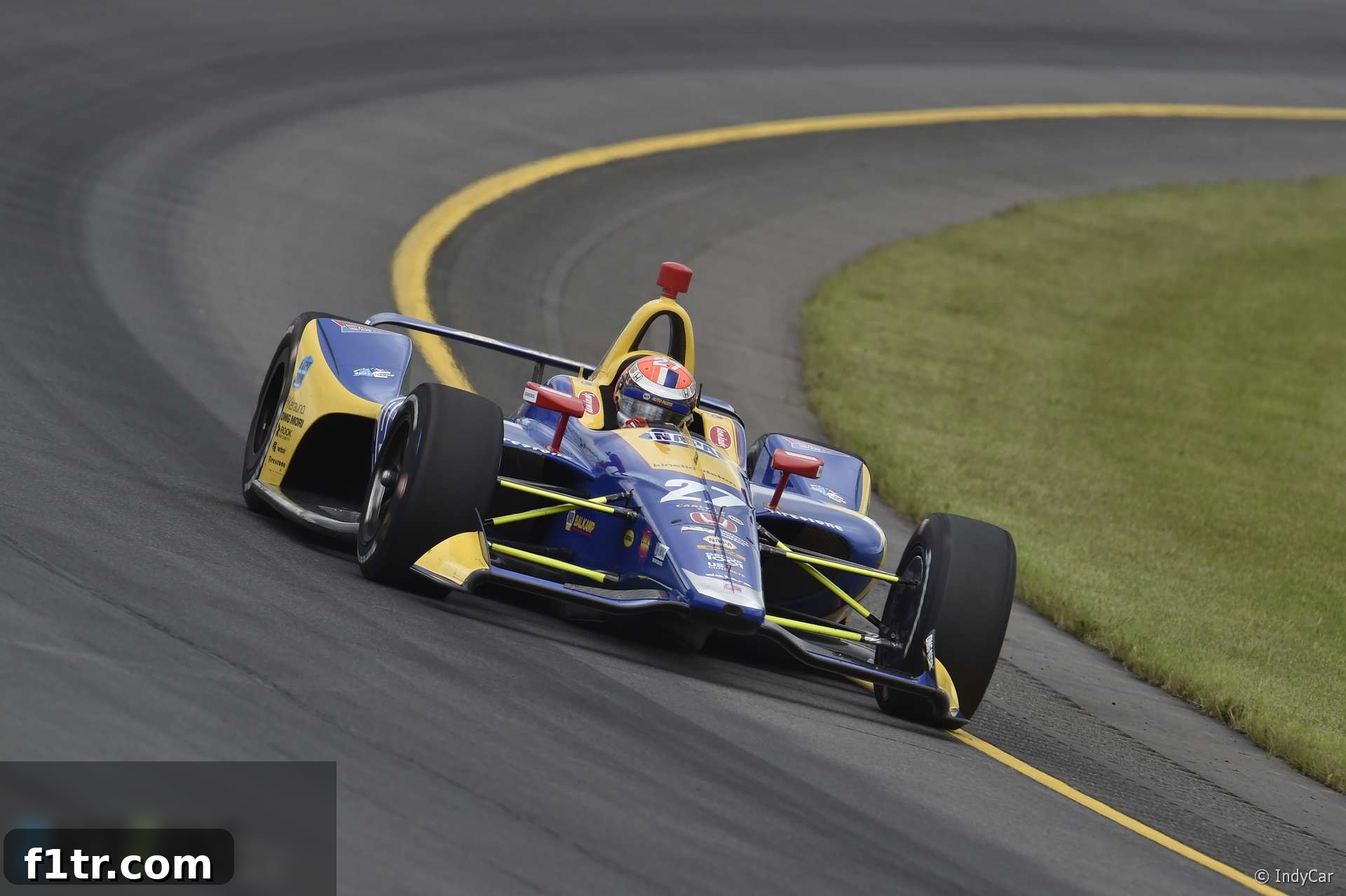
Alexander Rossi Claims Dominant Victory at Emotional 2018 ABC Supply 500 in Pocono
The 2018 ABC Supply 500 at Pocono Raceway will forever be etched into the annals of IndyCar history, not just for Alexander Rossi’s spectacular and dominant victory, but for a harrowing incident that underscored the inherent dangers and remarkable resilience of motorsport. What began as an anticipated 200-lap battle on the challenging “Tricky Triangle” transformed into a race defined by both extraordinary driving skill and profound concern for driver safety. Rossi’s second consecutive win of the season cemented his status as a formidable championship contender, yet it was the terrifying crash involving rookie sensation Robert Wickens that became the race’s most significant, and sobering, talking point.
This event served as a powerful reminder of the fine line between triumph and tragedy in high-speed open-wheel racing, showcasing the unwavering commitment of safety crews and the bravery of every competitor. The extensive delay and the subsequent discussions about track safety highlighted critical aspects of modern motorsport, while Rossi’s unflappable performance provided a masterclass in how to navigate immense pressure and deliver a winning drive.
The Shocking Incident: Robert Wickens’ High-Impact Crash
The race’s opening laps provided an immediate precursor to the drama that would unfold. A collision at the initial start between Graham Rahal and Spencer Pigot necessitated a full-course yellow, but this minor entanglement was swiftly overshadowed. Just moments after the race resumed under green flag conditions, on only the seventh lap, the motorsports world held its breath as a catastrophic multi-car accident erupted in Turn 2.
Robert Wickens, the promising Canadian rookie who had been enjoying an impressive debut season, made contact with Ryan Hunter-Reay. The initial wheel-to-wheel contact, occurring at incredible speeds characteristic of Pocono’s long straightaways, sent Wickens’ car airborne with terrifying force. The vehicle spun violently as it launched into the catch fence, impacting the protective barrier with immense energy. The severity of the crash was immediately evident, as debris scattered across the track and the catch fence sustained extensive structural damage.
The incident triggered an immediate red flag, halting the entire field as emergency crews rushed to the scene. The highly trained AMR IndyCar Safety Team demonstrated exceptional professionalism and speed, arriving at Wickens’ car within mere seconds. Medical personnel worked meticulously and carefully at the scene to stabilize Wickens before he was safely extricated from the heavily damaged car and transported to a local hospital. Early reports from series officials, stating that he was “awake and alert,” offered a glimmer of hope amidst the grave concern for his well-being. The crash also regrettably collected three other drivers: Takuma Sato, James Hinchcliffe, and Pietro Fittipaldi, forcing their immediate retirement from the event and amplifying the scope of the incident.
A Race Halted: Safety Repairs and Driver Concerns
The impact of Wickens’ car had caused significant damage to a section of the catch fence, a critical safety barrier designed to prevent cars from entering spectator areas and to absorb energy during high-speed incidents. Repairing such extensive damage to ensure the continued safety of both drivers and fans was a meticulous and time-consuming process. Consequently, the red flag period stretched for approximately two agonizing hours, leaving drivers and fans in a state of suspense and reflection.
During this unprecedented delay, the discussion shifted momentarily from racing strategy to the paramount issue of safety. One prominent voice to express concerns was Sébastien Bourdais. The veteran driver openly questioned the efficacy and thoroughness of the repair job, suggesting that the patched-up barrier might not be sufficiently robust for the speeds involved. Bourdais’ comments resonated with the collective anxieties within the paddock, highlighting the drivers’ deep personal understanding of the risks they undertake and their inherent desire for the highest possible safety standards. Ultimately, race officials deemed the repairs sufficient, and the call to resume racing was given, but the underlying concerns lingered as the cars prepared to restart.
Advert | Become a Supporter & go ad-free
Rossi’s Unyielding Pace: A Masterclass in Oval Dominance
When the green flag finally dropped again, signaling the resumption of the ABC Supply 500 after the lengthy delay, Alexander Rossi wasted no time in re-establishing his authority. Having already moved into the lead during the initial restart following the Rahal-Pigot contact, Rossi maintained his position at the front of the field with unwavering confidence. The No. 27 NAPA Auto Parts Honda of Andretti Autosport appeared perfectly tuned for the unique challenges of Pocono, showcasing exceptional balance and blistering pace throughout the remainder of the race.
Rossi’s performance was a clinic in strategic oval racing. He managed his tires impeccably, conserving their life while maintaining a consistently fast rhythm. His pit stops were executed flawlessly by the Andretti Autosport crew, ensuring he lost minimal time to his competitors. While pole sitter Will Power, driving the formidable Team Penske Chevrolet, mounted a brief but determined challenge in the second half of the race, momentarily regaining the lead, Rossi’s response was swift and decisive. With cool precision, he reeled in the Australian driver, executed a clean and powerful overtake, and quickly re-established a comfortable buffer. By the time the checkered flag waved to conclude the 200-lap marathon, Rossi had built a lead of almost four-and-a-half seconds, a testament to his overwhelming dominance and strategic brilliance on the day. This commanding victory was Rossi’s second in a row, signaling a strong mid-season surge in his championship campaign.
Championship Battle Intensifies: Dixon’s Crucial Recovery Drive
While Rossi celebrated his momentous win, the broader championship narrative continued to unfold with intense drama. Scott Dixon, widely regarded as one of IndyCar’s greatest talents and Rossi’s primary rival for the Astor Cup, executed a remarkable recovery drive that proved invaluable for his title aspirations. Starting from a challenging 13th position on the grid, Dixon demonstrated his trademark consistency and race craft, meticulously working his way through the field. His ability to make passes, manage tire degradation, and maintain focus through restarts allowed him to climb steadily up the leaderboard.
Dixon’s relentless charge saw him cross the finish line in an impressive third place, limiting the damage to his championship lead. This podium finish, just six-tenths of a second ahead of Sébastien Bourdais, was a crucial display of damage limitation, turning a potentially difficult weekend into a strong points haul. In a season where every point could prove decisive, Dixon’s veteran savvy and unwavering determination underscored why he is a perennial championship contender. The fact that only a select few cars, including Rossi and Dixon, finished on the lead lap further emphasized the physically and mentally demanding nature of the Pocono circuit, and the exceptional performances of those at the front of the field.
Beyond the Podium: Other Key Performances at the Tricky Triangle
The 2018 ABC Supply 500 also showcased several other noteworthy performances, as drivers battled fiercely for every position across the unique Pocono Raceway layout. The “Tricky Triangle” – with its three distinct turns, each inspired by different ovals – demands a specific skill set and setup compromise, making strong finishes a testament to driver and team adaptability.
- Josef Newgarden: The reigning IndyCar Series champion delivered a solid and consistent performance for Team Penske, securing a valuable fifth-place finish that kept him firmly in the championship hunt.
- Zach Veach: Continuing his impressive progression in his rookie season, Veach demonstrated significant improvement on ovals. He executed a decisive late-race pass on veteran Marco Andretti to claim a strong sixth position, highlighting his growing confidence and potential.
- Marco Andretti: Driving for Andretti Herta Autosport, the third-generation racer put in a spirited effort to finish seventh, adding to his family’s storied legacy at Pocono.
- Simon Pagenaud: Another Team Penske driver, Pagenaud rounded out the top eight, contributing to the team’s strong overall presence and ensuring a consistent points haul.
- Charlie Kimball: A seasoned competitor, Kimball delivered a steady drive to secure ninth place, showcasing his ability to navigate the demanding oval effectively.
- Ed Carpenter: The oval specialist and team owner, known for his prowess on high-speed circuits, completed the top ten, always a threat when the series visits an oval.
These results, while not capturing the top headlines, were critical for team standings and individual championship aspirations, reflecting the depth of talent and competitive spirit present throughout the NTT IndyCar Series field.
Advert | Become a RaceFans supporter andgo ad-ad-free
A Race of Profound Impact: The Legacy of Pocono 2018
The 2018 ABC Supply 500 at Pocono Raceway will undoubtedly be remembered as a pivotal moment in the IndyCar season and a poignant chapter in the sport’s history. Alexander Rossi’s dominant display of skill and strategic acumen cemented his credentials as a premier talent and a serious title contender. His ability to perform under the immense pressure of a championship battle, coupled with his consistent pace, showcased a driver truly coming into his own. The back-to-back victories further amplified his impressive mid-season momentum.
However, the enduring image of the race remains the terrifying crash involving Robert Wickens. While devastating in its immediate impact and long-term consequences, the incident also served as a testament to the remarkable advancements in motorsport safety and the heroic actions of the emergency response teams. The immediate and professional medical attention Wickens received underscored the continuous evolution of safety protocols, which undoubtedly mitigated even more severe outcomes. The ensuing discussions about track integrity and driver feedback, exemplified by Sébastien Bourdais’ concerns, further highlighted the sport’s ongoing commitment to pushing the boundaries of safety.
Ultimately, Pocono 2018 encapsulated the very essence of IndyCar racing: exhilarating speed, fierce competition, strategic brilliance, and the ever-present, sometimes stark, reality of danger. It was a race that provided thrilling sporting drama while simultaneously fostering deep reflection on the human element and the extraordinary bravery required to compete at the highest echelons of motorsports.
IndyCar: Further Reading and Insights
Delve deeper into the world of IndyCar racing with more articles and analysis from our archives. Explore driver profiles, race recaps, and insights into the future of open-wheel competition.
- IndyCar driver McLaughlin cleared of injury after crashing through barrier at Barber
- Schumacher says his IndyCar feels like ‘an F2 car, just with better tyres’
- IndyCar “way faster than Formula 1” in some corners, says Grosjean
- FIA to award more F1 superlicence points to IndyCar drivers from 2026
- Schumacher to race full-time in IndyCar with RLL in 2026
Browse all IndyCar articles