Advert | Become a Supporter & go ad-free
Aston Martin’s Unforeseen Narrative: Stroll Leads Alonso Amidst Early Season Struggles
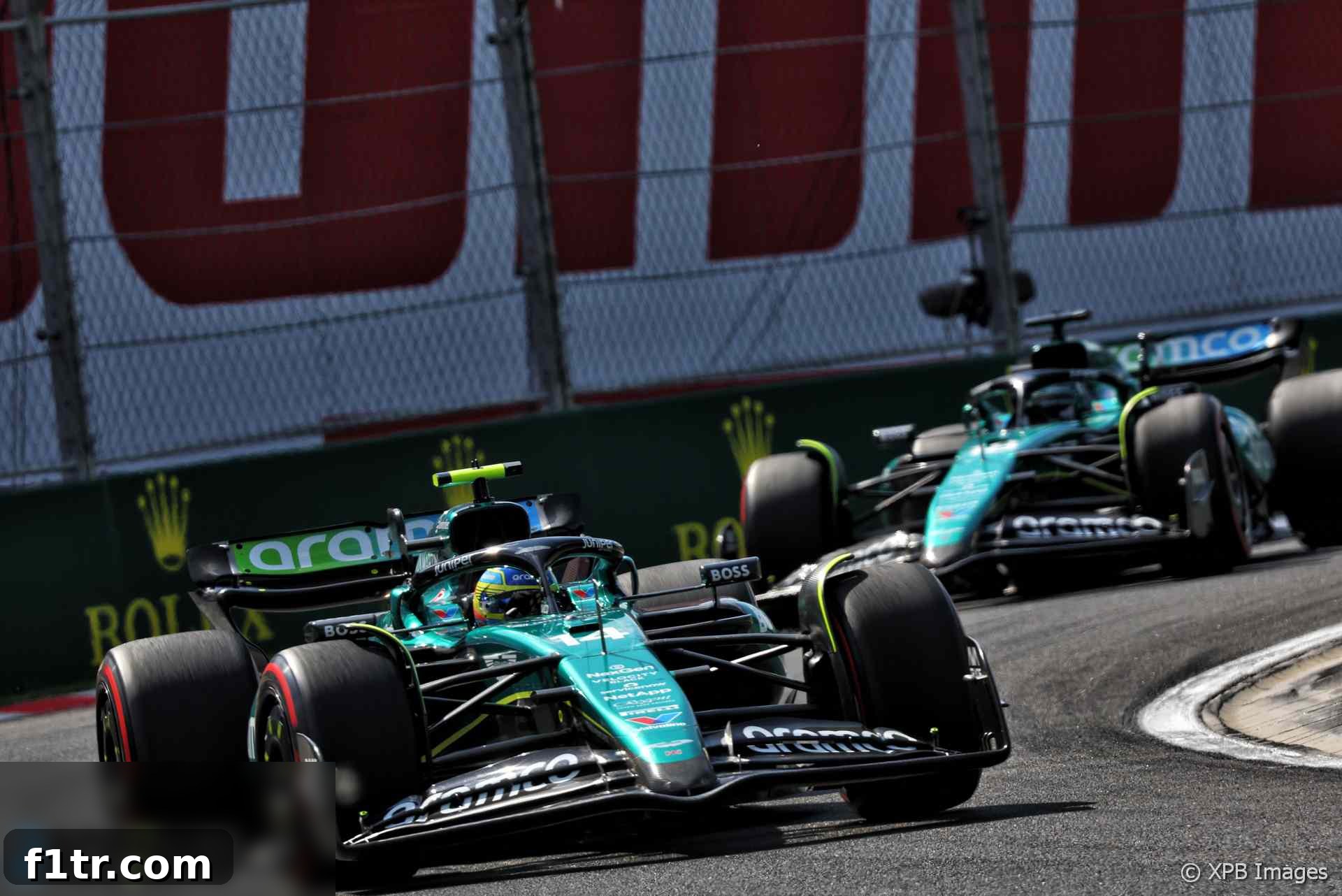
As the Formula 1 season enters its second quarter, the mood at Aston Martin is likely far from celebratory. Despite ambitious goals and significant investment, the Silverstone-based team finds itself trailing expectations, having accumulated a mere 14 points across the opening six rounds. This tally represents a stark decline from their impressive performance just a year ago, where they had already secured a substantial triple-digit points total by this stage and even surpassed their current haul in the very first race of 2023. The AMR24 has proven a challenging contender in a fiercely competitive midfield, struggling to consistently unlock the pace required to challenge the front-runners or even comfortably secure regular points finishes.
However, within this backdrop of collective disappointment, an unexpected individual narrative has emerged that offers a unique glimmer of satisfaction for one of Aston Martin’s drivers. Against all prior expectations and career trends, it is Lance Stroll, often the target of scrutiny and criticism, who has single-handedly garnered all 14 of the team’s points. This surprising turn of events sees him ahead of his illustrious teammate, the two-time world champion Fernando Alonso, marking a significant departure from their usual on-track hierarchy.
Lance Stroll’s Career Trajectory: A History of High Expectations and Tough Comparisons
Lance Stroll’s journey in Formula 1 has been a subject of continuous debate, often overshadowed by the fact that his father, Lawrence Stroll, owns the Aston Martin team. Debuting at a remarkably young age, Stroll has amassed considerable experience, becoming Canada’s most experienced F1 driver last year with 172 starts to his name. Over his eight seasons in the sport, Stroll has faced an array of highly talented teammates, and the data consistently shows a trend where he has been out-scored over the course of the year. Indeed, prior to the current season, Stroll had only managed to outscore a teammate once throughout his F1 career. This sole instance occurred in 2018, his second season, when he partnered rookie Sergey Sirotkin at Williams, a pairing conspicuously lacking in F1 experience. Together, they managed a paltry three points finishes, yet Stroll emerged ahead.
Aside from that singular season, the ledger has always tipped in favor of the driver alongside him. His teammates have included race winner Sergio Perez, four-time world champion Sebastian Vettel, and arguably one of the greatest drivers of all time, Fernando Alonso. Supporters of Stroll frequently highlight the caliber of these individuals, arguing that being measured against such benchmarks would be a monumental task for any driver. They suggest that Stroll’s often slender points deficits to these champions are, in fact, nothing to be ashamed of, demonstrating his capability to operate at the pinnacle of motorsport.
Historically, Lance Stroll has consistently been outscored by his teammates in Formula 1, with the exception of his 2018 season alongside rookie Sergey Sirotkin. He finished behind Felipe Massa in 2017, Sergio Perez in 2019 and 2020, Sebastian Vettel in 2021 and 2022, and Fernando Alonso in 2023. This season, however, marks a significant shift, with Stroll currently holding a points advantage over Alonso after the opening six rounds.
*After six of 24 rounds
NB. Massa missed one round in 2017, Perez missed two rounds in 2020, Stroll missed one round in 2020, Vettel missed two rounds in 2022.
Conversely, Stroll’s detractors often point to this consistent trend of being out-scored as evidence that he has been promoted beyond his natural ability. While he has had flashes of brilliance, particularly in challenging wet-weather conditions, and has generally avoided the catastrophic crashing tendencies that have derailed many junior careers, a fundamental observation has been his tendency to be slightly slower than his teammates over a single flying lap. This consistent qualifying deficit often translates into finishing positions behind them during races.
Advert | Become a RaceFans supporter andgo ad-free
The Unexpected Turn: Stroll’s 2025 Performance vs. Alonso’s Challenges
The current 2025 season presents a fascinating anomaly. How significant is it that Lance Stroll, now in his ninth season, finds himself ahead of a driver of Fernando Alonso’s legendary stature? Alonso, one of the most experienced F1 drivers ever at 43 years old, remains fiercely competitive, harboring hopes of challenging for a third world championship in 2026 should the colossal investment from Stroll’s consortium, combined with Honda power and Adrian Newey’s design prowess, deliver a championship-contending package.
A closer look at the season’s unfolding rounds reveals a series of unfortunate events for Alonso, contrasted with Stroll’s ability to capitalize on the opportunities that arose. Stroll opened his points account at the very first race in Melbourne, a circuit that, with its challenging and often treacherous conditions, has historically played to his strengths (notably his commanding performance at the 2020 Turkish Grand Prix). Although he was running behind his teammate at the time, Alonso’s race ended prematurely when he ran wide, hitting a patch of gravel thrown onto the track at Turn Seven and subsequently crashing out.
The subsequent sprint race in China saw Stroll narrowly miss out on points, dropping out of the top ten with just three laps remaining. However, in the main Grand Prix, after finishing 12th on the road, he was promoted three places to collect two points due to post-race disqualifications of competitors. Alonso, meanwhile, had been running two positions ahead of Stroll before suffering a critical brake failure on Lap Four, forcing his retirement.
Despite these incidents, Alonso has consistently demonstrated raw pace, almost invariably out-qualifying Stroll and often showing superior race pace. Yet, on occasions where his speed was evident, like at Suzuka where he finished 11th, a lack of retirements among rivals meant the top ten places were locked out, making points scoring an arduous task for anyone outside the absolute leading contenders. He faced similar frustration at Jeddah, finishing 11th again and no doubt regretting a lapse after the restart that allowed Isack Hadjar to slip ahead into an eventual tenth place.
The Miami sprint race further exemplified this disparity in fortunes. Stroll, running outside the points in 11th, made an early, audacious gamble on pitting for slick tires as the track rapidly dried. His exquisite car control on the low-grip surface paid off handsomely. Alonso, positioned in eighth, found his team more resistant to risking his points position and consequently pitted much later. This left him vulnerable to those who had come in early and successfully warmed their tires, such as Liam Lawson, who subsequently made contact with Alonso, bundling him into a barrier as he attempted to overtake. Further post-race penalties to other drivers then astonishingly promoted Stroll to a fifth-place finish.
The cumulative effect of these events is that Lance Stroll is currently tied on 14 points with ninth-placed Esteban Ocon in the drivers’ standings. In stark contrast, Fernando Alonso is experiencing his worst start to a Formula 1 season since his challenging tenure with McLaren-Honda, coinciding with his current teammate’s debut season in the sport. It’s not necessarily a sudden, marked improvement in Stroll’s inherent pace, but rather a testament to his opportunistic driving and his ability to leverage every chance that has come his way. Conversely, it’s undeniable that Alonso has endured more than his fair share of misfortune and strategic missteps, with the cards simply not falling in his favor.
Advert | Become a RaceFans supporter andgo ad-free
Alonso’s Unwavering Self-Belief and Aston Martin’s Future Focus
The question inevitably arises: Is Alonso’s renowned speed finally beginning to fade with age? Is he allowing opportunities to slip through his grasp that he would have once ruthlessly seized? The Spanish veteran vehemently dismisses such notions. Earlier this year, he confidently asserted, “I’m as fast as in 2004 – or faster, now,” highlighting his unwavering belief in his abilities and physical conditioning. His qualifying performances and flashes of pace in races certainly back up his claim that his raw speed remains at an exceptionally high level, a testament to his dedication and unparalleled experience.
With three-quarters of the season still to unfold, it would be a significant surprise if Fernando Alonso does not reassert his natural advantage and continue to lead Stroll on raw pace for the majority of the remaining rounds. The more critical question, however, revolves around the competitiveness of the Aston Martin AMR24. The car was notably the slowest at the most recent Grand Prix, indicating a worrying trend. Furthermore, with Aston Martin’s strategic focus increasingly shifting towards the significant technical regulations overhaul expected in 2026, there may be limited resources and development planned for the current AMR25. This strategic prioritization of the future could severely impact the car’s ability to become more competitive in the short term, thereby limiting Alonso’s opportunities to consistently challenge for points.
While an unlikely scenario just two years ago, when Alonso convincingly outscored Stroll in the standings, the current unique alignment of Stroll’s astute opportunism and Alonso’s string of bad luck has created an unexpected dynamic. The opportunity for Stroll to maintain his lead over his illustrious teammate, or at least significantly narrow the gap compared to previous seasons, undoubtedly exists. However, for Alonso to reverse his current deficit and propel Aston Martin higher in the constructors’ championship, the team will need to find incremental performance from the AMR24, and crucially, for fortune to finally swing back in his favor. The remainder of the season promises to be a compelling narrative of veteran resilience against unexpected ascendancy, all set against the backdrop of Aston Martin’s broader ambitions for the future of Formula 1.
Formula 1 Insights & Analysis
- F1’s India Return: Optimism or Reality?
- Verstappen’s Dislike for New F1 Cars: Driver Reactions
- The Flawed ‘Throwback Weekend’ Concept in F1
- F1’s Double Race Cancellation: A Hidden Opportunity?
- Todt Confirms Schumacher’s Intentional Crash: Title Implications
Explore more Formula 1 articles