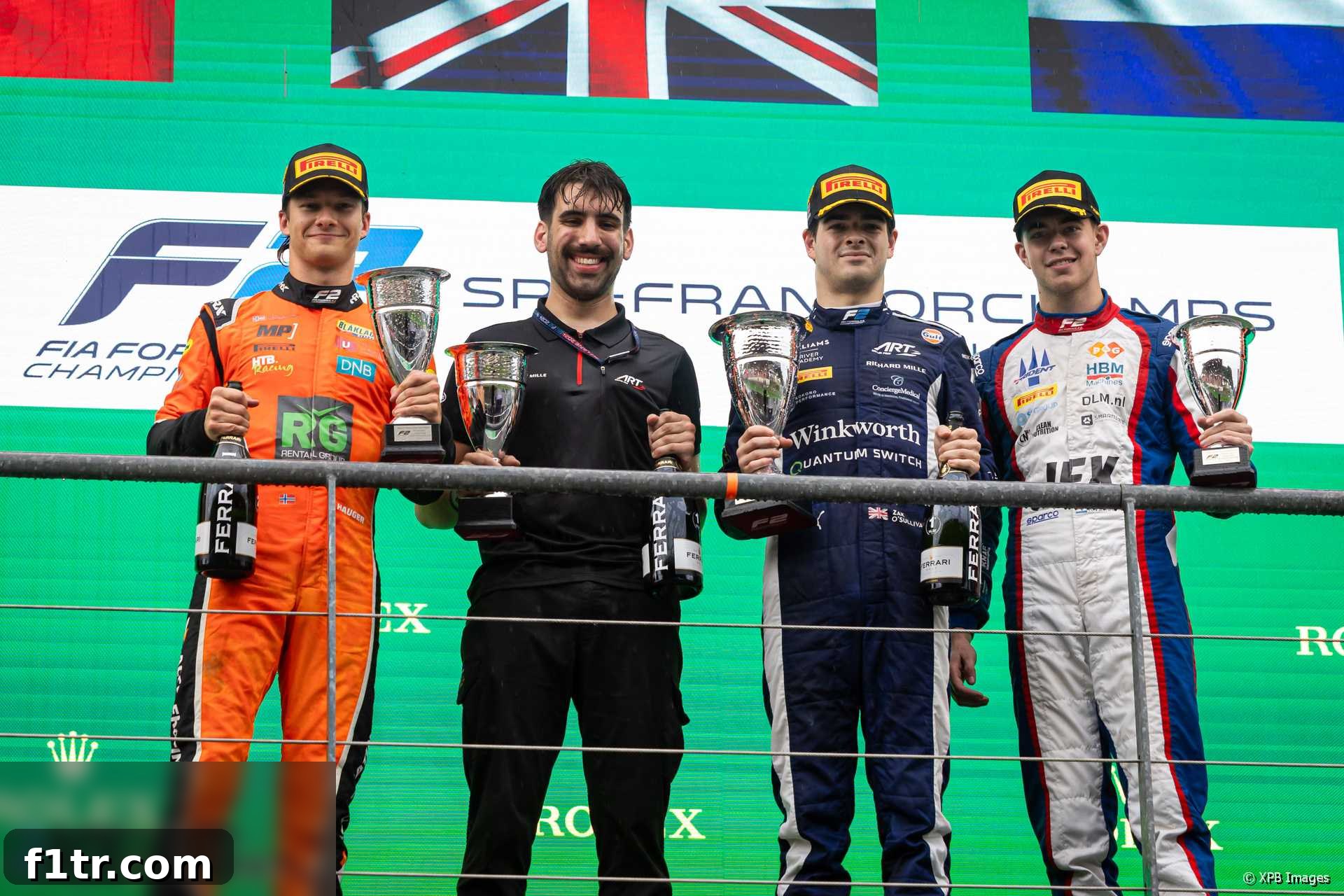
Zak O’Sullivan’s Controversial F2 Sprint Win at Spa: A Deep Dive into Shortened Races and Safety
The exhilarating world of Formula 2 racing often delivers unpredictable drama, but few events encapsulate the bittersweet essence of motorsport quite like Zak O’Sullivan’s sprint race victory at Spa-Francorchamps. Despite clinching his second win of the season, the young driver openly admitted to feeling a peculiar mix of triumph and unease, questioning the very definition of a “race” when the checkered flag falls after only a handful of laps. His sentiment resonated deeply across the paddock and with fans, igniting a crucial discussion about the integrity of competition under extreme conditions and, more importantly, the paramount importance of driver safety.
A Race Against the Weather: The Spa F2 Sprint Unfolds
The notorious microclimate of Spa-Francorchamps once again asserted its dominance on a challenging Saturday, throwing the Formula 2 schedule into disarray. Persistent, heavy rainfall transformed the iconic Ardennes circuit into a treacherous aquatic playground, forcing organizers to drastically alter plans. The sprint race, initially slated to precede Formula 1’s pivotal qualifying session, endured a significant four-hour postponement. Spectators, teams, and drivers alike were left in a frustrating limbo, waiting for a break in the weather that never truly materialized.
When the green light finally flickered, initiating a standing start, the track was already damp, with a fine drizzle quickly intensifying. The initial laps unfolded with an almost surreal tension as drivers navigated the slippery conditions, their machines kicking up colossal plumes of spray. However, the respite was fleeting. By the third lap, a stationary car on track necessitated the deployment of the Safety Car, momentarily halting the frantic pace. It was during this period, under the yellow flags, that the heavens truly opened. The rain became a deluge, drastically reducing visibility to perilous levels. Recognizing the rapidly deteriorating and unsafe environment, race control made the inevitable decision: the red flag was waved, bringing the event to an immediate halt. A swift assessment followed, leading to the definitive abandonment of the race, much to the frustration of many but to the relief of those prioritizing safety.
Driver Reactions: Mixed Emotions on a Shortened Victory
O’Sullivan’s Bittersweet Triumph
For Zak O’Sullivan, who had masterfully secured pole position on the partially-reversed grid after qualifying 10th, the abrupt end to the race left him with decidedly mixed emotions. While a win is undeniably a win, the nature of this particular victory felt hollow. “It would have been nice to do 18 laps, I think it was meant to be,” O’Sullivan reflected post-race, expressing a sentiment shared by many competitors. He continued, “Four or five push laps and it’s classed as a race, but not really a race.” His comments underscore the inherent paradox of motorsport: the desire to compete fiercely and fairly for the full duration, juxtaposed with the reality of circumstances dictating an unsatisfactory conclusion. For a developing driver in Formula 2, every competitive lap is invaluable experience, and to be denied the majority of a race distance is a significant blow to their development and the pure joy of racing.
Verschoor’s Strategic Advantage and Disappointment
Richard Verschoor, who navigated the chaotic opening laps to finish in a commendable second place, echoed O’Sullivan’s disappointment regarding the premature cessation of the race. However, his perspective offered a nuanced take, acknowledging a pragmatic benefit. “Of course you would prefer to do the full race,” Verschoor stated, articulating the universal desire for complete competition. Yet, he candidly admitted, “At this point, I was being attacked by Zane [Maloney] so of course I didn’t mind the Safety Car at that point, and get away with the trophy.” This honest admission highlights the split-second strategic considerations that permeate high-stakes racing. While the competitive spirit yearns for a full contest, the immediate reality of a trophy and valuable points can temper that desire, especially when under intense pressure from rivals. Nevertheless, his overarching commitment to the sport remained clear: “But I’m here to race so of course I would have preferred to have a full race.”
The Evolving Points System: Fair Play or Flawed Formula?
The drastically shortened nature of the Spa sprint race triggered the revised points allocation system, a significant change implemented in motorsport to address past controversies. As less than half of the scheduled race distance was completed, drivers received a reduced tally of points. Only the top five finishers were awarded points, with Zak O’Sullivan securing five for his victory. This revision directly stems from lessons learned, most notably from the controversial Formula 1 Grand Prix at Spa in 2021, where half points were awarded for a race that officially lasted just one lap behind the Safety Car. That incident sparked widespread criticism regarding the fairness and integrity of awarding championship points for what many deemed a non-event.
The current F2 system aims to strike a balance: acknowledging the effort and positions achieved in a partial race while reflecting that it was not a full-distance contest. By limiting points to the top five and reducing their value, it attempts to mitigate the impact on the championship standings compared to a full-length race. However, it still raises questions about what constitutes a truly “valid” race and whether any points should be awarded for such minimal running. The debate continues to evolve, as motorsport strives to find the most equitable solution for extreme circumstances, balancing the desire for competition with the imperative of safety.
Safety First: The Lingering Shadow of Spa
While the truncated race left many feeling unfulfilled, there was unanimous agreement among the drivers regarding the necessity of the red flag. The rapidly deteriorating conditions on track simply made it too dangerous to continue. “It started off pretty okay, that’s also the reason why we did a standing start,” explained Verschoor. “But it got progressively worse throughout the race. To be honest I was just thinking about the red for I think 10 seconds and then it became red. Then there was too much [rain] and I could only imagine the guys behind me, they had so much more spray. Already for me in third it was quite bad so it did get worse during the race.” His testimony paints a vivid picture of the escalating hazard, particularly for those further back in the pack.
The Driver’s Perspective on Visibility
Dennis Hauger, who was running in a strong position, initially found himself questioning the decision. “I had no idea why the red flag was shown at first and wondered what happened on track, because for me it didn’t feel like it was that wet,” he admitted. From his vantage point higher up the grid, he experienced better visibility, leading to his initial confusion. “Even the spray for me wasn’t that bad so it wasn’t really in my mind,” he continued. However, Hauger quickly acknowledged the broader picture: “But looking back obviously for the guys further back for sure it would have been more of an issue.” This highlights a critical aspect of wet weather racing: the visibility challenges are exponentially worse for cars deeper in the field, where the spray from multiple cars ahead creates an impenetrable wall of water. His eventual acceptance of the decision underscored the collective understanding that safety must always take precedence.
“But I felt we’ve been in these similar conditions in Silverstone where maybe it also should have been red-flagged,” Hauger added, suggesting inconsistencies in past race control decisions. “At least from my point of view it wasn’t too bad but for sure the safety is the most important and in the end it’s their call and they know better than us who has the full picture? So in the end it was the right call, I guess.” This reflects the difficult position of drivers who, in the heat of competition, often push boundaries, contrasting with race control’s responsibility to make difficult, overarching safety decisions based on a comprehensive view of the entire circuit.
Spa’s Tragic History and Lessons Learned
The imperative for extreme caution at Spa-Francorchamps, particularly in wet conditions, carries a heavy and recent weight. The circuit, renowned for its challenging high-speed sections and unpredictable weather, has unfortunately been the scene of several serious accidents. Tragically, in the previous year, young Dilano van ‘t Hoff lost his life in a devastating crash during a Formula Regional European race at the track. This incident occurred following a restart in extremely wet conditions with severely limited visibility, serving as a stark and painful reminder of the critical dangers of racing in such circumstances. The memory of Van ‘t Hoff’s accident undoubtedly influenced the race director’s swift decision to red-flag the Formula 2 sprint. Modern motorsport prioritizes safety above all else, and while fans and drivers crave racing action, no victory or championship point is worth risking a life. The Spa F2 sprint race, brief as it was, served as another powerful illustration of the delicate balance between competitive ambition and the non-negotiable demands of driver safety.
Conclusion: A Necessary Interruption in the Pursuit of Excellence
Zak O’Sullivan’s F2 sprint race victory at Spa-Francorchamps will undoubtedly be remembered as one of the most unusual wins of his burgeoning career. While the thrill of standing on the top step of the podium is undeniable, the context of a drastically shortened race, marred by severe weather and safety concerns, casts a unique light on the achievement. The event highlighted the ongoing challenges faced by race organizers, drivers, and governing bodies in managing motorsport in extreme conditions. It underscored the revised points system’s role in attempting to provide a fairer outcome for truncated races and, most importantly, reaffirmed the unwavering commitment to driver safety. The lingering shadow of past tragedies at Spa, combined with the real-time observations of worsening visibility, made the decision to red-flag and abandon the race not just justifiable, but essential. While the racing spectacle was cut short, the ultimate victory belonged to safety, ensuring that drivers lived to fight another day, hopefully, under clearer skies and for a full race distance.
Formula 2
- Formula 2 to debut in Miami and Montreal after Iran war cancellations
- Ex-McLaren junior Dunne’s move to Alpine finally confirmed
- Schumacher says his IndyCar feels like ‘an F2 car, just with better tyres’
- The Formula 2 team with an older driver line-up than almost half the F1 grid
- FIA to award more F1 superlicence points to IndyCar drivers from 2026
Browse all Formula 2 articles