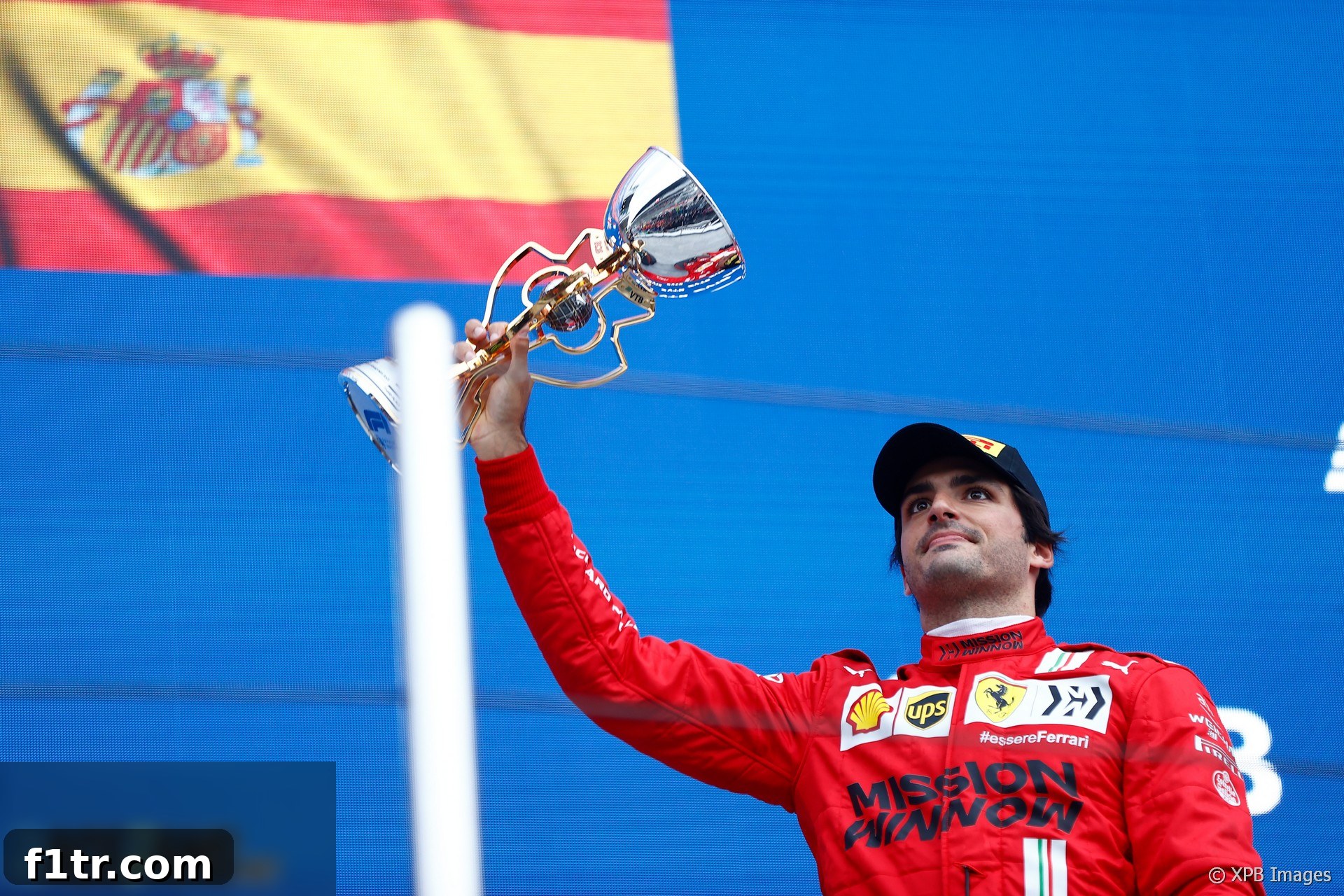
In the latest motorsport round-up, Carlos Sainz Jnr has openly admitted that he still hasn’t found complete harmony with his Ferrari, despite consistently delivering strong performances, including his third top-three finish for the Scuderia at the Sochi Grand Prix.
Driver Performance Insights
Sainz Grapples with Ferrari F1 Car Comfort, Reflecting on Atypical Crashes
Become a Supporter & go ad-free
As the Formula 1 season progresses through its initial 15 races, Carlos Sainz finds himself in a fascinating position. He currently holds an 8.5-point advantage over his highly-rated teammate, Charles Leclerc, a testament to his undeniable talent and adaptability. However, this statistical lead doesn’t fully tell the story of a driver still grappling with the nuances of his new machinery. Sainz has revealed that a series of uncharacteristic incidents and crashes in recent races stem from a fundamental lack of complete comfort within the SF21 chassis.
“We’ve successfully capitalised on opportunities to secure these three podium finishes, which is a positive outcome for the team,” Sainz commented, reflecting on his season so far. “But I suspect it’s evident from an external perspective that I’m not yet entirely at home or 100 percent comfortable with the car’s behaviour and characteristics. There’s still a journey to fully unlock its potential with my driving style.”
The Spanish driver underscored the unusual nature of his recent setbacks, which included a notable crash during practice at Zandvoort. “Throughout my career, I’ve always been known as a driver who rarely makes mistakes or puts the car into the wall. It’s an anomaly for me,” he explained, visibly frustrated by the recent occurrences. “For some reason, there have been a few crashes this season, and this clearly indicates that I haven’t yet achieved a full, 100 percent understanding of the car’s limits and how to extract its maximum performance consistently without overstepping that boundary.”
The intricate relationship between a Formula 1 driver and their car is paramount to success. Achieving a symbiotic connection, where the car feels like a natural extension of the driver’s will, is what separates good performances from truly exceptional ones. For Sainz, this process of adaptation has proven more challenging than anticipated, even for a driver as experienced and meticulous as he is. The SF21, with its unique aerodynamic properties and power unit characteristics, demands a specific driving approach that Sainz is still fine-tuning. This challenge is further compounded by the relentless pace of the F1 calendar, offering limited testing opportunities to truly bond with the machine. The subtle feedback from the steering wheel, the brake pedal, and the throttle, coupled with the car’s behaviour through high-speed corners and over kerbs, all contribute to a driver’s sense of “comfort.” When this comfort is lacking, drivers tend to hesitate, or conversely, push too hard in an attempt to compensate, often leading to errors.
The recent Sochi Grand Prix provided a glimpse into Sainz’s evolving strategy to overcome these hurdles. After qualifying on the front row and ultimately securing a commendable third place, he elaborated on his modified approach. “In Sochi, I made a very conscious effort to take things step-by-step, meticulously building up my pace through free practice sessions and qualifying. The goal was to be truly fast exactly when it mattered most, rather than attempting to be instantaneously quick from the very first lap of FP1,” Sainz explained. This methodical strategy, focusing on incremental gains and understanding rather than immediate aggression, appears to be yielding positive results.
“It has certainly worked effectively for me,” he affirmed, pleased with the outcome. “This approach has instilled a greater sense of confidence throughout the weekend. I felt quick, and perhaps more importantly, I started to feel genuinely at home with the car, which is a crucial breakthrough in my adaptation process.” This strategic shift highlights Sainz’s analytical prowess and his determination to master the SF21, promising a strong finish to his debut season with the Prancing Horse. The journey to full comfort is ongoing, but the progress in Sochi signals a positive trajectory for the talented Spaniard and Ferrari’s championship ambitions.
IndyCar’s Future Stars: Junior Series Titles Concluded
A week after the dramatic conclusion of the NTT IndyCar Series, the spotlight shifted to its vibrant junior categories, where the next generation of motorsport talent wrapped up their respective championship battles at Mid-Ohio. These feeder series are crucial stepping stones for aspiring open-wheel racers, providing invaluable experience and pathways to the pinnacle of American single-seater racing.
In the premier feeder series, Indy Lights, **Kyle Kirkwood** cemented his status as a formidable talent by clinching the championship title in the final race. Kirkwood, an Andretti Autosport driver, secured the crown despite finishing outside the top two for the first time since June, ultimately crossing the line in fifth. His consistent season-long performance was enough to edge out his fierce rival, David Malukas of HMD Motorsports, who finished a strong second behind race winner Linus Lundqvist. This marked a triumphant return for the Indy Lights series, which was notably absent from the motorsport calendar in 2020 due to the global pandemic, making Kirkwood’s victory even more significant for the series’ resurgence and for his career trajectory towards IndyCar.
The Road to Indy ladder system saw further champions crowned during the same thrilling weekend. **Christian Rasmussen** showcased his exceptional skill and consistency by wrapping up the Indy Pro 2000 title. Rasmussen’s dominant season positioned him as a clear talent for the future, demonstrating mastery over the competitive field. Similarly, in the USF2000 championship, **Kiko Porto** delivered a stellar performance that put the crown out of his rivals’ reach with a race still to spare, underscoring his early promise and potential. These three young champions now stand on the cusp of realizing their dreams in top-tier motorsport, with their titles serving as a clear indicator of their readiness for the next challenge in the high-stakes world of professional racing. Their achievements highlight the strength of the IndyCar development pipeline, which continues to identify and nurture future stars for the sport.
Become a RaceFans supporter andgo ad-free
Social Media Highlights
A selection of notable posts and insights from across Twitter, Instagram, and other platforms:
Champions. What a year. pic.twitter.com/Kkc0wHr6BV
— Kyle M. Kirkwood (@KKirkwoodRacing) October 3, 2021
This celebratory post from newly crowned Indy Lights champion Kyle Kirkwood captures the elation and hard work culminating in a championship victory. It’s a testament to the dedication required to succeed in the demanding world of junior open-wheel racing.
- For more official F1 accounts and motorsport personalities to follow, explore the comprehensive F1 Twitter Directory.
Essential Motorsport Links & Reads
A curated selection of compelling motor racing links and related articles of interest from around the web:
Huge ‘Pandora Papers’ leak exposes secret offshore accounts of politicians, celebrities and billionaires (CBC)
The monumental “Pandora Papers” leak sent shockwaves across the globe, revealing the intricate financial dealings and secret offshore accounts of numerous high-profile individuals, including politicians, celebrities, and billionaires. Among the notable figures mentioned in these extensive documents is former Formula 1 world champion Jacques Villeneuve. The report from CBC highlights that the Pandora Papers shed light on Villeneuve’s use of offshore companies, established in zero-tax jurisdictions as early as 1992, at the nascent stages of his racing career. These entities were reportedly set up to manage and receive his substantial racing and endorsement income. This revelation sparks important discussions about financial transparency, tax avoidance strategies among elite athletes, and the ethical considerations surrounding such practices in the competitive world of professional sports.
The New Ricciardo Has Arrived: Navigating the Challenges of F1 Adaptation (Man of Many)
Daniel Ricciardo’s transition to McLaren has been one of the most talked-about storylines in recent Formula 1 seasons. The charismatic Australian driver, known for his infectious grin and aggressive racing style, faced an immense challenge in adapting to a completely new environment, a different car philosophy, and a new team culture. In this insightful interview, Ricciardo articulates the profound difficulties involved: “You’re getting thrown into a whole new environment, with new people, so you’ve got to try to quickly build very strong relationships. Beyond that, you’re trying to not only learn the new car but also figure out how to drive it fast – not just quickly, but to its absolute limit.” He candidly describes this as “the biggest challenge” of his career. The turning point, and a significant confirmation of his successful adaptation, came with his stunning victory at the Italian Grand Prix in Monza. “That win confirmed that I found it,” he declares, referring to his renewed confidence and understanding of the McLaren MCL35M. This interview offers a fascinating peek into the mental fortitude, technical acumen, and sheer perseverance required for even the most seasoned F1 drivers to thrive in ever-changing circumstances.
German F4 Round 16, 17 and 18: Sachsenring Highlights (German F4 via YouTube)
For those keen to witness the raw talent emerging through the ranks of junior motorsport, this YouTube video from German F4 showcases the thrilling highlights from Rounds 16, 17, and 18 at the challenging Sachsenring circuit. Formula 4 categories serve as a critical proving ground for young drivers, providing them with their first taste of professional single-seater racing. The intense wheel-to-wheel action, strategic overtakes, and high-speed battles captured in these highlights exemplify the competitive nature and skill development fostered in these foundational series, offering a glimpse into the future stars of Formula 1 and other top-tier motorsport disciplines.
We always endeavour to credit original sources and provide relevant content. If you have a compelling tip for a link relating to single-seater motorsport that you believe would enhance the next RaceFans round-up, please feel free to send it in via our dedicated contact form. Your contributions help us keep our community informed and engaged.
Become a RaceFans supporter andgo ad-free
Community Voice: Comment of the Day
The aftermath of the controversial Belgian Grand Prix at Spa-Francorchamps has ignited widespread debate within the Formula 1 community regarding the sport’s approach to extreme wet weather conditions. One thought-provoking perspective questions whether Formula 1 is at risk of an over-reaction to the washed-out event, arguing against drastic rule changes for rare occurrences.
I’m not sure there actually needs to be a “solution” to wet weather running. The conditions at Spa were extremely rare, where there was persistent heavy rain coupled with almost no wind. It was the lack of wind that was a huge part of the problem, because wind is needed to disperse water thrown up by the tyres.
Why are we so fixated on a situation that in recent years has happened only once? Surely with the massive number of races per year, a single washout once in a blue moon is not really going to be an issue.
Another example of trying to fix a problem that isn’t a problem. Certainly allow for earlier start times, but that’s about all that is required.
DB-C90 (@Dbradock)
This insightful comment from DB-C90 (@Dbradock) offers a rational counterpoint to calls for immediate and radical changes. The core of the argument rests on the rarity of the specific conditions experienced at Spa – not merely heavy rain, but critically, an almost complete absence of wind. As DB-C90 highlights, wind plays a vital role in helping to disperse the immense amounts of spray generated by modern F1 cars in the wet, thereby improving visibility. Without this natural dispersal mechanism, the spray hangs in the air, creating dangerously low visibility for following cars, as was evident during the Belgian GP. The commenter suggests that such a confluence of factors is an infrequent occurrence, making widespread regulatory overhauls potentially unnecessary. Instead, DB-C90 advocates for more pragmatic adjustments, such as allowing for earlier race start times to maximise daylight and improve the chances of running in more favourable conditions, rather than attempting to “fix a problem that isn’t a problem” in the grand scheme of a long F1 season. This perspective underscores the complexity of balancing driver safety, the spectacle of racing, and the practical realities of a global sporting calendar.
Happy Birthday to Our Fellow RaceFans!
A very special happy birthday goes out today to our cherished community members: Iceshiel, Strferrari4Ever, Elaine Aka Mclarensgirl1, and Kaiie! We hope you all have a fantastic day filled with joy and celebration.
If you’d like to receive a birthday shout-out in a future round-up, please don’t hesitate to inform us of your special day via our contact form, or by adding your details to our dedicated birthday list here. We love celebrating with our community!
On This Day in Motorsport History
- Exactly 35 years ago today, motorsport legend Emerson Fittipaldi claimed victory in the CART Indycar Road America 200. This memorable race had faced an initial delay, being postponed by 13 days from its original scheduled date due to persistent heavy rain, showcasing how weather can unpredictably impact even top-tier motorsport events.