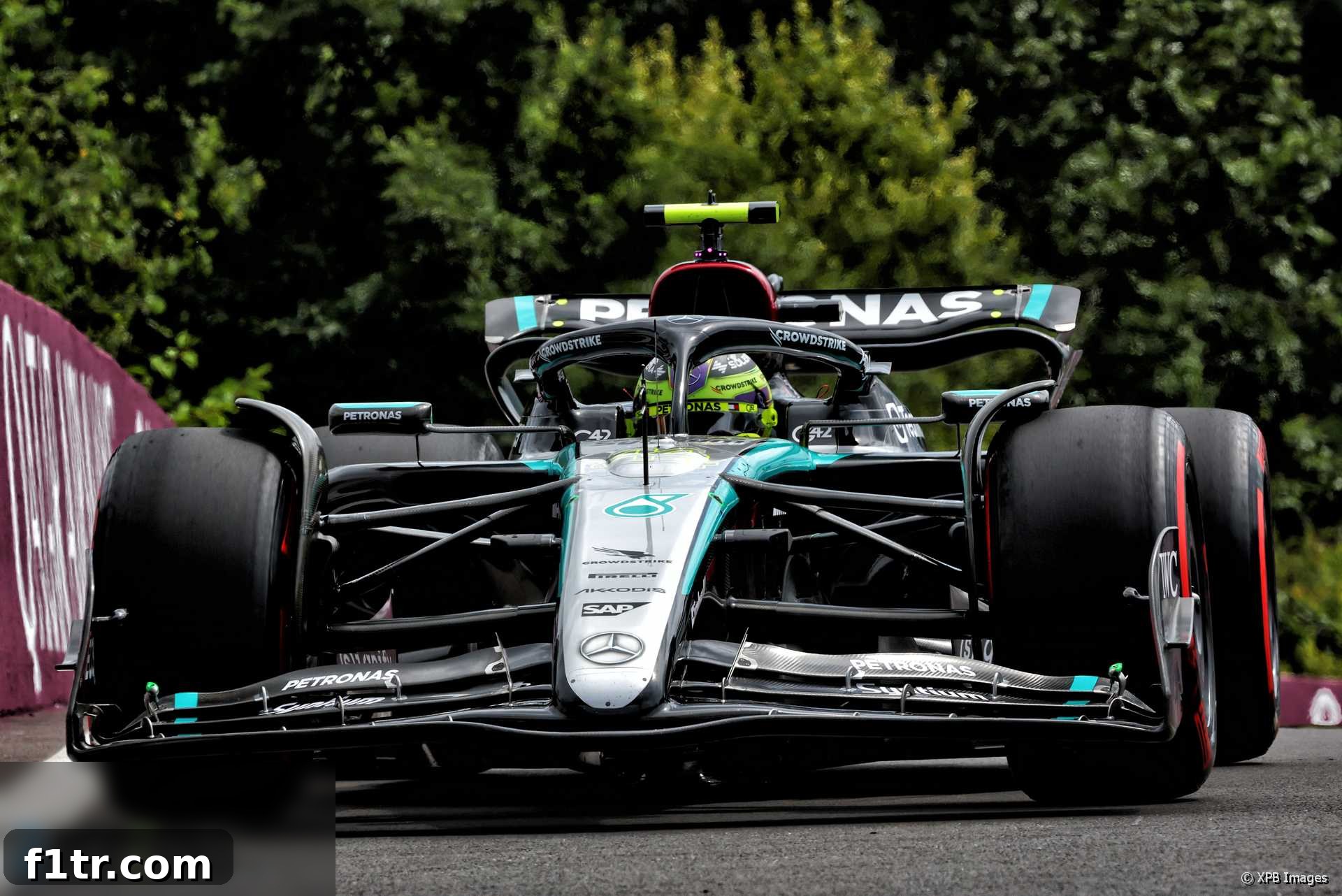
In a compelling demonstration of resilience and engineering acumen, seven-time Formula 1 world champion Lewis Hamilton has significantly elevated his performance in recent races. This resurgence comes as the Mercedes-AMG Petronas F1 Team, spearheaded by their trackside engineering director Andrew Shovlin, has deepened its understanding of the intricate W15 challenger and how to optimally configure it for peak performance. The journey from early-season struggles to podium contention highlights the relentless pursuit of perfection inherent in elite motorsport.
Advert | Become a Supporter & go ad-free
The initial phase of the season presented a stark contrast to Hamilton’s current form. Over the first nine Grand Prix events, he managed to out-qualify his highly-rated teammate, George Russell, on only one occasion. This period was marked by challenges in extracting consistent pace and understanding the nuances of the new Mercedes car. However, the tide has unmistakably turned in the subsequent four races. Hamilton has not only surpassed Russell in qualifying twice but has also finished ahead of him on three occasions, culminating in a momentous victory – his first in two and a half years. This triumph wasn’t merely a personal milestone; it signaled a profound shift in the team’s trajectory and a tangible reward for their collective efforts.
Shovlin elaborated on the difficulties Hamilton faced early in the season, noting that the car proved “more difficult to deal with.” This wasn’t just a matter of pace; it was about the car’s unpredictable nature and its narrow operating window. “One of the key areas we’ve managed to improve with the car is our ability to establish a solid setup in Free Practice 1 that serves as a robust foundation,” Shovlin explained. “This allows us to efficiently build upon that performance throughout the weekend, fine-tuning rather than fundamentally rebuilding the car. That foundational consistency is incredibly beneficial for a race weekend.”
The early part of the year was characterized by a frustrating sensitivity where even minor setup adjustments could drastically alter the car’s balance, leaving both drivers struggling. “In the early part of the year, we were making relatively small changes, and suddenly the entire car balance would abandon us, leaving us truly struggling,” Shovlin recalled. “So, achieving that consistent P1 foundation has certainly helped. It’s also probably fair to say that in those earlier races, Lewis found the car significantly more challenging to set up and extract performance from compared to George.” This candid admission underscores the complexity of the W15 and the steep learning curve required to tame it.
A recurring theme throughout the initial races of 2024 was Mercedes’ car exhibiting strong performance in isolated sessions where track and ambient conditions serendipitously aligned with its narrow operating window. However, as conditions evolved – be it temperature shifts, wind changes, or track evolution – the car’s balance would rapidly deteriorate, leading to inconsistent results. Shovlin confirmed that the team has now gained a far superior understanding of how to adapt the W15 to varying scenarios. This adaptive capability is paramount in Formula 1, where track conditions are rarely static and demands constant engineering responsiveness.
“We always believed this car, on its best day, possessed genuine speed,” Shovlin affirmed. “But translating that raw potential into consistent, competitive performance across an entire Grand Prix weekend was a significant hurdle for us during the early stages of the year. The challenge wasn’t just about unlocking speed but sustaining it consistently.” The underlying potential of the W15 was never in doubt within the team, yet its inherent characteristics made it notoriously difficult to exploit. This period of the season saw Mercedes engineers and strategists working tirelessly, dissecting data and exploring countless setup permutations.
Advert | Become a RaceFans supporter andgo ad-free
“The car is now considerably more usable,” Shovlin proudly stated. “This isn’t attributable to a single, miraculous development or upgrade. Instead, it’s the cumulative result of numerous adjustments, developments, and a deeper understanding that we’ve diligently pursued to overcome those persistent issues. We were genuinely surprised not to be quicker at the very start of the season. Internally, we believed we had designed a good car, and fundamentally, it was. It simply harbored certain problems that we had to systematically address and resolve. Now, we are finally witnessing the positive outcomes of that immense hard work and dedication.” This underscores the iterative nature of F1 development, where breakthroughs often come from a myriad of small, incremental improvements rather than a singular grand design.
The successful turnaround also highlights the critical role of driver cooperation. Shovlin detailed how both Hamilton and Russell collaborated effectively to unravel the W15’s complexities. “There’s a very specific driving style that optimally suits these modern-era tyres,” Shovlin explained, referencing the nuanced demands of Pirelli’s compounds. “You tend to observe that the two drivers are rarely far apart in terms of their preferred setup once the car enters a good operating window. This means that what works well for one driver often works equally effectively for the other.”
This symbiotic relationship between teammates has been a cornerstone of Mercedes’ recent progress. “Between sessions, they are constantly analyzing each other’s data, scrutinizing driving lines, braking points, and setup nuances to identify where the marginal gains can be found,” Shovlin added. “Throughout the year, both Lewis and George have been working in unison. In the early stages, neither of them was content with our finishing positions, which fueled their collaborative spirit. They were instrumental in helping each other by trying diverse experimental setups and adapting their driving styles. This collaborative approach is how a modern, high-performing Formula 1 team, with its two exceptional drivers, truly progresses and maximizes its potential.” Their shared objective to propel Mercedes forward superseded any individual rivalries, becoming a powerful force for development.
Hamilton himself acknowledged the immense effort required to bring the W15 to a winning state, describing the process as one of “great difficulty.” He emphasized the continuous cycle of exploration and experimentation: “You just have to keep exploring, keep trying new avenues. We have literally tried so many different setups, pushing the boundaries of what we thought was possible with this car.” This relentless dedication from a driver of Hamilton’s stature is a testament to his enduring passion and commitment to the team.
“Ultimately, you have to grasp that the situation doesn’t always have to remain challenging. However, it requires working hand-in-hand with people who possess the expertise to make a genuine difference,” Hamilton stated, emphasizing the human element in overcoming engineering hurdles. “This involves meticulous communication with the dedicated individuals back in my team – being as detailed as humanly possible in the debriefs about what the precise issues are, ensuring absolutely nothing gets lost or misinterpreted in translation. Clarity and precision in feedback are paramount.”
Advert | Become a RaceFans supporter andgo ad-free
Hamilton further detailed the comprehensive, integrated development approach: “For me, this means we go back to the simulator, dedicating countless hours to testing and refining ideas there. We then return to the factory, engaging in in-depth discussions with all the heads of departments, for instance, ensuring every facet of our development is aligned. We head into the wind tunnel, working closely with the engineers who are designing and refining the upgrades, making sure they feel completely supported and aligned with our vision on this journey. It’s about deeply understanding every step they are taking to reach our desired performance level.” This holistic involvement, from virtual testing to physical validation, showcases Hamilton’s deep engagement beyond just driving.
“That’s precisely what we’ve done, and it makes the entire process infinitely more rewarding and joyous,” Hamilton concluded. “Because if you simply arrive at each race weekend with a car you’re merely tasked to drive, you miss a crucial part of the journey. When you are intimately involved in the entire development process behind the scenes, contributing to its evolution, it makes it so much more gratifying when the car finally reaches the performance level you’ve collaboratively strived for.” This personal investment from Hamilton, an integral part of the W15’s evolution, underscores the symbiotic relationship between driver and machine, ultimately leading to Mercedes’ rekindled success on track.
Miss nothing from RaceFans
Get a daily email with all our latest stories – and nothing else. No marketing, no ads. Sign up here:
2024 Belgian Grand Prix
- Lost Spa win last year was ‘the best race I’ve ever done in Formula 1’ – Russell
- Belgian GP was “still a win” for Russell despite disqualification
- High plank wear also a factor in Russell’s disqualification, say Mercedes
- Russell is sixth F1 driver to be disqualified after winning a grand prix
- Unheard radio shows why Hamilton missed Russell’s (almost) race-winning strategy
Browse all 2024 Belgian Grand Prix articles