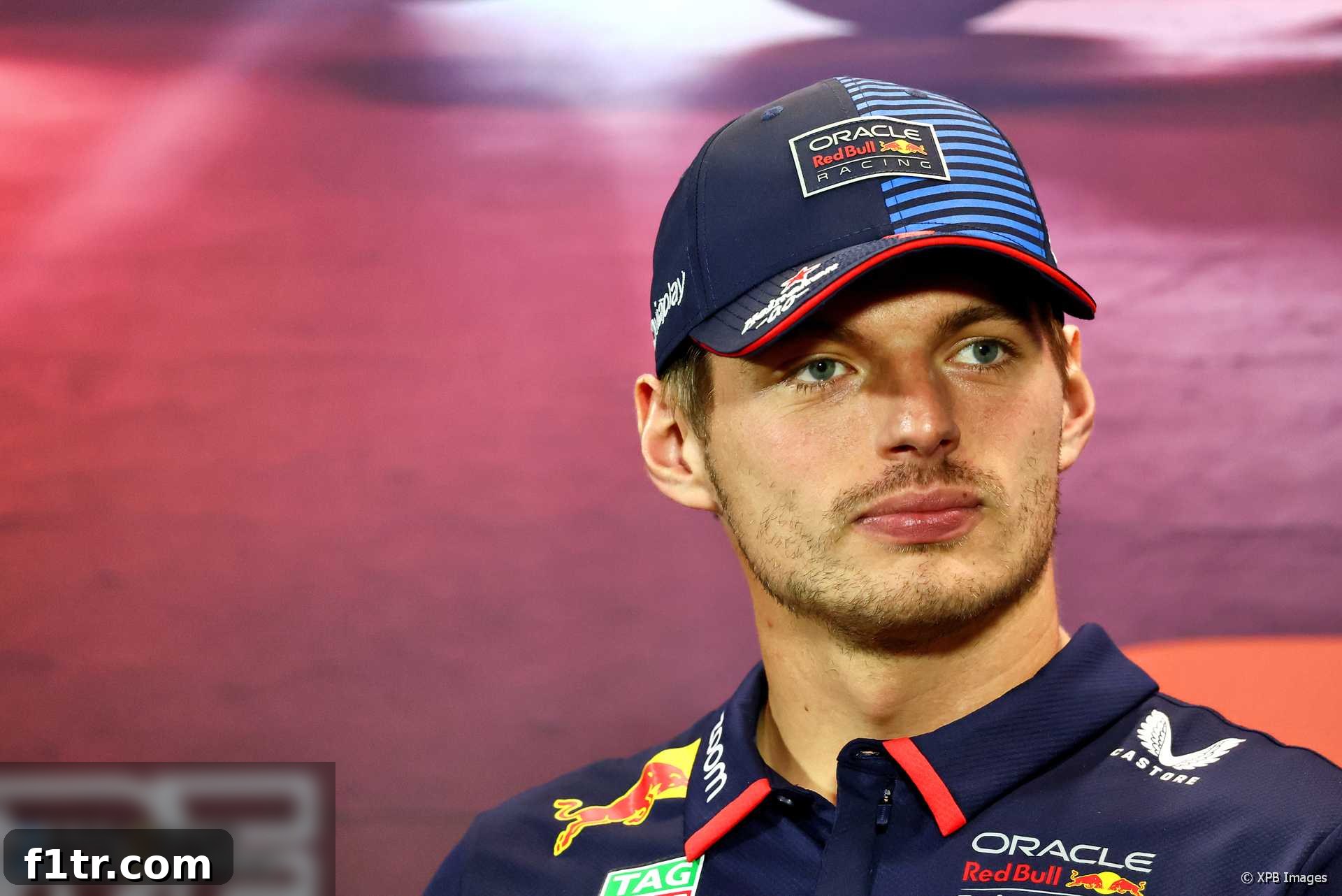
Max Verstappen has issued a strong appeal to Formula 1’s governing bodies, urging them to exercise greater discretion when selecting team radio clips for public broadcast. His call for a more selective approach comes amidst increasing scrutiny over drivers’ use of expletives during races, particularly as the sport strives to maintain a global, family-friendly image.
The debate gained significant traction following recent remarks from FIA President Mohammed Ben Sulayem, who openly expressed his disapproval of the frequent instances of swearing heard during Formula 1 telecasts. This has set the stage for a compelling discussion about authenticity, entertainment, and the sport’s public presentation.
FIA President Calls for Cleaner F1 Broadcasts: Upholding Motorsport’s Image
FIA President Mohammed Ben Sulayem recently articulated his strong reservations regarding the prevalence of swearing on team radio, a feature that has become a staple of F1 broadcasts. His comments underscore a clear desire to elevate Formula 1’s public image, consciously distancing it from other cultural forms where explicit language might be more accepted.
“We have to differentiate between our sport – motorsport – and rap music,” Ben Sulayem told Motorsport.com. “We’re not rappers. They say the ‘f’ word how many times per minute? We are not on that. That’s them and we are [us].” This stark comparison highlights the FIA’s ambition for Formula 1 to embody a certain standard of decorum, befitting its status as a premier global sport with a diverse and extensive viewership.
Ben Sulayem further suggested that the FIA might consider intervening to limit the sheer volume of team radio content made available to the public. He reminded stakeholders that while the FIA had previously endorsed increasing the broadcast of radio communications to enhance fan experience, this increased access inherently comes with regulatory responsibilities.
“We are the ones who actually approved more [radio] talk [on the TV broadcast],” he explained. “But we have rules, and the rules are there for the benefit of the sport and the rules are there to be policed and to be respected also.” This statement signals a potential shift towards tighter controls or a more proactive editorial role by the FIA in curating broadcast content to align with their vision for the sport’s presentation and public perception.
Max Verstappen Advocates for Pragmatism: Adrenaline, Privacy, and Broadcaster Responsibility
In response to Ben Sulayem’s comments, reigning world champion Max Verstappen offered a candid and pragmatic counter-argument. He highlighted the unique intensity of the racing environment, where drivers are constantly mic’d, a situation vastly different from most other sports where athletes’ spontaneous, emotionally charged reactions often go unrecorded.
“I think you will swear anyway,” Verstappen stated during a recent FIA press conference. “If it’s not in this room, maybe somewhere else. Everyone swears. Some people a bit more than others.” He underscored the universality of swearing as a natural human reaction, particularly when experiencing extreme stress, frustration, or exhilaration. This perspective differentiates the controlled setting of a press conference from the raw, high-stakes environment of a race.
Verstappen further elaborated on the distinct nature of Formula 1 drivers compared to athletes in other fields. “It also depends a bit what language you speak. Of course, abuse is something else. I think a lot of things get broadcast nowadays where in other sports you don’t run around with a mic attached to you.” He clearly distinguished between general expletives, which he views as expressions of emotion, and genuinely abusive language, which he acknowledges as unacceptable. However, he stressed that the omnipresent audio monitoring in F1 means that moments of intense frustration, which might pass unnoticed in other sports, are often amplified and broadcast, frequently for entertainment purposes. “A lot of people say a lot of bad things when they are full of adrenaline in other sports, it just doesn’t get picked up. Where here, probably also for entertainment purposes, things get sent out and that’s where people can pick up on it, discuss it on social media and you get all sorts of trouble.”
The world champion firmly believes that the most effective and straightforward solution lies with the broadcasters, specifically Formula One Management (FOM), and their editorial discretion. Rather than attempting to suppress drivers’ natural reactions through bans, he proposes a simpler, more practical measure: selective broadcasting.
“It just starts with not broadcasting it,” Verstappen asserted. “If you don’t broadcast it, no one will know. Only the team, but with that, you deal internally with these kind of things.” This approach would allow drivers to express their genuine emotions in the cockpit, which are an intrinsic part of high-stakes racing, while simultaneously shielding the public from language deemed inappropriate. He acknowledged the evolving sensitivities of modern society. “It’s just probably a bit the world that we live in, within the sport but also in general, it seems like people are a bit more sensitive to stuff. That’s how it goes. I guess the world is changing a bit. But I think it already just starts with not broadcasting it or not giving the option for people to hear it in general.”
The Evolution of F1 Broadcasts and the Demand for Delayed Feeds
Since 2018, Formula 1 has significantly enhanced fan engagement by offering viewers in various countries expanded access, including individual driver onboard camera feeds and their real-time radio messages via the F1 TV streaming service. While these feeds have been subjected to censorship since last year, Verstappen contends that this measure does not go far enough and requires a more sophisticated technical solution.
During the same press conference, Verstappen himself was gently reminded about his choice of words, which underscored the immediate relevance and personal dimension of his arguments. He proposed that if the sport is truly committed to curbing public exposure to expletives, it should implement a broadcast delay, similar to practices in other live media.
“There are a lot of apps where people can listen to radios and stuff. You have to probably limit it or have a bit of a delay that you can censor out a few things,” he suggested. This technical solution would empower broadcasters to filter out undesirable language before it reaches the audience, a standard procedure for many live television programs. He passionately argued against outright bans or penalties on drivers for their natural reactions, framing such measures as unrealistic given the intensely competitive nature of motorsport.
“That will help a lot more than putting bans on drivers because for example, I couldn’t even say the ‘f’-word [during the press conference]. It’s not even that bad, right? I mean ‘the car was not working, the car is ‘effed’,” he illustrated, using a softened expletive to make his point about perceived over-sensitivity. He questioned the practicality and ultimate efficacy of such strict censorship, particularly when considering younger audiences.
“And then, excuse me for the language but come on, what are we? Five-year-olds, six-year-olds? Even if a five-year-old or six-year-old is watching, they will eventually swear anyway even if their parents won’t or they will not allow it. When they grow up they will walk around with their friends and they will be swearing. So this is not changing anything.” Verstappen’s robust defense champions the idea that raw, unscripted emotion is an inherent part of the sport’s authenticity, and attempting to completely sanitize it is both an unrealistic and ultimately futile endeavor.
Yuki Tsunoda’s Experience Reinforces Driver Perspective and Cultural Nuances
RB driver Yuki Tsunoda, who garnered notoriety for his fiery and often expletive-laden radio communications during his early seasons in the sport, recently faced direct disciplinary action for his language. He was fined by Austrian Grand Prix stewards after being heard using an ableist slur over the radio during qualifying. Tsunoda promptly issued apologies to both the stewards and the public, explaining his unawareness of the term’s offensive nature in English, which highlighted the significant cultural and linguistic complexities inherent in a truly global sport like Formula 1.
Despite his personal experience with penalties, Tsunoda largely concurs with Verstappen’s sentiment that the broader concern over drivers expressing frustration with common expletives is often disproportionately emphasized. He draws a clear line between genuinely offensive language and mere expressions of momentary anger or frustration.
“Obviously, there’s certain words that will go above the limit,” Tsunoda conceded, likely referring to his own recent incident. “It happened to me this year.” However, he quickly transitioned to defend the general use of less severe expletives. “If it’s just like ‘f’-words or whatever, it’s just part of the world that you express the feeling. So I don’t see why there’s an issue.” To underscore his point with a touch of humor and realism, Tsunoda added: “I’m sure even FIA people swear sometimes.” This reinforces the idea that such language is a pervasive aspect of human communication, not exclusive to the high-pressure world of motorsport.
The Broader Debate: Balancing Entertainment Value with Brand Image
The crux of this ongoing debate lies at the intricate intersection of Formula 1’s dual identity: a fiercely competitive, elite sport and a captivating global entertainment spectacle. Team radio, in its raw, unfiltered state, offers fans an unparalleled, intimate glimpse into the drivers’ minds – their frustrations, strategic discussions, moments of triumph, and intense emotional responses. This authentic, unscripted drama is a significant draw, contributing immensely to the human element and narrative that captivates millions worldwide. However, this very authenticity often creates friction with the sport’s ambition to present a polished, universally appealing, and family-friendly image suitable for its diverse international audience and substantial corporate sponsors.
Broadcasters and rights holders, such as FOM, navigate a challenging tightrope, attempting to balance the demand for compelling, insight-rich content with the imperative to adhere to global broadcasting standards and societal expectations. The initial decision to make more team radio public was largely driven by a desire to enhance fan engagement, offering a deeper, more personal connection to the heroes in the cockpit. The subsequent move to introduce censorship on these feeds demonstrates a clear acknowledgment of the potential pitfalls and negative perceptions that unedited content can generate.
The unique operational environment of F1, where drivers are confined to a mic’d-up cockpit for extended periods, presents a distinctive challenge not commonly found in many other sports. While a football player might curse on the pitch, without a direct, constantly open microphone, their expletives are rarely captured and broadcast. An F1 driver’s every sigh, grunt, and expletive is potentially a broadcastable moment. This fundamental difference forms the core of Verstappen’s argument: if the primary objective is to sanitize the broadcast, the responsibility and solution should logically reside with the broadcasters and their editorial processes, rather than attempting to fundamentally alter how drivers naturally react under immense, career-defining pressure.
Ultimately, a pragmatic and sustainable solution will likely involve a multifaceted approach. This could include selective editing and implementing a short broadcast delay for mainstream channels to effectively filter out truly offensive or excessively strong language, while perhaps maintaining more raw, unedited feeds for dedicated streaming services, accompanied by appropriate content warnings. Furthermore, ongoing education for drivers, particularly concerning culturally sensitive terminology, is vital, as vividly illustrated by Yuki Tsunoda’s recent predicament. Striking the right balance between preserving the raw, human drama that defines Formula 1 and upholding its global brand appeal will be a critical challenge as the sport continues to evolve.
Related Articles: 2024 Singapore Grand Prix
- Ricciardo’s brake woe and why Perez thought he had an engine problem: Singapore GP radio
- ‘Perez is only quicker when he has DRS’: How Hulkenberg’s Haas beat a Red Bull – again
- Mercedes explain “clear mistake” strategy call which left Hamilton “so angry”
- “Sometimes I wonder why I do this”: How Hamilton endured a slog to sixth in Singapore
- F1’s rules need surgery as well as sticking plaster after fastest lap controversy
Browse all 2024 Singapore Grand Prix articles