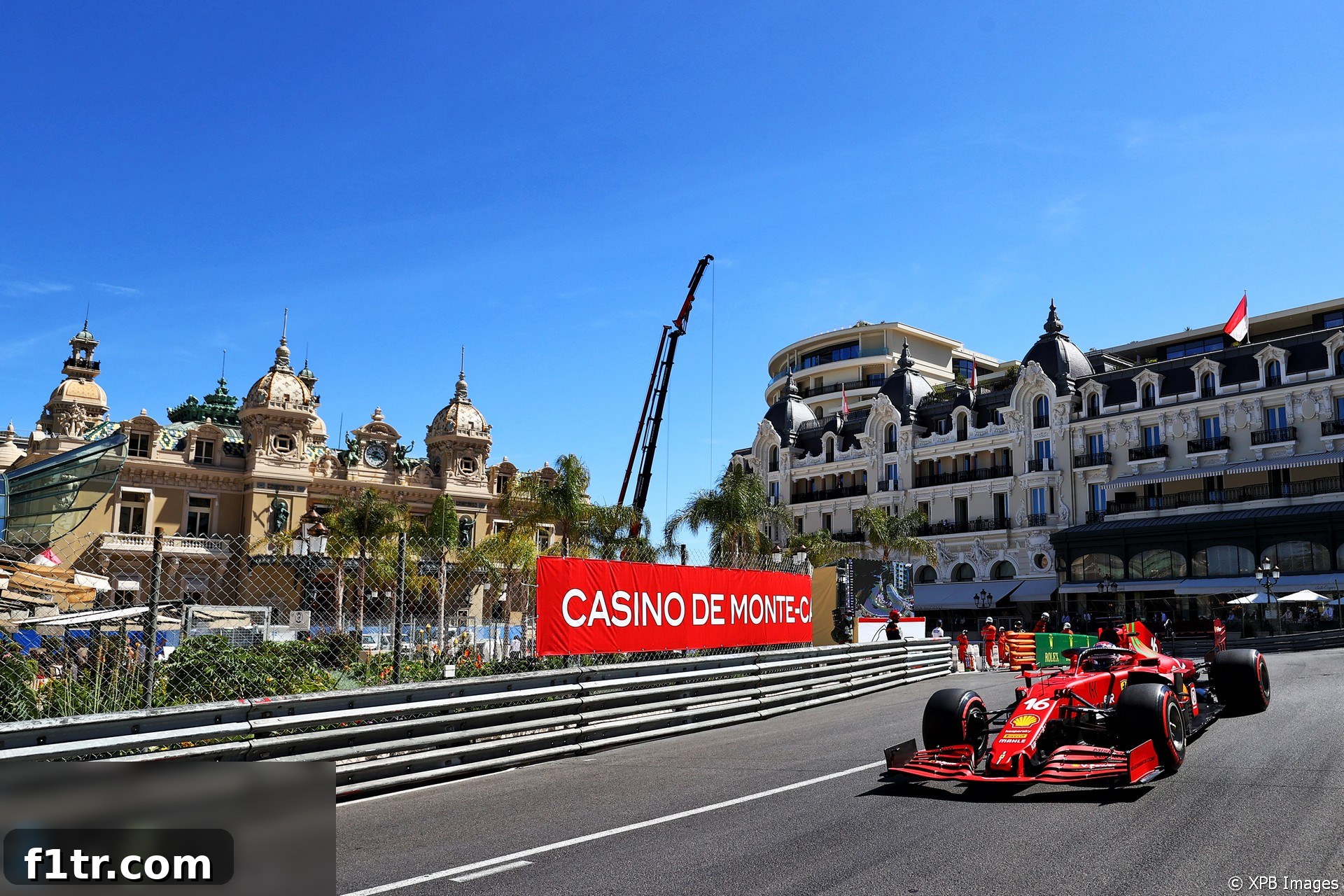
The iconic Monaco Grand Prix, a jewel in the Formula 1 calendar, often defies expectations, and the opening practice sessions for this weekend’s race proved no exception. While many predicted Red Bull would hold a significant advantage on the tight, twisting streets of Monte Carlo, it was Ferrari who emerged as the surprise pace-setters. Their stellar performance on Thursday, with both drivers topping the qualifying simulation runs during second practice, sent ripples through the paddock, suggesting the Scuderia might have unlocked a unique setup advantage others are yet to discover.
Advert | Become a Supporter & go ad-free
The conditions between the first and second practice sessions saw a notable shift, with the track temperature soaring by 10 degrees Celsius. The asphalt, which peaked at 41.1°C in the morning, reached a scorching 51.1°C in the afternoon. This significant increase in track temperature can have a profound impact on tyre performance and car balance, potentially playing a role in the fluctuating pecking order witnessed throughout the day.
Ferrari’s unexpected burst of speed in Monaco wasn’t entirely unforeseen, particularly when examining their prowess in the final sector of the Circuit de Catalunya during the previous Spanish Grand Prix. That sector, characterized by its slower corners and technical demands, provided a strong indicator of the SF21’s capabilities in low-speed environments. In Thursday’s second practice, Charles Leclerc once again demonstrated this advantage, outperforming both Max Verstappen and Lewis Hamilton in the crucial slow-speed sections of the Monaco track. This stark contrast to their performance in Spain, where Verstappen and Hamilton ultimately pulled ahead in qualifying, suggests Ferrari’s car characteristics are exceptionally well-suited to the unique demands of Monte Carlo.
The impressive showing from the Maranello outfit leads to a couple of compelling theories. One possibility is that Ferrari, despite Max Verstappen’s prior grumbling about Red Bull’s car not being fast enough, simply laid all their cards on the table early, showcasing their full potential, while Mercedes and Red Bull deliberately held back, keeping their true performance in reserve for qualifying. Alternatively, it could be that Ferrari had to make more compromises in their car setup for the quicker, sweeping corners of the Spanish Grand Prix, a design constraint that is entirely negated by Monaco’s distinct lack of high-speed sections. This natural synergy between the SF21’s design philosophy and the circuit’s demands would explain their sudden jump in competitiveness.
The paddock reaction to Ferrari’s pace varied, with some drivers expressing surprise. However, McLaren’s Lando Norris proved to be a shrewd observer, revealing he had anticipated their strength. So confident was Norris that he even messaged his former teammate, Carlos Sainz Jnr, before the weekend, predicting a Ferrari victory. “I think it’s quite obvious that they were going to be very quick here,” Norris stated. “They were very quick in the slow speed corners and that’s basically all we have here.” His assessment underscores the critical importance of low-speed corner performance on a circuit like Monaco, where maximum downforce and mechanical grip are paramount.
AlphaTauri’s Unexpected Surge in Performance
Perhaps even more surprising than Ferrari’s pace was the sudden turn of speed from AlphaTauri. In recent rounds, Pierre Gasly had consistently voiced concerns about his car’s inability to perform effectively in low-speed corners, particularly after struggling at Portimão. Before the Barcelona race, he openly admitted: “We’ve tried many things in terms of set-up to solve the issues. And unfortunately, it didn’t really work. So that’s probably something a bit more fundamental, which takes slightly longer than we would like.”
Whatever fundamental adjustments or insights the AlphaTauri engineers managed to implement, they appear to have paid dividends. Gasly, often a strong contender in single-lap pace, found himself comfortably within the top 10. Even Monaco newcomer Yuki Tsunoda initially demonstrated impressive pace, securing a top-10 spot in first practice before unfortunately ending his second practice session early by damaging his suspension against a wall. Gasly, however, maintained his strong form, finishing in the top 10, notably ahead of Sergio Perez’s Red Bull, a remarkable achievement that signals a potential breakthrough for the Faenza-based team in low-speed corner performance.
Red Bull’s Mixed Bag and Tyre Strategy
Red Bull Racing themselves experienced a rather inconsistent day. The team opted for differing tyre allocation strategies for their two drivers, with Verstappen running the soft compound less frequently than Perez. This difference in approach could partially explain why Sergio Perez initially held an edge over his teammate in first practice. While their times were closely matched in the morning, the afternoon session saw a significant gap emerge, with Perez finishing over half a second adrift of Verstappen. However, it’s worth noting that Perez’s second practice was frequently hampered by traffic, a common frustration on the congested Monaco circuit, which may have skewed his true performance.
McLaren’s Internal Battle: Ricciardo vs. Norris
Another significant disparity in performance was observed within the McLaren camp. Daniel Ricciardo continued to grapple with adapting to the MCL35M, particularly when compared to his in-form teammate, Lando Norris. During the morning session, Ricciardo’s engineer attempted to offer encouragement, suggesting he was only losing time to Norris in the final few corners of the circuit. However, closer analysis revealed this wasn’t entirely accurate; Ricciardo was struggling significantly in the crucial middle sector as well. This struggle intensified in second practice, leading to an extended mid-session debrief with his engineers, as they meticulously tried to identify where Norris was extracting speed that Ricciardo couldn’t match. Norris concluded second practice in an impressive sixth position, while Ricciardo languished in 15th, still noticeably slower in both the second and third sectors. This eight-tenths deficit to Norris will undoubtedly be a heavy burden on Ricciardo’s mind during Friday’s crucial downtime, especially at a circuit where qualifying position is paramount to any hopes of a strong race result.
Alpine and Alfa Romeo: Midfield Musings
Alpine had arrived in Monaco with cautious optimism, following two relatively strong weekends in Algarve and Barcelona, which hinted at improved performance. However, initial practice sessions provided little evidence to suggest they will be challenging at the sharp end of the midfield this weekend. Both Fernando Alonso and Esteban Ocon are returning to the Monaco circuit for the first time since 2018, and Alonso, in particular, seemed to be reacquainting himself with the challenging street circuit, experiencing a few minor brushes with the walls. There remains potential for them to find more pace with cleaner runs in upcoming sessions, but the initial signs are not as promising as they might have hoped.
Conversely, at the back of the grid, Alfa Romeo displayed encouraging form and appears well-placed to capitalize should teams like Alpine or Aston Martin fail to maximize their potential. Kimi Raikkonen secured a respectable tenth place in first practice, while Antonio Giovinazzi went one better with ninth in second practice. These performances are substantially stronger than any of the other teams currently struggling for championship points, positioning Alfa Romeo as a dark horse for a surprise points finish if they can maintain this level of competitiveness through qualifying.
Qualifying: The Ultimate Decider in Monaco
The qualifying strategy for the Monaco Grand Prix is typically a straightforward affair, with grid position being overwhelmingly critical. Starting as high up the grid as possible is absolutely vital, given the notorious difficulty of overtaking on these narrow streets. Therefore, no team or driver will want to compromise their starting position. Expect every driver who reaches the final qualifying segment (Q3) to go all out on the softest available tyre compound, not only to secure the best possible grid slot but also to start the race on the same compound. This maximizes their chances of defending track position and optimizing the early race strategy. The unique nature of Monaco amplifies the importance of a perfect qualifying lap, making Saturday’s session one of the most anticipated of the season.
Quotes: Dieter Rencken
Combined Practice Times: A Snapshot of Performance
The combined times from both practice sessions offer a consolidated view of each driver’s immediate pace and potential heading into the critical qualifying day. These results are often a strong indicator, though not always definitive, of where teams and drivers stand in the pecking order on the challenging streets of Monaco.
| Pos | Driver | Car | FP1 | FP2 | Total laps |
|---|---|---|---|---|---|
| 1 | Charles Leclerc | Ferrari | 1’19.618 | 1’11.684 | 31 |
| 2 | Carlos Sainz Jnr | Ferrari | 1’12.606 | 1’11.796 | 56 |
| 3 | Lewis Hamilton | Mercedes | 1’12.995 | 1’12.074 | 55 |
| 4 | Max Verstappen | Red Bull-Honda | 1’12.648 | 1’12.081 | 59 |
| 5 | Valtteri Bottas | Mercedes | 1’13.131 | 1’12.107 | 60 |
| 6 | Lando Norris | McLaren-Mercedes | 1’13.236 | 1’12.379 | 49 |
| 7 | Sergio Perez | Red Bull-Honda | 1’12.487 | 1’12.708 | 55 |
| 8 | Pierre Gasly | AlphaTauri-Honda | 1’12.929 | 1’12.498 | 58 |
| 9 | Antonio Giovinazzi | Alfa Romeo-Ferrari | 1’14.106 | 1’12.746 | 49 |
| 10 | Sebastian Vettel | Aston Martin-Mercedes | 1’13.732 | 1’12.982 | 52 |
| 11 | Kimi Raikkonen | Alfa Romeo-Ferrari | 1’14.081 | 1’13.065 | 54 |
| 12 | Fernando Alonso | Alpine-Renault | 1’14.205 | 1’13.175 | 56 |
| 13 | Lance Stroll | Aston Martin-Mercedes | 1’14.090 | 1’13.195 | 52 |
| 14 | Esteban Ocon | Alpine-Renault | 1’14.320 | 1’13.199 | 59 |
| 15 | Daniel Ricciardo | McLaren-Mercedes | 1’14.281 | 1’13.257 | 58 |
| 16 | George Russell | Williams-Mercedes | 1’14.840 | 1’13.509 | 60 |
| 17 | Nicholas Latifi | Williams-Mercedes | 1’14.268 | 1’13.593 | 64 |
| 18 | Yuki Tsunoda | AlphaTauri-Honda | 1’13.746 | 1’14.829 | 49 |
| 19 | Nikita Mazepin | Haas-Ferrari | 1’14.616 | 1’14.407 | 52 |
| 20 | Mick Schumacher | Haas-Ferrari | 1’14.801 | 1’14.416 | 54 |
Advert | Become a RaceFans supporter andgo ad-free
2021 Monaco Grand Prix Articles
- ‘I need that point, we’ve lost a ton’: Hamilton team radio transcript analysis
- Perez sees Austrian double-header as valuable chance to master his RB16B
- No fun to be had in Monaco Grand Prix even if you’re winning, says Hamilton
- Mercedes explain Bottas’ Monaco pit stop failure
- F1 will consider adopting “intelligent” IndyCar rule in wake of Leclerc crash
Browse all 2021 Monaco Grand Prix articles