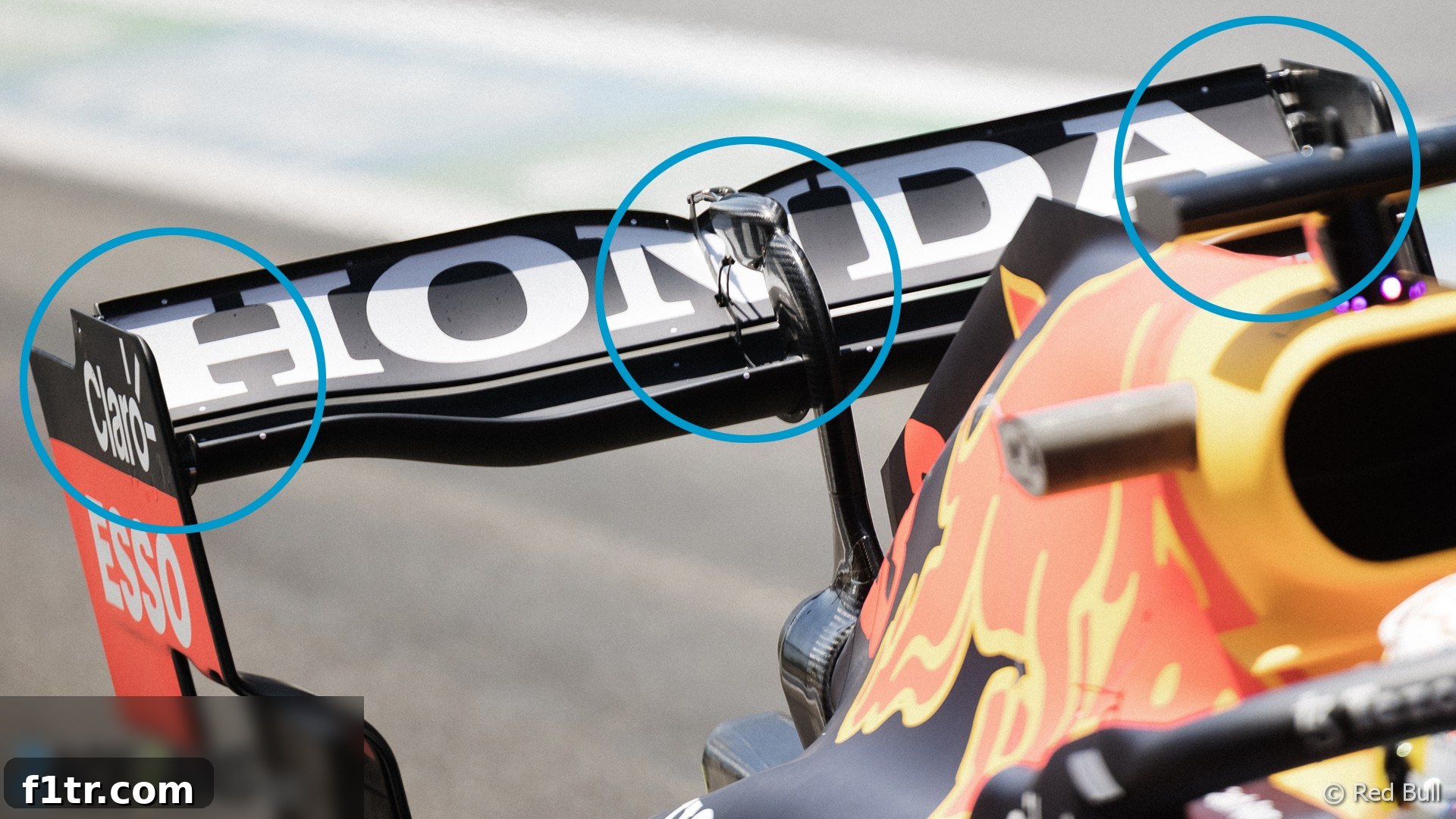
FIA Deploys Advanced Monitoring System to Clamp Down on Flexible F1 Rear Wings
Formula 1’s governing body, the FIA, has escalated its efforts to police the legality of rear wings, introducing a sophisticated new monitoring system at the Baku City Circuit for the Azerbaijan Grand Prix. This comes in response to growing concerns and visual evidence of significant rear wing deflection on several cars during previous races, notably the Spanish Grand Prix weekend. The move underscores the FIA’s commitment to fair play and the stringent enforcement of its technical regulations, particularly those governing aerodynamic performance.
The Rise of the Flexible Wing Controversy in Formula 1
The practice of designing rear wings that exhibit excessive flexibility at high speeds has long been a contentious issue in Formula 1. While all aerodynamic components are designed to deform minimally under load, the key regulatory challenge lies in distinguishing between inherent material flex and deliberate engineering intended to gain an unfair advantage. When a rear wing flexes more than permitted, it can reduce drag on straights, leading to higher top speeds, and potentially offer aerodynamic stability in corners. This “active” aerodynamic effect is strictly prohibited, as all parts influencing aerodynamic performance must remain static relative to the car’s sprung mass. The visually apparent flexing observed during the Spanish Grand Prix reignited the debate, putting several teams under the microscope and prompting the FIA to take swift action.
FIA’s Innovative Solution: Dot-Shaped Stickers and Onboard Footage
To address this complex issue, the FIA has implemented an ingenious new monitoring system. Teams were informed of this development through a revised technical directive issued last week. This system involves placing small, dot-shaped stickers, measuring 10mm across, on the main plane and flap of the rear wings. Six of these stickers are applied to each crucial surface. The brilliance of this method lies in its simplicity and effectiveness: the FIA is now utilizing high-definition onboard video footage to meticulously observe any movement or distortion of these stickers as cars navigate the high-speed sections of the Baku circuit. By tracking the displacement of these dots, officials can accurately judge the degree of rear wing deflection at speed, providing concrete evidence of non-compliance.
McLaren’s Stance: A Call for Immediate and Decisive Action
The introduction of the new monitoring system has been met with approval from various team principals, particularly McLaren’s Andreas Seidl. Speaking to media outlets, including RaceFans, in Baku, Seidl reiterated his team’s unwavering position on the matter, emphasizing the necessity for firm action against any team found to be exploiting flexible wing designs. “Our position hasn’t changed compared to what I communicated during the Monaco race weekend,” Seidl stated, underscoring the consistent call for regulatory integrity. He expressed satisfaction with the FIA’s proactive approach: “It was good to see that there was an update on the directive to the teams last week, that these stickers have been introduced already for this weekend, which gives the FIA a better opportunity or possibility to measure what’s actually going on.”
Seidl further articulated McLaren’s expectation for immediate intervention: “From our point of view, if we see deflections again, like we’ve seen in Barcelona, there needs to be action here this weekend.” This highlights a key point of contention for some teams: the timing of enforcement. The FIA had initially announced that new, more rigorous static tests on rear wings would only be introduced following the Azerbaijan Grand Prix. This raised concerns that teams with potentially non-compliant designs might continue to benefit from their flexible wings during the Baku event. However, Nikolas Tombazis, the FIA’s head of single-seaters, has since provided crucial clarification, indicating that evidence gathered from the new sticker system could indeed form the basis for immediate action against any team found to be in breach of the rules this very weekend.
Navigating the Technical Regulations: Article 3.8 and the ‘Grey Area’ Debate
At the heart of the flexible wing controversy lies Article 3.8 of Formula 1’s technical regulations. This critical clause stipulates that, with certain specified exceptions, “any specific part of the car influencing its aerodynamic performance must remain immobile in relation to the sprung part of the car.” This principle aims to prevent teams from designing components that actively change shape to gain an advantage. Andreas Seidl firmly rejects the notion that there is a “grey area” between Article 3.8 and Article 3.9, which defines the load tests applied to wings. “I don’t think it’s grey, from our point of view,” Seidl asserted. He elaborated on McLaren’s perspective, highlighting the intent behind certain designs. “You simply need to go into the detail of the design of these parts. If you detect – again that’s not our job, it’s FIA’s job to do – if you then detect that there is certain designs around which are made on purpose to flex in a certain way, I think it’s pretty clear what’s happening.”
Seidl’s comments underscore the distinction between accidental material flex and deliberate engineering to circumvent regulations. He believes that Article 3.8 provides sufficient clarity: “[Article] 3.8 pretty much defines clearly what is allowed and what is not allowed. And then if someone designs a rear wing or endplate with the clear intention to flex in a certain way, even in a way that doesn’t get detected by the test in 3.9, I think it’s pretty clear what that means. That’s our point of view. And again, we’re happy with all the actions FIA has put in place with the technical directive as well, even with the update of the technical directive.” The McLaren team principal’s sentiments reflect a broader call within the paddock for robust enforcement, ensuring that the spirit of the rules is upheld alongside their letter.
The Implications for Teams and the Future of F1 Aero Development
The FIA’s intensified scrutiny and the introduction of the dot-sticker system carry significant implications for teams. Engineers constantly push the boundaries of design within the technical regulations, seeking marginal gains that can translate into crucial tenths of a second on track. However, the current situation serves as a stark reminder that deliberate exploitation of loopholes will be met with decisive action. The ability for Nikolas Tombazis to potentially penalize teams based on evidence from the new stickers during the Azerbaijan Grand Prix weekend itself means that teams cannot simply wait for the future static tests. They must ensure their current designs are fully compliant. This puts immense pressure on teams that might have been sailing close to the wind, forcing them to re-evaluate their rear wing specifications for the remainder of the weekend and beyond.
While Seidl emphasized the urgency for action, he also acknowledged the practicalities of a Grand Prix weekend. He noted that it was too early to consider lodging a formal protest, as teams often don’t run their final race-specification rear wings until later in the weekend, typically Saturday. “In general it doesn’t make sense to do anything before the event because you can change rear wing on Saturday morning. There’s no point to do anything on a Friday night.” This cautious approach highlights the strategic considerations involved, as teams wait to see what designs their rivals ultimately deploy for qualifying and the race.
Beyond Baku: A Stronger Stance on Aerodynamic Integrity
The flexible wing saga at the Azerbaijan Grand Prix marks a pivotal moment in Formula 1’s ongoing battle against technical non-compliance. The FIA’s swift and innovative response with the dot-sticker system, coupled with the clear statements from officials like Nikolas Tombazis and influential team principals like Andreas Seidl, signals a stronger, more proactive stance on aerodynamic integrity. This focus is not just about penalizing past infractions but also about shaping future design philosophies. Teams will undoubtedly adopt a more conservative approach to rear wing design, ensuring that their components remain rigidly compliant under all operating conditions. This development is crucial for maintaining the competitive balance and the integrity of the sport, ensuring that success is earned through genuine engineering prowess and adherence to the established rules, rather than the exploitation of grey areas or subtle flexing.
2021 Azerbaijan Grand Prix Insights
Explore more articles related to the 2021 Azerbaijan Grand Prix:
- Aston Martin also confirms it followed Pirelli’s tyre restrictions before crash
- Pirelli confirm teams not to blame for Baku tyre failures following investigation
- “Tyres should not explode like that” says Villeneuve as Pirelli prepares to reveal findings
- Why Alonso is able to enjoy F1 more now than when he left
- Penalty for Safety Car error was just one of Latifi’s frustrations in Baku
Browse all 2021 Azerbaijan Grand Prix articles