In the high-stakes world of Formula 1, where every millisecond and every aerodynamic tweak can define a season, McLaren has quietly but decisively emerged as one of the standout revelations. After years of navigating challenging waters and struggling to find their competitive edge, the Woking-based team has orchestrated a remarkable turnaround. Despite the inherent power deficit of their customer Renault engine, the MCL34 chassis has demonstrated exceptional harmony with the 2019-specification Pirelli tires, propelling the team steadily up the grid from its previously accustomed positions at the back.
The transformation seen in the MCL34 is a testament to McLaren’s rigorous off-season development. Whatever fundamental changes were implemented in the chassis and aerodynamic departments over the winter have clearly paid dividends, even if some of the initial aero features raised eyebrows for their unconventional design. The Spanish Grand Prix marked a pivotal moment, as McLaren rolled out an extensive update package that replaced some of these unique aerodynamic solutions with more conventional, yet highly effective, designs. This major overhaul, particularly for the MCL34, introduced a long list of visible modifications, with even more subtle changes likely hidden beneath the surface, all aimed at unlocking greater performance potential.
A Radical Shift in Front Wing Philosophy
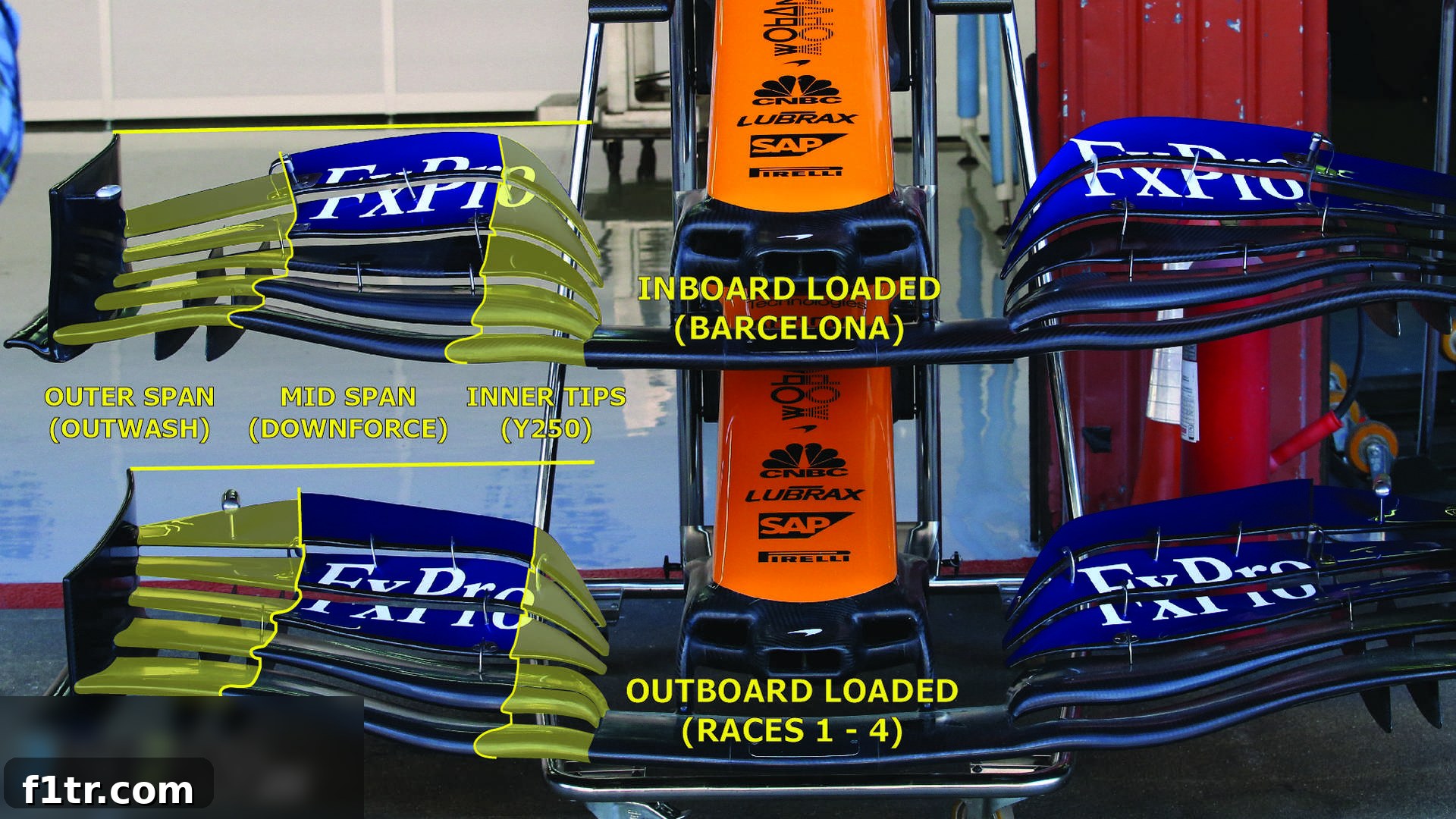
One of the most striking and strategically significant changes introduced by McLaren in Barcelona was a complete overhaul of its front wing philosophy. In a bold move, McLaren became the first team of the 2019 season to fundamentally switch from one of the two dominant front wing concepts to the other. They transitioned from an outboard-loaded wing design to an inboard-loaded configuration. This profound change is not merely a cosmetic alteration; it represents a fundamental re-thinking of how airflow is managed at the very front of the car, inevitably prompting a cascade of further aerodynamic updates downstream.
To fully grasp the magnitude of this shift, it’s essential to understand the two prevailing front wing philosophies in Formula 1’s 2019 regulatory landscape. Following the new rules for 2019, which simplified front wings to reduce the aerodynamic sensitivity of cars following one another, F1 front wings are tasked with three critical functions: generating crucial downforce, producing controlled ‘outwash’ to push turbulent air away from the car’s body, and effectively managing the powerful Y250 vortex. All these actions are designed to meticulously manage the airflow downstream, optimizing its quality to allow other aerodynamic surfaces on the car, such as the bargeboards, floor, and diffuser, to generate maximum downforce.
The **outboard-loaded front wing**, a design favored by powerhouse teams like Mercedes and Red Bull, is often considered the more conventional approach. This design features a steeper wing profile towards the outer span, close to the endplate, and a somewhat shallower angle towards the middle section. The primary advantage here is that a significant portion of the downforce is generated near the endplate. This localized downforce creation near the outer edge helps induce outwash, guiding turbulent air generated by the front tires away from the critical areas of the car. Furthermore, the flatter inner wing span requires less energy from the incoming airflow, ensuring a cleaner, more energetic airflow feeds the bargeboards. This, in turn, allows the bargeboards to operate more efficiently, generating additional outwash and downforce. However, a drawback of this design is that the steeper outer section can be less effective at creating ideal outwash, often doing so with a flow structure that sits higher off the ground, potentially impacting the efficiency of other components.
Conversely, the **inboard-loaded front wing**, adopted by teams like Ferrari, Toro Rosso, and Alfa Romeo, is essentially the inverse. Here, the wing elements are steeper near their inner tips and progressively flatter towards the endplate. The main advantage of this philosophy lies in its ability to ‘open up’ the endplate area, facilitating a greater outwash effect. By manipulating the airflow more aggressively inboard, the endplate can be designed to maximize its role in pushing turbulent air away from the car. However, the steeper inboard sections can divert or disrupt airflow that would otherwise feed the bargeboards, potentially making them less effective in their primary role. A common misconception, often debunked by engineers, is that an inboard-loaded design inherently cannot generate the same overall level of downforce as its outboard-loaded counterpart. McLaren’s decision to embrace this concept underscores their confidence in overcoming any such perceived limitations through holistic car design.
McLaren’s new inboard-loaded front wing, as debuted in Barcelona, is a truly bespoke design. Few, if any, of the leading edge profiles match between the new and old specifications. Even the endplate, as illustrated above, features subtle yet aerodynamically significant differences, such as a small cut-out at its rear corner, indicating meticulous attention to detail in airflow management.
Bargeboard Revolution: Redefining Mid-Car Aerodynamics
Complementing the radical front wing change, McLaren also introduced a completely revised philosophy for its bargeboards, a critical area in the middle of the car for optimizing airflow. Since its launch and even through the Bahrain update, the MCL34’s bargeboard package was characterized by a distinctive rectangular ‘boomerang’ setup that led a series of vanes behind it. This unique configuration was a hallmark of McLaren’s initial aerodynamic philosophy.
The Barcelona update saw the original boomerang and sidepod vanes completely redesigned. The angled boomerang is gone, replaced by a new unit (1 in analysis) that connects to the sidepod vanes in a more conventional manner. Furthermore, the sidepod vanes themselves have been overhauled. Previously, the car featured a single “L” shaped sidepod vane; now, there are four distinct vanes (2 in analysis). Notably, one of these new vanes (3 in analysis) seamlessly forms the vertical end of the redesigned boomerang, showcasing an integrated approach to airflow management.
These sophisticated bargeboard changes serve multiple crucial aerodynamic purposes. The boomerang element continues to work tirelessly to produce a downwash effect, expertly guiding airflow towards the sidepod’s aggressive undercut. This helps to seal the floor and prevent turbulent air from entering the underbody, where clean airflow is paramount for downforce generation. Simultaneously, the newly configured pod vanes have become significantly more powerful and efficient. Their primary functions include straightening the airflow as it expands outwards in front of the sidepods, effectively mitigating the disruptive tyre wake from the front wheels. By doing so, they ensure that a stronger, cleaner inner airflow is directed towards the diffuser at the rear of the car, enhancing its performance. Moreover, as the airflow passes through these meticulously curved vanes, their lower edges are shaped to create additional downforce, functioning much like miniature wings. The extensive nature of these major bargeboard modifications also necessitated several intricate detail modifications to adjacent surfaces, ensuring seamless integration and optimal aerodynamic performance across the entire mid-car section.
Engine Cover and Rear Wing Enhancements
Another distinctive feature of the McLaren in the early races of the season was the ‘baby shark fin’ on the engine cover. This unique element, which also bore the driver’s number, was designed to help direct airflow under the rear wing, particularly when the car was cornering. In Barcelona, McLaren opted for a more extensive solution, extending the entire spine of the engine cover to the maximum permissible area under the regulations. This change has clear aerodynamic benefits, improving the quality of airflow to the rear wing and potentially enhancing stability. While the smaller fin would become a legal requirement from 2020 onwards, and one might have expected McLaren to retain it to gather more data, the team’s decision to pursue the larger, aerodynamically superior solution highlights their immediate performance focus.
Regarding the rear wing, McLaren had previously employed a stepped profile, a design choice often made to improve aerodynamic efficiency, especially given the power characteristics of the Renault engine. However, the Barcelona specification saw the introduction of a full-depth rear wing, featuring effectively straight profiles across its entire span. This design typically translates to higher downforce and, consequently, higher drag, implying a potential penalty in top speed. Given Barcelona’s notoriously long main straight, this might appear counterintuitive. However, this strategic choice strongly suggests that the major upstream changes – particularly the front wing and bargeboard overhauls – have significantly improved overall aerodynamic efficiency. By managing front tire turbulence far more effectively and delivering cleaner airflow towards the rear of the car and the diffuser, McLaren has likely unlocked the ability to run a higher downforce rear wing without incurring an unacceptable drag penalty. Further aiding the rear wing’s performance are several intricately designed strakes on the outer face of its endplate, which work to optimize local airflow and enhance downforce.
Adding another layer of intrigue to McLaren’s performance potential, Daniel Ricciardo revealed that Renault had prepared a reliability upgrade for their power unit for this very weekend. While it was not immediately confirmed whether McLaren chose to run this specific upgrade, any improvement in engine reliability or performance would only amplify the impact of their comprehensive aerodynamic package.
Strategic Risk and Reward: A Bold Step Forward
The sheer scale and philosophical nature of McLaren’s Barcelona update sets them apart as one of the few teams this season not just to bring a major upgrade, but to fundamentally switch its aerodynamic design philosophy. Even Mercedes’ significant update during the second week of pre-season testing, while impactful, did not represent as drastic a change in aerodynamic direction as McLaren’s move. This bold strategy, however, is not without its risks. Such a profound change to the car’s fundamental aerodynamic principles carries the inherent danger that the new package might not perform as simulated in real-world conditions.
Yet, McLaren’s decision to undertake such a significant transformation speaks volumes about their confidence in their development processes. They must have been thoroughly convinced that the correlation between their pre-season predictions and the on-track reality of their early-season package was accurate. If this correlation holds true, then there is every reason to believe that this extensive Barcelona update will perform exactly as expected, delivering the gains observed in their simulations and wind tunnel data.
Indeed, for McLaren to embark on such a drastic and resource-intensive step, the expected gains in performance must have been substantial. In the fiercely competitive midfield battle, where rivals are often taking more incremental steps, McLaren’s audacious move could prove to be a game-changer. This comprehensive update has the potential to cement their position, not just as a strong midfield contender, but as a genuine threat to the teams consistently challenging for the top spots, marking a new chapter in their resurgence.
Experience RaceFans Ad-Free: Become a SupporterFor just £1 per month, you can enjoy all our in-depth F1 analysis and news without interruptions. Discover more and join our community of supporters today.
Explore More F1 Technology Insights
- McLaren, Red Bull and Ferrari bring rear corner updates to Imola
- Ferrari, McLaren and Red Bull bring upgrades again for Saudi Arabian Grand Prix
- McLaren introduce major floor upgrade for Norris’ car at Mexican Grand Prix
- McLaren, Mercedes and Red Bull detail upgrade packages for United States GP
- Red Bull remove engine cover ‘cannons’ in major RB20 update – but they may return
Browse all F1 technology articles