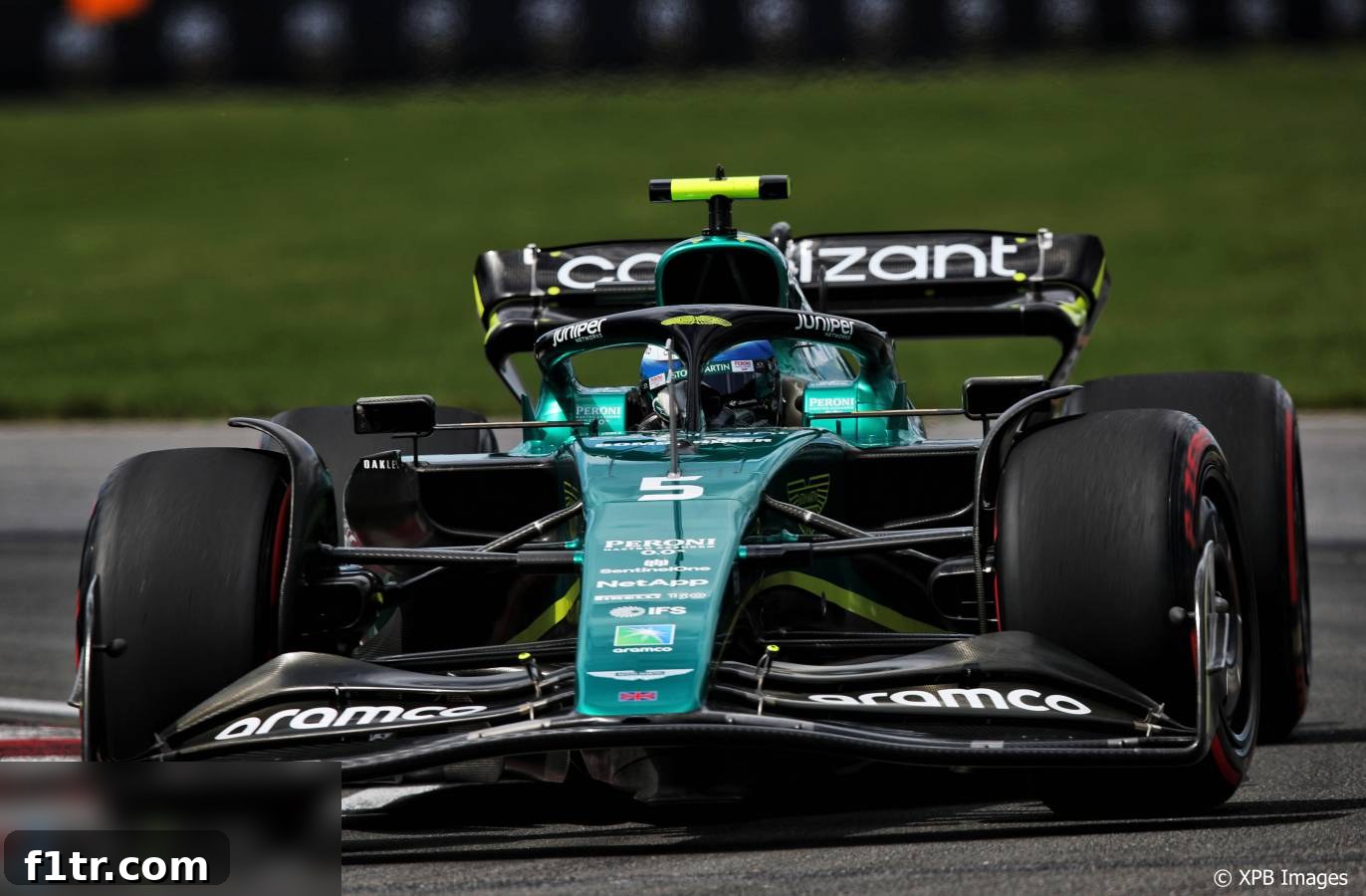
The highly anticipated Canadian Grand Prix weekend at the iconic Circuit Gilles Villeneuve kicked off with drama and controversy during Friday’s second practice session. Three prominent drivers – Aston Martin’s Sebastian Vettel, AlphaTauri’s Pierre Gasly, and home hero Lance Stroll from Aston Martin – each found themselves in hot water with the FIA stewards, receiving reprimands for identical infringements. Their misstep involved failing to correctly navigate the demanding final chicane, a critical section of the Montreal track, before rejoining the main straight.
Advert | Become a Supporter & go ad-free
The incident unfolded as drivers pushed the limits during FP2, running off the circuit at the final chicane before the pit straight. This specific manoeuvre immediately drew the attention of race control, leading to investigations into all three drivers. The FIA’s Event Notes, issued by F1 Race Director Eduardo Freitas for the Canadian Grand Prix weekend, explicitly detail the procedure for drivers who overshoot or miss this particular chicane. According to these notes, any driver failing to make the corner “must keep completely to the left of the… orange block/bollard on the exit of the corner and re-join the track at the far end of the asphalt run-off area.” This precise directive is not new; it mirrors the rule enforced by former Race Director Michael Masi during the last Grand Prix held at the Circuit Gilles Villeneuve in 2019, highlighting its consistent application over time.
Following a thorough review of telemetry data, on-board footage, and discussions with the drivers, the stewards concluded that Vettel, Gasly, and Stroll had all failed to adhere to the stipulated procedure. Each driver had bypassed the designated orange bollard by passing it to the right, thereby not keeping completely to its left as required. This seemingly minor deviation from the rule is crucial for maintaining fair play and preventing drivers from gaining an unfair advantage by cutting the corner. In contrast, other drivers, notably Carlos Sainz Jnr of Ferrari and Haas’s Mick Schumacher, were observed correctly following the prescribed procedure after making similar errors under braking for the chicane, demonstrating that the rule was both clear and manageable for those who paid close attention.
During his hearing with the stewards, Sebastian Vettel raised a point about the absence of the orange bollard during the first practice session held earlier in the day. While this might have presented an initial point of confusion, the stewards swiftly dismissed the argument. They emphasized that the race director’s event notes for the weekend were “clear” on the matter, leaving no room for ambiguity regarding the required rejoining procedure. Consequently, failing to follow such a direct instruction, regardless of the bollard’s prior installation status, was deemed worthy of a reprimand. This underscores the importance for all competitors to be fully aware of and adhere to the regulations outlined in the event notes, which serve as the primary guide for track procedures throughout a Grand Prix weekend.
A reprimand in Formula 1, while not a direct grid penalty, carries significant weight due to its cumulative effect over a season. Under FIA regulations, a driver who accumulates five reprimands in a single season will receive a ten-place grid penalty for their next Grand Prix start. This penalty is particularly severe if four out of the five reprimands are for driving-related offenses, as was the case with the chicane infringement. This system is designed to encourage consistent adherence to driving standards and track regulations, ensuring safety and fairness across the grid. It acts as a progressive warning system, escalating in severity with each subsequent offense.
For Sebastian Vettel and Pierre Gasly, these were their first reprimands of the current season, marking a fresh start on their respective tallies. However, for Lance Stroll, this reprimand was his second of the year, placing him closer to the five-reprimand threshold. Stroll’s first reprimand came earlier in the season during the Bahrain Grand Prix, where he was penalized for an impeding incident with Yuki Tsunoda during a practice session. This pattern suggests a need for increased vigilance from the Canadian driver to avoid further sanctions that could potentially impact his starting position in future races. The cumulative nature of reprimands means that each incident, no matter how minor it seems individually, contributes to a larger risk.
The final chicane’s importance extends beyond practice sessions, as it is expected to be a critical focal point for drivers and teams during Sunday’s main race. Race Director Eduardo Freitas has proactively communicated to all teams that any driver who misses the chicane on three separate occasions during the Grand Prix will be shown a black-and-white ‘unsportsmanlike conduct’ flag. This flag serves as a formal warning from the stewards, indicating that the driver’s actions are bordering on unsportsmanlike behavior or could be perceived as deliberately attempting to gain an advantage. While not an immediate penalty like a five-second time penalty, receiving a black-and-white flag puts a driver on notice, and any subsequent similar infringement could lead to a more severe sanction, such as a time penalty or even disqualification, demonstrating the FIA’s firm stance on maintaining track integrity and driver conduct.
This isn’t the first time Sebastian Vettel has faced scrutiny regarding track limits and corner cutting in Montreal. In a high-profile and controversial incident during the 2019 Canadian Grand Prix, Vettel, while leading the race, missed the Turn 3/4 chicane (a different chicane from the one in question during FP2). He subsequently rejoined the track ahead of Lewis Hamilton, who was forced to lift off the throttle to avoid a collision. The stewards investigated the incident and ultimately handed Vettel a five-second time penalty, which was added to his race time. Despite crossing the finish line first, this penalty demoted him to second place, elevating Hamilton to victory in a decision that sparked considerable debate and fan discussion. While the current FP2 reprimands are far less severe, the historical context serves as a reminder of the circuit’s challenges and the FIA’s consistent application of rules designed to prevent unfair advantages from track excursions.
It is important to note that the reprimands issued to Sebastian Vettel, Pierre Gasly, and Lance Stroll for their infringements in second practice have no bearing on their superlicence penalty points. Superlicence points are a separate system used by the FIA to track more severe driving infractions that could lead to a driver being suspended from a race if they accumulate too many points within a 12-month period. Reprimands, while a formal warning and part of the disciplinary record, fall into a different category, primarily impacting the cumulative reprimand count for the season rather than directly affecting a driver’s superlicence status. This distinction ensures that minor practice infringements are dealt with appropriately without unduly jeopardizing a driver’s ability to compete.
Advert | Become a RaceFans supporter andgo ad-free
2022 Canadian Grand Prix
- Alfa Romeo see “great future in F1” for Zhou after best result so far
- Ocon has “big hopes” for Alpine’s Silverstone upgrade package
- Hamilton’s Canada podium especially satisfying after run of “bad luck” – Wolff
- Verstappen urges Red Bull to find more pace after close win in Canada
- More confident Sainz is now a contender for wins – Binotto
Browse all 2022 Canadian Grand Prix articles