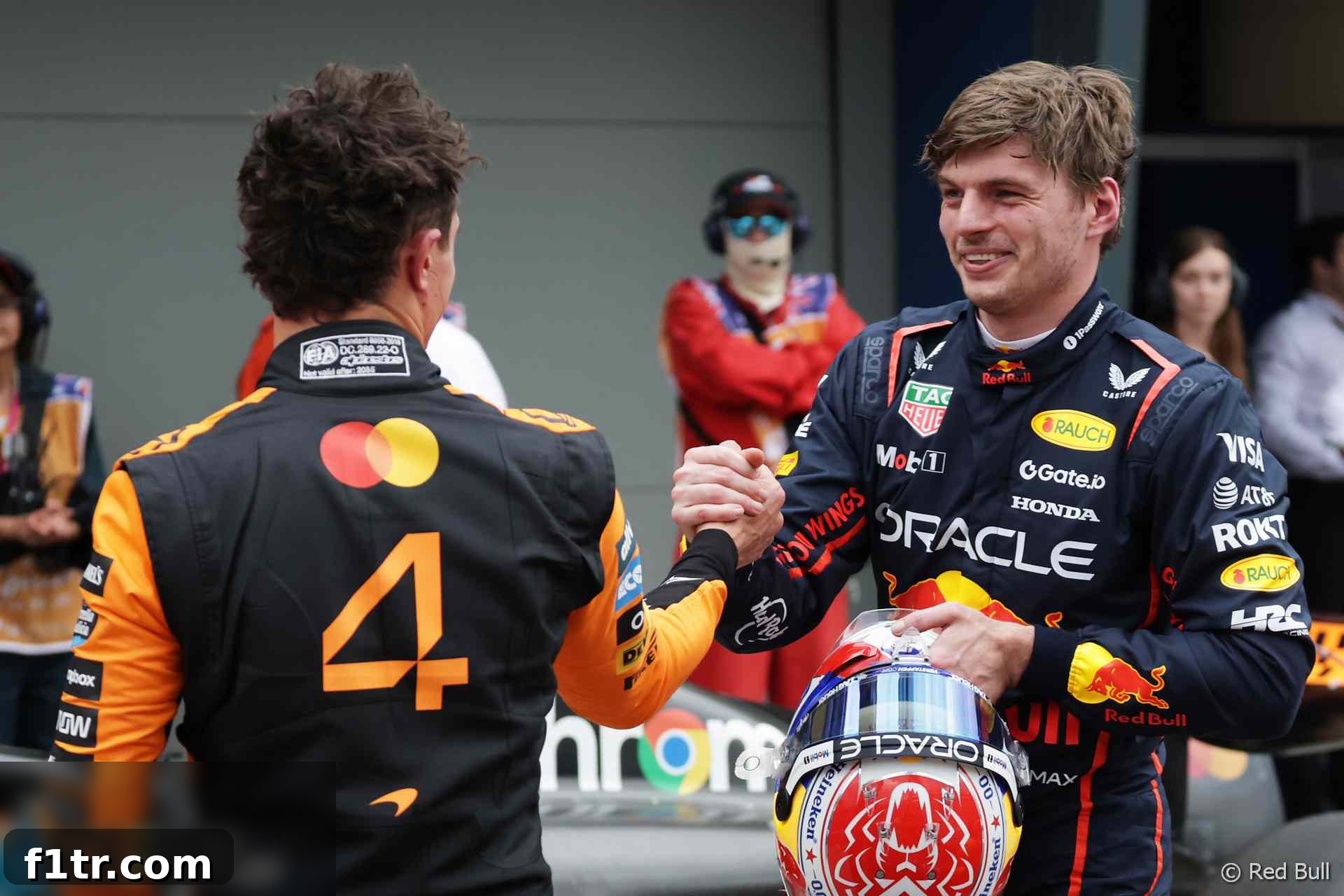
Max Verstappen Secures Resilient Third Place Amidst McLaren’s Surge in Australian GP Qualifying
Melbourne’s iconic Albert Park circuit once again set the stage for a captivating qualifying session at the Australian Grand Prix, culminating in a fiercely contested Q3. Reigning world champion Max Verstappen, driving for Red Bull Racing, ultimately secured a commendable third place on the grid. This result, achieved after overcoming initial weekend struggles and a strong challenge from McLaren, left the Dutchman expressing satisfaction, despite briefly holding provisional pole position.
The weekend had begun with notable challenges for Red Bull. On Friday, Verstappen’s pace trailed his competitors by a significant six-tenths of a second, suggesting that the team needed to make substantial improvements. However, demonstrating their characteristic ability to adapt and refine, the Red Bull engineers and Verstappen himself managed to unlock a crucial second in pace by the final practice session. This remarkable turnaround completely reshaped their competitiveness, setting the stage for a compelling qualifying battle where Verstappen found himself consistently vying with the resurgent McLaren drivers.
The Thrilling Battle for Pole Position in Q3
The decisive Q3 segment of qualifying saw Verstappen make an immediate and powerful statement. His initial flying lap was exceptionally strong, good enough to place him provisionally at the top of the leaderboard. This early advantage fueled speculation of a potential surprise pole position, particularly as both Lando Norris and Oscar Piastri of McLaren, who were proving to be Red Bull’s closest rivals, made minor but costly errors on their respective first attempts.
However, the narrative of Q3 shifted dramatically in its dying moments. McLaren, exhibiting impressive composure and raw speed, delivered two impeccably clean and fast laps on their second runs. Both Norris and Piastri managed to extract every fraction of performance from their MCL38s, ultimately leapfrogging Verstappen. The final gap to pole position was a mere 0.385 seconds, a testament to the intense competition at the very top of Formula 1 and the incredibly fine margins that separate the leading contenders.
Verstappen’s Contentment: Overcoming Albert Park’s Unique Demands
Despite having claimed pole position in the previous two Australian Grands Prix, Max Verstappen articulated a clear and understandable sense of contentment with his third-place starting slot. His post-qualifying comments provided valuable insight into the unique challenges and historical context of the Albert Park circuit for Red Bull’s machinery.
“We had a bit of a tough start,” Verstappen admitted, openly acknowledging the struggles faced earlier in the weekend. “This has never really been a good track for us, so it took a bit of time to understand how we could improve the situation. We did that today.” This statement underscores the Red Bull team’s relentless pursuit of optimization, even on circuits that, historically, have not played to the inherent strengths of their car’s design philosophy. Albert Park, with its street circuit characteristics and specific demands on setup, has often presented a trickier challenge for the Milton Keynes squad compared to more conventional tracks.
The Dutchman’s surprise at the extent of the turnaround was also palpable, highlighting the significant effort expended. “Honestly, I’m quite surprised to be sitting here after yesterday,” he continued, emphasizing the stark contrast in performance. “I felt confident, I felt one with the car, but clearly, we were lacking a bit of pace.” This candid assessment reveals the intricate and often complex relationship between a driver’s subjective feel for the car and its objective performance on the stopwatch. While Verstappen felt connected and comfortable, the raw data from Friday clearly indicated a deficit that demanded substantial engineering intervention to overcome.
Overnight Engineering: Unlocking the RB20’s Full Potential
The dramatic improvement in performance from Friday’s practice sessions to Saturday’s qualifying was a dominant theme throughout the paddock. Verstappen was quick to credit the extensive overnight changes implemented by the Red Bull engineers for fundamentally transforming the car’s behaviour and increasing its competitiveness. “It came alive a little more,” he noted, suggesting that crucial adjustments to the car’s setup – potentially encompassing aerodynamics, suspension geometry, differential settings, or even brake bias – were instrumental in unlocking significant lap time.
This meticulous optimization process is a cornerstone of modern Formula 1. Teams continuously analyze vast amounts of data from telemetry, driver feedback, and simulations to make minute adjustments aimed at finding the perfect operating window for their cars. Albert Park, with its demanding mix of high-speed sweeps, rapid changes of direction, and tighter sections, requires a car that is exquisitely balanced and responsive. Red Bull’s ability to diagnose issues and adapt their car so swiftly and effectively within a limited timeframe underscores their unparalleled technical prowess and operational efficiency. While Verstappen described Friday’s car as “quite okay to drive, just too slow,” the refinements brought for Saturday undoubtedly made it “a little faster,” though ultimately “still not fast enough” to snatch pole position.
Mastering Tyre Sensitivity at Albert Park
Beyond car setup, Verstappen also placed significant emphasis on the critical role of tyre management on the notoriously demanding Australian circuit. “Overall, I’m happy with the laps in qualifying,” he stated, indicating his satisfaction with his personal performance in extracting the maximum from the car. “I tried to really extract everything. The tyres are quite sensitive around here, with all these high-speed corners, but I’m happy to be here.”
Albert Park’s layout, characterized by its fast, flowing corner sequences, heavy braking zones, and abrasive surface, imposes immense stress on the Pirelli tyres. Drivers must constantly walk a tightrope, balancing the desire to push for ultimate lap time with the necessity of preserving the delicate tyre compounds over the course of a qualifying run. The “sensitive” nature of these tyres means that even a slight over-push or momentary loss of control can lead to rapid overheating, resulting in a significant and irreversible drop in grip, particularly towards the end of a lap where fractions of a second decide grid positions. Mastering this delicate balance is not just crucial for qualifying glory but will also be a major determinant of success during the longer race stints on Sunday, where tyre degradation is expected to be a significant strategic factor.
Liam Lawson’s Challenging Qualifying Session
While Max Verstappen celebrated a strong qualifying performance for Red Bull, another talented driver within the broader Red Bull motorsport program, Liam Lawson, encountered a more challenging session. Lawson, driving for RB (formerly AlphaTauri), unfortunately dropped out in the first round of qualifying (Q1) after an incident where he slid off-track towards the conclusion of his crucial final lap. This incident serves as a stark reminder of the unforgiving nature of Formula 1 qualifying and the incredibly tight margins within which all drivers, especially those newer to the sport or substituting, must operate. For young drivers like Lawson, every session is a vital learning opportunity, and the immense pressure to perform on such a high-stakes global stage is a constant factor.
Race Day Outlook: Strategy and Competitive Landscape
Starting from third place on the grid, Max Verstappen is exceptionally well-positioned for the Australian Grand Prix. While narrowly missing out on pole position, his starting slot still offers excellent strategic flexibility for the race. Albert Park is notoriously known for its relatively narrow sections and somewhat limited overtaking opportunities, which typically makes a strong grid position incredibly valuable. However, the potential for Safety Car periods, the impact of tyre degradation, and the varied tyre strategies employed by different teams often create dynamic and unpredictable racing conditions.
Verstappen’s renewed confidence in the improved RB20, coupled with Red Bull’s historically renowned race strategy capabilities, means he will undoubtedly be a formidable contender for victory. The battle with McLaren, who showcased exceptional one-lap pace, is expected to extend fiercely into Sunday’s race. Furthermore, Verstappen’s insightful comment, “Still, to be ahead of Ferrari and Mercedes here is good for us,” underscores the broader competitive landscape. Both Ferrari and Mercedes are highly capable teams with strong driver lineups, and the achievement of beating them in qualifying on a track that has historically presented challenges for Red Bull is a significant accomplishment and a positive indicator for their race prospects.
The Australian Grand Prix promises an enthralling and unpredictable contest. With Max Verstappen aiming to convert his resilient qualifying performance into a strong race result, and the team’s impressive ability to rebound from a difficult Friday, all eyes will be on Albert Park for what is set to be a thrilling Sunday of Formula 1 action.