Formula 1 continues to demonstrate remarkable resilience and growth, especially within its pivotal US market. Despite a season characterized by significant on-track dominance from a single team, the sport’s appeal shows no signs of waning. This extensive round-up delves into the latest developments, from robust viewing figures and strategic debates to captivating motorsport headlines and engaging fan discussions, painting a comprehensive picture of the current landscape.
Formula 1’s Enduring Appeal: US Growth, Racing Debates, and Motorsport Headlines
F1’s Strong Momentum Continues in the USA Amidst Global Expansion
Unpacking Formula 1’s “Solid Growth” in the US Market
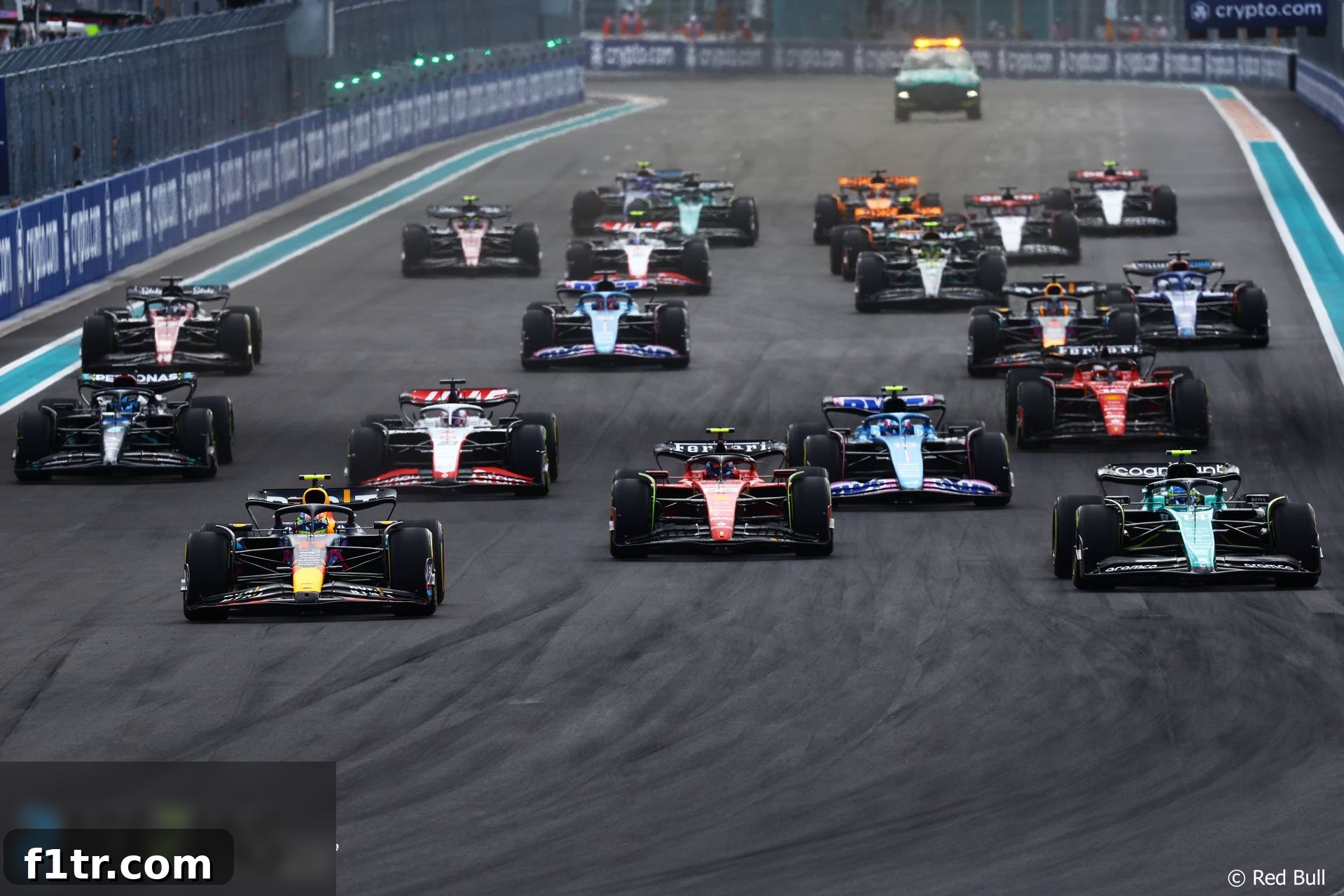
Formula 1’s journey into the heart of American sports culture has been nothing short of spectacular. Owners Liberty Media have confirmed that the series is consistently attracting formidable viewing figures across the United States, an impressive feat considering the unparalleled dominance of Red Bull Racing, which has secured every victory so far in the 2023 season. This sustained engagement underscores the sport’s growing footprint and its ability to captivate audiences irrespective of immediate competitive parity.
Liberty Media president and CEO Greg Maffei recently shared positive insights with investors, highlighting the sport’s “particularly solid growth in the US” throughout the current year. Maffei elaborated, “Viewership on ESPN is up season to date versus the 2022 average viewership, complemented by strong performance on the dedicated F1 TV platform.” This dual-platform success indicates a broadening fan base and diverse consumption habits, with both traditional broadcast and dedicated streaming services thriving.
The 2023 season has already etched itself into F1 history, witnessing three of the four largest live audiences on US television, including monumental events like the Miami, Monaco, and Canadian Grands Prix. These marquee races illustrate the increasing mainstream appeal of Formula 1, transcending its niche origins to become a significant draw for a wider American audience. Maffei emphasized the scale of this achievement, stating, “All but two of our races have averaged more than one million viewers. These are huge numbers for the US market,” underscoring the significant leap in fan engagement and commercial value.
Beyond the borders of the United States, Formula 1’s global appeal continues its upward trajectory. The sport consistently reports sell-out crowds at nearly all race weekends, a testament to the fervent passion of its international fan base. The strategic introduction of sprint race weekends has proven particularly effective in driving year-over-year growth in viewership. For instance, the total audience for the Spa weekend, encompassing the main race, sprint shoot-out, and qualifying sessions, saw a substantial increase compared to the Belgian Grand Prix of the previous year. This innovative approach to race formats contributes to a dynamic and engaging spectacle, ensuring sustained interest and attracting new viewers globally.
This growth is not merely incidental; it is the culmination of strategic efforts by Liberty Media, leveraging popular culture phenomena like Netflix’s ‘Drive to Survive’ documentary series, expanding the calendar to include new and exciting venues, and enhancing the overall fan experience. The investment in marketing, digital engagement, and accessibility has transformed Formula 1 into a global entertainment powerhouse, with the US market standing out as a prime example of its flourishing success. Even with a single team dictating the results, the drama, technological marvel, and the captivating personalities of the sport continue to draw immense crowds and viewership.
The Overtaking Conundrum: IndyCar’s Push-to-Pass vs. F1’s DRS
Rahal Champions IndyCar’s “Mano-a-Mano” Battle Over F1’s DRS
The eternal debate surrounding overtaking aids in motorsport received fresh commentary from IndyCar veteran Graham Rahal, following a thrilling battle at a recent race. Rahal found himself in a captivating chase against eventual winner Scott Dixon, with the pair separated by less than half a second at the chequered flag. This nail-biting finish provided Rahal with ample ground to articulate his preference for IndyCar’s unique approach to facilitating overtakes compared to Formula 1’s Drag Reduction System (DRS).
Dixon’s strategic management of his Push-to-Pass speed boost in the closing laps proved decisive, allowing him to maintain a crucial gap from Rahal. Despite the sting of defeat, Rahal was quick to highlight what he perceives as the superior racing dynamics offered by IndyCar’s system. He explained, “Because of his race pattern being so much more fuel saving, he had a lot more overtake at one stage. We were catching him at the end. He was starting to use overtake. At one point he had 60 seconds more than me. I think at the end we ended up equal. He was using it to stay ahead of me.”
Rahal’s remarks underscore a fundamental difference in philosophy between the two series. IndyCar’s Push-to-Pass system provides drivers with a finite amount of additional horsepower, which can be deployed strategically throughout the race, both offensively to overtake and defensively to hold position. This creates a tactical layer, forcing drivers to manage their boost, anticipating when and where to use it most effectively, adding an element of chess-like strategy to on-track battles.
In contrast, Formula 1’s DRS, or Drag Reduction System, allows a driver to open a flap on their rear wing, significantly reducing aerodynamic drag and providing a burst of speed. This system is typically available in designated “DRS zones” when a car is within one second of the car ahead. While designed to promote overtaking, DRS has frequently drawn criticism for making passes too straightforward, sometimes described as “press a button, pass a car,” thereby diminishing the skill and effort traditionally associated with executing an overtake.
Rahal’s strong preference resonated with many purists in motorsport. “That’s what I kind of love about our version of overtake frankly. It’s a mano-a-mano battle. You use it offensively, defensively. None of this DRS crap that makes it easy,” he asserted. His statement champions the raw, unadulterated wheel-to-wheel combat that Push-to-Pass often fosters, where driver skill, race craft, and strategic timing dictate the outcome, rather than a system perceived by some as artificial.
The debate between these two systems highlights a broader discussion within motorsport about finding the ideal balance between promoting exciting on-track action and preserving the integrity of racing. While DRS undoubtedly leads to more overtakes in F1, it often comes at the cost of the challenging, drawn-out battles that characterize IndyCar’s Push-to-Pass engagements. The tactical depth offered by IndyCar’s system, where a driver’s decision-making can be as crucial as their raw speed, continues to be a point of pride for the series and its competitors.
Motorsport Insights: Legal Battles, Aspiring Racers, and Event Stewardship
Delving deeper into the motorsport world, here are some notable links and expanded narratives of interest:
Williams Racing Embroiled in $100 Million Lawsuit
Slow-motion F1 crash amid claims of fraud and adultery (The Times – subscription required)
A dramatic legal battle has unfolded within the ranks of Formula 1, with Williams Racing at the center of a high-stakes $100 million (£79 million) lawsuit in the United States. The controversy stems from a series of surprising dismissals at the constructor, leading to allegations of fraud and adultery. Claudia Schwarz, a former marketing executive at Williams Racing, has initiated the lawsuit, claiming she was unjustly forced out of her position. This case not only sheds light on the internal dynamics of an F1 team but also underscores the significant financial and reputational risks involved in high-level corporate disputes within the ultra-competitive world of Formula 1. The outcome of this legal challenge could have far-reaching implications for Williams Racing and potentially other teams in the paddock, setting precedents for how such disputes are handled.
Kyle Busch’s Indy 500 Aspirations Reignited by Kanaan Ride
Ride with Kanaan whets Busch’s ‘500’ appetite (IndyCar)
NASCAR superstar Kyle Busch’s long-standing desire to compete in the prestigious Indianapolis 500 appears to have been strongly rekindled following a memorable ride with IndyCar legend Tony Kanaan. Busch, a two-time NASCAR Cup Series champion, has openly expressed his interest in tackling the ‘Greatest Spectacle in Racing’ for years. Kanaan recounted the experience, stating, “A guy like Kyle knows exactly the speeds. He knew exactly when I braked. It was fun. Obviously, I drove as hard as I could because I would not do justice to the guy if I was taking it easy. So, I think he enjoyed it. He probably would rather be driving, but that wasn’t up to me.” This high-speed passenger experience served as a powerful reminder of the unique challenges and thrills of IndyCar racing, reinforcing Busch’s ambition to add an Indy 500 entry to his illustrious career. The prospect of one of NASCAR’s most dominant figures competing in IndyCar’s marquee event is a tantalizing one for motorsport fans across disciplines.
Path to Becoming an Event Steward in Motorsport
Become an event steward (Motorsport UK)
For those passionate about motorsport beyond the driver’s seat, becoming an Event Steward offers a crucial role in ensuring the safety, fairness, and smooth operation of race events. Motorsport UK emphasizes that Event Stewards must possess a deep understanding of the intricacies involved in organizing and running motorsport competitions. This demanding role necessitates building up extensive experience over several years, often through mentorship and guidance from seasoned professionals. The accumulated knowledge and practical experience are paramount for individuals aspiring to progress from a local Event Steward to a highly respected Motorsport UK Steward, a position of significant authority and responsibility within the sport. This pathway highlights the extensive dedication and expertise required to uphold the integrity and standards of motorsport events.
Indy NXT by Firestone Grand Prix Highlights
Race highlights: Indianapolis Motor Speedway road course (Indy Nxt via YouTube)
Experience the exhilarating action from the Indianapolis Motor Speedway road course with these race highlights from Indy NXT by Firestone. The feeder series to IndyCar consistently delivers thrilling, close-quarters racing, showcasing the talent of tomorrow’s stars. These highlights capture the intense battles, strategic maneuvers, and high-speed drama that define Indy NXT, offering a glimpse into the fierce competition and the potential future champions honing their skills on iconic tracks. The Indianapolis road course itself is known for its blend of fast straights and challenging technical sections, providing a perfect stage for up-and-coming drivers to prove their mettle.
We always endeavour to credit original sources. If you have a tip for a link relating to single-seater motorsport to feature in the next RaceFans round-up please send it to us via the contact form.
Engaging with the Motorsport Community: Social Media Highlights
Insights and Chatter from Twitter, Instagram, and Beyond
Social media platforms continue to serve as vibrant hubs for motorsport enthusiasts, offering direct access to drivers, teams, and commentators. Here’s a snapshot of notable posts that recently captured the community’s attention:
Iconic move 🤯 pic.twitter.com/xoHhQVujrZ
— Andretti INDYCAR & INDY NXT (@AndrettiIndy) August 12, 2023
Andretti INDYCAR & INDY NXT shared a captivating clip showcasing an “Iconic move,” sparking discussions among fans about remarkable on-track maneuvers and driver skill. These moments, often shared virally, highlight the raw excitement inherent in open-wheel racing.
Car felt good all weekend. Got stuck in the lap 1 chaos and our day finished with a mechanical on the last lap.
But the car was fast and consistent
Thought we could have had a chance at a great finish— Romain Grosjean (@RGrosjean) August 12, 2023
Romain Grosjean, reflecting on his recent race, expressed mixed feelings. Despite the car’s strong performance throughout the weekend and hopes for a significant finish, his day was unfortunately cut short by a mechanical issue on the final lap, compounded by early race chaos. Such candid reflections from drivers offer fans a personal glimpse into the highs and lows of competitive racing.
The last time Scott Dixon went winless in an IndyCar season was the year Toyota struggled massively with the downsized engines.
The only other time that happened? His team in CART folded mid-season and he landed in a Ganassi spare car to finish the year.
— RJオコンネル 💙💜🩷 (@rjoconnell) August 12, 2023
Motorsport journalist RJ O’Connell provided an interesting historical insight into Scott Dixon’s career, highlighting the rare instances when the legendary driver has gone winless in an IndyCar season. These detailed historical tidbits resonate deeply with long-time fans, providing context and appreciation for Dixon’s consistent excellence.
Our F1 collection. 😍 Which car are you taking for a lap and where are you driving it… 💭 pic.twitter.com/ptb79XCKLO
— Mercedes-AMG PETRONAS F1 Team (@MercedesAMGF1) August 12, 2023
The Mercedes-AMG Petronas F1 Team delighted fans by showcasing their impressive F1 car collection, inviting engagement by asking followers which car they would choose for a lap and where they would drive it. Such interactive posts foster community and allow fans to dream about experiencing the pinnacle of motorsport technology.
- Find more official F1 accounts to follow in the F1 Twitter Directory
The Great Calendar Debate: Race Formats vs. Track Identity
Fan Disagreement on What Truly Makes a Grand Prix Unique
Haas team principal Guenther Steiner recently ignited a lively debate by suggesting that varying the format of Formula 1 race weekends is key to keeping an expanding calendar interesting. However, his perspective found significant dissent among fans, highlighting a fundamental difference in opinion regarding the essence of a compelling Grand Prix experience.
I completely disagree with him on what makes for a “unique” GP or a GP seem fresh.
For me, it is not the format, not in the slightest, not at all, because it doesn’t define the experience. It is ALL about the racing track, because that’s what defines everything. The Belgian GP with always be a drastically different experience to the Monaco GP, whereas two grands prix on cookie cutter, flat Arabic Tilkedromes will always feel the same no matter how different the weekend format is.
Expanding the season is only expanding the number of redundant, passable grand prix weekends, which makes you less engaged with the sport.
Asd
The fan, identified as ‘Asd’, expressed a strong counter-argument, asserting that the format plays a negligible role in defining the uniqueness or freshness of a Grand Prix. Instead, Asd firmly believes that “it is ALL about the racing track, because that’s what defines everything.” This perspective champions the intrinsic character of circuits, using the stark contrast between the legendary Spa-Francorchamps (Belgian GP) and the iconic street circuit of Monaco as prime examples of how track layouts fundamentally shape the racing experience and atmosphere.
Asd further criticized the proliferation of modern, often homogenized “cookie-cutter, flat Arabic Tilkedromes,” arguing that these venues, regardless of weekend format variations, inherently offer a similar, less engaging experience. The core of this argument is that artificial changes to a weekend schedule cannot compensate for a lack of distinctive track characteristics or historical significance. This viewpoint highlights a nostalgia for traditional circuits and a skepticism towards new venues that might prioritize infrastructure over racing pedigree.
The fan also raised concerns about the ongoing expansion of the F1 calendar. Asd contended that merely increasing the number of races, particularly if they are held on similar-feeling tracks, only leads to an accumulation of “redundant, passable grand prix weekends.” This, in turn, risks diminishing fan engagement by saturating the season with events that fail to stand out, potentially leading to viewer fatigue rather than heightened interest. The debate encapsulates a critical tension in modern Formula 1: how to balance commercial growth and innovation with the preservation of the sport’s core identity and its most cherished elements.
While Steiner’s argument for format variation seeks to inject novelty and maintain interest across a longer season, Asd’s powerful rebuttal underscores the enduring value of unique track layouts, historical venues, and the pure racing spectacle they provide. This discussion is vital for the sport’s future, as it navigates the complexities of global expansion, technological advancement, and fan expectations, continually seeking the optimal formula for sustained success and fan loyalty.
Join the Weekend’s Caption Competition
There’s still time to join in this weekend’s Caption Competition here:
- Caption Competition 220: Alpine Pair Meet Famous Farmer
Happy Birthday to Motorsport Enthusiasts!
A very happy birthday to Chris Monk, Ciaran, Jonathan, Camo8723, David Knutson, Sevrige, and Omarr-Pepper! May your day be filled with speed and celebration.
On This Day in Motorsport History
- 45 years ago today, the legendary Ronnie Peterson secured his final Formula 1 victory in a dramatic, rain-affected Austrian Grand Prix. The race, marked by challenging conditions, was red-flagged after just seven laps before being restarted, adding to the tension and historical significance of Peterson’s memorable triumph. This victory stands as a poignant reminder of his incredible talent and the unpredictable nature of F1 racing in its golden era.
This comprehensive overview highlights the dynamic and multifaceted world of Formula 1 and broader single-seater motorsport. From its surging popularity in the US to deep-seated debates on race integrity and critical historical reflections, the sport continues to evolve, challenge, and captivate audiences worldwide. The discussions around formats, tracks, and technological aids are vital as motorsport strives to maintain its exhilarating essence while adapting to a rapidly changing global landscape.