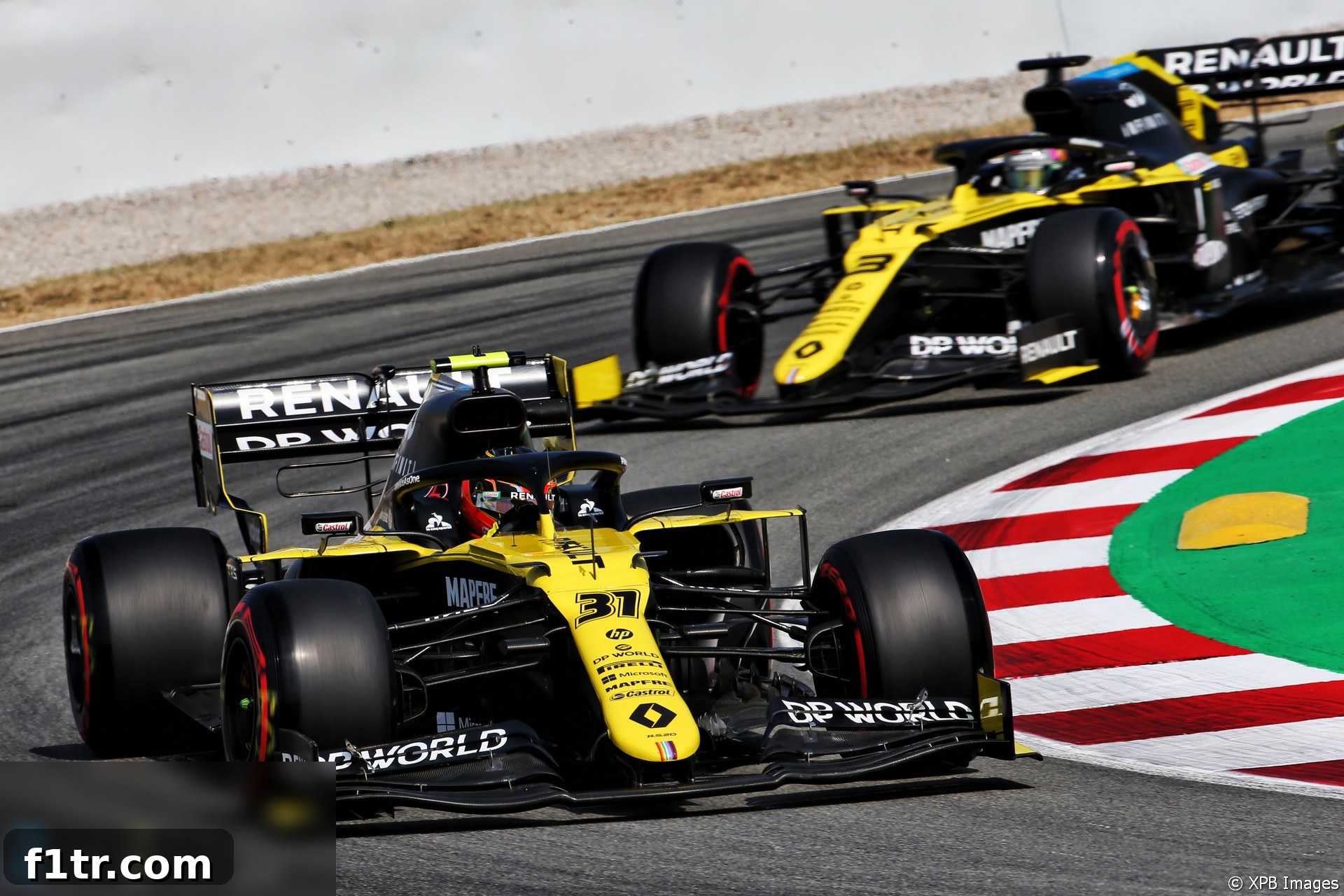
In a significant development for the Renault F1 team, French driver Esteban Ocon is set to receive a brand-new power unit for his R.S.20 ahead of the upcoming Belgian Grand Prix at the iconic Spa-Francorchamps circuit. This strategic decision comes as Ocon and his team meticulously analyze a persistent performance deficit, particularly in straight-line speed, which has been evident in recent races compared to his highly-rated teammate, Daniel Ricciardo. The move is a clear indication of Renault’s commitment to optimizing Ocon’s machinery and ensuring he has every tool necessary to compete at the sharp end of the grid.
Ocon has been vocal about his struggles, pinpointing the loss of straight-line performance as a key factor hindering his overall lap times. The issue became particularly pronounced starting from the second Silverstone race, the 70th Anniversary Grand Prix, and persisted through the Spanish Grand Prix at Circuit de Catalunya. “The main loss is in the straight-line,” Ocon confirmed on Saturday during the Spanish GP weekend. “This is what we see at the moment since Silverstone [race] two. There is a bit of a lap time that I’m losing in the straight between the two cars.” This observation is crucial, as even minor discrepancies in top-end speed can translate into significant lap time differences over the course of a race, making overtakes harder and defensive driving more challenging. In modern Formula 1, where margins are incredibly fine, a few tenths of a second gained or lost on the straights can dictate a driver’s entire race outcome.
Advert | Become a Supporter & go ad-free
The discrepancy in straight-line speed between Esteban Ocon’s car and Daniel Ricciardo’s has naturally led to questions regarding the health and performance of Ocon’s current power unit. While Ricciardo had already moved onto his second power unit of the season at this point, Ocon was still utilizing his initial allocation. This fact introduced a variable that the team has been carefully scrutinizing. Ocon acknowledged this, stating, “Obviously Daniel is [already] on his second engine so we don’t know if that comes from that. But at the moment we are seeing a loss of straight-line speed on my car.” The challenge for engineers lies in diagnosing whether such a deficit stems from the internal combustion engine (ICE), the turbocharger, the Motor Generator Units (MGU-H or MGU-K), or other ancillary components that comprise the complex hybrid power unit. Even subtle degradation or a slight calibration issue can have a measurable impact on power delivery, especially on long straights.
In response to these findings and Ocon’s consistent feedback, Renault has opted for a decisive course of action: a complete power unit change. The new power unit will be fitted to Ocon’s R.S.20 ahead of the Belgian Grand Prix. This race, held at the legendary Spa-Francorchamps circuit, is renowned for being one of the most demanding venues for engine performance on the Formula 1 calendar. With its iconic Eau Rouge-Raidillon complex leading into the long Kemmel Straight, followed by other significant acceleration zones, Spa puts a premium on raw power and aerodynamic efficiency. A robust and well-performing power unit is not just an advantage; it’s an absolute necessity for competitive lap times and effective racing at this historic track. The team’s choice to introduce a new unit here underscores the severity of the perceived deficit and their determination to rectify it swiftly.
Following the Spanish Grand Prix, Ocon expressed a palpable sense of relief and optimism regarding the upcoming changes. He views the power unit replacement as an opportunity for a complete reset, both mechanically and psychologically. “I feel like it’s going to be a fresh start,” Ocon declared after Sunday’s race in Spain. “We have a week to analyse and recover all together. It’s going to be a new gearbox for me, a new engine, a lot of new parts as well, because we are obviously not happy with the performance difference between the cars.” The mention of a new gearbox and “a lot of new parts” suggests a more comprehensive overhaul than just the engine. This indicates that Renault engineers are exploring multiple avenues to ensure Ocon’s car performs identically, or as close as possible, to Ricciardo’s, eliminating any potential underlying issues that might contribute to performance disparities. Such a multifaceted approach reflects the intricate nature of F1 car development and problem-solving, where multiple minor issues can collectively create a significant performance gap.
While the power unit change addresses the most pressing concern of straight-line speed, Ocon was also candid about other areas where he feels his car’s performance could be improved relative to his teammate. “We are obviously changing the engine for the straight-line speed that I was lacking,” he explained. “But there’s also other areas where I feel and we feel that we are not competitive enough compared to the other side of the garage.” This broader statement opens the door to discussions about chassis setup, aerodynamic balance, tire management, and even driver confidence and adaptation. Even with identical machinery, drivers often prefer different setups, and finding the optimal balance for each individual is a continuous process. It highlights that F1 performance is a complex tapestry of factors, and while a new engine might fix one major thread, others still need attention to weave a complete competitive picture. Renault’s objective is not merely to bring Ocon’s straight-line speed up to par but to ensure he has a fully optimized package that allows him to extract maximum performance across all aspects of a Grand Prix weekend.
Advert | Become a RaceFans supporter andgo ad-free
For Renault, this proactive step is crucial. The team, aiming to establish itself as a consistent contender for podiums and eventually wins, cannot afford significant performance differences between its drivers. Ensuring both cars are performing optimally is vital for maximizing constructors’ points and demonstrating the overall capability of the R.S.20 chassis and its power unit. For Esteban Ocon, a driver who returned to F1 in 2020 after a year on the sidelines, consistency and strong results are paramount to cement his long-term future in the sport. Matching or even challenging Daniel Ricciardo, widely regarded as one of the grid’s top talents, is the benchmark. A persistent deficit, regardless of its origin, can erode confidence and hinder progress. The Belgian Grand Prix, therefore, represents a pivotal moment for Ocon. A strong showing at Spa, coupled with the improved straight-line speed, could be the catalyst he needs to turn his season around and begin consistently delivering the performances both he and the team expect. The decision to change the power unit is not just a technical fix; it’s a vote of confidence from Renault in Ocon’s potential and a clear signal of their intent to support both their drivers equally in the pursuit of performance excellence. The team will be closely monitoring the data from Spa, hoping that this ‘fresh start’ translates directly into a tangible improvement on track, paving the way for a more competitive second half of the 2020 F1 season for Ocon.
2020 F1 season
- Grosjean to make F1 test return tomorrow for first time since Bahrain horror crash
- Pictures: Wrecked chassis from Grosjean’s Bahrain fireball crash to go on display
- Bottas vs Rosberg: Hamilton’s Mercedes team mates compared after 78 races each
- F1 revenues fell by $877 million in Covid-struck 2020 season
- Hamilton and Mercedes finally announce new deal for 2021 season
Browse all 2020 F1 season articles