Revolutionizing the Grid: A Deep Dive into Formula 1’s Groundbreaking 2022 Technical Regulations
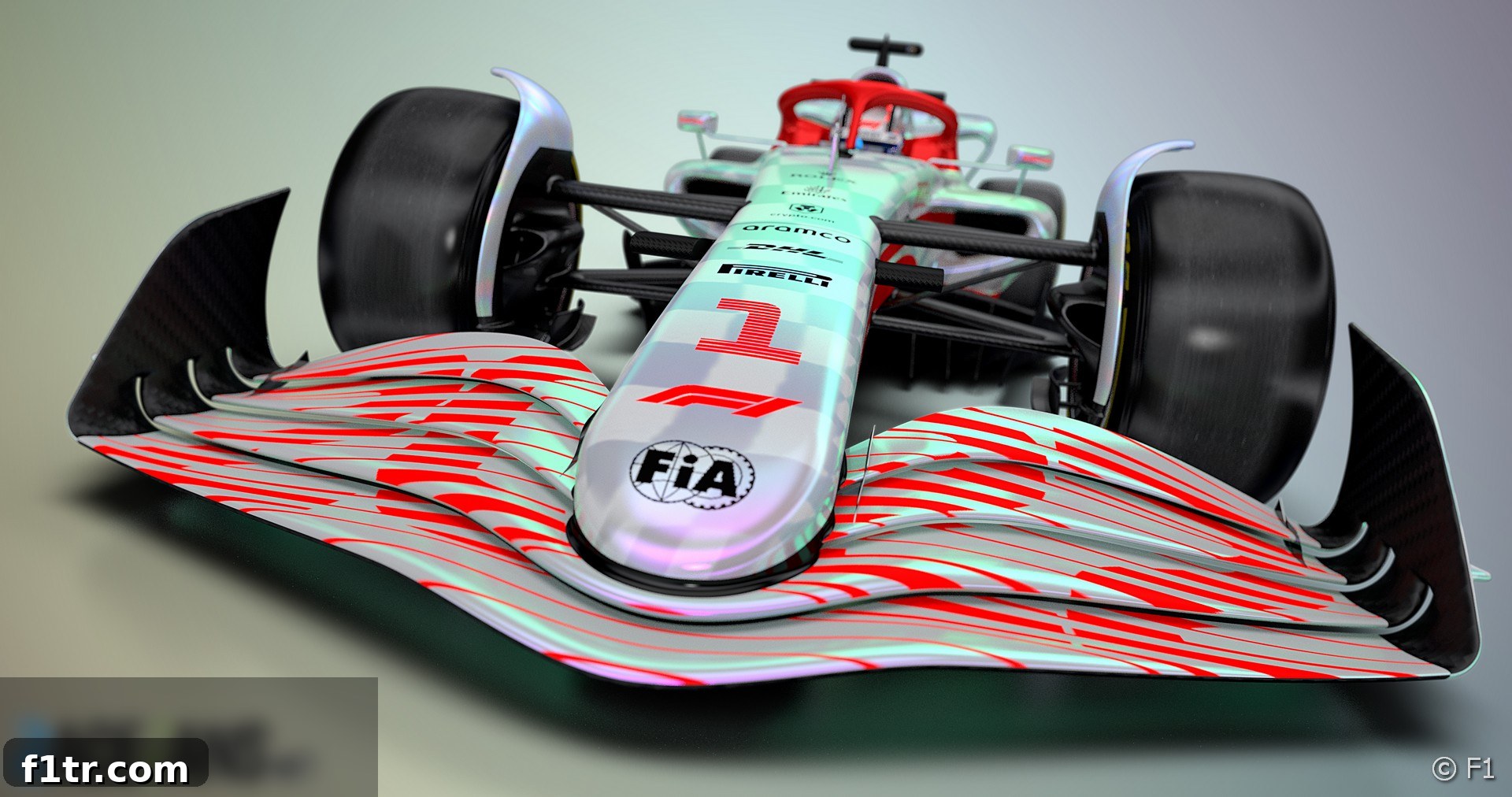
Formula 1 is set to unveil the first full-size model of a car meticulously designed under its radical new technical regulations for the 2022 season. This highly anticipated reveal marks a pivotal moment for the sport, signaling a bold step towards a new era of competitive and thrilling racing. These transformative rules, initially slated for introduction in 2021 but delayed due to the global pandemic as a cost-saving measure, are the culmination of extensive research and development aimed at fundamentally changing how F1 cars interact on track.
The core objective of these new regulations is singularly focused: to make it significantly easier for Formula 1 cars to race closely together and facilitate more spectacular overtaking maneuvers. For years, the inherent aerodynamic characteristics of F1 cars have presented a formidable challenge, often hindering intense wheel-to-wheel battles. The pursuit of maximum downforce, while essential for blistering lap times, inadvertently creates a highly turbulent wake – colloquially known as “dirty air” – which severely compromises the performance of a following car.
The Quest for Closer Racing: A Historical Perspective
The aspiration for improved racing dynamics is not new to Formula 1. The sport has, on several occasions, attempted to address the issue of overtaking with varying degrees of success. A notable effort came in 2009 with the introduction of new rules devised by the Overtaking Working Group. These regulations aimed to reduce downforce and simplify aerodynamic elements, hoping to diminish the impact of dirty air. However, the efficacy of these changes proved limited, a fact underscored by F1’s subsequent reliance on more drastic measures.
Just two years after the 2009 overhaul, Formula 1 resorted to the Drag Reduction System (DRS) as a direct aid to overtaking. While DRS has undoubtedly increased the number of overtakes, it has also sparked debate regarding the artificial nature of some passes. The recurring problem has been that any attempts to reduce overall downforce or simplify aerodynamics have frequently been circumvented by the prodigious development power of F1 teams. Their relentless pursuit of performance through sophisticated aerodynamic design often led to the re-establishment of complex aero structures, negating the original intent of the regulations and perpetuating the challenge of close following.
This historical pattern highlighted a fundamental dilemma: how to create cars that are incredibly fast and aerodynamically sophisticated, yet simultaneously capable of racing nose-to-tail without a significant performance penalty for the following driver. The 2022 regulations represent a fresh, and perhaps more robust, approach to solving this long-standing puzzle.
A New Era of Development: F1’s Unprecedented Computing Power
What sets the 2022 regulations apart is that Formula 1 now possesses two significant advantages that were not available in previous attempts. Firstly, the new rules increasingly restrict the scope and resources teams can dedicate to aerodynamic development, ensuring a more level playing field and preventing runaway design escalation. Secondly, and perhaps more crucially, F1 itself can now harness impressively advanced levels of computing power for its own research and regulation development. This technological capability is so profound that one of the key figures driving it describes it as “face-melting.”
Rob Smedley, a former Williams and Ferrari engineer with vast experience in F1, now serves as Formula 1’s director of data systems. He emphasizes the sheer scale of F1’s in-house development capabilities, stating that their computing power is “orders and orders of magnitude bigger” than what individual teams can access under the stringent aerodynamic testing restrictions. This unparalleled analytical capacity has been instrumental in devising the new regulations, allowing F1 to conduct exhaustive simulations that effectively ‘pin down’ teams to producing cars inherently designed for close racing, all without compromising the pinnacle of performance that defines Formula 1.
Smedley elaborates on this critical advantage: “That’s why we at Formula 1 were able to support in such a crucial way the FIA in defining these regulations. We were able to go outside of that aerodynamic test restriction and we were able to say, right, this has all got to be about compute power.” This freedom from the constraints placed on individual teams allowed for a comprehensive, holistic approach to aerodynamic design, focusing on the collective impact of cars racing together rather than individual car performance in isolation.
Harnessing the Power of Computational Fluid Dynamics (CFD)
While F1 teams traditionally concentrate their design efforts on optimizing the performance of a single car, the challenge for Formula 1’s regulatory body was unique: they needed to simulate the intricate aerodynamic behavior of two cars in close proximity. This scenario is incredibly complex and would be prohibitively expensive, if not impossible, to achieve accurately and repeatedly in a full-scale wind tunnel. This is where Computational Fluid Dynamics (CFD) simulations became the indispensable solution.
CFD is a branch of fluid mechanics that uses numerical methods and algorithms to solve and analyze problems that involve fluid flows. In the context of F1, it allows engineers to model how air moves over and around the car, predicting pressure distributions, lift, and drag. The ability to perform “two-car CFD” simulations – modeling one car closely following another – was paramount. This allowed F1’s technical team to understand precisely how the wake from a leading car affects a trailing car’s downforce and stability, and crucially, to design regulations that minimize this detrimental effect.
Smedley explains the demands of this complex simulation: “If you want a two-car CFD – one car following the other, full-car CFD simulation – and you want to be able to rapidly iterate across lots of design concepts, this is going to have to be quicker than what we could do under the aerodynamic test restrictions, where typically half [scale] of a single car will take you four hours.” The initial attempts at these two-car simulations were incredibly time-consuming.
The AWS Partnership: Accelerating Innovation and Design
When Formula 1’s technical department first embarked on these ambitious two-car CFD simulations, efficiency was a major hurdle. “We were into four days, when we first started off, four days to do a single simulation or a single design iteration, which is just not efficient enough,” Smedley recounts. To accelerate this critical design process and enable rapid iteration across a multitude of design concepts, Formula 1 forged a strategic partnership with Amazon Web Services (AWS).
This collaboration proved to be a game-changer, dramatically slashing the time required for complex simulations. “Finding that solution, the thing just runs like a machine now,” Smedley proudly states. The impact of this partnership is truly staggering: “This to me is a really, really impressive stat and a really impressive way that we’ve been able to use the partnership to such great effect: We are down to like seven hours now per simulation, per design iteration, which is just insane.” This exponential leap in processing speed allows for an unprecedented depth of analysis and refinement, enabling F1’s engineers to test countless aerodynamic configurations and scenarios in a fraction of the time previously possible.
The scale of Formula 1’s computational endeavors for the 2022 car design is genuinely mind-boggling. Their simulations, which meticulously analyzed the aerodynamic wake of one car upon another under the new rules, involved the processing of over 550 million data points. Smedley further illustrates the intensity of this work: “When we were pushing through the peak number of jobs in one day we were at seven-and-a-half million cells to calculate across the CFD mesh and around about 7,000 cores we were spinning up at the same time in the EC2 service. That is just face-melting compute power.” This level of computational horsepower ensures that every nuance of the new aerodynamic package is thoroughly understood and optimized for its intended purpose: delivering closer, more exciting racing.
Crafting Airtight Regulations: The “Poacher-Gamekeeper” Approach
The new regulations, while conceptualized and heavily developed by Formula 1’s technical team, are ultimately defined and implemented by the FIA. A crucial phase in their development involved close consultation and further refinement in conjunction with the F1 teams themselves. This collaborative, yet strategically adversarial, process was spearheaded by F1’s chief technical officer, Pat Symonds.
Symonds, possessing decades of invaluable experience with championship-winning F1 teams, understood the inherent nature of competitive engineering – teams will always seek to exploit any gray areas or ambiguities in the rulebook to gain a performance advantage. To counteract this, Symonds and his team implemented what Smedley describes as a “poacher-gamekeeper” strategy. This involved a rigorous, iterative process aimed at systematically identifying and eliminating any potential loopholes or areas of the rules that could lead to unintended consequences or allow teams to deviate from the spirit of the regulations.
“So you get the first proper design iteration out that you’re happy with, the first iteration of the rules, and then it’s getting people to read through that and see where the loopholes are and then tightening it again and using the CFD and redesigning for certain aspects of it,” Smedley explains. “And then doing this whole process again and going through the loop a number of times to try to get to a reasonably tied down aerodynamic rule set.” This meticulous, almost adversarial, review process ensures that the final regulations are robust, comprehensive, and as resistant as possible to interpretations that could undermine the goal of promoting closer racing.
Key Aerodynamic Innovations in the 2022 F1 Car
A smaller wind tunnel model of the planned car was first presented in 2019, offering an initial glimpse into the radical design philosophy before its introduction was put on hold. The full-size model being unveiled today incorporates several crucial aerodynamic changes specifically engineered to enhance close racing. These innovations represent a departure from previous F1 car designs and aim to fundamentally alter how the cars generate downforce and manage their turbulent wake.
Among the most significant changes are simpler upper surfaces. By reducing the complexity of winglets, bargeboards, and other intricate aerodynamic appendages that have adorned F1 cars for years, the new regulations aim to lessen the amount of “dirty air” generated. A cleaner, less turbulent wake means a following car will experience less performance degradation, allowing drivers to stay closer without losing critical grip.
Crucially, the new design sees the return of the “ground effect,” a concept that was prominent in F1 during the late 1970s and early 1980s. This is achieved through the incorporation of large ‘tunnels’ under the car’s floor. These tunnels are designed to accelerate airflow beneath the car, creating a low-pressure area that effectively sucks the car to the ground, generating significant downforce. The beauty of ground effect is that it produces downforce more efficiently and with far less turbulent air than traditional over-body wings. This means cars can generate high levels of downforce while simultaneously producing a cleaner wake for following cars.
Furthermore, the design includes sophisticated strakes over the front wheels. These elements are specifically positioned to manage the turbulent air created by the spinning wheels, further improving the airflow for a following car and contributing to a more predictable and stable aerodynamic environment in close quarters. Collectively, these aerodynamic innovations represent a holistic approach to tackling the dirty air problem, seeking to foster an environment where driver skill, rather than aerodynamic disadvantage, dictates the outcome of battles on track.
The Road Ahead: Anticipation for the 2022 Season
Today’s unveiling of the full-size 2022 Formula 1 car model is more than just a presentation; it’s a statement of intent. It embodies years of rigorous research, advanced computational analysis, and a dedicated effort to redefine the very essence of F1 racing. While the design has benefited immensely from technology that Rob Smedley and his team could only have dreamt of a few years ago, the ultimate test still awaits.
We will have to wait until next year, when these revolutionary machines hit the track for the first time, to truly ascertain whether Formula 1’s latest, technologically-driven attempt to aid overtaking and foster closer racing will finally succeed where previous efforts have faltered. The anticipation is palpable, not just among fans, but throughout the sport. The hope is that these meticulously crafted regulations will usher in a golden age of Formula 1, characterized by intense, wheel-to-wheel battles, more overtakes, and a renewed focus on driver talent battling it out without being unduly hampered by aerodynamic turbulence. The future of Formula 1 promises to be exhilarating, built on a foundation of innovation and a clear vision for more competitive action.
2022 F1 Season News & Updates
- Mercedes told me “you’re wrong” about 2022 car’s problems – Hamilton
- FIA confirms all 10 F1 teams complied with 2022 cost cap
- Steiner “not ashamed” of panning “slow” Schumacher in Drive to Survive
- Albon believes year out of F1 improved him as a driver
- Hamilton sees diversity gains in F1 years on from his ‘traumatising’ experience of racism
Browse all 2022 F1 season articles