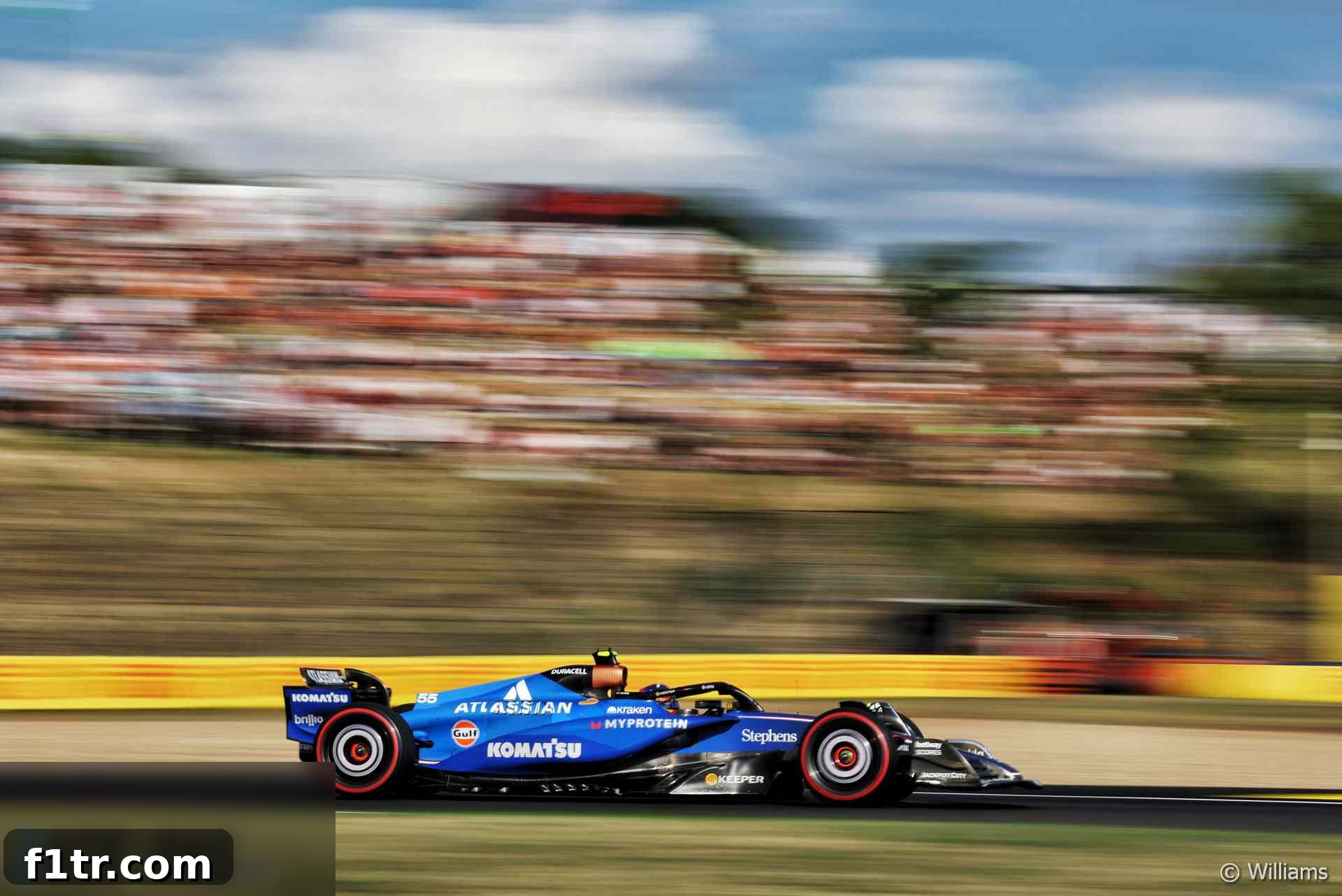
Carlos Sainz Jr. has voiced significant skepticism regarding Williams’ prospects of scoring points in today’s Hungarian Grand Prix. The Spanish driver’s reservations come after the team made extensive reversions to his car’s setup following a challenging qualifying session at the Hungaroring, a circuit notoriously difficult for Williams’ FW47 chassis.
Carlos Sainz Jr. Faces Uphill Battle for Points at Hungarian Grand Prix
The highly anticipated Hungarian Grand Prix is set to unfold, and for Williams driver Carlos Sainz Jr., the outlook appears to be more about damage limitation than a pursuit of glory. Despite securing a respectable 13th position on the grid – the better of the two Williams drivers – Sainz Jr. remains realistic, if not pessimistic, about his chances of breaking into the top ten and securing valuable championship points. His qualifying effort saw him narrowly miss a spot in Q3 by a mere 0.094 seconds, a testament to the fine margins in Formula 1, yet also a clear indicator of the inherent struggles faced by the team at this particular venue.
Qualifying Challenges: Reverting to Basics on the Hungaroring
The Hungaroring, with its tight, twisty layout and relentless series of corners, demands exceptional aerodynamic grip and mechanical balance. It’s a circuit that often exposes any weaknesses in a car’s chassis, and for the Williams FW47, it has proven to be a particularly stern test. Sainz Jr. explained the team’s predicament, stating, “We ended up reverting back on a lot of the set-up items we tried during the weekend.” This candid admission highlights a fundamental issue – the experimental setup directions explored earlier in the race weekend did not yield the desired performance gains, forcing the team to retreat to a more familiar configuration.
The decision to revert to a known setup, while providing a degree of comfort and predictability for the driver, also signifies a compromise. It suggests that the team was unable to unlock extra performance from new ideas, effectively limiting their potential ceiling for the weekend. “We went back to a car I know and more or less did the maximum that was available to us today with P13,” Sainz Jr. elaborated. This statement underscores the team’s understanding that their current package, particularly at a circuit like the Hungaroring, is operating near its absolute limit. The constant struggle for performance, especially on high-downforce tracks, has been a recurring theme for Williams, and Hungary appears to be no exception.
“It’s been a very difficult track for the Williams so far, but we knew that [would be the case] coming into here, and we just need to maximise whatever we have,” Sainz Jr. added. This proactive acceptance of their car’s limitations, while pragmatic, doesn’t diminish the challenge. It means that any points finish would require not just a flawless drive from Sainz Jr., but also a considerable degree of luck, such as attrition among rivals or strategic opportunities created by unforeseen circumstances.
The Intricacies of Setup Changes and Their Impact
The world of Formula 1 setup optimization is incredibly complex, involving a myriad of variables from suspension stiffness and ride height to wing angles and differential settings. Each change aims to extract tenths of a second, but sometimes, a radical departure from a baseline setup can have unintended consequences, leading to instability, poor tire wear, or a general lack of driver confidence. The fact that Williams opted to revert implies that the experimental setups likely caused more issues than they solved, forcing them to prioritize reliability and predictability over unknown potential.
For a team like Williams, operating with fewer resources than some of their rivals, every weekend is a learning opportunity. However, a Grand Prix like Hungary, where track position is paramount and overtaking is notoriously difficult, demands a finely tuned machine from the outset. The lost track time experimenting with setups, only to return to a baseline, could be seen as a missed opportunity to optimize the FW47 for the unique demands of the Hungaroring.
Realistic Expectations: A Fight for Survival, Not Glory
When pressed on his chances for the race, Sainz Jr.’s assessment was stark. “We’re going to try our best to get a point or two, but realistically speaking, we don’t have the pace to do so,” he admitted. This candid outlook reflects the harsh reality of competing in the midfield of Formula 1, especially when starting outside the top ten. Scoring points from 13th on the grid at the Hungaroring is a formidable task, typically requiring a combination of exceptional strategy, stellar driving, and a significant stroke of fortune.
However, the spirit of racing dictates that hope endures until the chequered flag. “But the races, you always need to race them and see what we can do,” Sainz Jr. concluded, leaving a sliver of possibility open. This philosophy is common in Formula 1 – the race itself can be unpredictable, with safety cars, unexpected weather changes, or rival incidents often shuffling the pack and creating opportunities where none seemed to exist. For Williams, who are constantly fighting for every available point, capitalizing on such chaos becomes crucial.
Advert | Become a RaceFans supporter andgo ad-free
Teammate Struggles and Divergent Strategies: Alexander Albon’s Hungarian GP
While Sainz Jr. secured 13th, his teammate, Alexander Albon, endured an even tougher qualifying session, finishing last on the grid. Albon’s discomfort with the FW47 was evident, as he reported not feeling very confident or at ease with the car’s balance throughout the weekend. This discrepancy in performance between the two Williams drivers, despite both piloting the same chassis, was not by chance.
Team Principal James Vowles shed light on the situation, confirming that the two cars had indeed been set up differently. This strategic divergence is not uncommon in Formula 1, especially when a team is trying to understand the limits of their car or test different developmental directions. “With Alex, we tried a different direction and a different way of working the tyres, and we learned a lot thanks to his efforts,” said Vowles. Albon, therefore, was effectively tasked with an experimental role, pushing a setup that might have been less optimal for immediate qualifying pace but was designed to gather crucial data for the team’s long-term development.
The Value of Experimental Setups, Even at a Cost
The decision to run divergent setups, while potentially sacrificing one driver’s immediate qualifying performance, can be invaluable for a team like Williams. By exploring different aerodynamic and mechanical configurations, they can collect a broader range of data on how the FW47 reacts under various conditions. This information is critical for understanding the car’s characteristics, identifying areas for improvement, and informing future upgrade packages. Albon’s feedback, even if it stemmed from a challenging experience, contributes significantly to this knowledge base, allowing the engineering team to make more informed decisions moving forward.
However, this strategy comes with inherent risks, particularly at a circuit where track position is so vital. Starting from the very back of the grid for Albon means an incredibly difficult race, with overtakes being a premium. While the data collected is important, the immediate championship implications of a last-place start are not insignificant.
Weather Wildcard and Race Day Optimism
Despite the challenging qualifying results, Vowles expressed a degree of optimism for the race itself, particularly given the car’s potential and the unpredictable weather forecast. “The car in a race condition should be better than where it is today,” Vowles predicted. This suggests that the FW47 might have better tire degradation characteristics or a more stable balance over longer runs compared to its single-lap qualifying pace. Many F1 cars behave differently on a race stint with a full fuel load compared to a qualifying run, and Williams might be banking on their car’s stronger points emerging over 70 laps.
Crucially, Vowles also highlighted the potential for rain. “It also looks like there’s rain on the forecast, and in that condition, your qualifying place is less important than the ability to get the execution right on the day,” he noted. Rain is often considered the great equalizer in Formula 1. It can negate the inherent pace advantage of faster cars, introduce chaos, and open up strategic gambles that might otherwise be impossible. In wet or variable conditions, driver skill, quick decision-making from the pit wall, and car adaptability become paramount, often providing opportunities for teams starting further down the grid to make significant gains.
Embracing the Unpredictability of F1
For Williams, a wet Hungarian Grand Prix could be their best chance to upset the established order and potentially salvage some points. It transforms the race from a purely pace-driven contest into a chess match of strategy, tire choices, and car control on a slippery track. The team will be meticulously monitoring weather radars and track conditions, ready to seize any opportunity that arises. Executing pit stops flawlessly, making the right tire calls, and guiding the drivers through treacherous conditions will be key if the rain materializes.
Both Sainz Jr. and Albon are capable drivers in varied conditions, and if the weather turns, their experience could be a valuable asset. The Hungaroring, already a demanding track, becomes even more so in the wet, testing every aspect of a driver’s abilities. For Williams, starting from P13 and P20, the rain offers a glimmer of hope to overcome their qualifying deficit and make a dramatic charge up the field.
Concluding Thoughts: A Sunday of Strategic Gambles and Resilience
The Hungarian Grand Prix promises to be a test of resilience for Williams. Carlos Sainz Jr.’s realistic assessment of their pace underscores the inherent challenges faced by the team, particularly at a circuit that accentuates the FW47’s weaknesses. However, the collective efforts of the team, from Sainz Jr.’s determined driving to Alexander Albon’s data-gathering mission and James Vowles’ strategic foresight, indicate a full commitment to maximizing their potential.
With the car expected to perform better in race conditions and the ever-present threat of rain, the Hungarian Grand Prix remains an open book. While securing points will undoubtedly be an uphill battle, Formula 1 has a long history of delivering unexpected results, especially when conditions are challenging. Williams will be hoping that a combination of disciplined driving, astute strategy, and perhaps a touch of good fortune will allow them to defy expectations and finish a difficult weekend on a more positive note.
Don’t miss a moment of the action from RaceFans. Get daily updates directly to your inbox with all our latest stories – no marketing, no ads. Subscribe today!
2025 Hungarian Grand Prix Insights
- Leclerc admits problem which struck Ferrari in Hungary is likely to recur
- Permane impressed by Lawson’s progress after “breakthrough” in Austria
- Albon expects “dogfight” as Williams aim to hold fifth place
- Mercedes eye more wins post-break after dropping revised rear suspension
- McLaren pair equal Senna and Prost’s run in second-fastest ever Hungarian GP
Browse all 2025 Hungarian Grand Prix articles