Unraveling the Monza Q3 Mayhem: Charles Leclerc Rejects Hamilton’s Ferrari Strategy Accusations
The 2019 Formula 1 season delivered countless moments of nail-biting drama, but few sessions sparked as much debate and controversy as qualifying for the Italian Grand Prix at Monza. The hallowed “Temple of Speed” is famed for its unique aerodynamic demands, where slipstreaming – gaining an aerodynamic advantage by following closely behind another car – becomes a critical, high-stakes game. This strategic element culminated in a chaotic Q3 session that saw the vast majority of drivers, including both Ferrari contenders Charles Leclerc and Sebastian Vettel, fail to start their final flying laps in time. While Charles Leclerc ultimately secured a crucial pole position, his achievement was immediately overshadowed by accusations from rival Lewis Hamilton, who suggested Ferrari had deliberately orchestrated the slowdown to “time everyone out.” Leclerc, however, was quick to vehemently reject these claims, portraying the incident as an unplanned, collective blunder rather than a calculated team strategy.
The Chaotic Climax of Monza Q3: A Symphony of Miscalculation
The final segment of qualifying, Q3, is designed to be the ultimate shootout, where the fastest drivers push their machinery to the absolute limit. At Monza, however, an additional layer of strategy unfolds. Drivers meticulously plan their out-laps to ensure they can latch onto the slipstream of a competitor, gaining a vital tenth or two on the long straights. This pursuit of the perfect tow frequently leads to a concertina effect, where drivers slow down excessively to create gaps, only to accelerate into the final sector with a tow. The 2019 Monza Q3 session, however, escalated this phenomenon into unprecedented disarray.
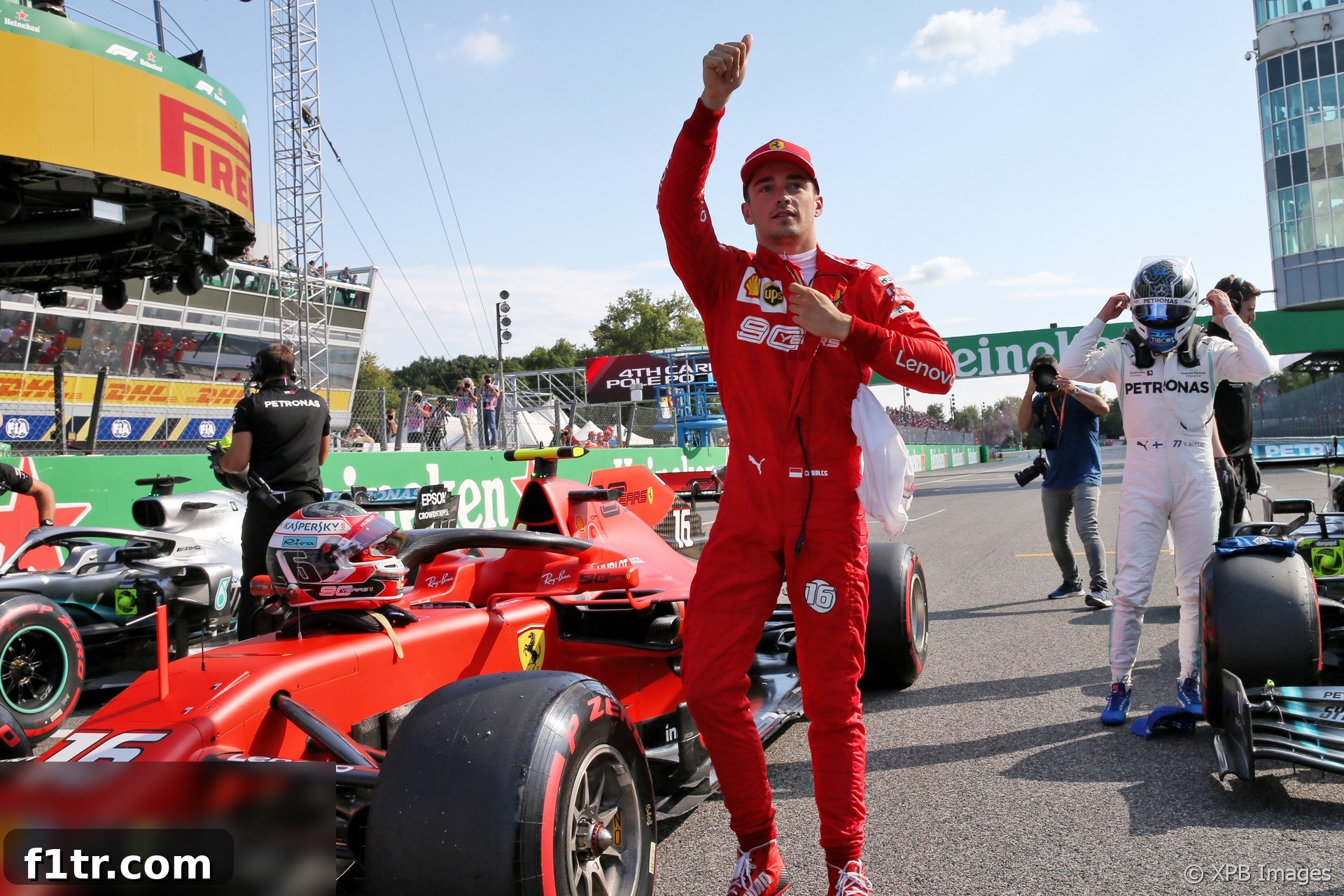
With mere minutes left on the clock for the final runs, an astonishing eight of the nine remaining drivers failed to cross the start-finish line before the chequered flag fell, effectively preventing them from completing a timed lap. This bizarre scenario left the provisional pole-sitter, Charles Leclerc, unchallenged at the top, securing his pole position without any further threat. While Leclerc celebrated, his competitors, most notably Mercedes’ Lewis Hamilton, expressed immense frustration. Hamilton publicly accused Ferrari of employing tactical maneuvers to deliberately impede their rivals, suggesting a calculated effort to “time everyone out” and safeguard Leclerc’s provisional top spot. This accusation set the stage for a heated post-qualifying debate, casting a shadow over what should have been a triumphant moment for the young Monegasque driver.
Leclerc’s Vehement Denial: A Matter of Chaos, Not Conspiracy
Faced with Hamilton’s pointed allegations, Charles Leclerc was resolute in his denial of any intentional Ferrari strategy to disrupt the session. Speaking candidly after qualifying, Leclerc painted a picture of an unplanned, chaotic event, driven by the collective desire for a slipstream rather than a deliberate team directive. “I think today was special, was definitely not intentional from our side,” he stated, emphasizing the inherent complexity of the situation for Ferrari. He further highlighted the internal team dynamic, acknowledging that his teammate Sebastian Vettel was also a contender for pole position.
“Obviously there was also Seb that was capable of having the pole position and we obviously didn’t want to sacrifice one car for the pole [over] the other so it was quite tricky,” Leclerc explained. This crucial detail underscores the difficulty of implementing a deliberate blocking strategy when two drivers from the same team are vying for the same top spot. Sacrificing one driver’s chances for another’s pole is a risky and often frowned-upon tactic within a team, especially when both are in contention. Leclerc’s explanation shifted the blame from a Machiavellian Ferrari plot to a more systemic issue rooted in the nature of Monza’s qualifying. He firmly believed the problem stemmed from drivers slowing excessively to achieve a tow, creating a bottleneck that spiraled out of control.
Unpacking the “Monza Mess”: The Anatomy of a Slipstream Strategy Gone Awry
The “Monza Mess” as it quickly became known, was a vivid illustration of the delicate balance between strategic advantage and dangerous congestion. Leclerc elaborated on the root cause, stating, “I definitely think that situations like after the second corner shouldn’t happen when there are two cars side-by-side they cannot go at 20kph. We couldn’t pass them.” He pointed out that many drivers behind him were eager to accelerate and start their laps but found themselves trapped behind an agonizingly slow procession of cars.
The unique characteristics of the Autodromo Nazionale Monza make slipstreaming an irresistible temptation for every team. With its long straights and fast corners, the aerodynamic benefit of a tow can shave critical tenths off a lap time. Drivers are willing to slow down considerably on their out-laps to ensure they catch the car ahead at the optimal point for a slipstream in the final sector. However, when every driver on the track attempts this precise maneuver simultaneously, the system breaks down. The collective slowing creates a traffic jam, where the pursuit of individual advantage leads to collective detriment. What began as a strategic play for an edge quickly devolved into a gridlock, proving to be the undoing of almost every driver’s final Q3 attempt, including those from Ferrari.
Hamilton’s Accusation: A Rival’s Perspective and the Heat of Competition
Lewis Hamilton’s frustration was palpable after the qualifying session. As a fierce competitor and a driver renowned for his strategic acumen, Hamilton’s accusation against Ferrari was not made lightly. From his perspective, the sight of multiple cars, including the Ferraris, deliberately slowing to an extreme degree felt like a calculated move to gain an unfair advantage. He understood the concept of a tow but believed the situation at Monza had crossed a line, moving beyond clever strategy into potentially manipulative tactics.
Hamilton’s comments also reflect the intense pressure and psychological warfare inherent in Formula 1. When every fraction of a second counts, any perceived unfair play can ignite immediate suspicion and animosity. His accusation, though denied by Leclerc, fueled the narrative of Ferrari pushing the boundaries, especially given their historical rivalry and the high stakes of the 2019 championship battle. It was a testament to the raw emotion and competitive fire that define F1, where rivals are quick to call out anything that seems to bend or break the unwritten rules of engagement.
The Internal Ferrari Dynamic: Leclerc and Vettel’s Misunderstanding
Adding another layer of complexity to the Monza Q3 saga was the internal dynamic between Charles Leclerc and Sebastian Vettel. After qualifying, Vettel voiced his own frustrations, suggesting Leclerc had not adhered to their agreed-upon plan regarding the tow. Leclerc quickly clarified the sequence of events, revealing the pre-arranged strategy: “To be completely honest the plan was that in the first run Seb was giving me the tow, in the second run I will give him the tow.” This demonstrates Ferrari’s attempt at fair play, ensuring both drivers received an advantage.
However, the chaotic nature of the session utterly derailed this plan. Leclerc explained, “So I actually went out of the box in front of him. Then there was the huge mess after turn one and two. The McLaren and a Renault, I don’t know whoever that was, they stopped in the middle of the track and we had nowhere to go.” It was amidst this unprecedented traffic and confusion that Vettel overtook Leclerc, an understandable move given the rapidly dwindling time. Leclerc continued, “Seb overtook me there with the mess because obviously we were aware we were quite tight on time. And then I stayed basically behind Seb until the last straight when I heard also on the radio ‘you can overtake Seb’.” This radio instruction led to Leclerc re-passing Vettel, but by then, it was too late for either driver to benefit. “So that’s why I overtook him. But then I had no time for me either to start the lap. It was a shame but I don’t think I could have done much more,” he concluded. This detailed account underscored that even within the same team, the unpredictable nature of the session had overridden any pre-planned strategy, leaving both drivers caught in the same time trap.
The Ethics and Rules of F1 Qualifying: Navigating the Grey Areas
The 2019 Monza qualifying session brought into sharp focus the perennial debate surrounding driving standards and strategic maneuvers in Formula 1. While slipstreaming is a legitimate tactic, the extent to which drivers can slow down to create a gap, or potentially impede others, often falls into a grey area. The FIA, F1’s governing body, has regulations against dangerous driving, impeding other drivers, and failing to maintain a consistent speed on out-laps. However, proving intent in such a fast-paced and fluid environment can be challenging.
The Monza incident highlighted the need for clearer guidelines or even potential rule changes to prevent a recurrence of such widespread chaos. The drivers, caught between the desire for a strategic advantage and the need to start their laps, collectively created a situation that bordered on dangerous. While no penalties were ultimately levied against Leclerc or Ferrari for the “mess,” the incident served as a stark reminder of how rapidly the pursuit of an edge can devolve into controversy and calls for stricter oversight.
The Significance of Pole: A Foundation for Victory
Despite the accusations and the chaotic circumstances, Charles Leclerc’s pole position at Monza was a monumental achievement. It marked his fourth pole of the 2019 season and, crucially, put him in prime position for the Italian Grand Prix. For Ferrari, securing pole at their home race, in front of the passionate Tifosi, is always a moment of immense pride and pressure. Leclerc capitalized on this opportunity, converting his pole into a memorable victory on Sunday, securing Ferrari’s first home win since Fernando Alonso in 2010.
This victory, fueled by the controversial pole, cemented Leclerc’s rising star status and further endeared him to the Ferrari faithful. It demonstrated his ability to perform under immense pressure and delivered a crucial morale boost to the Scuderia during a competitive season. The pole, however it was achieved, laid the essential groundwork for one of his most significant career triumphs to date, adding another chapter to the storied history of Monza and Ferrari.
Monza’s Enduring Legacy of Drama and Debate
The 2019 Monza Q3 session will forever be etched in the annals of Formula 1 as one of the most bizarre and talked-about qualifying sessions in recent memory. It was a potent blend of strategic ambition, collective miscalculation, and intense rivalry that produced a spectacle unlike any other. Charles Leclerc’s firm rejection of Lewis Hamilton’s accusations underlines the complex nature of F1 racing, where driver intentions, team strategies, and track dynamics all intertwine to create moments of both brilliance and controversy.
Ultimately, whether the “Monza Mess” was a deliberate Ferrari strategy or an unpredictable consequence of every driver seeking an advantage, it served as a powerful reminder of the unique challenges and high stakes involved in Formula 1 qualifying. It remains a testament to Monza’s enduring ability to deliver unparalleled drama, often blurring the lines between skillful driving and contentious tactics, ensuring its place as a truly iconic circuit on the F1 calendar.
Explore More from the 2019 F1 Season
- Crying in the Melbourne car park at 2019 grand prix was my career low – Ocon
- McLaren Racing reports reduced £71 million loss in 2019
- Kvyat: Hockenheim podium last year was “my biggest achievement” so far
- How the FIA’s new encrypted fuel flow meter targets Ferrari’s suspected ‘aliasing’ trick
- “He smashed my office door”: 23 must-see moments from ‘Drive to Survive’ season two
Browse all 2019 F1 season articles