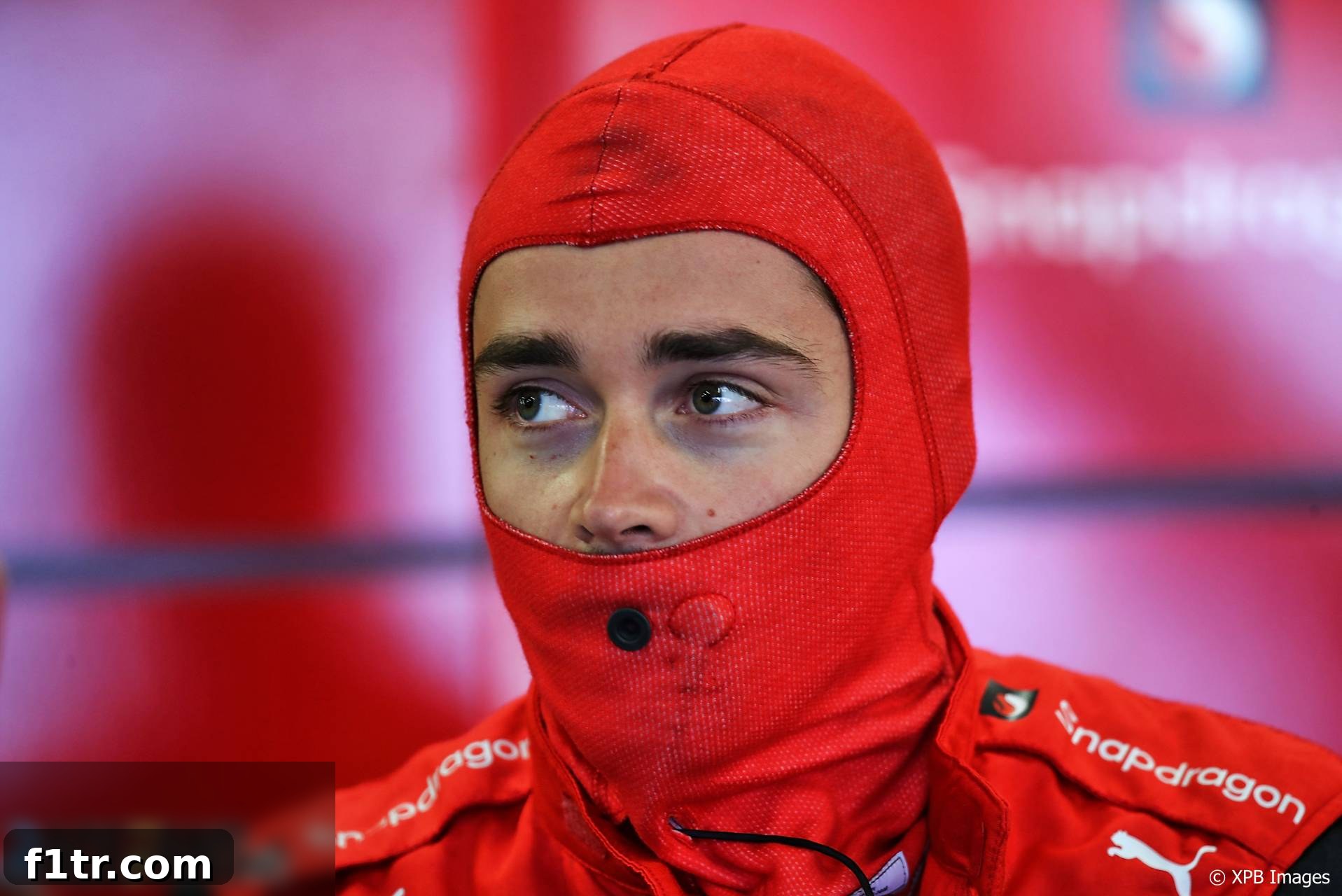
Charles Leclerc is set to incur a significant grid penalty at this weekend’s Canadian Grand Prix following Ferrari’s decision to change further power unit components on his car, a move that severely impacts his championship campaign.
Advert | Become a Supporter & go ad-free
Charles Leclerc Faces Grid Penalty at Canadian Grand Prix Amidst Power Unit Woes
In a major blow to Ferrari and their championship hopeful, Charles Leclerc, the Monegasque driver will indeed face a grid penalty at this weekend’s Canadian Grand Prix. This development stems from the team’s need to replace yet another critical power unit component – specifically, the control electronics – pushing Leclerc beyond the permitted allocation for the 2022 Formula 1 season. This decision comes on the heels of a devastating power unit failure that forced Leclerc to retire from the lead of the Azerbaijan Grand Prix just days prior, a bitter and recurring setback for his title challenge.
Ferrari’s Unfortunate Power Unit Dilemma in Montreal
The Canadian Grand Prix, held at the challenging Circuit Gilles Villeneuve, was poised to be a crucial event for Ferrari to regain momentum after recent disappointments. However, the persistent technical issues plaguing Charles Leclerc’s F1-75 have necessitated a series of component replacements, inevitably leading to a grid drop. For the Montreal race, Ferrari has opted to fit new control electronics (CE) to Leclerc’s car. This marks the third set of control electronics utilized by Leclerc this season, directly exceeding the maximum allowance of two components per driver for the entire championship. As per Formula 1 regulations, the first instance of exceeding this limit for a specific power unit component results in an automatic 10-place grid penalty.
This penalty is a direct consequence of the escalating reliability problems that have haunted Leclerc’s campaign. The power unit failure in Baku was notably the second time he had retired from a leading position due to engine-related issues, following a similar incident at the Spanish Grand Prix. Such critical setbacks not only cost valuable championship points but also put immense pressure on the team to find a durable solution quickly without compromising performance or incurring further penalties, a challenge they are clearly struggling to overcome.
Understanding F1 Power Unit Regulations and Component Limits Explained
Formula 1’s stringent regulations are meticulously designed to control costs, promote parity, and prevent excessive development, placing strict limits on the number of power unit components each driver can use throughout a season. The modern F1 power unit is an exceptionally intricate hybrid system, comprising several sophisticated key elements, each with its own allocation limit:
- ICE (Internal Combustion Engine): The core gasoline engine, responsible for primary propulsion. Drivers are permitted three per season.
- TC (Turbocharger): A device that boosts engine power by compressing and forcing more air into the engine cylinders. Drivers are permitted three per season.
- MGU-H (Motor Generator Unit – Heat): A complex energy recovery system that converts heat energy from exhaust gases into electrical energy. Drivers are permitted three per season.
- MGU-K (Motor Generator Unit – Kinetic): Recovers kinetic energy during braking, converting it into electrical energy to be stored or deployed. Drivers are permitted three per season.
- ES (Energy Store): The high-voltage battery pack that stores electrical energy recovered by the MGU-H and MGU-K. Drivers are limited to two per season.
- CE (Control Electronics): The sophisticated electronic brain that manages and coordinates the entire complex power unit system. Drivers are limited to two per season.
- EX (Exhaust System): The complete set of exhaust pipes and associated components. Drivers are allowed eight per season, reflecting their higher wear and tear.
Exceeding these predefined limits triggers mandatory grid penalties. The penalty structure begins with a 10-place grid drop for the first power unit component that goes over its specific allocation. Subsequent components exceeding their individual limits incur an additional five-place drop each. Furthermore, a complete new power unit change beyond the allowed allocation typically results in the driver starting the race from the very back of the grid, a highly undesirable scenario for any competitive team.
Leclerc’s penalty specifically stems from deploying a third set of control electronics. Prior to this weekend’s Canadian Grand Prix, Ferrari had already made a series of power unit component changes to his car in an effort to mitigate ongoing reliability concerns. These included fitting a new internal combustion engine (ICE), MGU-H, and MGU-K ahead of the first practice session. Crucially, these specific changes did not incur a penalty at the time because they remained within the season’s permissible allocation for those individual components. However, the subsequent, and seemingly unavoidable, need for a third set of control electronics has now definitively pushed him over the edge, making the 10-place grid penalty for Sunday’s race an unalterable reality.
The Looming Threat: A Potential Back-of-the-Grid Start?
The situation for Charles Leclerc could yet worsen significantly, escalating from a 10-place grid penalty to an even more severe consequence. During the second practice session in Montreal, a worrying issue with his turbocharger came to light. His race engineer, Xavier Marcos Padros, communicated that Leclerc was unable to perform customary “burn-outs” with the car due to problems identified with this critical component. The turbocharger (TC) is notably one of the few core power unit components on Leclerc’s car that has yet to be replaced this weekend, suggesting it might be an older unit nearing the end of its life or suffering from prior stress.
This development raises the alarming possibility that Ferrari may be forced to undertake yet another comprehensive power unit change, potentially involving the turbocharger itself or other integral, highly stressed parts, before Sunday’s Grand Prix. Should Ferrari decide to replace additional power unit components that further exceed the allowable limits – particularly if it constitutes a complete new power unit assembly, or if multiple components go beyond their individual allocations at once – Leclerc would face an even more severe penalty: starting the Canadian Grand Prix from the very back of the grid. Such a scenario would undoubtedly deal a crushing blow to his hopes of securing a strong result and regaining vital ground in the closely contested championship battle against Max Verstappen.
The team now faces a difficult and high-stakes strategic choice: risk another critical component failure during the intense pressures of the race, which could lead to another DNF and zero points, or bite the bullet and take a full grid penalty now. Opting for a full power unit replacement would effectively sacrifice one race weekend, but it could potentially ensure greater reliability and longevity for the remainder of the demanding season. Given the immense championship stakes, this decision, to be made in consultation with engineers and strategists, will be absolutely critical for Ferrari’s 2022 campaign and Leclerc’s title aspirations.
Power Unit Component Usage Across the Grid: A Comparative Analysis
Charles Leclerc’s current predicament at the Canadian Grand Prix vividly highlights a broader, season-long challenge faced by many teams on the Formula 1 grid regarding power unit reliability, performance management, and strategic component usage. The comprehensive table below provides a detailed overview of the power unit components utilized by each driver up to this point in the Canadian Grand Prix weekend. This data offers crucial insight into which drivers and manufacturers are performing well within limits, and who else might be precariously approaching or already exceeding their allocated component thresholds, potentially facing similar penalties in upcoming races.
| N° | Car | Engine | Driver | ICE | TC | MGU-H | MGU-K | ES | CE | EX |
|---|---|---|---|---|---|---|---|---|---|---|
| 63 | Mercedes | Mercedes | George Russell | 2 | 2 | 2 | 2 | 1 | 1 | 3 |
| 44 | Mercedes | Mercedes | Lewis Hamilton | 2 | 2 | 2 | 2 | 1 | 1 | 3 |
| 1 | Red Bull | Red Bull | Max Verstappen | 2 | 2 | 2 | 2 | 1 | 1 | 3 |
| 11 | Red Bull | Red Bull | Sergio Perez | 2 | 2 | 2 | 2 | 1 | 1 | 4 |
| 16 | Ferrari | Ferrari | Charles Leclerc | 3 | 3 | 3 | 3 | 1 | 3 | 4 |
| 55 | Ferrari | Ferrari | Carlos Sainz Jnr | 2 | 2 | 2 | 2 | 1 | 2 | 4 |
| 3 | McLaren | Mercedes | Daniel Ricciardo | 2 | 2 | 2 | 2 | 1 | 1 | 2 |
| 4 | McLaren | Mercedes | Lando Norris | 2 | 2 | 2 | 2 | 1 | 1 | 2 |
| 14 | Alpine | Renault | Fernando Alonso | 4 | 4 | 4 | 4 | 3 | 3 | 4 |
| 31 | Alpine | Renault | Esteban Ocon | 3 | 3 | 3 | 3 | 2 | 2 | 3 |
| 10 | AlphaTauri | Red Bull | Pierre Gasly | 3 | 3 | 3 | 3 | 2 | 2 | 5 |
| 22 | AlphaTauri | Red Bull | Yuki Tsunoda | 4 | 4 | 4 | 4 | 2 | 2 | 5 |
| 18 | Aston Martin | Mercedes | Lance Stroll | 2 | 2 | 2 | 2 | 2 | 2 | 2 |
| 5 | Aston Martin | Mercedes | Sebastian Vettel | 2 | 2 | 2 | 3 | 2 | 2 | 2 |
| 23 | Williams | Mercedes | Alexander Albon | 2 | 2 | 2 | 2 | 2 | 2 | 2 |
| 6 | Williams | Mercedes | Nicholas Latifi | 2 | 2 | 2 | 2 | 2 | 2 | 2 |
| 77 | Alfa Romeo | Ferrari | Valtteri Bottas | 3 | 3 | 3 | 2 | 1 | 2 | 4 |
| 24 | Alfa Romeo | Ferrari | Zhou Guanyu | 2 | 2 | 2 | 2 | 1 | 1 | 3 |
| 20 | Haas | Ferrari | Kevin Magnussen | 3 | 3 | 3 | 3 | 2 | 2 | 4 |
| 47 | Haas | Ferrari | Mick Schumacher | 2 | 3 | 2 | 2 | 2 | 2 | 4 |
From the detailed data presented in the table, it becomes unequivocally clear that Charles Leclerc (Car N°16) is a notable outlier among the front-running teams. He has now utilized three internal combustion engines (ICE), three turbochargers (TC), three MGU-Hs, three MGU-Ks, and crucially, three control electronics (CE). This positions him significantly ahead of his main championship rival, Max Verstappen, and other top contenders like Lewis Hamilton, who are still predominantly on their second units for most core power unit components. While other drivers, such as Fernando Alonso (Car N°14 for Alpine), have also exceeded limits on ICE, TC, MGU-H, and MGU-K, his situation with the Energy Store (ES) and Control Electronics (CE) is currently less critical than Leclerc’s. This stark disparity in component usage underscores the severe and persistent reliability issues impacting Ferrari’s power unit design this season, problems that appear to be affecting Leclerc’s car more frequently and severely than that of his teammate, Carlos Sainz Jnr, who is still on his second CE and largely on his second allocation for other major components.
Impact on Championship Hopes and Ferrari’s Strategic Crossroads
This escalating series of grid penalties could prove incredibly costly for Charles Leclerc in his fervent bid for the 2022 Formula 1 World Championship. Having commenced the season with formidable pace and a strong points lead, Leclerc has tragically seen his initial advantage over Max Verstappen evaporate due to a combination of strategic missteps and, more critically, recurring power unit failures. Entering the Canadian Grand Prix weekend, he was already trailing Verstappen in the drivers’ standings, and a guaranteed 10-place grid drop will make it exceptionally harder to challenge for victory or even a crucial podium finish at a circuit known for its challenging nature and propensity for unpredictable races.
The Circuit Gilles Villeneuve is a unique semi-street circuit characterized by its distinct layout featuring long, high-speed straights interspersed with tight chicanes and heavy braking zones. This configuration demands a delicate balance of top speed for overtaking and robust braking stability. Overtaking opportunities certainly exist, particularly into the final chicane infamously known as the ‘Wall of Champions,’ but starting from well outside the top ten will necessitate an exceptionally aggressive and calculated recovery drive. Such a high-intensity performance will inevitably put additional stress on the very power unit components that have been causing Ferrari so much grief throughout the season.
Ferrari’s engineers and strategists are now undeniably at a precarious crossroads. They must meticulously weigh the immediate impact of the confirmed 10-place penalty against the long-term reliability and integrity of Leclerc’s power unit. If the turbocharger issue detected during FP2 proves to be significant and indicative of an impending failure, taking a full new power unit and consequently starting from the back of the grid might be reluctantly viewed as a necessary evil. This proactive measure would aim to ensure no further retirements in subsequent, equally crucial races. Such a strategic move, albeit painful in the short term, would allow Leclerc to cycle in entirely fresh components across the board, hopefully providing a comprehensive reset for his engine allocation and fundamentally enhancing reliability for the remainder of what promises to be an intensely tight and demanding championship fight.
The pressure is mounting exponentially on team principal Mattia Binotto and his entire technical team to address these critical reliability concerns comprehensively and with utmost urgency. With Red Bull Racing consistently demonstrating robust performance and commendable reliability, Ferrari simply cannot afford any more operational missteps, strategic blunders, or technical failures if they genuinely hope to challenge for both the Drivers’ and Constructors’ World Championship titles in 2022.
Looking Ahead: The Road to Recovery for Leclerc and Ferrari
While a grid penalty is unequivocally never ideal, especially for a title contender in the thick of a championship battle, Charles Leclerc is widely renowned for his resilient driving style, unwavering determination, and exceptional ability to perform under immense pressure. His primary focus will undoubtedly be on maximizing every available opportunity in qualifying, even with the looming penalty, and then executing a meticulously planned, flawless race to climb through the field as efficiently as possible. The Canadian Grand Prix has historically delivered some of Formula 1’s most thrilling and unpredictable races, offering a potential glimmer of hope for a strong recovery drive, should strategy and circumstances align favorably.
However, the underlying and persistent issue of power unit reliability remains Ferrari’s single most pressing concern. The team urgently needs to thoroughly diagnose and definitively rectify the fundamental problems afflicting their power units to prevent any further penalties, costly retirements, and erosion of championship points. The 2022 championship battle is fiercely contested and finely balanced, and every single point, every race finish, and every reliable power unit component will be absolutely crucial in the remaining races of this exhilarating Formula 1 season. Ferrari’s ability to overcome these reliability hurdles will largely dictate the trajectory of Leclerc’s championship challenge and their overall success in 2022.
Advert | Become a RaceFans supporter andgo ad-free
2022 Canadian Grand Prix Related Articles
- Alfa Romeo see “great future in F1” for Zhou after best result so far
- Ocon has “big hopes” for Alpine’s Silverstone upgrade package
- Hamilton’s Canada podium especially satisfying after run of “bad luck” – Wolff
- Verstappen urges Red Bull to find more pace after close win in Canada
- More confident Sainz is now a contender for wins – Binotto
Browse all 2022 Canadian Grand Prix articles