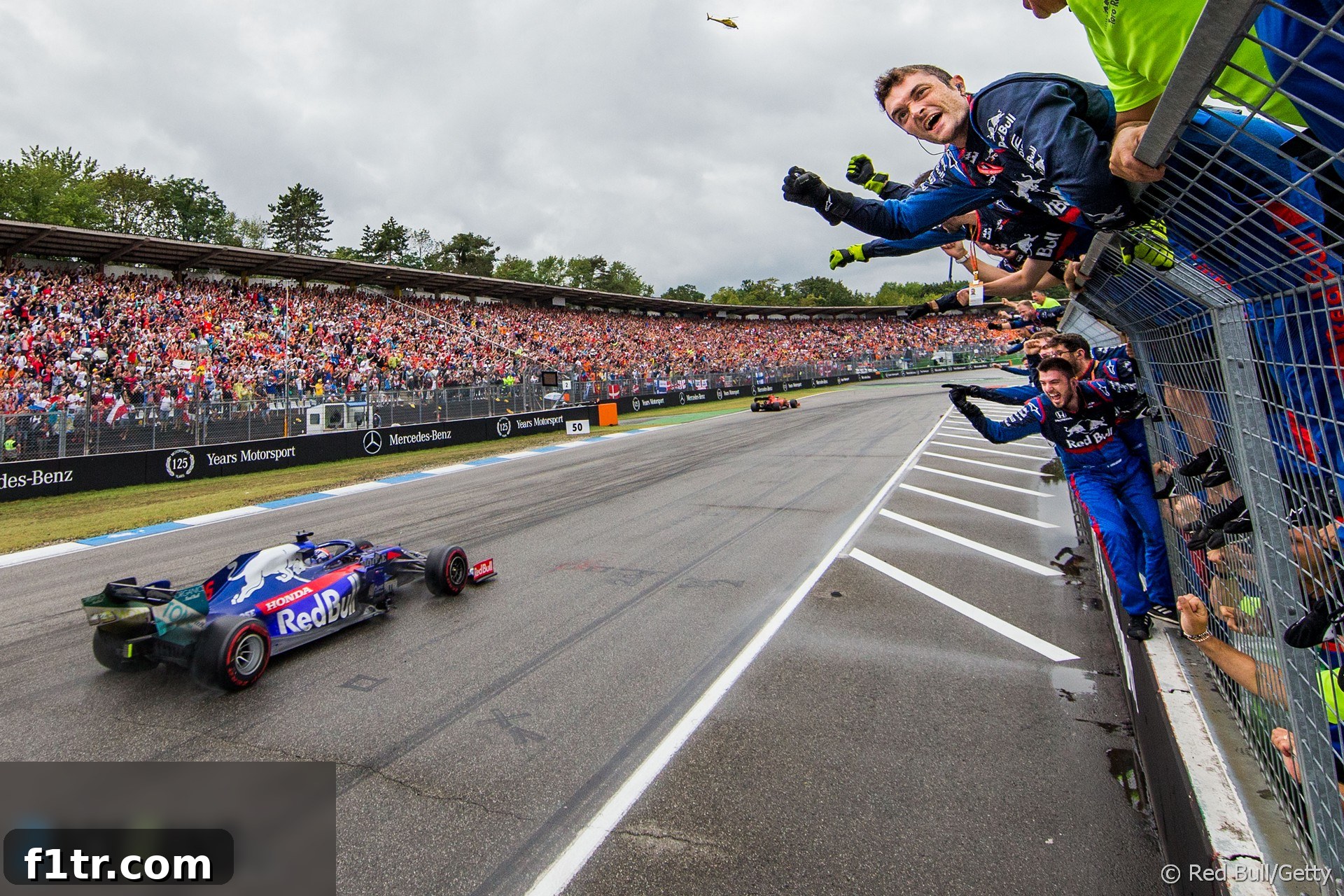
The 2019 Formula 1 season presented a complex narrative for Daniil Kvyat. Returning to the sport for his third stint with the Red Bull-backed Toro Rosso team, the Russian driver’s year was a tapestry woven with moments of undeniable brilliance and frustrating inconsistency. While he delivered a sensational third-place finish at the chaotic German Grand Prix – marking only the second podium in Toro Rosso’s then 14-year history – this high point often served to underscore a season where he was largely outshone by both of his different teammates.
Kvyat’s performance over the year revealed a concerning trend. When comparing the points tallies from the races where Alexander Albon and Pierre Gasly competed alongside Kvyat, their combined efforts significantly outscored him 48 to 37. This disparity is particularly telling, considering the varied circumstances of his teammates. Alexander Albon began the season as a complete Formula 1 rookie, having never driven an F1 car before February testing. Pierre Gasly, on the other hand, endured the considerable challenge of adjusting to a new chassis and environment mid-season after his demotion from Red Bull Racing. For an experienced driver like Kvyat, these comparisons painted a picture of unfulfilled potential and a struggle to consistently perform at the expected level.
In the initial phase of the season, Kvyat and Albon appeared reasonably closely matched. However, for Kvyat, this proximity in performance was unsettling. As the more experienced driver, he was expected to comfortably lead the team, especially against a rookie with no prior F1 experience. While his third-place finish in Germany was genuinely well-deserved and a testament to his race craft in challenging conditions, it must be contextualized. The podium outcome hinged on a daring tyre gamble, a strategic risk that Kvyat was primarily in a position to take because he spent a significant portion of the race behind his teammate, Albon, who himself delivered a superb and steady drive in the treacherous wet-dry conditions. This dynamic highlighted that while Kvyat could seize opportunistic moments, Albon often set a strong, consistent benchmark.
Following Red Bull’s dramatic mid-season seat swap, which saw Albon promoted and Gasly demoted, Pierre Gasly joined Kvyat at Toro Rosso for the remainder of the year. Despite Kvyat having the advantage of familiarity with the team and car, he was comfortably outscored by Gasly in the second half of the season. This period brought into sharp focus Kvyat’s ongoing struggles. While some of his troubles were certainly not of his own making, they nonetheless contributed to the widening performance gap between him and his revitalized teammate.
For instance, a debilitating loss of oil pressure at the Italian Grand Prix in Monza robbed Kvyat of a likely sixth-place finish after what had been an excellent drive. His home race in Russia was also severely hampered by a series of technical problems during practice, compromising his qualifying and race performance. These unfortunate incidents undoubtedly impacted his points tally and overall standing. However, even accounting for these setbacks, Gasly’s consistent speed and impressive results, particularly towards the end of the season, demonstrated a clear edge.
Daniil Kvyat |
|
|---|---|
| Beat team mate in qualifying | 7/19 |
| Beat team mate in race | 10/17 |
| Races finished | 18/21 |
| Laps spent ahead of team mate | 565/1182 |
| Qualifying margin | +0.09 |
| Points | 37 |
One area where Kvyat frequently found himself on the back foot was qualifying. Pierre Gasly regularly outperformed him over a single lap, which often dictated their race positions and point-scoring opportunities. Kvyat notably failed to progress out of Q1 in both Singapore and Brazil. The latter had a particularly significant effect on the points difference between the two drivers, as Gasly, after a strong qualifying, went on to achieve an incredible second-place finish in the Brazilian Grand Prix. Kvyat also struggled to match Gasly’s raw one-lap pace at the Suzuka circuit, further highlighting a recurring weakness in his overall performance profile against his teammates.
Beyond raw pace, Kvyat’s season was marred by a series of incidents that rekindled his unwelcome “torpedo” moniker – a reputation earned for aggressive and sometimes clumsy wheel-to-wheel combat. Having amassed enough starts in his latest return to Toro Rosso to become the team’s longest-serving driver, one might have expected a greater degree of maturity and precision in his racing. Yet, that characteristic carelessness was evident again in his tangles with the McLaren drivers in China, resulting in a penalty, and a collision with Antonio Giovinazzi in Bahrain. These early-season skirmishes served as a precursor to similar incidents later in the year.
As the season progressed, Kvyat found himself on course for points in Mexico and the United States, only to pick up late-race penalties for collisions. In Mexico, he clashed with Nico Hulkenberg, and in the USA, he was penalized for an incident with Sergio Perez. What was perhaps more telling than the incidents themselves was Kvyat’s consistent reluctance to admit his error, often shifting blame or maintaining his innocence. This perceived lack of self-reflection suggested that a change in approach was unlikely, leaving observers to anticipate more of the same in subsequent seasons.
Perhaps the most telling verdict on Daniil Kvyat’s 2019 efforts came directly from Red Bull. On two separate occasions during the season, the senior team had the opportunity to recall their most experienced junior driver to Red Bull Racing – a position Kvyat had previously held. Both times, they unequivocally chose Alexander Albon over him. This decision spoke volumes about their assessment of Kvyat’s readiness and overall performance compared to a rookie. With Pierre Gasly rebounding so impressively from his Red Bull ejection, demonstrating renewed speed and maturity at Toro Rosso, it became increasingly difficult to envision Kvyat getting another chance with the main Red Bull team. While we should never assume too much when it comes to the unpredictable nature of Red Bull’s young driver program, the signs from 2019 were clear: Kvyat’s path back to the top seemed more closed than ever.
Over to you: What’s your verdict on Daniil Kvyat’s 2019 season?
Having reviewed the highs and lows of Daniil Kvyat’s 2019 Formula 1 season, we invite you to share your thoughts. What were your impressions of his performance? Which drivers do you feel he performed better or worse than throughout the year? Did his German Grand Prix podium overshadow his inconsistencies, or did it highlight his missed opportunities? We value your insights and encourage you to have your say in the comments section below.
Vote for your 2019 F1 driver of the year
In addition to discussing Kvyat’s season, don’t miss the opportunity to cast your vote for the standout performer of the 2019 F1 season. Join in our poll and have your say here:
- Vote for your 2019 F1 Driver of the Year
2019 F1 season review: Dive deeper into the year’s top performances
- ‘I should have done a better job. There’s things that I know I can do better’
- ‘I am definitely not a rookie anymore – but I’m still getting better’
- ‘I didn’t believe in myself much. But after Australia and Bahrain and I gained a lot of confidence’
- ‘It was my best season for sure so far in terms of pure results and speed’
- ‘There’s been plenty of good performances – but there’s also other years I’ve performed at my best’
Browse all 2019 F1 season review articles