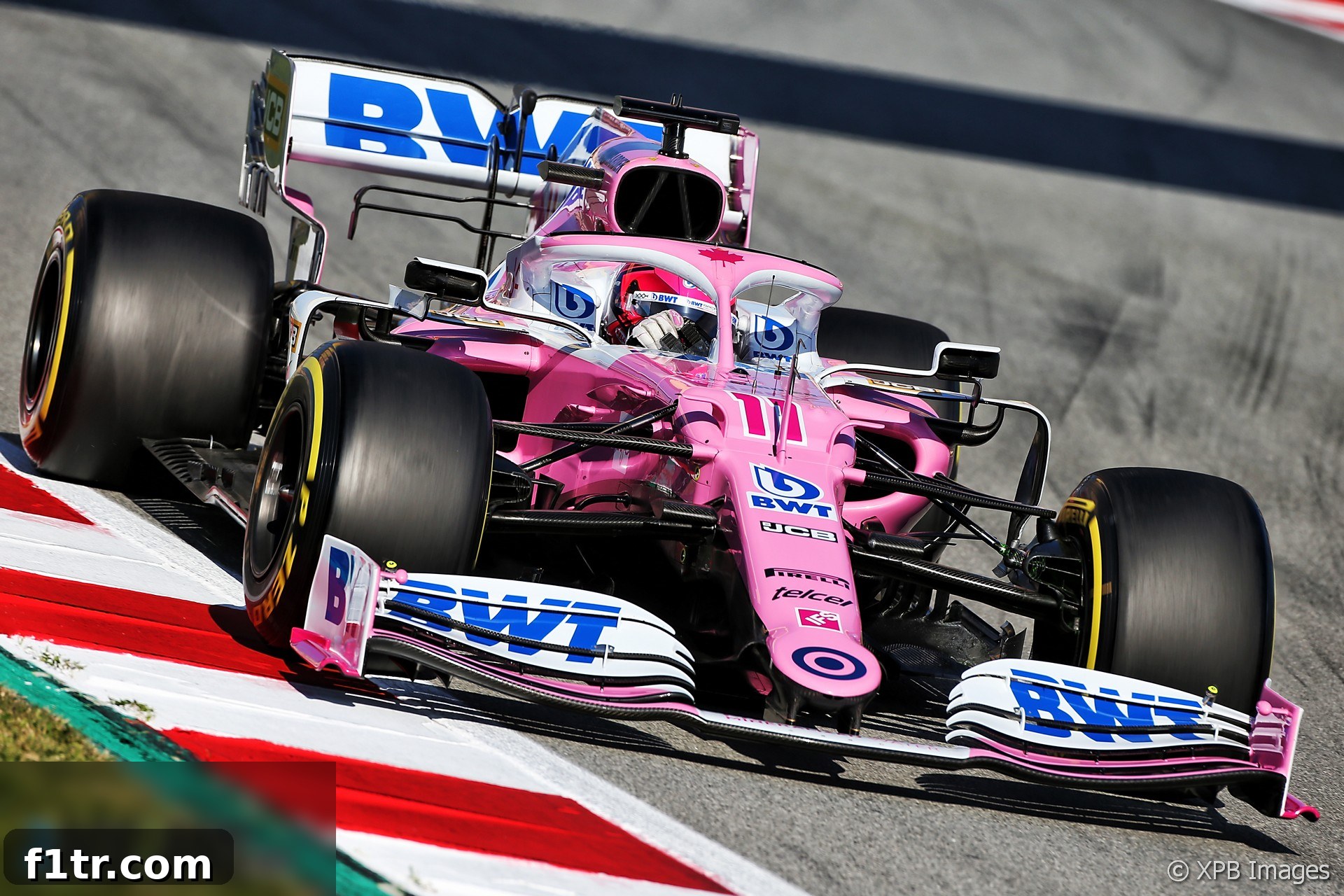
Racing Point’s RP20: Andrew Green Defends “Completely Legal” Design Amidst Rival Criticism
Racing Point’s technical director, Andrew Green, has delivered a scathing assessment of rival teams who have voiced strong criticism regarding the striking resemblance of their 2020 F1 challenger, the RP20, to the championship-winning Mercedes W10. Green dismissed their concerns as “naive” and firmly asserted that rivals had fundamentally underestimated Racing Point’s potential and strategic approach.
The RP20, often dubbed the ‘pink Mercedes’ by its detractors, shares a remarkable visual and aerodynamic philosophy with Mercedes’ dominant 2019 car. This isn’t entirely coincidental; Racing Point has a well-established technical partnership with Mercedes, utilising their power unit, gearbox, and various suspension components. Green openly confirmed that the team’s new car intentionally adopted the aerodynamic concepts pioneered by the reigning world champions, a move that ignited a significant debate within the Formula 1 paddock.
This controversial design choice has led to considerable backlash from several midfield competitors, some of whom have sarcastically rebranded the team as ‘Tracing Point’. However, Green remains unfazed, suggesting that instead of complaining, these rivals should be introspectively questioning why they failed to pursue a similar, highly effective strategy.
Rivals’ Frustration and the “Naive” Underestimation
Green didn’t mince words when addressing the perceived frustration from other teams. “It boils down to the fact that some of the teams may have not done as good a job as they should have done. I think they’re probably seeing that,” he stated. He drew attention to Racing Point’s impressive track record under its previous guise as Force India, where, despite operating on an extremely limited budget, the team consistently outperformed expectations.
“We’re a team that finished fourth two years on the trot with next to no money at all. We were absolutely hand-to-mouth and we finished fourth in the championship, we beat the likes of McLaren. We could do that with next to nothing,” Green reminded critics, highlighting the team’s inherent capability and resourcefulness even in financially constrained circumstances.
For anyone to believe that injecting substantial capital and resources into such an already capable team wouldn’t yield significant improvement, Green argued, was profoundly naive. He implied that the rivals’ complaints stemmed from their own shortcomings rather than any perceived wrongdoing by Racing Point. “I think a lot of their frustration is probably looking inwards and going ‘crikey, we haven’t done a very good job’,” he mused. “That’s what I’d be thinking if I was looking from the outside, then I’d be looking at my aero department going, ‘Come on guys, what on earth have you been playing at?'”
The RP20’s Legality: A Firm Stance
Central to Green’s defence is his unwavering conviction in the complete legality of the RP20. He categorically dismissed any suggestions of rule-breaking. “I don’t know what they’ve got to complain about because what we’ve done is completely legal,” he asserted, challenging rivals to point to any specific infringement. His argument hinges on the fundamental principle of Formula 1: operating within the established regulatory framework to achieve maximum performance.
“What we’re doing is racing with the rules that are written. Which I think is the idea of the game, really: You’re given a set of rules and you go fast. And that’s what we’re doing. We’ve been given a set of rules, we’re going as fast as we can,” Green elaborated, framing their strategy as a pure application of competitive ingenuity within the given parameters. The team, according to Green, meticulously adhered to the FIA’s technical regulations regarding “listed parts” and intellectual property, ensuring that every component and design philosophy was acquired or developed in accordance with the rules.
This raises an intriguing question about why other teams, particularly those with similar customer relationships with Mercedes, haven’t adopted a comparable strategy. Green himself expressed surprise on this front. Asked whether he was astonished that fellow Mercedes customer Williams hadn’t taken a similar approach, Green replied, “Yeah, very. I’m surprised a few teams haven’t done it.” This suggests that the opportunity was available, but other teams made different strategic decisions for reasons unknown to Racing Point.
A Long-Awaited Strategic Shift: The Impact of Lawrence Stroll
Green clarified that the strategic decision to adopt this design philosophy was not made lightly or hastily. It was, in fact, an ambition that the team harboured for a considerable period but lacked the financial capability to execute. “It’s something that we’ve been wanting to do for a very long time and haven’t had the budget to do. This was a natural thing for us to do. Absolutely, 100% natural,” he explained, painting a picture of a team finally empowered to realise its true potential.
The turning point, Green confirmed, arrived with the acquisition of the team’s assets by Lawrence Stroll and his consortium in the middle of 2018, following Force India’s entry into administration. This injection of capital provided the critical resources necessary to undertake such a fundamental design overhaul, a luxury previously unavailable to the cash-strapped outfit.
“We couldn’t go this route earlier. Our hands were tied financially and had been for many, many years,” Green detailed the team’s historical predicament. “We had to carry over a huge amount of components from one year to the next and it wasn’t possible to do a reset like we’ve done. We didn’t have the financial resource, we didn’t have the people and we didn’t have the manufacturing capability as well. It takes a lot of infrastructure change to be able to do what we’ve just done and we didn’t have that.”
The implementation of this ambitious plan required significant time and investment. Green recounted the extensive process: “From the time that Lawrence and the consortium took over, for me to explain what we wanted to do and how we wanted to work, for all that to be implemented took quite a while. It took six to nine months and then we could start work. It was a long process, but one we decided we were going to do right from the very beginning, as soon as we came out of the administration.” This narrative underscores that the RP20’s design was not a spontaneous decision but the culmination of years of ambition and strategic planning, finally made possible by new ownership.
Criticism as Encouragement: A Sign of Success
Far from being disheartened by the critical reception, Andrew Green admitted that the complaints from rival teams actually provide him with a sense of encouragement. “People are complaining about us. That is a good indication to me that we’re doing something really good. I’m happy. If we were at the bottom of the pack, no one would be mentioning what we’ve done at all,” he said with a touch of defiance. This perspective suggests that the uproar is, in fact, a testament to the RP20’s perceived performance and the threat it poses to the established pecking order in the midfield.
The “pink Mercedes” controversy highlights the competitive intensity of Formula 1, where every team seeks an advantage within the strictures of the rules. Racing Point’s bold move with the RP20 not only sparked a contentious debate about car design ethics and the spirit of the regulations but also positioned the team as a serious contender for top midfield honours, capable of challenging even the constructors with significantly larger budgets and historical prowess. Their defiance in the face of criticism, underpinned by a strong legal standing and a clear strategic vision, solidifies their position as a team that is not afraid to push boundaries to achieve success.
Impact on the 2020 F1 Season and Beyond
The performance of the RP20 throughout the 2020 F1 season was a direct vindication of Andrew Green’s confidence. Despite the initial uproar and ongoing scrutiny, the car proved highly competitive, securing podiums and consistent points finishes. This success fueled further debate on “copycat” designs and ultimately led to some adjustments in F1 regulations concerning the transfer of intellectual property between teams.
The Racing Point story, culminating in its transformation into Aston Martin F1, stands as a significant chapter in modern Formula 1 history. It demonstrated how strategic alliances and a shrewd interpretation of regulations, when combined with substantial investment, can dramatically alter a team’s fortunes and challenge the established order. Green’s steadfast defence of the RP20 not only championed his team’s approach but also ignited crucial discussions that helped shape the future technical landscape of the sport.
The legacy of the “pink Mercedes” is complex: a symbol of ingenuity for some, an example of controversial design for others. But for Andrew Green and Racing Point, it was a perfectly legal and natural step towards competitiveness, born out of years of ambition and finally realised through opportunity. Their journey served as a powerful reminder that in the high-stakes world of Formula 1, finding every possible advantage within the rulebook is not just a right, but often a necessity for success.