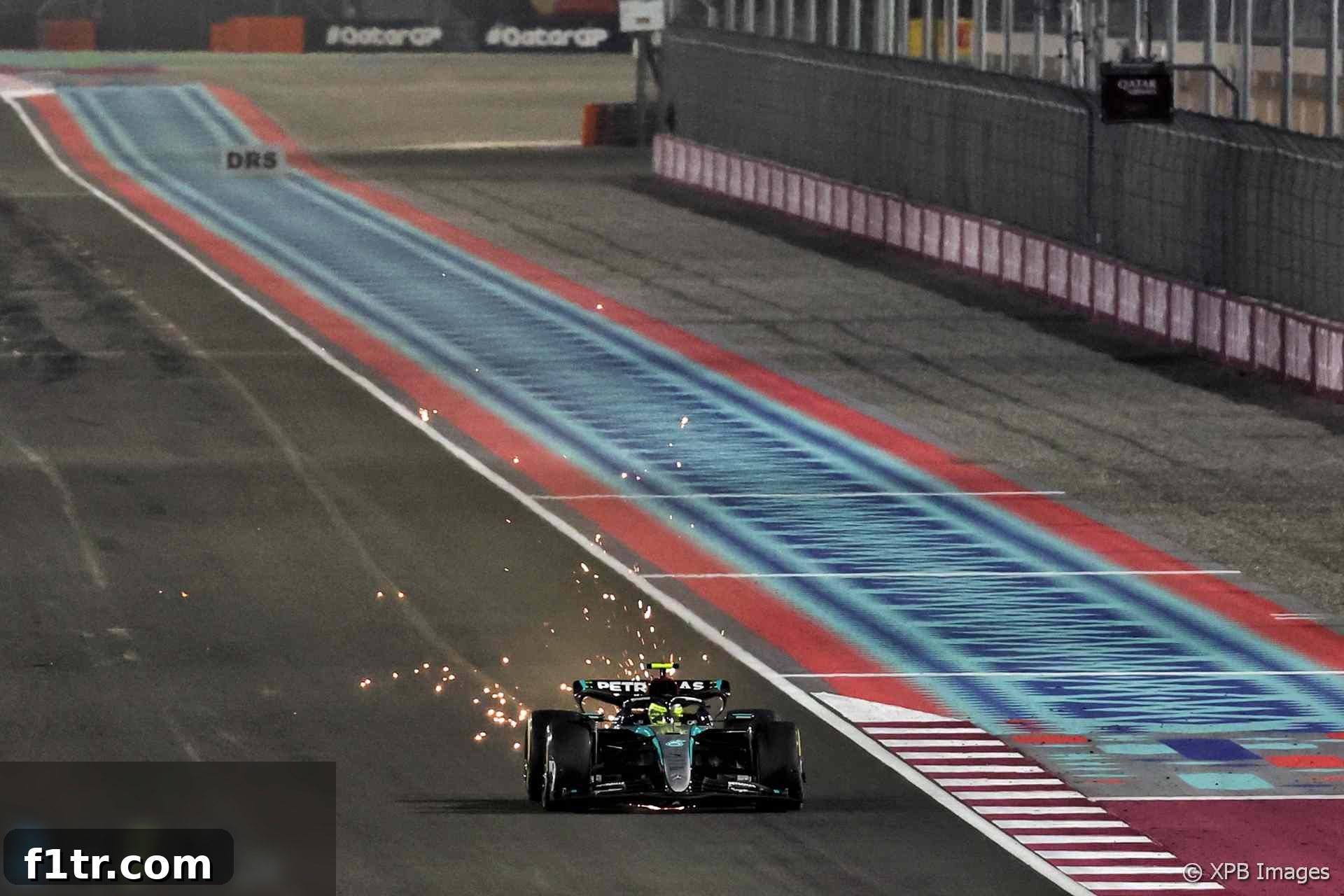
The mystery surrounding Lewis Hamilton’s untimely puncture during the high-stakes Qatar Grand Prix has taken a significant turn. Initial speculation heavily pointed towards the scattered debris from Valtteri Bottas’s incident with a wing mirror. However, a meticulous investigation by the Mercedes-AMG Petronas F1 team now suggests that this was not the root cause of Hamilton’s tyre failure, adding another layer of intrigue to a dramatic race weekend.
The incident involving Bottas, which saw him strike a wing mirror that had detached from Alexander Albon’s car, sent fragments across the track. This prompted race control to initially deploy yellow flags. Yet, controversially, these warnings were withdrawn without the debris being fully recovered, a decision that drew considerable criticism from various quarters, including fans, pundits, and some team personnel. The FIA F1 race director, Rui Marques, faced scrutiny for his choice not to neutralise the race with a Virtual Safety Car (VSC) or full Safety Car, which would have allowed marshals to safely clear the track. The FIA later provided an explanation for this decision, citing various operational considerations.
Mercedes’ Deep Dive into Hamilton’s Tyre Failure
Mercedes’ head of trackside engineering, Andrew Shovlin, recently shed light on the team’s comprehensive analysis of Hamilton’s damaged front-left tyre. Their findings challenge the widely held belief that the mirror debris caused the puncture. Shovlin’s insights, shared in a video published by the team, revealed a critical timeline discrepancy that fundamentally alters the understanding of the incident.
“We’ve obviously got the video data, we can see exactly when that mirror got smashed, when it got broken into a lot of pieces,” Shovlin explained. “We’ve also got the on-car data and we’re measuring the pressure in the tyres live. Now, surprisingly, we can see Lewis start to lose pressure prior to the mirror being hit by Valtteri. So from that, we would say it’s unlikely that it was a debris puncture. That was certainly what we thought at the time because the two appeared to be almost simultaneous.” This crucial detail, the pre-existing pressure loss, effectively decouples Hamilton’s puncture from Bottas’s mirror incident.
Beyond the Mirror: Unraveling the True Cause
While the immediate culprit appears to be ruled out, the exact cause of Hamilton’s puncture remains under investigation. Shovlin acknowledged that although the broken mirror debris is no longer suspected, the possibility of some other, unidentifiable piece of debris triggering the failure cannot be entirely ruled out. This underscores the complexities of F1 incident investigations, where precise forensic analysis is paramount.
The focus now shifts to F1’s official tyre supplier, Pirelli, which is conducting its own rigorous analysis. “It doesn’t mean that he didn’t pick up some debris elsewhere, but we need to wait for Pirelli to do their analysis and their investigations,” Shovlin stated. “They’ll do a lot of detailed checks on all the tyres, trying to understand if there’s any deterioration.” Pirelli’s examination will be crucial, involving microscopic inspection of the tyre structure, seeking signs of punctures, cuts, or internal structural failures that might not be immediately visible. Their findings will be vital for all teams to understand the tyre behavior under extreme conditions at the Lusail International Circuit.
The Demanding Nature of the Qatar Grand Prix
Hamilton was on lap 34 when he reported the puncture, a significant number of laps into his stint on the medium compound tyres. Prior to the race, Pirelli had issued cautionary advice, suggesting that drivers would struggle to extend the life of their medium tyres beyond lap 25. This pre-race guidance highlights the inherent challenge presented by the Qatar circuit, known for its high-speed corners and abrasive surface, which put immense stress on the tyres.
“A huge amount of load goes through the front-left around Qatar,” Shovlin elaborated. “There were also bits of the tyre that were wearing quite heavily and again that’s linked to the fact that you’ve got these super-fast corners that are flat out at nearly 300 kph. So once we get that analysis, we will understand a bit more.” The unique characteristics of the Lusail track, with its relentless series of high-energy turns, particularly stress the front-left tyre. This constant loading can lead to accelerated wear and, ultimately, structural integrity issues if the tyres are pushed beyond their optimal lifespan or encounter unforeseen stresses.
It’s also worth noting that Hamilton was not the only driver to suffer a puncture. Carlos Sainz’s car also experienced a tyre failure, with video evidence from his on-board cameras indicating his tyre failed before he even reached the debris field scattered by Bottas’s incident. This pattern of multiple punctures among different teams and drivers strongly suggests a broader issue at play, potentially related to the circuit’s demands or the tyre compounds themselves, rather than isolated incidents of debris.
Implications for Race Safety and Debris Management
The unfolding revelations from Mercedes’ investigation have significant implications for discussions surrounding race safety and debris management in Formula 1. If multiple tyre failures occurred independently of identifiable debris, it raises questions about the robustness of the tyres for the specific demands of a circuit like Lusail, or the accuracy of pre-race tyre life predictions. While the FIA explained its decision not to neutralise the race, the fact that tyre failures were occurring elsewhere on the track, possibly due to accumulated wear, reinforces the argument for a more proactive approach to potential hazards.
For Hamilton, the puncture was a devastating blow to his race, leading to an immediate pit stop and severely compromising his position. His radio message, “Am I dead last now?” captured the frustration and disappointment of a driver whose race was unfairly curtailed. The incident serves as a stark reminder of the fine margins in Formula 1, where a seemingly minor issue can have catastrophic consequences for a driver’s performance and championship aspirations.
The Road Ahead: Pirelli’s Verdict and F1’s Lessons
As the F1 community awaits Pirelli’s official report, the findings will be instrumental in shaping future strategies for tyre management, circuit design, and race control protocols. Understanding whether the punctures were caused by intrinsic tyre wear, unseen minor debris, or structural fatigue will inform adjustments to tyre compounds, mandatory pit stop windows, or even track resurfacing. This level of detailed post-race analysis is crucial for maintaining both the competitive integrity and the safety standards that define Formula 1.
The Qatar Grand Prix served as a powerful reminder of the extreme forces at play in modern Formula 1 and the critical role of every component, especially the tyres, in ensuring both performance and safety. Mercedes’ preliminary findings have shifted the narrative, and all eyes are now on Pirelli to deliver the definitive answer to what truly caused Lewis Hamilton’s and other drivers’ punctures on that challenging weekend in Qatar.
Related Articles from the 2024 Qatar Grand Prix
- Horner ‘believes 100%’ Verstappen did not threaten to crash into Russell
- Russell and Verstappen cast new light on clash which triggered explosive row
- Hamilton’s puncture not caused by mirror debris – Mercedes
- Another start-to-finish win shows Qatar GP could be F1’s most processional race
- “Am I dead last now?” Unheard radio from Hamilton’s disastrous Qatar GP
Browse all 2024 Qatar Grand Prix articles