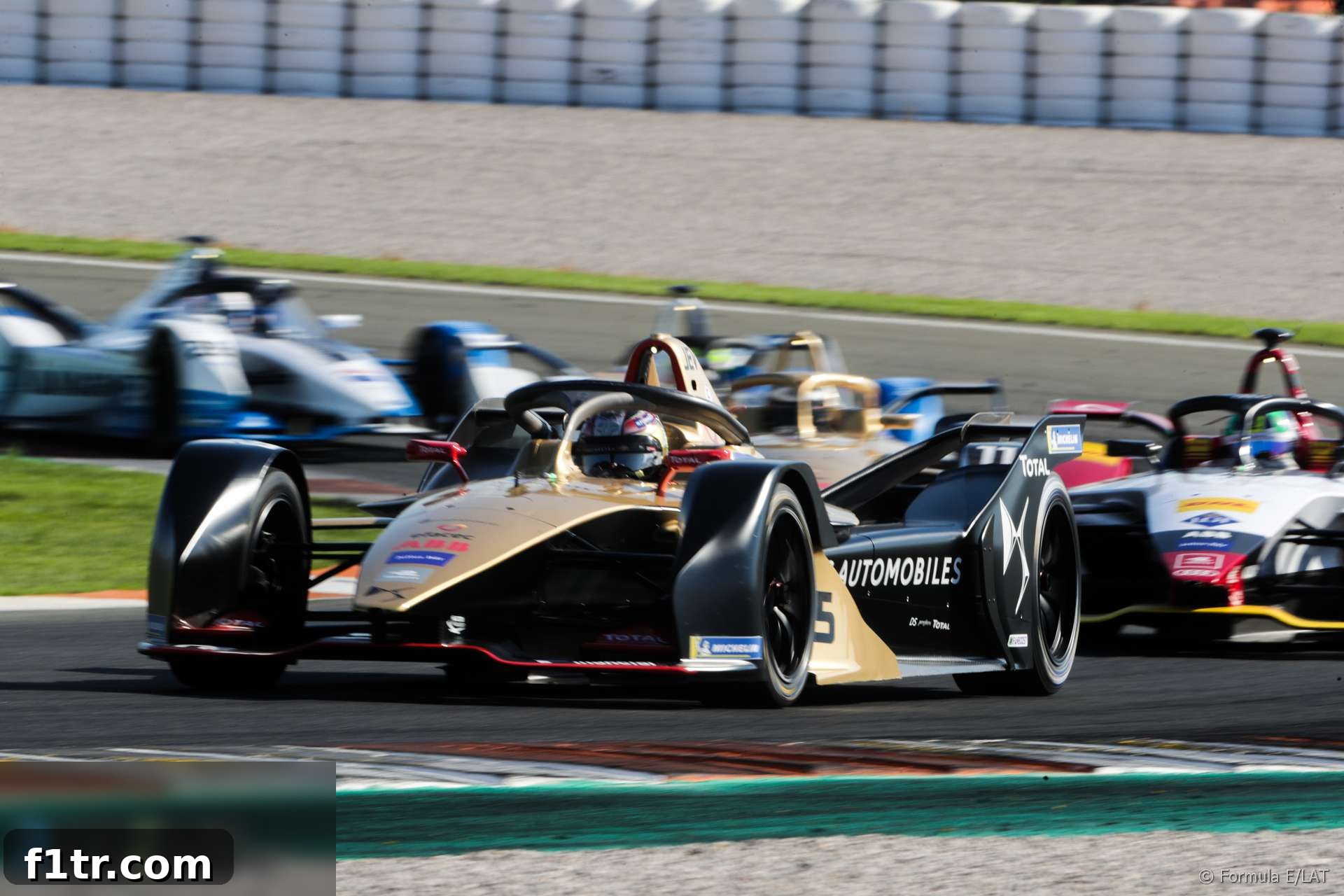
Formula E Champion Jean-Eric Vergne Voices Concerns Over New Gen2 Race Format
As the FIA Formula E Championship geared up for its highly anticipated fifth season in 2018-19, featuring the revolutionary Gen2 car and an updated race format, reigning champion Jean-Eric Vergne expressed significant apprehension. The French driver, known for his strategic prowess and articulate views on the sport, raised concerns that the series’ new structure could inadvertently lead to an increase in “flat-out” racing, a style he believes would ultimately diminish the on-track action and spectacle that has become synonymous with electric motorsport.
Vergne’s insights offered a champion’s perspective on the delicate balance Formula E strives to maintain between technological advancement, competitive fairness, and captivating entertainment. His warnings highlighted a potential paradox where efforts to enhance the sport’s technical capabilities might, without careful consideration, undermine its unique racing appeal.
The Dawn of the Gen2 Era: A Game Changer
The 2018-19 season marked a pivotal moment for Formula E with the introduction of its second-generation racing machine. The Gen2 car represented a monumental leap forward in electric vehicle technology, boasting not only a striking, futuristic design but also substantially improved performance capabilities. Its most significant upgrade was a battery pack with nearly double the energy storage capacity compared to its predecessor. This advancement meant that, for the first time in the championship’s history, drivers would be able to complete an entire race distance without the mid-race car swap that had been a characteristic feature of the first four seasons.
This elimination of the car change was widely celebrated as a crucial step towards mainstream motorsport credibility, removing a perceived “gimmick” and allowing for more traditional race narratives. Alongside the new car, Formula E also unveiled a revised race format: events would now run to a fixed time limit of 45 minutes plus one lap. This change was designed to introduce new strategic layers, forcing teams and drivers to manage energy more dynamically over a consistent period, rather than planning for a mid-race vehicle exchange.
Speaking in an exclusive interview with RaceFans at the prestigious FIA Gala, Vergne acknowledged the inherent potential of these changes. “I think it makes it very interesting, a lot of different strategies to have,” he commented, recognizing the expanded possibilities for tactical play within the new 45-minute-plus-lap structure. However, this initial optimism was quickly tempered by a critical underlying concern.
Vergne’s Central Worry: The Energy Management Paradox
At the heart of Vergne’s apprehension lay the intricate relationship between energy management and race excitement. Formula E has meticulously carved out its niche in the motorsport landscape through racing that places a premium on strategic energy conservation. Unlike traditional combustion engine racing where drivers often push their cars to the absolute limit from start to finish, Formula E demands a nuanced approach, requiring drivers to constantly balance raw speed with careful energy usage to reach the checkered flag. This strategic element is what often leads to fluctuating race paces, diverse strategies, and ultimately, more overtaking opportunities as drivers manage their battery levels.
Vergne articulated his fear that specific race scenarios, particularly extended Safety Car periods, could inadvertently nullify this crucial aspect of the competition. “The only concern I have and it’s quite a big one, is that in case of [a] long Safety Car the race becomes flat-out,” he explained. During a Safety Car intervention, race speed is significantly reduced, meaning cars consume far less energy. If such a period is prolonged, drivers would accumulate a surplus of energy, effectively negating the need for careful management for the remainder of the race.
The consequence, as Vergne highlighted, would be a shift towards “flat-out” racing – an approach where drivers simply push their machines to the maximum for every remaining lap. While this might sound appealing to some, the champion argued it fundamentally deviates from “the DNA of the championship.” He elaborated, “We don’t want flat-out races. We want to think it’s important also to save energy throughout the race.” The absence of energy management challenges, in Vergne’s view, would strip Formula E of one of its most compelling strategic dimensions, leading to processions rather than dynamic battles.
Preserving the Spectacle: Why Overtaking Matters
Vergne’s concerns were not born out of self-interest or a desire for personal advantage, but rather a profound commitment to the sport’s long-term appeal and its ability to captivate audiences worldwide. He candidly stated, “I don’t say that because it would be a benefit to me or whatever, I’m saying that because of the show, the spectacle.” His worry stemmed from the potential for a decline in exciting on-track action if energy-saving strategies become obsolete.
In a flat-out scenario, where all drivers can push their cars to their maximum performance limits, the strategic variability that generates overtaking opportunities significantly diminishes. Overtaking in Formula E is often a result of one driver managing their energy more effectively than another, allowing them to gain a late-race advantage, or by drivers being forced to lift and coast, creating speed differentials. If everyone is pushing hard, without the need for energy conservation, cars tend to form static trains, making genuine overtakes exceedingly difficult.
“If you have the race with everybody following each other with no overtaking, people will be bored and that’s not what we want as a championship,” Vergne warned. His statement underscored a critical understanding of modern sports entertainment: close competition and unpredictable outcomes are paramount for audience engagement. A lack of genuine on-track battles, even with powerful new cars, risks alienating viewers and undermining the championship’s growth trajectory.
Vergne revealed that he had already communicated his concerns to the series organizers. “I already suggested the idea but nobody really listened to me,” he explained, hinting at a frustrating lack of receptive ears within the decision-making body. Despite this, he maintained a humble perspective, adding, “Maybe I’m wrong, I don’t know, it’s just my feeling.” However, he also issued a stark informal prediction: “Hopefully I’m wrong but if in the first race we see some crashes, which we probably see in every race in Formula E, and that people are following each other because they can’t overtake because it’s a flat-out race, I think they will have to change some things.” This highlights his belief that the practical implications would become immediately apparent once racing commenced.
The Peril of Technological Dominance: Learning from F1
Beyond the immediate concerns surrounding the new race format, Vergne also touched upon a broader, more fundamental issue for the championship’s long-term health: the delicate balance between technological advancement and competitive parity. Formula E, as an all-electric series, is inherently a platform for showcasing cutting-edge electric vehicle technology. However, Vergne emphasized the collective sentiment among drivers that this technological showcase must not overshadow the competitive aspect of the sport.
“The only thing that we all tend to agree as drivers is we hope that technology will not be making too big of a difference because then if it makes a big difference it becomes like Mercedes in F1. Domination,” he articulated. This reference to the era of overwhelming F1 dominance by a single manufacturer, particularly Mercedes in the turbo-hybrid era, served as a potent cautionary tale. When one team or manufacturer achieves a significant technological advantage, it can lead to predictable outcomes, diminish suspense, and ultimately reduce viewer interest. This phenomenon is often cited as a reason for declining viewership in other motorsport categories.
Formula E, in contrast, has built its success on a foundation of fierce, unpredictable competition, where multiple manufacturers and teams genuinely feel they have a shot at victory. “I think one of the reasons why the championship is successful, and why there is so many manufacturers is that they all have the feeling, rightfully so, that they can win or achieve podiums at every race if they do the right job,” Vergne pointed out. This sense of achievable success for a wide range of competitors is a powerful magnet for new manufacturers and fosters a truly diverse and exciting grid.
Maintaining this parity requires careful regulation and a commitment to ensuring that technological innovation serves to enhance, rather than dictate, the sporting outcome. If technological superiority becomes the sole arbiter of success, the vibrant, multi-manufacturer ecosystem that defines Formula E could be at risk. Vergne concluded on this point with cautious optimism: “So hopefully we’re not going too much in that direction, too far. But so far it’s OK.”
The Road Ahead: A Champion’s Vision for Formula E
Jean-Eric Vergne’s outspoken concerns provided a vital perspective as Formula E embarked on its Gen2 journey. His warnings were not criticisms aimed at undermining the championship but rather insights from a seasoned competitor deeply invested in the sport’s continued success and evolution. The introduction of the Gen2 car and the new race format represented ambitious steps forward, designed to elevate Formula E’s profile and appeal. However, as Vergne meticulously argued, progress must be carefully balanced with the core principles that have made the series so compelling: strategic racing, energy management, and unpredictable on-track action.
The champion’s emphasis on the “show, the spectacle” underscored the commercial and entertainment imperatives facing modern motorsport. In an increasingly competitive sports landscape, a championship must consistently deliver exciting, engaging content to maintain and grow its audience. The potential for flat-out racing and the erosion of overtaking opportunities, especially if triggered by prolonged Safety Car periods, presented a tangible threat to this crucial aspect of Formula E’s identity.
Furthermore, Vergne’s call for technology not to dominate competition resonated deeply within the broader motorsport community. Formula E has successfully positioned itself as a unique blend of cutting-edge innovation and pure sporting contest. Preserving the feeling that any team, with the right strategy and execution, can achieve success is fundamental to sustaining manufacturer interest and fostering a genuinely competitive environment. As the Gen2 era unfolded, the championship faced the crucial task of listening to its champions and adapting where necessary to ensure that its bold vision for electric racing translated into a consistently thrilling spectacle for fans worldwide, cementing its position as a leading light in global motorsport.
Related Formula E Articles
- McLaren to quit Formula E at end of season
- Wehrlein beats Jaguar pair to title in dramatic Formula E finale
- Wehrlein’s London win sets up thrilling three-way title showdown in finale
- Da Costa takes hat-trick of wins in chaotic second Portland race
- Da Costa inherits Portland win from Evans after Cassidy spins lead away
Browse all Formula E articles