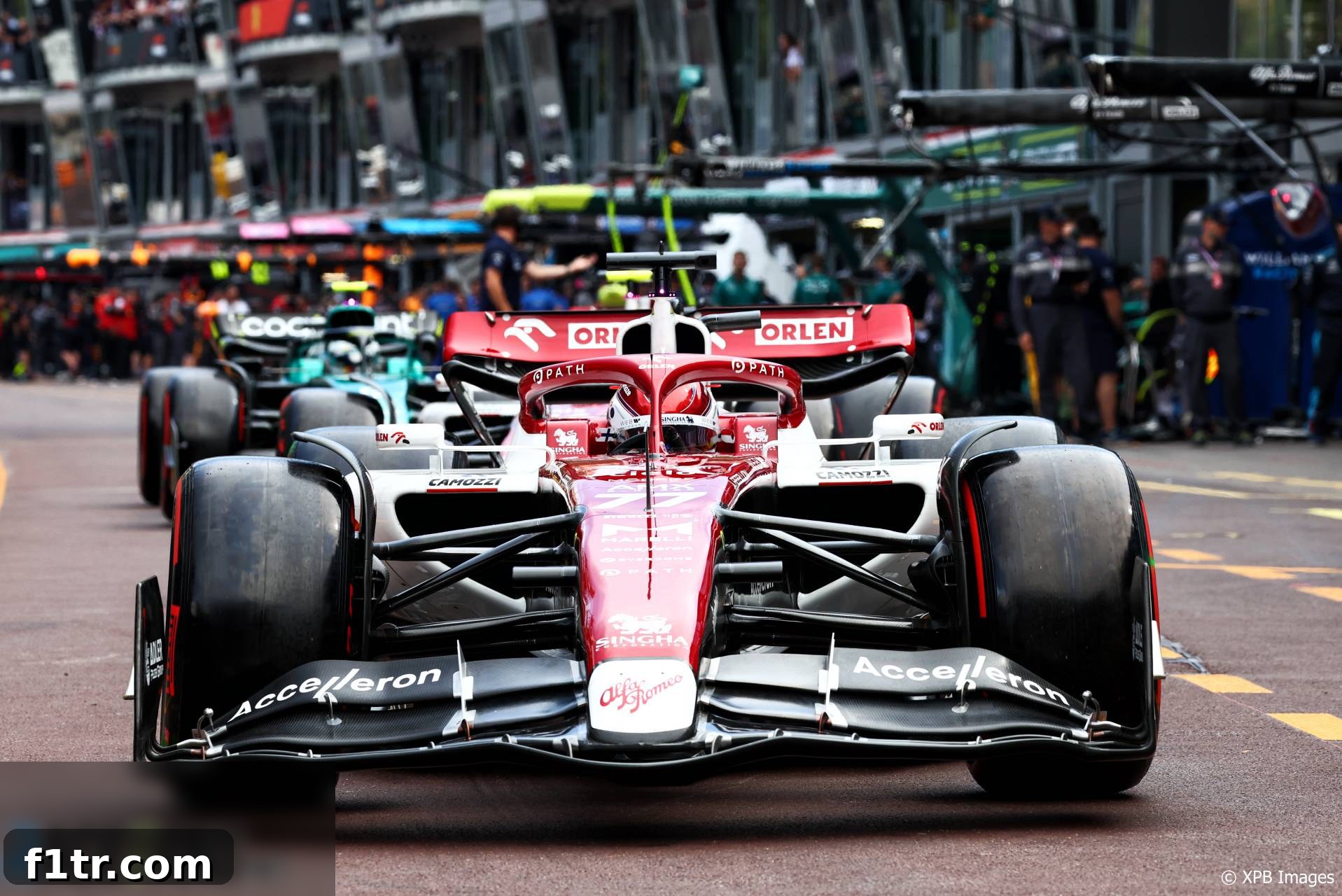
Valtteri Bottas Expresses Surprise Over Alfa Romeo’s Unexpected Underperformance at Monaco Grand Prix Qualifying
Valtteri Bottas voiced his astonishment regarding Alfa Romeo’s unexpected lack of pace at the Monaco Grand Prix qualifying session, having anticipated a much stronger showing from his team on the iconic street circuit. The Finnish driver, a seasoned veteran of Formula 1, found himself eliminated in Q2, a result that significantly fell short of both his personal expectations and the team’s ambitions for the principality.
Bottas managed to secure only 12th position on the grid for the illustrious Monte Carlo race, marking his joint worst qualifying performance of the current season. Despite his best efforts to improve his lap time on his final attempt in Q2, he could only climb from 15th to 12th. His struggles were mirrored, and perhaps amplified, by his teammate, Zhou Guanyu, who was unfortunately eliminated in Q1, placing slowest of all contenders. This collective performance represented a significant downturn for Alfa Romeo, especially given the unique characteristics of the Monaco track.
A Disappointing Qualifying Session for Alfa Romeo
The streets of Monte Carlo are known for their unforgiving nature, demanding absolute precision, supreme confidence, and a car that perfectly balances mechanical grip with aerodynamic efficiency in low-speed corners. For a team like Alfa Romeo, which had shown promising flashes of form earlier in the season, this particular qualifying session in Monaco proved to be a perplexing challenge. The C42 chassis, which had previously demonstrated a respectable competitive edge, seemed to lose its way amidst the tight confines of the principality.
When questioned by RaceFans about whether the team’s season-low qualifying results were merely an anomaly attributable to Monaco’s distinct layout, Bottas candidly admitted his surprise. He had fully expected Alfa Romeo to display significantly stronger pace throughout the weekend, an expectation that was clearly not met.
The Monaco Paradox: Expectations Versus Reality
“I feel like this result today is a bit of an outlier,” Bottas stated, reflecting on the qualifying session. “I think the performance of the car should be better. I think it’s track-related and in the opposite way that what I thought – I thought we were going to be great here, but it turns out not. Again, the next race [Baku] is a street track again, but I think the car is still good, it just didn’t quite fit to this race today.”
Bottas’s comments highlight a key challenge in Formula 1: predicting car performance across diverse track types. Street circuits, with their bumpy surfaces, tight turns, and limited run-off areas, often necessitate a specific car setup that prioritizes mechanical grip and suspension compliance over outright aerodynamic downforce. Many believed Alfa Romeo’s C42, known for its decent low-speed performance, would thrive in such an environment. Bottas himself shared this optimistic outlook, making the actual outcome all the more puzzling for the seasoned driver and the engineering team alike.
Overcoming Friday’s Setback: MGU-K Failure’s Limited Impact
Adding to the challenges of the weekend, the Alfa Romeo driver had faced an interrupted start to his Monaco Grand Prix preparations. A MGU-K (Motor Generator Unit – Kinetic) failure during Friday’s first practice session meant Bottas was unable to complete any meaningful running. This component, crucial for energy recovery and deployment, curtailed valuable track time, which is particularly precious on a circuit like Monaco where every lap counts for driver acclimatization and setup refinement.
However, despite losing a significant hour of crucial running, Bottas firmly believed that this technical hiccup did not ultimately compromise his performance in qualifying. He emphasized his ability to quickly find a rhythm and adapt to the circuit and car setup.
“I actually felt like I got to a good rhythm, even though I missed the session,” Bottas confirmed. “I had a good day today to get a feel of the set up and the grip and everything. I felt like I was confident – I don’t think it was about that. I think it was just about us not being fast enough here, which is weird because I really thought we would be fast, but it’s something we need to understand.” His assessment points away from driver error or lack of practice, squarely placing the focus on an inherent lack of pace in the car for the specific conditions of Monaco.
Decoding the Mechanical Mystery: Focus on Sector 2
Bottas’s insights suggest that the team’s underperformance was rooted in a fundamental characteristic of the car’s setup or design, rather than external factors or driver limitations. His hypothesis zeroes in on mechanical aspects, particularly the car’s behavior in the middle sector of the track, which features a series of challenging and undulating corners.
“It’s important to learn,” he stated, emphasizing the critical need for detailed analysis. “My feeling is it’s something to do with the car mechanically, because I think that most of the time we’re losing is sector two with those warped corners and the ride doesn’t feel that great there. So it could be something linked to that.”
The term “warped corners” likely refers to the uneven, often bumpy and undulating sections of the Monaco track, particularly evident in Sector 2 (which includes the iconic Casino Square, Mirabeau, and the Loews hairpin). These irregularities demand a highly compliant suspension system that can absorb bumps efficiently without unsettling the car’s balance. When Bottas mentions the “ride doesn’t feel that great,” he is referring to the car’s ability to smoothly traverse these uneven surfaces. A poor ride quality can lead to instability, a loss of grip, and a lack of driver confidence, all of which translate directly into lost lap time on a circuit where precision is paramount. This mechanical sensitivity often stems from the interplay between suspension stiffness, aerodynamic platform stability, and tire performance over bumps.
The Critical Need for Data Analysis and Improvement
The team now faces the arduous task of dissecting telemetry data, overlaying it with driver feedback, and pinpointing the exact mechanical characteristic that hampered their performance. Understanding whether it’s related to damper settings, spring rates, anti-roll bar stiffness, or even the aerodynamic sensitivity to ride height variations over bumps will be crucial. This deep dive into the car’s dynamic behavior is essential not only for future Monaco appearances but also for optimizing performance on other circuits with similar characteristics, such as the upcoming Azerbaijan Grand Prix in Baku, another street circuit.
Alfa Romeo’s Season Trajectory: A Test of Consistency
The Monaco result comes at a pivotal time for Alfa Romeo, a team that has shown glimpses of strong performance throughout the season, establishing itself as a consistent points contender. Before Monaco, Bottas, in particular, had delivered a series of commendable performances, frequently dragging his Alfa Romeo into the points-paying positions. This unexpected setback in Monaco poses a challenge to the team’s consistency and its aspirations in the Constructors’ Championship.
The 2022 season marked a significant regulation change in Formula 1, and Alfa Romeo, under the leadership of Frédéric Vasseur, had seemingly adapted well to the new ground-effect era. Their car had demonstrated good straight-line speed and respectable performance in medium to low-speed corners on several occasions. This made the struggles in Monaco, a track traditionally perceived as favoring mechanical grip, particularly perplexing. The team’s ability to quickly understand and rectify this performance dip will be a true testament to their engineering prowess and their ambition to climb higher in the constructors’ standings.
The Unpredictable Nature of Street Circuits in Formula 1
Street circuits are a unique beast in Formula 1. Unlike purpose-built race tracks, they feature varying surfaces, often tighter confines, and a distinct lack of forgiveness. Monaco, in particular, with its historical significance and extreme technical demands, tends to amplify the strengths and weaknesses of different car philosophies. Some cars, with their supple suspension and robust low-speed downforce, flourish, while others, despite excelling on conventional circuits, can struggle immensely. This unpredictability makes for exciting racing but can also lead to frustrating weekends for teams and drivers.
The delicate balance between achieving mechanical grip, managing tire temperatures, and maintaining optimal aerodynamic performance over bumps and kerbs is a constant tightrope walk. A car that feels planted and responsive on a smooth, flowing circuit might feel skittish and unpredictable on the bumpy, unforgiving streets of Monaco. Drivers often need to make significant compromises in their setup, and even then, some car concepts simply do not align with the unique demands of these urban environments. Alfa Romeo’s experience in Monaco serves as a vivid reminder of this fundamental challenge in modern Formula 1.
Looking Ahead: Baku and Beyond
As the Formula 1 circus moves to another street circuit in Baku for the Azerbaijan Grand Prix, the lessons learned from Monaco will be invaluable. While Baku presents a different challenge with its long straights and fast corners alongside tight sections, the underlying principles of car setup for street racing remain. Alfa Romeo’s engineers will be working tirelessly to understand the data, ensuring that the Monaco performance was indeed an “outlier” and not indicative of a deeper, systemic issue with the C42 on urban tracks. The team’s ability to adapt and respond will be critical in maintaining their competitive edge and continuing their fight in the challenging 2022 Formula 1 season.
2022 Monaco Grand Prix
- Whatever triggered it, Verstappen’s defiance of his own team makes little sense
- Transcript: How Red Bull seized a win that ‘Ferrari looked like they had in the bag’
- Verstappen now has as many poles as Leclerc – but six times as many wins
- Schumacher’s chassis-splitting crash shows effects of rising car weight – Alonso
- Norris still can’t drive McLaren the way he wants to, despite strong results
Browse all 2022 Monaco Grand Prix articles