`
Verstappen Paces Friday Practice at Red Bull Ring as Ricciardo Crashes and Weather Looms
The highly anticipated Friday practice sessions for the Red Bull Ring, host of the 2020 Styrian Grand Prix, concluded with a breathtaking display of speed and an unexpected twist of drama. Max Verstappen of Red Bull Racing delivered a stellar performance, securing the fastest time in the second practice session (FP2) by a mere four-hundredths of a second over Mercedes’ Valtteri Bottas. This razor-thin margin set the stage for what promises to be an intensely competitive race weekend in Spielberg, Austria.
Dominant Performance from Verstappen Ahead of Rivals
The Red Bull Ring circuit, with its fast straights and challenging corners, once again proved to be a fitting arena for Formula 1’s elite. Max Verstappen’s blistering lap of 1’03.660 underscored Red Bull’s strong form and potential for the Styrian Grand Prix. His precision and aggressive driving allowed him to just edge out Bottas, showcasing the Dutchman’s determination to convert practice pace into a strong qualifying position and a potential race victory on his team’s home ground. The close proximity of the top two drivers indicates that both Red Bull and Mercedes are operating at the peak of their capabilities, with every millisecond counting towards ultimate success.
Throughout the session, Verstappen demonstrated excellent control and understanding of his Honda-powered machine, consistently logging competitive times. The Austrian circuit’s relatively short lap distance amplifies the impact of even minor setup differences and driver precision, making these small time gaps incredibly significant. Fans and analysts alike will be eagerly watching to see if Red Bull can maintain this edge over the reigning champions as the weekend progresses, especially given the various factors that came into play during Friday’s running.
Dramatic Incidents Shape the Session: Ricciardo’s Heavy Crash
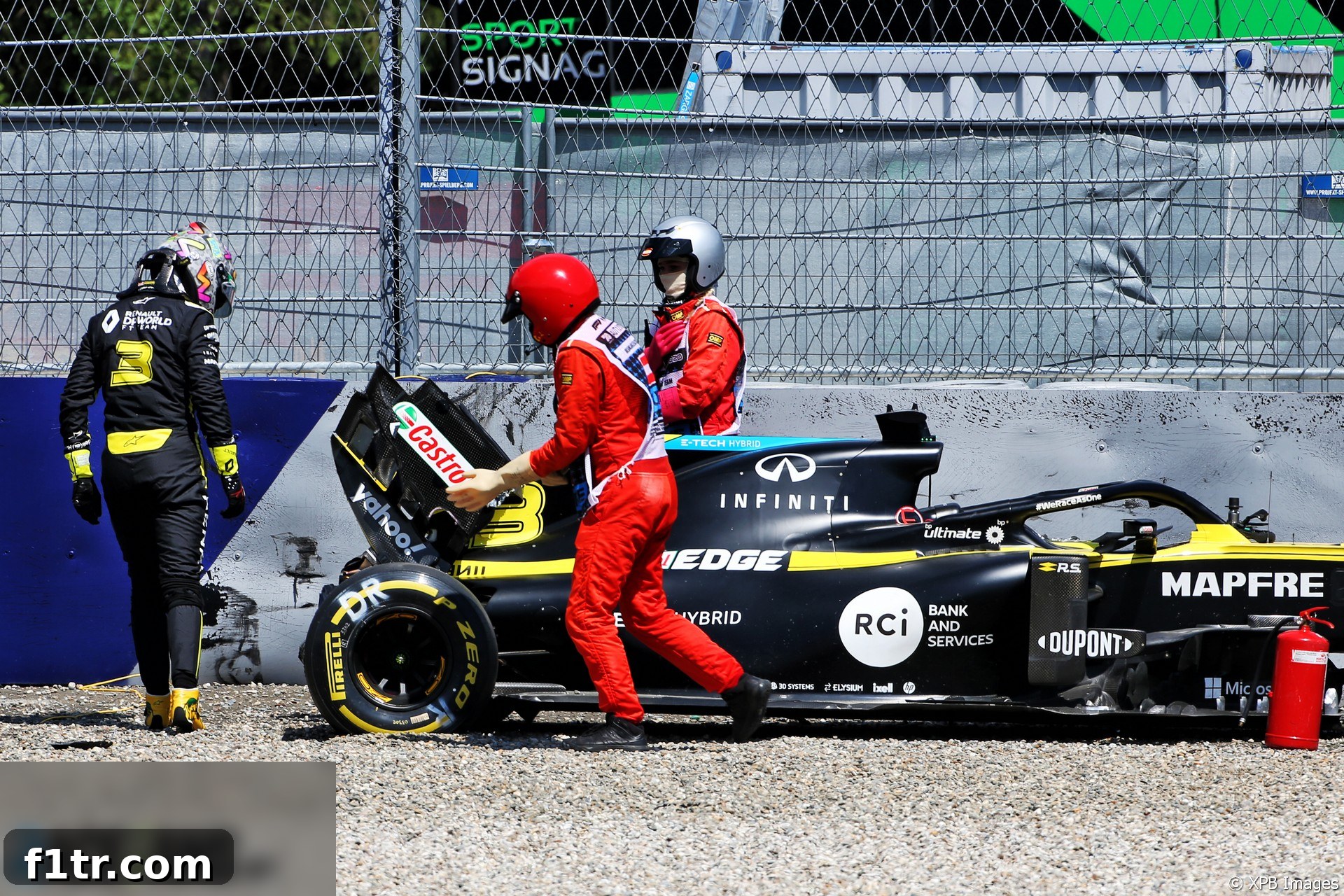
The second practice session was not without its heart-stopping moments, most notably a significant incident involving Daniel Ricciardo. The Renault driver suffered a heavy crash at Turn 9, one of the high-speed sections of the Red Bull Ring. His car snapped sideways upon entry to the corner, sending him into a violent impact with the outside barrier. The sheer force of the collision caused extensive rear-end damage to his Renault R.S.20, immediately bringing out the red flags and halting the session.
Ricciardo was seen limping away from his extensively damaged car, a worrying sight for his team and fans. Thankfully, after being taken to the medical center for precautionary checks, he was declared fit to continue for the remainder of the race weekend. While Ricciardo’s physical condition was cleared, the damage to his car poses a significant challenge for the Renault team, who will be working tirelessly overnight to repair or prepare a new chassis for Saturday’s crucial sessions. This incident certainly added an unexpected layer of tension and urgency to an already important practice day.
Adding to the list of on-track drama, Alexander Albon, Verstappen’s teammate at Red Bull, experienced a high-speed spin late in the session. Despite setting the seventh-fastest time, Albon lost control, sending his car into a pirouette. Fortunately, he managed to avoid any contact with the barriers, preventing what could have been another costly incident for Red Bull Racing. These events serve as a stark reminder of the fine margins and inherent risks involved in pushing Formula 1 cars to their absolute limits.
Weather Forecast Casts Shadow on Qualifying and Grid Formation
Beyond the on-track action, strategic considerations loomed large due to the impending weather forecast for Saturday. Renault, among other teams, had already indicated that their Friday practice plans were meticulously crafted with an eye on the high probability of heavy rain disrupting tomorrow’s sessions. This foresight proved to be critical, as the possibility of a washout for both Saturday’s practice and qualifying sessions became a real concern.
The implications of such a scenario are profound for the entire grid. Should Saturday’s qualifying be sufficiently disrupted or cancelled due to adverse weather conditions, the regulations stipulate that the times from Friday’s second practice session (FP2) would be used to determine the starting grid for the Grand Prix. This rule immediately elevated the significance of FP2, transforming it from a routine data-gathering exercise into a de-facto qualifying simulation for many teams and drivers, consciously or unconsciously.
Hamilton’s Struggles and Racing Point’s Surprise Pace
Lewis Hamilton, the reigning world champion, found himself in an uncharacteristic position, managing only the sixth-quickest time in FP2. Mercedes reported that Hamilton was openly unhappy with the balance of his W11, indicating a struggle to find the optimal setup for the demanding Austrian circuit. This difficulty, coupled with the threat of Saturday’s heavy rain, meant that his lower-than-expected position could prove to be highly significant if FP2 times were indeed used for the grid. A start from the third row would present a considerable challenge for the British driver, who typically aims for pole position.
In contrast to Mercedes’ challenges, the ‘Pink Panthers’ of Racing Point showcased surprisingly rapid pace. Sergio Perez and Lance Stroll secured third and fourth positions respectively, effectively locking out the second row of the provisional grid. Their strong performance raised eyebrows across the paddock, further fueling discussions about the car’s striking resemblance to last year’s championship-winning Mercedes. This ‘best of the rest’ performance puts them in an enviable position should qualifying be affected by the weather.
Also impressing was Carlos Sainz Jnr in his McLaren, who split the two Racing Points on the timesheets by securing the fifth-fastest lap. McLaren continues to demonstrate its consistent progress and competitiveness within the midfield, with Sainz delivering a strong performance that could pay dividends in a challenging race weekend. His ability to extract pace from the McLaren MCL35 is a testament to both his skill and the team’s engineering efforts, solidifying their position as strong contenders for points.
Midfield Melee and Top Ten Overview
Beyond the top contenders, the battle for the top ten positions remained fiercely competitive. Following Alexander Albon in seventh, McLaren’s Lando Norris secured eighth place, once again highlighting McLaren’s strong two-car performance. Charles Leclerc managed to put his Ferrari in ninth, showcasing the Scuderia’s ongoing struggle to match the pace of the frontrunners but still securing a respectable position. Rounding out the top ten was Renault’s Esteban Ocon, who showed promising pace before his teammate’s unfortunate incident.
The midfield was, as ever, a tight affair, with Pierre Gasly (AlphaTauri), Daniil Kvyat (AlphaTauri), and veterans like Kimi Raikkonen (Alfa Romeo) all vying for position. The competitive nature of this segment of the grid means that small differences in car setup, driver performance, or track conditions can dramatically alter fortunes. With the potential for rain, strategic calls regarding tyre choices and car settings will be more critical than ever, offering opportunities for those who can adapt quickly to changing circumstances.
Styrian Grand Prix Second Practice Results
| Pos. | No. | Driver | Car | Best lap | Gap | Laps |
|---|---|---|---|---|---|---|
| 1 | 33 | Max Verstappen | Red Bull-Honda | 1’03.660 | 27 | |
| 2 | 77 | Valtteri Bottas | Mercedes | 1’03.703 | 0.043 | 36 |
| 3 | 11 | Sergio Perez | Racing Point-Mercedes | 1’03.877 | 0.217 | 43 |
| 4 | 18 | Lance Stroll | Racing Point-Mercedes | 1’04.241 | 0.581 | 43 |
| 5 | 55 | Carlos Sainz Jnr | McLaren-Renault | 1’04.333 | 0.673 | 45 |
| 6 | 44 | Lewis Hamilton | Mercedes | 1’04.348 | 0.688 | 27 |
| 7 | 23 | Alexander Albon | Red Bull-Honda | 1’04.437 | 0.777 | 28 |
| 8 | 4 | Lando Norris | McLaren-Renault | 1’04.541 | 0.881 | 31 |
| 9 | 16 | Charles Leclerc | Ferrari | 1’04.706 | 1.046 | 34 |
| 10 | 31 | Esteban Ocon | Renault | 1’04.746 | 1.086 | 32 |
| 11 | 10 | Pierre Gasly | AlphaTauri-Honda | 1’04.757 | 1.097 | 37 |
| 12 | 26 | Daniil Kvyat | AlphaTauri-Honda | 1’05.050 | 1.390 | 34 |
| 13 | 7 | Kimi Raikkonen | Alfa Romeo-Ferrari | 1’05.152 | 1.492 | 23 |
| 14 | 99 | Antonio Giovinazzi | Alfa Romeo-Ferrari | 1’05.365 | 1.705 | 36 |
| 15 | 63 | George Russell”>George Russell | Williams-Mercedes | 1’05.588 | 1.928 | 34 |
| 16 | 5 | Sebastian Vettel | Ferrari | 1’05.613 | 1.953 | 39 |
| 17 | 6 | Nicholas Latifi | Williams-Mercedes | 1’05.655 | 1.995 | 48 |
| 18 | 20 | Kevin Magnussen | Haas-Ferrari | 1’05.790 | 2.130 | 36 |
| 19 | 8 | Romain Grosjean | Haas-Ferrari | 1’06.096 | 2.436 | 38 |
| 20 | 3 | Daniel Ricciardo | Renault |
Second Practice Visual Gaps: A Closer Look at the Performance Spread
The visual representation of the time gaps from the fastest lap offers a compelling insight into the relative performance of each driver during FP2. These gaps, expressed as a percentage of Max Verstappen’s leading time, clearly illustrate the competitive hierarchy and the margins separating the field. It emphasizes just how tightly packed the top performers were and how quickly the gaps expanded through the midfield and backmarkers.
Max Verstappen – 1’03.660
+0.043 Valtteri Bottas – 1’03.703
+0.217 Sergio Perez – 1’03.877
+0.581 Lance Stroll – 1’04.241
+0.673 Carlos Sainz Jnr – 1’04.333
+0.688 Lewis Hamilton – 1’04.348
+0.777 Alexander Albon – 1’04.437
+0.881 Lando Norris – 1’04.541
+1.046 Charles Leclerc – 1’04.706
+1.086 Esteban Ocon – 1’04.746
+1.097 Pierre Gasly – 1’04.757
+1.390 Daniil Kvyat – 1’05.050
+1.492 Kimi Raikkonen – 1’05.152
+1.705 Antonio Giovinazzi – 1’05.365
+1.928 George Russell – 1’05.588
+1.953 Sebastian Vettel – 1’05.613
+1.995 Nicholas Latifi – 1’05.655
+2.130 Kevin Magnussen – 1’05.790
+2.436 Romain Grosjean – 1’06.096
Drivers more than ten seconds off the pace are omitted for clarity in this visual representation.
Looking Ahead: An Unpredictable Styrian Grand Prix Weekend
As the teams pack up their garages on Friday night, the mood is a mix of anticipation and caution. Max Verstappen’s strong performance has given Red Bull a significant boost, setting up a thrilling potential battle with Mercedes. However, the uncertainties surrounding Daniel Ricciardo’s car repairs and Lewis Hamilton’s balance issues add layers of intrigue.
The looming threat of heavy rain for Saturday’s sessions is perhaps the biggest wildcard. If qualifying is indeed called off, Friday’s FP2 results will become paramount, turning what was intended as a preparatory session into a defining moment for the grid. This scenario could dramatically alter race strategies and open up opportunities for teams and drivers who wouldn’t typically start at the front.
Fans can brace themselves for an unpredictable and action-packed Styrian Grand Prix weekend. Whether it’s dry or wet, the Red Bull Ring always delivers excitement, and with so many variables in play – from driver performance and car reliability to the ever-present challenge of the weather – the stage is set for a memorable Formula 1 spectacle.
More from the 2020 Styrian Grand Prix
- Binotto expects 16-year-old Mugello lap record to fall at Tuscan Grand Prix
- Bottas edges Hamilton, Perez a tenth away in final practice
- Mercedes still “not 100% clear” what caused gearbox problems
- 2020 Styrian Grand Prix Star Performers
- F1’s trophy robots are ‘a bit over the top’ – Hamilton
Browse all 2020 Styrian Grand Prix articles
`