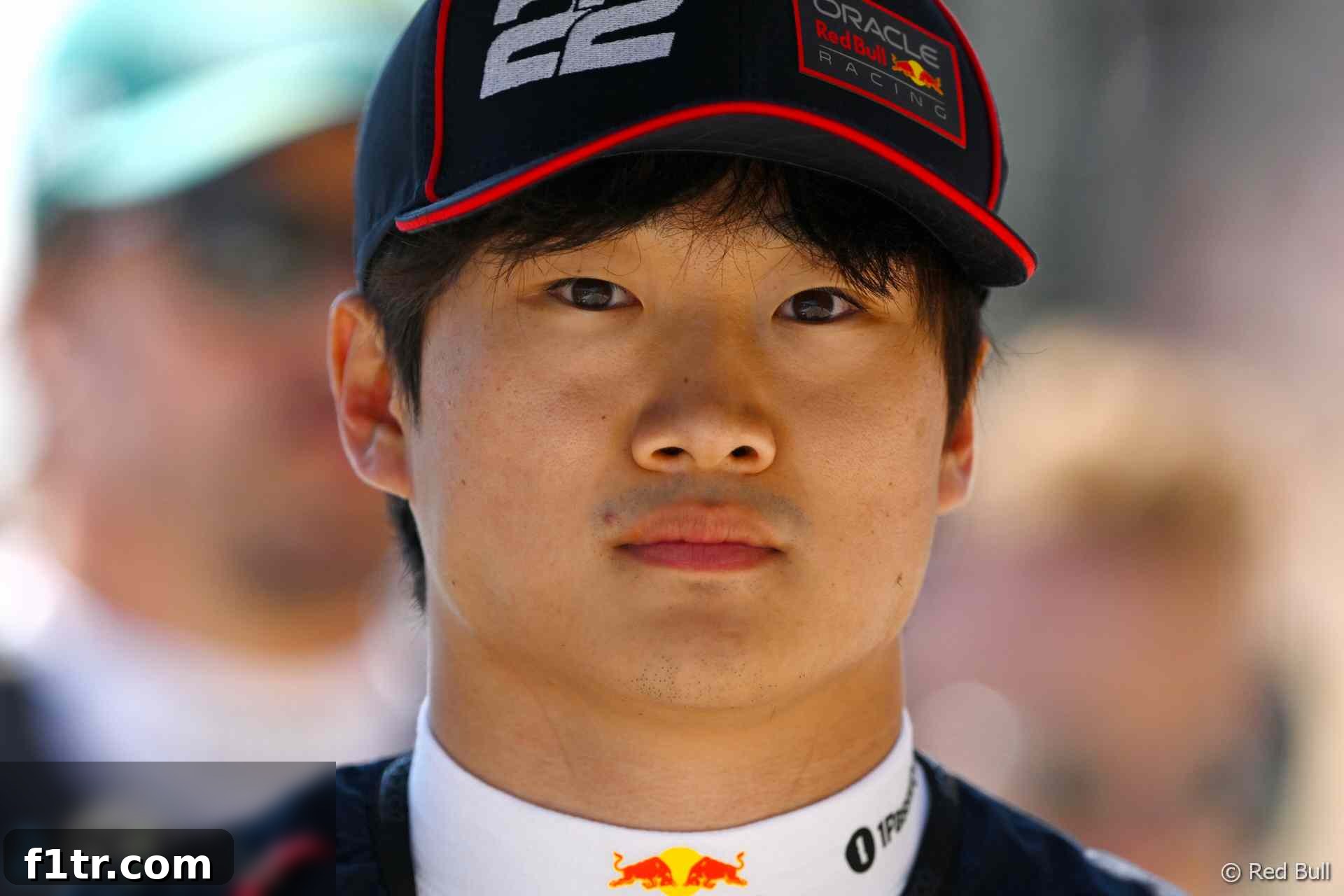
Yuki Tsunoda’s Rollercoaster F1 Season: Navigating Pressure and Potential
The world of Formula 1 is notoriously cutthroat, especially within the Red Bull driver development program. Every season presents a make-or-break scenario for aspiring talents, and Yuki Tsunoda’s recent journey has been a testament to this relentless pressure. After four arduous years within Red Bull’s junior Formula 1 team, the start of the year saw him seemingly overlooked for promotion, with Liam Lawson initially securing the coveted seat. A moment of understandable disappointment quickly turned into a twist of fate, however, as within a mere two rounds, Red Bull made an unexpected change, reinstating Tsunoda into the fold. This abrupt turn of events brought with it the profound realization of Oscar Wilde’s insightful observation: “When the gods wish to punish us they answer our prayers.” For Tsunoda, the dream promotion to the main Red Bull team, albeit under unforeseen circumstances, immediately brought with it immense scrutiny and the weight of sky-high expectations.
A Promising Start Amidst High Stakes
The initial phase of Tsunoda’s season with Red Bull suggested he was ready to seize the opportunity. His early performances showcased remarkable raw speed and a burgeoning confidence that belied the circumstances of his promotion. In Melbourne, he delivered a brilliant qualifying performance, securing fifth place on the grid – a significant achievement that immediately turned heads and ignited hopes within the team. This was followed by a solid sixth-place finish in the sprint race at Shanghai, further demonstrating his capability to extract performance from the machinery. Compared to his temporary predecessor, Liam Lawson, Tsunoda appeared to adapt more swiftly and effectively to Red Bull’s potent, yet notoriously demanding car. This vehicle, while inherently faster, is known for its unforgiving nature, requiring a precise and aggressive driving style to master. While he narrowly missed points on his debut for the senior team, a commendable ninth-place finish in Bahrain signalled that things were undoubtedly trending in a positive direction, hinting at a season of consistent points finishes and perhaps even podium contention.
The Mid-Season Slump: Crashes, Penalties, and Technical Setbacks
Despite the promising start, the demanding nature of Formula 1 soon began to expose the chinks in the armour. A period of mixed results followed, characterized by a challenging blend of modest points finishes and a frustrating spate of avoidable incidents. Two tenth-place finishes in subsequent races were a testament to his underlying pace, yet these were overshadowed by a series of crashes that severely hampered his progress and reputation. One such incident occurred in Jeddah, where Tsunoda failed to leave sufficient room for a competitor attempting an overtake on his outside. This was not an isolated error, as this particular misjudgment has manifested itself several times throughout the season, raising questions about his race craft under pressure and his spatial awareness in close-quarter battles.
A particularly detrimental setback occurred during Q1 at Imola, where Tsunoda suffered a significant crash on his first flying lap. This incident resulted in the total write-off of his RB21 chassis, forcing him to race with older-specification hardware for a critical period of several races thereafter. In the hyper-competitive world of Formula 1, even minor specification differences can translate into significant performance deficits on track. Running an older chassis effectively put Tsunoda at a disadvantage against his rivals, and even potentially against his own team mate, limiting his ability to challenge for points and showcase his true potential. This sequence of events offers a partial explanation for the subsequent decline in his results, including a disheartening last place in qualifying at Catalunya and similarly poor finishes at the Red Bull Ring and Silverstone. While Tsunoda undeniably bore responsibility for the damage he inflicted, the question of whether other top-tier teams might have provided him with updated hardware more swiftly, mitigating the prolonged performance penalty, remains a pertinent one within the cutthroat environment of elite motorsport.
Yuki Tsunoda Performance Overview
| Best | Worst | |
|---|---|---|
| GP Start Position | 5 | 20 (x2) |
| GP Finish Position | 9 | 17 (x2) |
| Total Points Scored | 10 | |
Beyond the technical disadvantages, Tsunoda also grappled with a worrying trend of avoidable penalties during this challenging phase. His carelessness manifested in a range of infractions that cost him valuable track position, time, and championship points. A notable incident involved overtaking Oscar Piastri under red flags during the Canadian Grand Prix, a fundamental rule violation that speaks to a lapse in concentration or judgment. Furthermore, collisions with Franco Colapinto and Oliver Bearman in the subsequent two rounds highlighted a recurring issue with aggressive driving leading to contact, rather than clean, decisive overtaking. These penalties not only added to his growing list of infractions but also collectively undermined his efforts to recover from the earlier technical setbacks. Such errors, especially for a driver under the watchful eye of Red Bull, are meticulously scrutinised and can have significant implications for a driver’s long-term future within the sport.
Glimmers of Hope and the Challenge of Consistency
Just as the narrative of his season seemed to be spiralling downwards, Belgium brought a much-needed promise of change and a potential turning point. Against a backdrop of increasing pressure, Tsunoda received a crucial technical upgrade in the form of a new floor for his car, delivered at the eleventh hour between the sprint race and grand prix qualifying. This seemingly minor component unlocked significant performance, and Tsunoda duly responded, delivering his best qualifying position since joining the team, securing an impressive seventh place. This performance was a powerful reminder of his underlying speed and potential when the car is optimally balanced and he can extract its full capabilities. Unfortunately, a late pit call on race day, a strategic misstep that was arguably outside his control, cost him a badly needed points finish. This instance underscored the fine margins in Formula 1, where a single strategic decision can dramatically alter a driver’s race outcome, regardless of their individual performance.
The Hungarian Grand Prix presented another tale of turmoil, yet one that also offered subtle indications of improved performance. Although Tsunoda faced another Q1 elimination, finishing 16th, the margins were impossibly tight. He was only a mere tenth of a second behind his world champion team mate, Max Verstappen, a testament to his raw pace in a finely balanced field. This incredibly close gap highlights the intensity of Formula 1 qualifying, where fractions of a second can mean the difference between advancing to Q2 or facing an early exit. His subsequent efforts to make progress after starting from the pit lane were further complicated by an unfortunate Gurney flap failure, a technical issue that hindered his aerodynamics. Despite these challenges, a 17th-place finish was still a dismal outcome for a team with Red Bull’s aspirations, emphasizing the relentless demand for results.
The Road Ahead: Defining the Narrative
The latter stages of the Formula 1 season present a crucial period for Yuki Tsunoda, one that could significantly redefine the narrative of his entire year. The glimpses of much closer performance relative to his formidable team mate, Max Verstappen, observed in Spa and the Hungaroring, offer a beacon of hope. For any driver, directly comparing pace with a multiple world champion is the ultimate litmus test. While consistently matching Verstappen’s unparalleled speed and consistency is an monumental challenge, Tsunoda’s ability to get within a tenth of a second in qualifying or demonstrate strong race pace, as he did in Belgium, is a vital indicator of his continued development and potential. Red Bull’s driver program is famously unforgiving, and a driver’s future often hinges on their ability to perform under extreme pressure and deliver consistent, strong results. Every remaining race is an audition, not just for his seat within the team, but for his long-term career trajectory in Formula 1.
To truly solidify his position and silence the critics, Tsunoda must demonstrate not only raw speed but also unwavering consistency, immaculate race craft, and a renewed discipline that minimizes avoidable errors. The talent is clearly evident; the challenge lies in harnessing it reliably weekend after weekend. His journey through this season—marked by initial disappointment, a sudden promotion, flashes of brilliance, and frustrating setbacks—epitomizes the high-stakes drama of Formula 1. The coming races will be pivotal in shaping whether Yuki Tsunoda’s 2024 season is remembered as a period of unfulfilled potential or as the crucial turning point where he matured into the consistent, top-tier driver Red Bull believes he can be.
Further Reading on Formula 1
- F1 returning to India soon after 2027 sounds like wishful thinking
- Verstappen loathes F1’s new generation of cars – but what do his rivals reckon?
- The ‘throwback weekend’ is back in fashion. But it’s a flawed concept – especially for F1
- Is Formula 1’s double race cancellation a blessing in disguise?
- Todt admits Schumacher crashed on purpose – but did it really cost him two titles?
Browse all Formula 1 articles