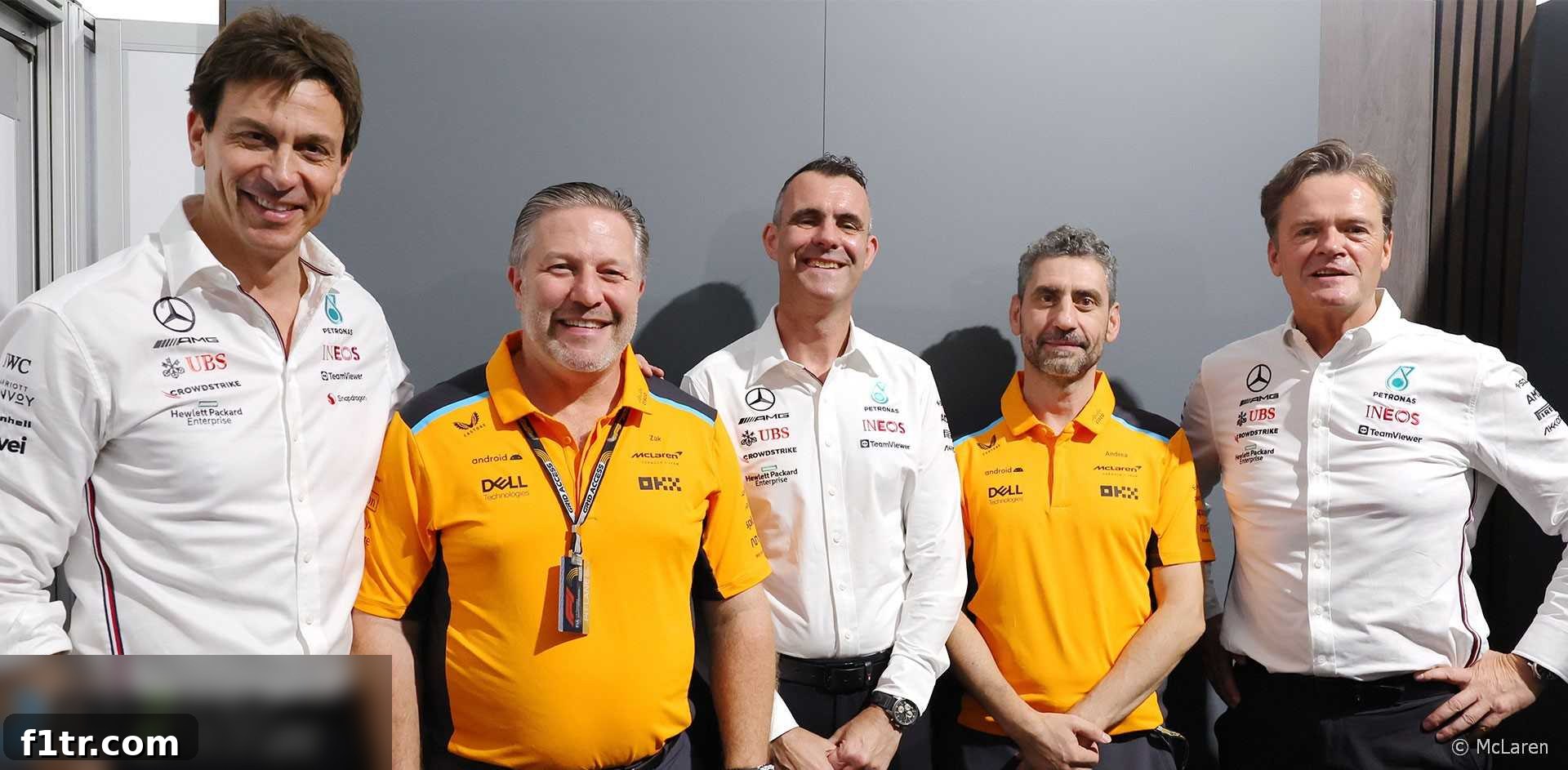
In a significant announcement shaping the future landscape of Formula 1, McLaren and Mercedes-Benz have officially extended their highly successful power unit supply partnership until the end of the 2030 season. This long-term commitment solidifies a crucial collaboration that has seen McLaren consistently climb the ranks since its reformation in 2021, and critically positions both entities strongly for the sport’s revolutionary new technical regulations set to debut in 2026.
The renewal, confirmed prior to the final race weekend of the current season at the Abu Dhabi Grand Prix, underscores the profound trust and mutual benefit shared between the Woking and Brixworth operations. McLaren has utilized Mercedes power units since the 2021 season, following stints with Renault and, famously, Honda. This extension ensures stability and continuity for McLaren through an era of substantial technical change, allowing the team to focus intently on chassis development and aerodynamic innovation, knowing their powertrain is in the hands of a proven winner.
A Partnership Forged in Confidence and Ambition
McLaren Racing CEO Zak Brown articulated the team’s profound confidence in their engine supplier, describing Mercedes as a “brilliant and reliable” partner. “The extension signifies the confidence that our shareholders and the wider team have in their powertrains and the direction we’re taking with them into the new era of regulations ahead,” Brown stated. His words reflect a strategic alignment, where both parties share a vision for success and a deep understanding of the challenges and opportunities presented by Formula 1’s evolving technical framework.
Brown further emphasized the historical and recent achievements of their collaboration, expressing an optimistic outlook for the coming years. “We have been successful together, both in the last three seasons and when they previously powered the team, so we look forward to the success to come as we continue our journey to fight consistently at the front of the grid.” This sentiment encapsulates McLaren’s ambition to return to championship-contending form, a goal made more attainable with a stable and high-performing engine supply.
For Mercedes-AMG High Performance Powertrains, the advantages of supplying a formidable rival like McLaren are manifold. Toto Wolff, Team Principal and CEO of the Mercedes-AMG Petronas Formula 1 Team, highlighted the strategic benefits for his organization. “McLaren have been fierce and fair competitors since 2021, especially in the second half of this season,” Wolff observed, acknowledging McLaren’s competitive resurgence. This rivalry, far from being a drawback, serves as a powerful catalyst for innovation and a transparent benchmark for Mercedes’ own factory team.
“McLaren’s strong performances underline the importance of transparent and equal supply to all customer teams in the sport, if we wish to achieve the goal of 10 teams capable of fighting for podium finishes,” Wolff continued. This philosophy of equitable supply not only fosters a more competitive grid but also accelerates Mercedes’ technical learning and strengthens the overall F1 business case for Mercedes-Benz. By pushing their customer teams to perform at their best, Mercedes inherently improves its own product and understanding of engine performance under varied chassis philosophies.
Navigating the 2026 Power Unit Revolution
The extended partnership gains particular significance when viewed through the lens of the upcoming 2026 technical regulations. Formula 1 is poised for a seismic shift with the introduction of new 1.6-liter V6 hybrid power units, which will feature a dramatic increase in electrical power (up to 350kW, nearly tripling current levels) and the exclusive use of 100% sustainable fuels. Crucially, the complex MGU-H component will be removed, aiming to simplify the power unit architecture and make it more relevant to road car technology, while attracting new manufacturers to the sport.
This overhaul represents an enormous engineering challenge and opportunity. Engine manufacturers will need to redesign their power units from the ground up, focusing on maximizing efficiency with sustainable fuels and integrating a more powerful, simplified electrical system. For a team like McLaren, having Mercedes as a long-term partner through this transition period offers invaluable security. Mercedes-AMG High Performance Powertrains has a stellar track record in developing championship-winning hybrid engines, a legacy that instills confidence that their 2026 power unit will be at the forefront of performance and reliability.
The stability provided by this early extension allows McLaren to engage deeply with Mercedes on the development of the 2026 package, ensuring seamless integration with their future chassis designs. This collaborative approach can be a significant advantage, potentially reducing the risks associated with such a radical regulatory change and enabling both teams to hit the ground running when the new era begins.
A Storied History: McLaren and Mercedes-Benz
The relationship between McLaren and Mercedes-Benz is deeply interwoven with Formula 1 history, marked by two distinct and highly successful chapters. The initial partnership, spanning from 1995 to 2014, was one of the most iconic collaborations in the sport. During this near two-decade stint, the McLaren-Mercedes alliance became synonymous with speed, innovation, and championship glory.
This golden era saw the team clinch three Drivers’ World Championships: first with the flying Finn Mika Häkkinen in 1998 and 1999, and then with the prodigious talent of Lewis Hamilton in 2008, his maiden F1 title. The partnership also delivered the Constructors’ Championship in 1998. Legendary cars like the MP4/13, MP4/22, and MP4/23 carried the silver and chrome livery to countless victories, etching themselves into the annals of Formula 1. The decision to part ways after 2014, with McLaren embarking on an ultimately unsuccessful and challenging journey with Honda power, served as a stark reminder of the critical importance of a competitive power unit.
The Modern Resurgence: A Reunited Force
After a difficult period, McLaren made the strategic decision to rekindle its partnership with Mercedes-Benz for the 2021 season, a move that immediately injected new life and performance into the Woking outfit. The reunion quickly bore fruit, culminating in a triumphant return to the top step of the podium at the 2021 Italian Grand Prix, where Daniel Ricciardo led a memorable one-two finish for the team, marking their first victory since 2012.
Since reforming their partnership, McLaren has demonstrated a steady upward trajectory. Across the nearly three full seasons since 2021, the team has accumulated a combined 15 podium finishes, a testament to the reliability and competitive edge provided by Mercedes power. With a dynamic driver lineup of Lando Norris and Oscar Piastri, McLaren has consistently shown flashes of brilliance, particularly in the latter half of the recent seasons, demonstrating their potential to challenge the established front-runners and reignite their championship aspirations.
The extended deal not only guarantees McLaren continued access to one of the most potent power units on the grid but also signals a shared vision for sustained success. It is a declaration of intent from both McLaren and Mercedes, aiming to build upon their rich history and recent gains to tackle the future of Formula 1 with renewed vigor and determination. As the sport moves towards a more sustainable and technologically advanced future, this long-term power unit agreement positions McLaren-Mercedes as a formidable force to be reckoned with, eyeing consistent battles at the sharp end of the grid.
2023 F1 season
- FIA president cleared of alleged interference in two 2023 races
- First week viewing figures for new Drive to Survive season fall again
- Max who? Drive to Survive season six prefers its favourite faces
- RaceFans’ complete 2023 season review
- The F1 drivers who pulled off the 10 biggest charges through the field in 2023
Browse all 2023 F1 season articles