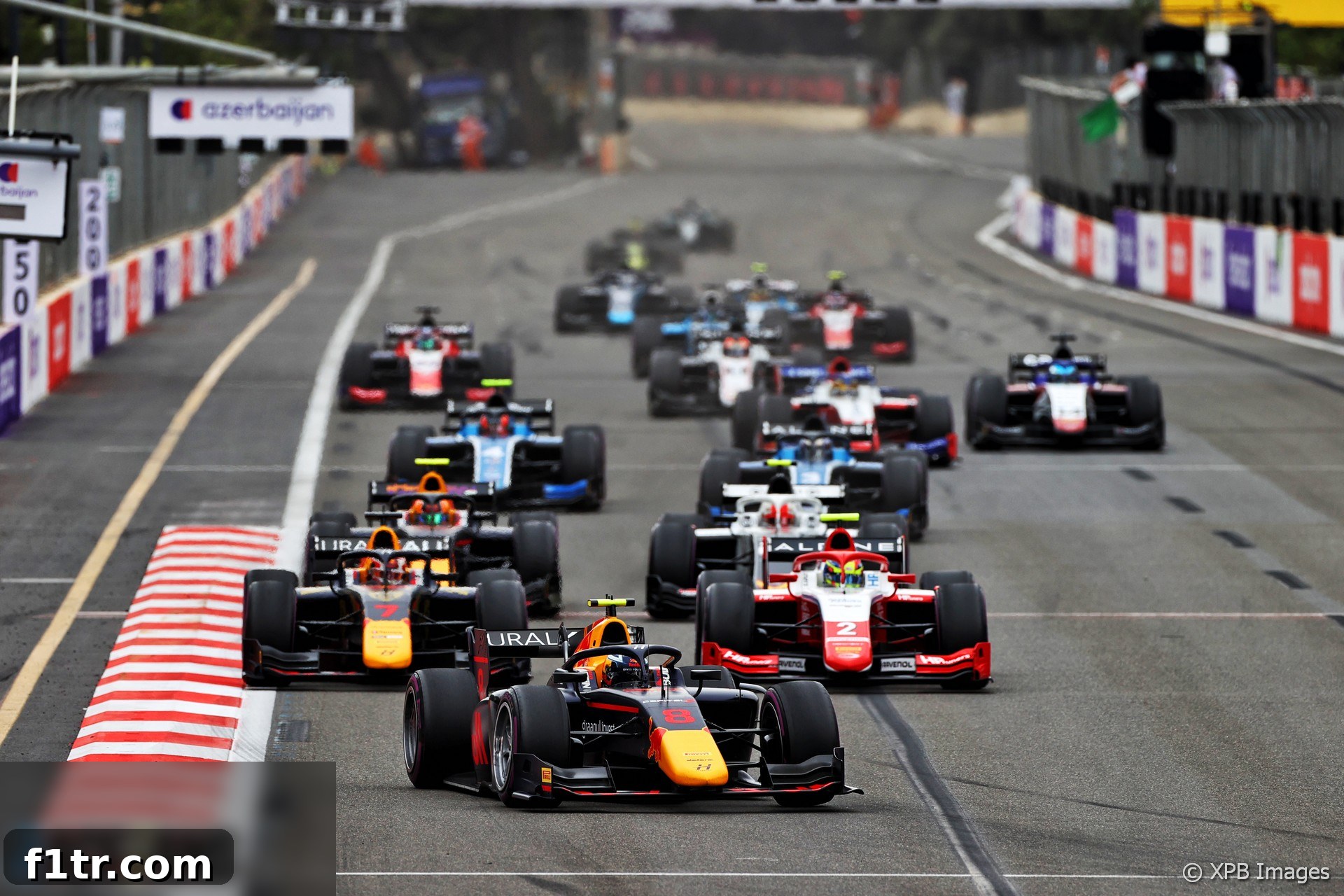
The exhilarating world of Formula 2 rarely fails to deliver drama, and the second feature race on the iconic Baku Street Circuit was no exception. Amidst a flurry of penalties and on-track incidents, Jüri Vips of Hitech Grand Prix emerged as the undisputed victor, showcasing a dominant performance that underscored his prowess on the challenging Azerbaijani urban layout. The race, a testament to F2’s unpredictable nature, kept fans on the edge of their seats as drivers battled not only each other but also the unforgiving walls and the vigilant stewards, profoundly impacting the championship landscape.
Vips Secures Dominant Victory in Chaotic Baku Feature Race
The stage for Sunday’s feature race was set on Friday, with Liam Lawson, Vips’ Hitech teammate and fellow Red Bull junior, seizing pole position. Vips himself lined up alongside Lawson, promising a formidable front row for the Hitech squad. Close behind, the highly-rated Oscar Piastri started from third, while Théo Pourchaire, fresh from his commanding feature race triumph in Monaco, occupied fourth, eyeing a repeat performance on another demanding street circuit. The grid was packed with rising stars, all eager to make their mark on a circuit renowned for its high-speed sections and tight, technical corners.
Pre-race conditions added an immediate layer of intrigue. Overnight rain had left the track slightly damp, resulting in significantly cooler temperatures compared to Saturday’s scorching sprint race. This subtle change in grip and tyre degradation dynamics meant strategies would be crucial. As the cars headed out for the formation lap, seasoned observer Dan Ticktum noted, “The whole field’s on the option [tyres] apart from one guy, I would imagine because of the high likelihood of a Safety Car in the first few laps.” His prediction proved prescient, highlighting the strategic gamble many drivers were taking in anticipation of inevitable chaos.
The race start itself was aborted due to that very individual – Jack Aitken, who had courageously opted for the medium compound tyres – stalling on the grid. His car, along with Campos’ Matteo Nannini, was wheeled back into the pits, forcing both drivers to start from there, effectively ending any hopes of an early challenge. This initial disruption served as a prelude to the action that was to follow, emphasizing the unforgiving nature of F2 starts and the tight confines of the Baku pit lane.
When the lights finally went out for the second time, Jüri Vips executed a textbook start, immediately surging past pole-sitter Liam Lawson. Vips expertly navigated the tricky run into Turn 1, establishing a lead he would rarely relinquish. Lawson, now on the defensive, found himself battling fiercely with Théo Pourchaire at the exit of the first corner. As Vips powered away into an early lead, seemingly untroubled, the pack behind him became entangled in a series of incidents that defined the race’s early stages.
Further around the treacherous Lap 1, Turn 3 once again lived up to its reputation as a magnet for drama. Marcus Armstrong, whose season had been plagued by an appalling streak of bad luck for the second consecutive year, became its latest victim. Running three-wide into the corner with Dan Ticktum and Théo Pourchaire, Armstrong’s car made contact with the TecPro barrier. In the ensuing scramble, Ticktum, who held the inside line, was the sole survivor of the trio to emerge unscathed, while Armstrong’s race came to an abrupt and disheartening end. The incident promptly triggered a brief Safety Car period, which circulated for a single lap before returning to the pits on Lap 2, setting the stage for a tense restart.
Penalties and Pit Lane Drama Define Mid-Race Battles
On the restart, Vips once again demonstrated his composure, effortlessly maintaining his lead. Oscar Piastri briefly capitalized on the restart to get a run on Lawson, momentarily snatching second place, but the Australian was swiftly re-passed by Lawson without significant resistance. However, the stewards were already reviewing the opening lap’s frenetic action. Liam Lawson was soon handed a crucial 10-second time penalty for pushing Théo Pourchaire wide at the start, an incident where both cars had crossed the pit exit line while battling for position. This penalty effectively dashed the pole-sitter’s hopes of a victory or a podium finish, forcing him to focus on damage limitation. Meanwhile, Dan Ticktum was also found at fault for his involvement in the Turn 3 incident with Pourchaire and Armstrong and was issued a time penalty to be served during his mandatory pit stop. These early penalties reshaped the strategic landscape for several key contenders, injecting an additional layer of complexity into an already unpredictable race.
The pit window soon opened, and Vips was one of the first to make his mandatory stop from the lead on Lap 6. For a moment, it appeared as though Oscar Piastri might have successfully engineered a ‘pit jump,’ potentially gaining track position over Vips. However, Vips, demonstrating superior out-lap pace and effectively utilizing DRS on the long main straight, was able to easily re-pass Piastri shortly after their stops, re-establishing his control at the front. Piastri’s pit lane woes were far from over, as he himself came under investigation for a separate pit lane incident, foreshadowing further penalties.
By Lap 10, the majority of the field had completed their mandatory pit stops. The stewards’ workload intensified significantly, with David Beckmann and Felipe Drugovich both placed under investigation for an unsafe release from their pit boxes. Compounding the confusion, Piastri and Drugovich were also separately investigated for a distinct unsafe release infringement. The FIA race control was clearly exercising a strict interpretation of pit lane safety regulations, ensuring fair play and minimizing risks in the congested pit lane.
Oscar Piastri’s earnest bid to challenge Vips for the race victory was significantly curtailed when he was ultimately issued a five-second time penalty for his unsafe release into the path of Felipe Drugovich. Despite this setback, the two leading drivers, Vips and Piastri, had managed to pull away from the chasing pack sufficiently. This allowed Piastri to retain his second-place position even after the penalty was applied. However, any realistic chance of him closing the gap to Vips, let alone attempting an overtake on the dominant Hitech driver, was now effectively neutralized. Vips continued his flawless drive, maintaining a comfortable margin at the front and skillfully managing his tyres and pace.
Further back in the field, the unique characteristics of the Baku Street Circuit generated scintillating on-track action. A thrilling three-wide battle unfolded into Turn 1 involving Liam Lawson, David Beckmann, and Guanyu Zhou. Zhou was initially forced wide, demonstrating the tight margins of the circuit. However, such is the nature of Baku that he ultimately re-emerged alongside his rivals. Lawson and Beckmann continued their clean fight down the exceptionally long main straight towards Turn 3, with all three drivers maintaining their formation. It was only as the track narrowed significantly through the challenging Turns 5 and 6 that they were finally forced into a more conventional racing order, a testament to their exceptional car control and race craft under intense pressure.
Shwartzman’s Stealthy Ascent and Championship Shake-Up
While the focus understandably remained on the front-runners and the multitude of penalties, Robert Shwartzman was quietly executing a masterful drive through the field. Starting from a modest 10th position, the Russian driver consistently made up ground across both stints of the race, showcasing excellent pace and strategic acumen. He adeptly capitalized on the unfolding chaos and the penalties affecting other drivers, demonstrating a remarkable ability to stay out of trouble. By the closing laps, Shwartzman had climbed to an impressive third place, securing a hard-fought podium finish that was richly deserved. Drivers who had been ahead of him for much of the race – such as Dan Ticktum and Jack Aitken, on an alternate strategy and penalised respectively – were effectively running in a different race context, highlighting the effectiveness of Shwartzman’s consistent pace and clean execution.
The remaining points-paying positions saw several strong performances. Felipe Drugovich secured a solid fourth place, a valuable haul of points for his championship campaign. Ralph Boschung delivered an excellent result for Campos, bringing his car home in an impressive fifth. Liam Lawson, despite his earlier penalty, managed to salvage a respectable sixth place from his pole position start, a testament to his underlying speed and determination to fight back. Jehan Daruvala finished seventh, followed by Dan Ticktum in eighth (after serving his penalty), Christian Lundgaard in ninth, and Lirim Zendeli rounding out the top ten points-paying positions.
Formula 2 race three results
| Position | Car | Driver |
|---|---|---|
| 1 | 8 | Juri Vips |
| 2 | 2 | Oscar Piastri |
| 3 | 1 | Robert Shwartzman |
| 4 | 4 | Felipe Drugovich |
| 5 | 21 | Ralph Boschung |
| 6 | 7 | Liam Lawson |
| 7 | 6 | Jehan Daruvala |
| 8 | 5 | Dan Ticktum |
| 9 | 9 | Christian Lundgaard | 10 | 12 | Lirim Zendeli |
| 11 | 22 | Jack Aitken |
| 12 | 14 | David Beckmann |
| 13 | 3 | Guanyu Zhou |
| 14 | 11 | Richard Verschoor |
| 15 | 25 | Marino Sato |
| 16 | 16 | Roy Nissany |
| 17 | 24 | Bent Viscaal |
| 18 | 15 | Guilherme Samaia |
| 19 | 23 | Alessio Deledda |
| DNF | 10 | Theo Pourchaire |
| DNF | 17 | Marcus Armstrong |
| DNF | 20 | Matteo Nannini |
The dramatic events in Baku had significant ramifications for the Formula 2 drivers’ championship standings. Guanyu Zhou, despite failing to score points in either the second sprint race or the feature race in Baku, narrowly retained his lead, sitting on 78 points. This precarious position highlighted the intense competition at the top. However, Oscar Piastri’s tenacious drive to second place, even with a penalty, propelled him much closer to the top. He now trailed Zhou by a mere five points, setting the stage for an even more intense championship battle in the upcoming rounds. Robert Shwartzman’s brilliant podium finish elevated him to third in the standings, on 66 points, firmly placing him within contention as the season progresses. The Baku feature race proved to be a pivotal moment, shaking up the championship order and injecting even more excitement into an already thrilling season, promising further high-stakes drama.
Jüri Vips’ dominant performance in the Baku feature race was a clear statement of intent, showcasing his control and speed amidst the characteristic chaos of the street circuit. While penalties and incidents painted a complex picture for many drivers, Vips maintained a clear path to victory. The race underscored the unpredictable nature of Formula 2 and the Baku Street Circuit itself, delivering a spectacle that kept fans on the edge of their seats from flag to flag. With the championship battle tightening considerably, the remainder of the F2 season promises even more high-stakes drama and thrilling competition among motorsport’s future stars.
Formula 2 News
- Formula 2 to debut in Miami and Montreal after Iran war cancellations
- Ex-McLaren junior Dunne’s move to Alpine finally confirmed
- Schumacher says his IndyCar feels like ‘an F2 car, just with better tyres’
- The Formula 2 team with an older driver line-up than almost half the F1 grid
- FIA to award more F1 superlicence points to IndyCar drivers from 2026
Browse all Formula 2 articles