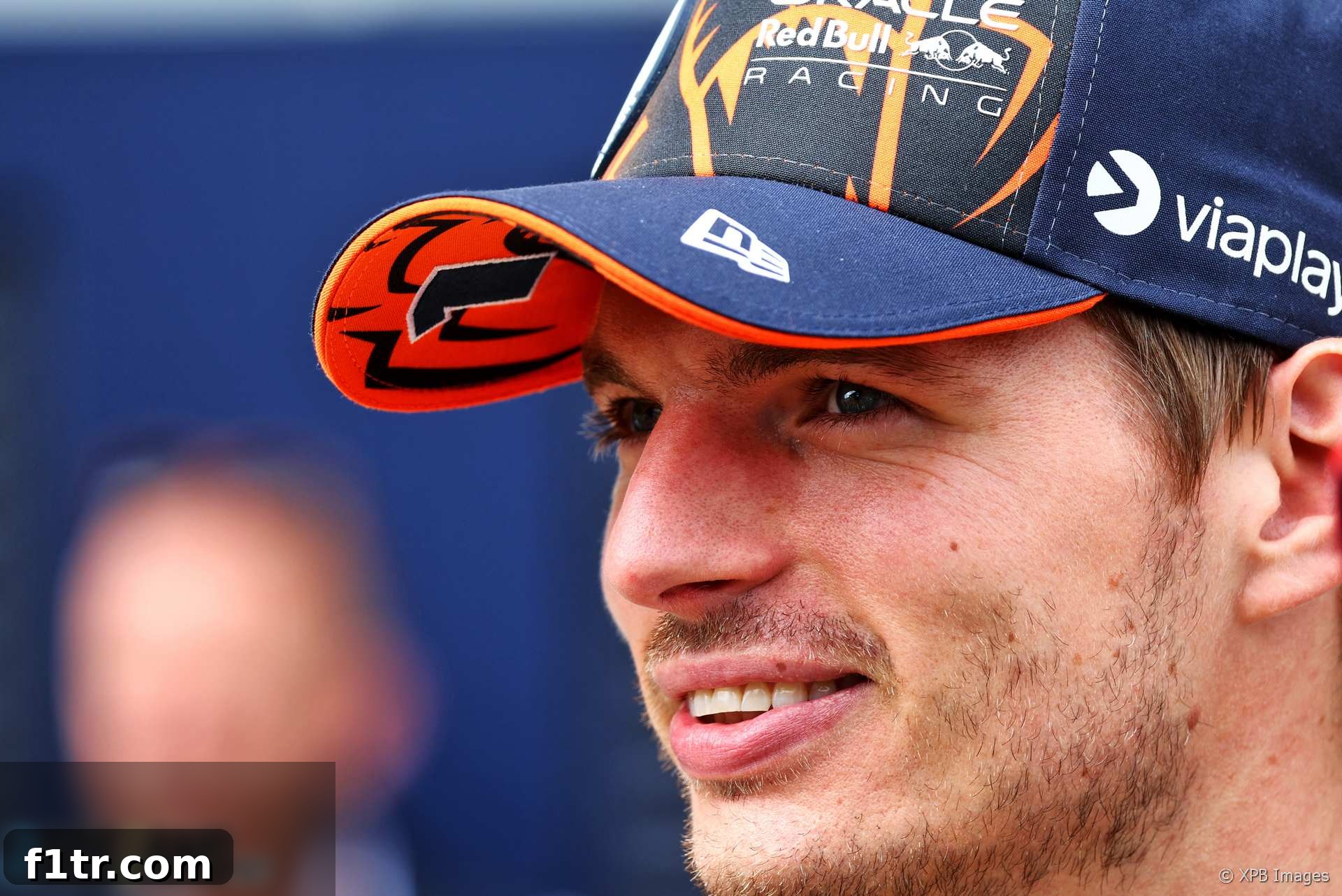
As the 2024 Formula 1 season progresses, one name consistently stands out as the epitome of speed, consistency, and unparalleled driving talent: Max Verstappen. Even after 14 exhilarating rounds, his dominance remains unquestioned, solidifying his position as the most outstanding driver on the grid. This year, much like the preceding seasons, has seen him relentlessly pursue perfection, making him the clear frontrunner for what would be his fourth consecutive world championship title.
Verstappen’s remarkable run over the initial two seasons of F1’s ground effect regulations set a new benchmark, a level of supremacy that even legendary figures like Michael Schumacher, Sebastian Vettel, or Lewis Hamilton couldn’t sustain for such an extended period. The beginning of the 2024 season hinted at a continuation of this extraordinary trajectory, with the reigning three-time world champion appearing virtually unstoppable.
Despite a turbulent off-track period for Red Bull Racing marked by various dramatic stories, Verstappen remained a beacon of professionalism and clinical execution on the track. He kicked off the season with a flawless double header, securing pole positions and dominant victories in Bahrain and Jeddah, signalling that it was “business as usual.” The momentum continued into Australia, where he secured his third consecutive pole. However, a rare mechanical setback intervened during the race, as a jammed right-rear brake forced his retirement – his first failure to finish in two years – as brake temperatures soared dangerously high. This unexpected DNF offered a glimmer of hope to his rivals, a fleeting illusion that the Red Bull juggernaut might finally be vulnerable.
However, any such hopes were swiftly extinguished. Verstappen delivered a crushing performance in Suzuka, reminding the paddock of his formidable pace and securing another dominant victory. China followed a similar pattern. Despite a challenging wet qualifying session for the sprint race, which saw him start fourth, he methodically climbed through the field to claim victory. He then effortlessly secured pole for the main Grand Prix and controlled the race from start to finish, never appearing under any real threat. These early races underscored his exceptional ability to extract maximum performance, even when conditions were tricky, and to convert pole positions into decisive wins with remarkable ease.
But as the season moved beyond its initial five rounds, a noticeable shift occurred. It was as if Verstappen encountered an “adaptive difficulty spike” in the championship. From this point onward, his path to victory would no longer be as straightforward or unchallenged. The first major test came in Miami. While he impressively secured another sprint pole and victory, the Grand Prix presented a different narrative. A perfectly timed Safety Car allowed Lando Norris to inherit the lead. At the restart, Verstappen struggled to match the McLaren’s pace, compounded by minor damage incurred from hitting a chicane bollard earlier in the race. This forced him to settle for second place – a position he hadn’t occupied in what felt like an eternity – signalling that McLaren had truly arrived as a force.
McLaren’s newfound pace was no fluke, as Red Bull quickly discovered. The intensity continued into Imola, where Verstappen needed a crucial slipstream from Nico Hulkenberg’s Haas at the very end of Q3 to snatch pole position by the narrowest of margins from Norris and Oscar Piastri. The race itself was a tense affair, with Verstappen having to fend off a relentless Norris over the final laps to secure his fifth victory of the season. This hard-fought win confirmed that the era of unchallenged dominance was fading, replaced by fierce battles at the very front of the grid.
The challenges for Red Bull and Verstappen intensified in Monaco, where the RB20 chassis revealed a distinct aversion to the bumpy, unforgiving streets of Monte Carlo. Verstappen could manage no better than sixth in qualifying after a brush with the barrier on his final Q3 lap. He finished the race in the same position after a largely processional event, a clear indication that Red Bull simply did not possess the necessary performance to compete with their rivals around the unique demands of the street circuit. This was a rare weekend where the team’s car characteristics genuinely hampered their star driver’s ability to contend for victory, underscoring the delicate balance required for street track performance.
Max Verstappen’s 2024 Season So Far
| Best | Worst | |
|---|---|---|
| GP start | 1 (x8) | 11 |
| GP finish | 1 (x7) | 6 |
| Points | 277 | |
By the time Formula 1 arrived in Canada, the competitive landscape had broadened even further. It wasn’t just McLaren challenging at the front; Mercedes had now joined the party. George Russell impressively matched Verstappen’s lap time to claim pole position in Montreal, highlighting the ever-increasing pressure on the reigning champion. However, amidst a challenging race marked by highly changeable weather conditions, Verstappen once again showcased his extraordinary skill set. He maintained composure and precision throughout, navigating the treacherous track while many of his rivals faltered, ultimately securing another crucial victory. This demonstrated his exceptional ability to thrive under pressure and adapt to adverse circumstances, converting chaos into triumph. The subsequent race in Spain saw him triumph again, expertly capitalizing on missed opportunities from others, getting ahead of Norris at the start, and then swiftly passing Russell for the lead before controlling the race with his characteristic poise.
However, Spain marked Verstappen’s most recent Grand Prix victory to date. At this juncture, it became evident that Red Bull’s rivals had truly caught up, and the team was arguably no longer the undisputed benchmark. Despite this, Verstappen’s fighting spirit remained undimmed. He claimed his third sprint race victory out of three attempts at the Red Bull Ring. The Grand Prix, however, saw him under intense pressure from Norris, leading to a multi-lap, wheel-to-wheel battle for the win. This epic encounter tragically ended in disaster when the two championship protagonists clashed at Turn 3, leaving both cars damaged and limping back to the pits. While the stewards apportioned blame to Verstappen, opinions across the paddock were divided. Norris was forced to retire, but Verstappen, demonstrating remarkable resilience, still managed to bring his damaged car home in fifth place, extending his championship lead in a testament to his never-say-die attitude.
The challenges persisted for Verstappen at Silverstone. His qualifying session was compromised when he ran off track at Copse on a damp surface, resulting in significant damage to his car’s floor. Despite this substantial setback, he still managed to salvage fourth place on the grid, a testament to his raw speed. Early in the race, he struggled to match the pace of the Mercedes and McLarens around him. However, as the race progressed and he switched to hard tyres, Verstappen unleashed an incredible surge, putting Lewis Hamilton under immense pressure in the closing laps. He was just seconds away from snatching yet another improbable victory, showcasing his relentless pursuit of every possible point, even with a compromised car.
Red Bull’s struggles continued in Hungary, where Verstappen made little effort to conceal his frustrations regarding the RB20’s lack of competitiveness compared to the resurgent McLarens. Despite his obvious discontent, he still produced another excellent qualifying performance, lining up third behind Norris and Piastri. However, his race was uncharacteristically ragged. He vociferously expressed his frustrations over the team radio and, in a rare display of impetuosity, clashed with Lewis Hamilton while battling for third place. This incident cost him a potential podium finish, dropping him to fifth – a highly unusual instance of Verstappen not maximizing his result, reflecting the immense pressure and the car’s perceived limitations.
The most recent round in Belgium saw Verstappen facing a power unit grid penalty, which meant he was not in contention for victory from the outset. However, he arguably delivered the most impressive driver performance of the weekend at Spa-Francorchamps. He utterly dominated qualifying, setting the fastest time by a significant margin, only to start 11th due to his penalty. In the race, he executed a superb recovery drive, climbing six places to finish fifth on track, which was subsequently elevated to fourth after George Russell’s post-race disqualification. This performance underscored his raw speed and unwavering ability to carve through the field, even when starting further down.
Currently, with an impressive tally of 277 points, seven Grand Prix victories, three sprint race wins, eight pole positions, and nine podium finishes, Max Verstappen comfortably sits atop the championship standings, even having not won a Grand Prix in the last four rounds. These remarkable achievements often overshadow the fact that he is currently whitewashing his teammate, Sergio Perez, on both Saturdays and Sundays in 2024. While this highlights Verstappen’s extraordinary consistency and performance, it also speaks volumes about the challenges faced by his teammate and the inherent difficulty of mastering the Red Bull machinery at such a high level.
Despite facing a level of competition unseen in the last two years, there remains very little doubt that Max Verstappen is on an unwavering path to secure his fourth consecutive world championship title by the end of the season. His accumulated points advantage, coupled with his unparalleled skill and mental fortitude, makes him an overwhelming favourite. Only an unprecedented collapse in form or a series of unforeseen circumstances would likely deny him this historical achievement, cementing his legacy as one of Formula 1’s true greats.