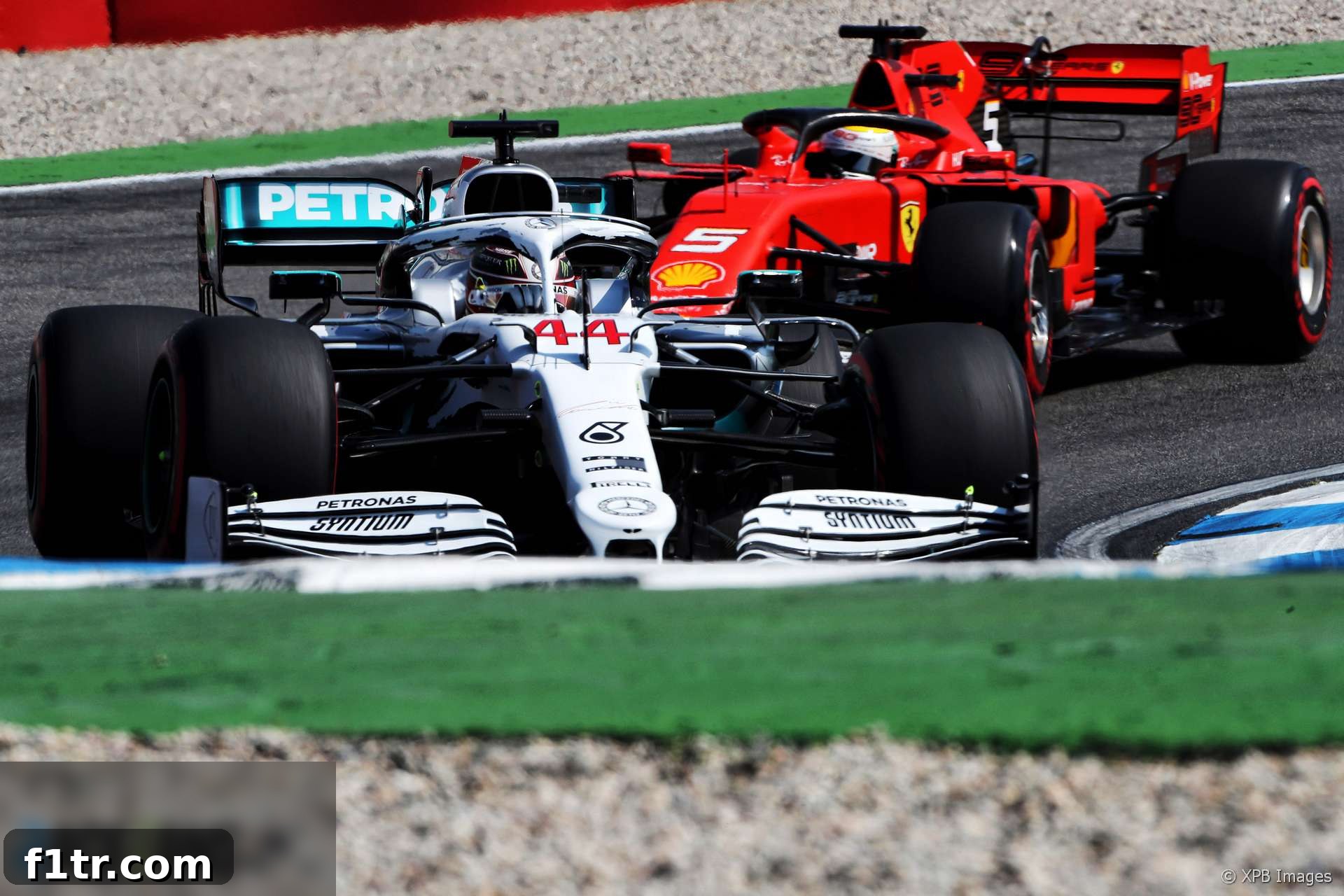
Mercedes’ Hockenheimring Puzzle: Wolff’s Concerns Despite Hamilton’s Pole
In a surprising turn of events for the dominant Mercedes-AMG Petronas Formula One Team, Team Principal Toto Wolff candidly admitted that the Silver Arrows were less competitive than anticipated at the Hockenheimring, home of the German Grand Prix. This revelation came despite Lewis Hamilton masterfully clinching pole position, underscoring a deeper underlying concern within the championship-leading squad.
The 2019 Formula 1 season had seen Mercedes enjoy a commanding lead, often dictating the pace and outcome of races. Therefore, any perceived weakness, even one masked by a pole position, raised eyebrows and prompted introspection. The Hockenheimring, a circuit with a blend of high-speed straights and a technical stadium section, was expected to play to Mercedes’ strengths. However, practice sessions painted a different picture, with a formidable rival consistently demonstrating superior pace.
Ferrari’s Ill-Fated Dominance in Practice
Throughout the crucial practice sessions leading up to qualifying, Scuderia Ferrari had consistently showcased blistering speed, appearing to hold a significant advantage over Mercedes. Both Sebastian Vettel and Charles Leclerc looked poised to challenge, if not outright dominate, qualifying. Their SF90 car, particularly potent on the straights, seemed perfectly suited to the Hockenheim circuit’s layout, leaving many to believe that a Ferrari front-row lockout was a strong possibility, potentially even threatening Hamilton’s remarkable pole streak.
However, the highly anticipated qualifying session brought a dramatic twist of fate for the Italian outfit. In a cruel stroke of misfortune, both Ferrari cars were struck down by technical problems, effectively sidelining their challenge. Charles Leclerc, having shown immense promise, suffered a fuel system issue in Q3, preventing him from setting a competitive lap. Earlier in Q1, Sebastian Vettel was plagued by a turbocharger problem, leaving him unable to even participate fully and relegating him to the very back of the grid. These unexpected mechanical failures dramatically altered the qualifying landscape, paving the way for Hamilton to secure pole position against a less formidable opposition.
The W10’s Aerodynamic Upgrade and Persistent Challenges
Mercedes had arrived at Hockenheimring armed with a significant aerodynamic upgrade package for its W10 challenger. This comprehensive update was not merely about raw performance gains but was partly aimed at solving a persistent cooling problem that had subtly hampered the car in earlier hot-weather races. Cooling in Formula 1 is a delicate balance; efficient cooling ensures optimal engine and component performance, but it often comes at the expense of aerodynamic efficiency, as larger inlets and exits create drag. The team believed this new package would offer a more optimized solution, enhancing both cooling and overall aerodynamic performance.
“We were expecting to be much more competitive this weekend,” Wolff articulated, reflecting the team’s initial confidence in their upgraded machinery. “We put a very solid upgrade package onto the car.” The expectation was that these refinements would translate into an immediate and tangible performance boost, consolidating their position at the front of the grid. Yet, the on-track reality during practice suggested that the full potential of the upgrade was either not being realized or that the competition, particularly Ferrari, had made greater strides.
Navigating Hockenheim’s Unique Demands: Speed vs. Corners
Wolff had a clear understanding of the circuit’s characteristics and their car’s inherent strengths and weaknesses. He acknowledged that “straight-line speed would go against us in Hockenheim,” implicitly recognizing Ferrari’s engine advantage on the circuit’s long straights. The Hockenheimring, with its iconic long run down to Turn 1 and the subsequent sections, traditionally rewards cars with superior top-end power and lower drag. This was an area where Ferrari often excelled.
However, Mercedes’ strategy was to counterbalance this deficit with the W10’s renowned strength in slower corners, particularly through the intricate and high-downforce stadium section at the end of the lap. This section, demanding precise handling and maximum aerodynamic grip, was where Mercedes typically shone. Wolff expected this advantage to “help tip the balance in their favour.” The hope was that the time gained in the technical parts of the circuit would offset any losses on the straights. Despite this strategic calculation, Ferrari had genuinely looked like a strong threat for pole position until their unfortunate technical woes struck, suggesting Mercedes’ anticipated cornering advantage wasn’t as decisive as hoped, or Ferrari had significantly improved their cornering prowess as well.
Wolff’s Unvarnished Assessment: A Quest for Perfection
The Mercedes team, accustomed to setting the benchmark for performance, found little solace in Hamilton’s pole position given the circumstances. Wolff’s assessment was unequivocally clear: “Fundamentally we are not happy with our own performance and [it] could have looked much different if Ferrari would have finished the qualifying.” This statement highlighted a deep-seated commitment to engineering excellence and an unwavering pursuit of perfection within the team. For Mercedes, simply winning or taking pole wasn’t enough; it had to be achieved through genuine, undisputed pace. The fact that their main competitor’s misfortune played a significant role in their qualifying success was a bitter pill to swallow for a team that prides itself on outright domination.
This candid admission underscores the relentless nature of Formula 1. Even when at the pinnacle of the sport, the pressure to optimize every single variable, every lap, and every component is immense. Wolff’s comments were not just about Hockenheim, but a reflection of the team’s internal standard – a standard that demands they are the fastest, irrespective of external factors. Relying on rivals’ misfortunes, even implicitly, is not the Mercedes way.
Unlocking the Upgrade’s Potential for Budapest
Looking beyond the Hockenheimring weekend, Wolff emphasized the critical task ahead for the team: fully understanding how to extract the maximum performance from their new upgrade package before the next round in Hungary, the Hungaroring. “It’s not understood [yet],” he confessed, indicating that while data might suggest the upgrade delivered certain improvements, its optimal integration and setup remained elusive. “I think we see that the upgrade package has delivered, we see that on the pressure cappings,” referring to aerodynamic pressure sensor readings that confirm the aero elements are working as designed.
However, the challenge lies in translating these raw data points into holistic on-track performance. Wolff highlighted the numerous interdependent factors that complicate this process: “But there are so many factors to consider: The specific circuit layout, the Tarmac, the heat. Have we completely understood how to tune the car for the aero upgrade? So there’s many variables we need to find out and analyse before going to Budapest.” Each circuit presents its own unique set of demands, from the abrasiveness of the tarmac affecting tyre degradation to ambient temperatures influencing engine and component cooling. Furthermore, a new aerodynamic package requires a complete re-evaluation of the car’s mechanical setup – suspension, ride height, wing angles – to achieve perfect balance and performance.
The Hungaroring, with its tight, twisty, and often hot characteristics, offers a stark contrast to Hockenheim. It’s often referred to as ‘Monaco without the walls,’ placing immense emphasis on high-downforce, mechanical grip, and driver skill rather than outright straight-line speed. This makes the task of analyzing the Hockenheim data and applying the lessons learned to the Budapest setup even more crucial and complex. The team’s engineers and strategists would delve into vast amounts of telemetry data, cross-referencing it with driver feedback to pinpoint areas for improvement and fine-tune the W10’s setup for the entirely different challenges of the Hungarian Grand Prix. This meticulous process of continuous learning and adaptation is a cornerstone of Formula 1 success, and for Mercedes, it was clear that the Hockenheimring had presented them with a significant, albeit valuable, learning curve.
2019 F1 season Related Articles
- Crying in the Melbourne car park at 2019 grand prix was my career low – Ocon
- McLaren Racing reports reduced £71 million loss in 2019
- Kvyat: Hockenheim podium last year was “my biggest achievement” so far
- How the FIA’s new encrypted fuel flow meter targets Ferrari’s suspected ‘aliasing’ trick
- “He smashed my office door”: 23 must-see moments from ‘Drive to Survive’ season two
Browse all 2019 F1 season articles