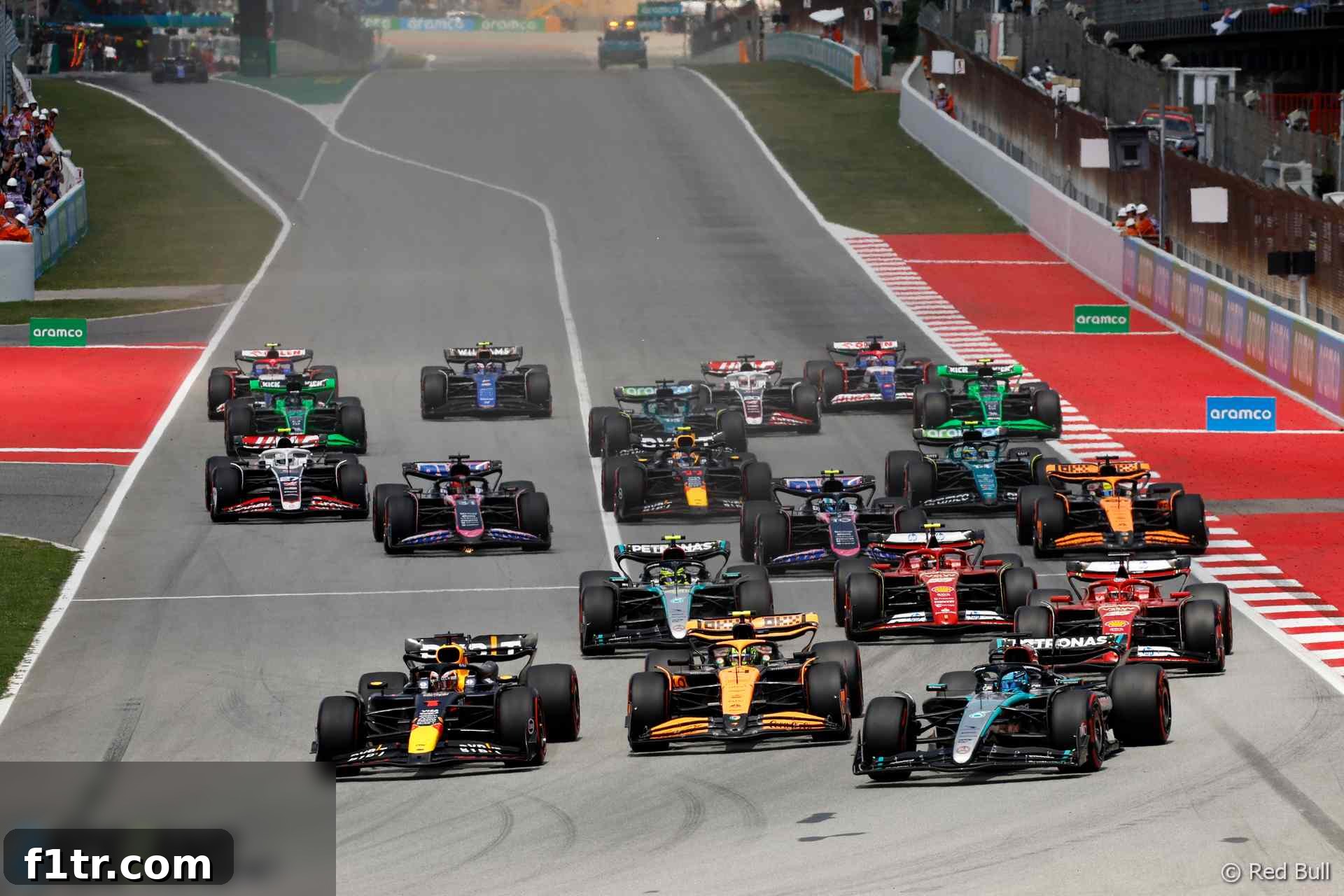
In a sport defined by razor-thin margins and instantaneous decisions, the opening moments of a Grand Prix often dictate the final outcome. At the recent Spanish Grand Prix, Lando Norris found himself grappling with this reality, openly attributing his loss of potential victory to a less-than-perfect start. Despite securing a hard-fought pole position, the McLaren driver saw his lead evaporate into Turn 1, ultimately yielding the top step of the podium to his fierce rival, Max Verstappen.
The Pole Position Paradox: A Strong Start, A Lost Lead
The Circuit de Barcelona-Catalunya is renowned for its challenging Turn 1, a long run from the starting grid that often sees slipstream effects play a pivotal role. Norris, starting from pole, had the best possible vantage point, yet the chaotic first few seconds of the race proved decisive. While his initial launch off the line was strong, matching and perhaps even surpassing that of Verstappen, it was the crucial second phase – the acceleration and drive out – that presented an unexpected hurdle.
“My initial launch, I think, was better than Max,” Norris reflected post-race, a hint of frustration in his voice. “The second phase, the drive out, was not as good. I don’t know anything more than that, apart from Max got alongside me.” This subtle but critical difference allowed Verstappen’s Red Bull to gain precious metres, setting the stage for the dramatic three-way tussle into the first corner.
Avoiding Disaster: Norris’s Crucial Decision at Turn 1
As the cars hurtled towards Turn 1, the situation escalated rapidly. Norris, Verstappen, and George Russell in the Mercedes found themselves three-abreast, a high-speed dance on the edge of disaster. It was Russell, starting from P4, who emerged as the surprise challenger, utilizing a potent double slipstream from both Norris and Verstappen to surge forward. This unexpected burst of speed placed him directly in contention, creating an intricate dilemma for Norris.
Faced with the imminent threat of a multi-car collision, Norris made a split-second, strategic decision that, while costing him the lead, likely prevented a catastrophic pile-up. He consciously backed off, allowing Russell to sweep around the outside and momentarily claim the lead, while Verstappen slotted into P2. Norris was forced to settle for third, a bitter pill to swallow for a driver who had started from pole and possessed the pace to win.
“I had to take third in Turn 2 because if I braked two metres later, I think I would have taken everyone out with me,” Norris explained, defending his choice. “I made the correct decision of backing out and letting George have it.” This mature and safety-conscious call underscored Norris’s growing experience and race craft, prioritizing a finish – and championship points – over a potentially reckless lunge for the lead. It’s a testament to his evolution as a top-tier F1 driver, understanding the delicate balance between aggression and self-preservation in the heat of battle.
The Inevitable Slipstream: A Barcelona Feature
Norris further elaborated on the challenging dynamics of the Barcelona circuit’s start, suggesting that Russell’s surge might have been unavoidable regardless of his own performance. “If George wasn’t there, I think I still could have kept first around Turn 1. But George had a run on both of us, so even if my start was one or two metres better – which I think was all I probably could have done – just the long run down to Turn 1, the slipstream [for] the Mercedes, on both Max and myself, was more than anything that I could have done.”
He continued, “I almost think George would have led no matter what, even if my start was two metres better. In some ways, that’s what happens in Barcelona. George got a good start and I couldn’t do anything about that.” This perspective highlights a recurring theme at the Spanish Grand Prix – the immense power of the slipstream on the long main straight, often nullifying the advantage of pole position if the car behind gets a strong tow. Russell’s shrewd exploitation of this aerodynamic phenomenon was a masterclass in opportunistic racing, momentarily placing the Mercedes at the front of the pack.
Verstappen’s Perspective: A Well-Handled Scramble
From the perspective of the eventual race winner, Max Verstappen, the opening skirmish was intense but ultimately well-managed by all three drivers. Verstappen, known for his relentless aggression, acknowledged the complexity of the situation.
“I think the first launch was quite okay, and then I got a little bit alongside [Norris]. I had to go a little bit on the grass,” Verstappen recounted. His brief excursion onto the grass indicated the fine margins and the lack of space available as the trio jostled for position. “But then I think George had a double slipstream and had a good run around the outside, which he managed really well. And I think the three of us managed everything really well into Turn 1.” Verstappen’s comments echoed Norris’s sentiment regarding Russell’s strong start and the respectful way in which the drivers navigated a potentially disastrous scenario, showcasing the mutual understanding and high skill level among the sport’s elite.
The Race Unfolds: Strategy, Pace, and the Final Verdict
Losing the lead at the start fundamentally altered Norris’s race strategy and trajectory. Instead of controlling the pace from the front, he found himself having to chase, battling through traffic and managing tyre degradation to try and close the gap to Verstappen. While McLaren’s upgraded package showcased exceptional pace throughout the Grand Prix, demonstrating their true championship credentials, the initial disadvantage proved insurmountable.
Norris’s ability to battle back and secure P2, finishing just over two seconds behind Verstappen, was a testament to his and McLaren’s potent combination of speed and strategic execution. However, the missed opportunity for victory weighed heavily. The race demonstrated that while McLaren has closed the performance gap to Red Bull significantly, execution in every single phase – especially the race start – remains paramount against a driver and team as formidable as Verstappen and Red Bull Racing.
Lessons Learned: A Deeper Dive with Engineers
Acknowledging the areas for improvement, Norris confirmed he would be engaging in a thorough debrief with his engineering team. “I will sit down with my engineers and talk” about their approach to the corner later, he stated. This proactive step is crucial for an F1 team striving for championship glory. Such discussions will likely involve a meticulous analysis of telemetry data, clutch settings, driver reaction times, and potential strategies for defending pole position more effectively in similar high-slipstream scenarios.
Understanding the nuances of clutch engagement, throttle mapping, and potential counter-strategies for defending against strong slipstream attacks will be vital for Norris and McLaren as they continue their intense championship battle against Verstappen and Red Bull. Every fraction of a second, every metre gained or lost, can be the difference between victory and defeat in the relentless pursuit of Formula 1 supremacy.
Championship Implications and Future Outlook
The Spanish Grand Prix outcome has significant implications for the drivers’ championship. While Norris proved McLaren’s pace is undeniable, Verstappen’s ability to capitalize on any advantage, however small, underscores his championship-winning prowess. This season is shaping up to be a thrilling head-to-head battle, with McLaren emerging as genuine contenders to Red Bull’s long-standing dominance.
For Norris, the disappointment of Barcelona will fuel his determination. It serves as a stark reminder that in Formula 1, perfection is not merely desired but often required to conquer a champion like Verstappen. The lessons learned from this race start, particularly the art of defending pole and managing the crucial run into Turn 1, will undoubtedly be applied and refined in future Grands Prix. The rivalry between Norris and Verstappen, McLaren and Red Bull, promises to deliver more captivating moments as the 2024 F1 season progresses, with every race start now carrying amplified significance.
Further Insights from the 2024 Spanish Grand Prix
- Russell ensures Norris has still never kept his lead from pole position
- Williams repeatedly switch floors in search for Sargeant’s missing downforce
- “Why’s he not defending?”: How Russell sank to fourth after stunning start
- What radio calls reveal about Verstappen’s controlled pace and Perez’s struggles
- 2024 Spanish Grand Prix weekend F1 driver ratings
Browse all 2024 Spanish Grand Prix articles