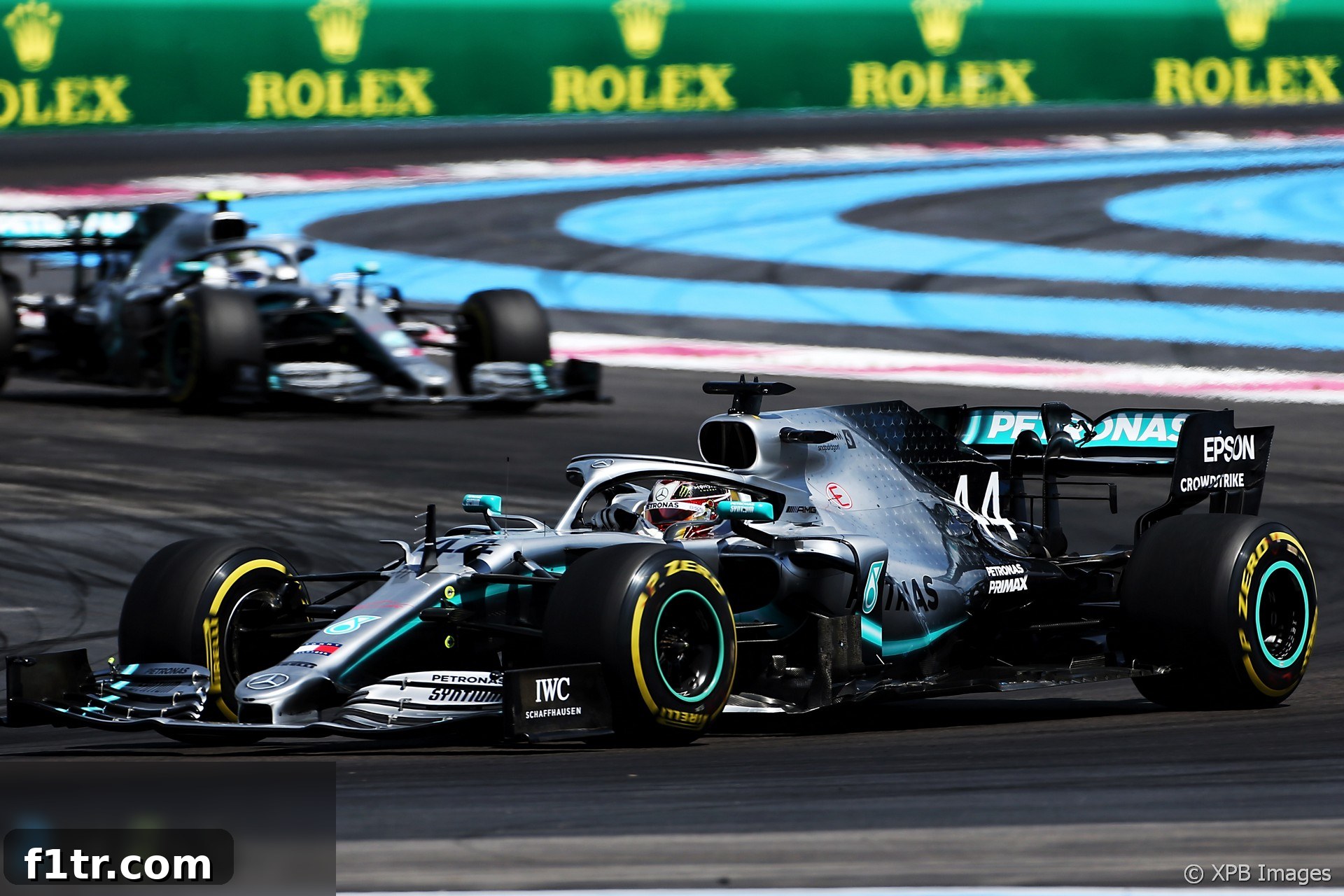
The 2019 French Grand Prix at the iconic Circuit Paul Ricard unfolded as another masterclass in dominance from Lewis Hamilton and the Mercedes-AMG Petronas F1 Team. Hamilton secured a resounding victory, crossing the finish line a comfortable 10 seconds ahead of his teammate Valtteri Bottas. This commanding performance not only extended his lead in the Drivers’ Championship but also underscored Mercedes’ formidable package and Hamilton’s unparalleled skill, leaving competitors struggling to match their pace on the challenging Le Castellet track.
From the moment the lights extinguished, signalling the start of the 53-lap race, Hamilton was in a league of his own. Having started from pole position, he maintained an immaculate lead throughout, never once truly threatened by any rival. His strategic brilliance in managing tire degradation, combining blistering pace with an acute awareness of race conditions, and executing a flawless race plan allowed him to dictate the proceedings from the front. This victory was a profound testament not only to his exceptional driving prowess but also to the meticulous preparation and strategic acumen of the entire Mercedes team, solidifying their status as the benchmark in Formula 1.
Valtteri Bottas, who started alongside Hamilton on the front row, found himself unable to mount a serious challenge to his teammate’s supremacy. While he commendably held a solid second position for the majority of the afternoon, the gap to Hamilton steadily widened during the crucial opening stint. This early separation meant that even after the mandatory pit stops, the Finn was too far adrift to pose a direct threat. Instead, Bottas spent the latter half of the race under significant pressure, diligently defending his position from a rapidly charging Charles Leclerc, a clear indicator of Ferrari’s relentless pursuit.
Charles Leclerc delivered a truly commendable performance for Scuderia Ferrari, securing a hard-fought third place and a valuable podium finish. The young Monegasque driver spent a considerable portion of the race seemingly stranded behind Bottas, yet his resolve never wavered. In the closing laps, Leclerc mounted an impressive charge, significantly closing the gap to the Mercedes ahead. On the very final lap, he made a late, speculative lunge into the final corner, a bold move that showcased his aggressive intent and unyielding desire for a higher finish. Although he ultimately had to settle for third, his tenacious drive was a powerful signal of Ferrari’s improving form and Leclerc’s burgeoning confidence within the team.
Further back in the field, the battle for fourth and fifth positions offered its own share of compelling drama. Max Verstappen, behind the wheel of his Aston Martin Red Bull Racing car, secured a respectable fourth place. While he couldn’t realistically challenge the leading Mercedes duo or the impressive Ferrari of Leclerc, Verstappen drove a characteristically clean and consistent race, maintaining a comfortable buffer to the chasing pack. His steady performance was a crucial points haul for Red Bull, firmly establishing their position as the third-fastest team on this particular weekend, showcasing the reliability and competitive edge of their package.
Sebastian Vettel, in the sister Ferrari, endured a more challenging afternoon, although he ultimately showcased his resilience by recovering to claim fifth place. Starting further down the grid after a difficult qualifying session, Vettel demonstrated his skill by quickly making up positions in the early stages of the race. He effectively utilized the DRS zone to swiftly dispatch both McLaren drivers, a clear demonstration of the Ferrari’s outright pace. However, his charge was significantly hampered when he flat-spotted his tires towards the end of his first stint. This incident forced him to manage the compromised tires, impacting his overall race pace and preventing him from truly challenging Verstappen for fourth, leaving him with an uphill battle to salvage points.
In a strategic move late in the race, Vettel pitted for a fresh set of soft tires, specifically aiming to snatch the bonus point for the fastest lap. This calculated gamble paid off, as he successfully set the quickest lap of the race. However, his achievement was almost instantly overshadowed by Lewis Hamilton. Despite being on much older tires, Hamilton incredibly lapped within two-hundredths of a second of Vettel’s best effort on the very final lap. This astonishing feat highlighted Hamilton’s unparalleled mastery and the sheer potential of the Mercedes W10 package, even under less than optimal conditions, sending a clear message to his rivals about his unwavering pace.
The midfield battle, as is often the case in Formula 1, was as intense and unpredictable as ever, with the McLaren team emerging as a standout performer. Carlos Sainz Jnr continued his highly impressive season by securing a brilliant sixth place. He demonstrated exceptional race craft by making a decisive move past his teammate Lando Norris at the start and then maintaining a consistent, strong pace throughout the entire race. This performance further solidified McLaren’s ‘best of the rest’ status and was a crucial testament to the significant progress the team had made in the 2019 season, showcasing their improved reliability and competitive speed.
Unfortunately for McLaren, Lando Norris experienced a heartbreaking end to his otherwise strong race. After running comfortably in seventh position for the majority of the afternoon, he suffered an apparent hydraulic problem on the final lap. This sudden and severe issue drastically hampered his car’s performance, causing him to dramatically drop three places to tenth in the dying moments of the Grand Prix. This late-race drama saw him overtaken by both Renault drivers, Daniel Ricciardo and Nico Hulkenberg, and also by Kimi Raikkonen of Alfa Romeo Racing, ultimately costing McLaren valuable points and denying Norris a well-deserved higher finish after a superb drive.
The beneficiaries of Norris’s unfortunate setback were primarily the Renault team and Kimi Raikkonen. Daniel Ricciardo, after an initially quiet race, capitalized on the late-race chaos to secure a hard-fought seventh place. He engaged in a spirited battle with Kimi Raikkonen, ultimately outmaneuvering the experienced Finn. Nico Hulkenberg, in the other Renault, also made significant gains in the final stages of the race to finish in a solid ninth position, thereby securing a valuable double-points finish for the French manufacturer on their home soil. Kimi Raikkonen, ever the consistent performer, expertly brought his Alfa Romeo home in eighth, adding crucial points to his team’s tally and showcasing his enduring skill and race craft.
Strategic Decisions and Tire Management
The Circuit Paul Ricard, with its smooth asphalt and challenging high-speed corners, places a significant premium on meticulous tire management and shrewd strategic planning. Most teams opted for a conventional single-stop strategy, transitioning from medium to hard compound tires, or soft to medium/hard, depending on their qualifying compound choice and starting grid position. Hamilton’s unparalleled mastery of the medium tire during his opening stint proved instrumental in his early dominance, allowing him to build an unassailable lead before smoothly switching to the hard compound for a comfortable finish. The varied tire strategies observed throughout the midfield, coupled with the late-race incidents, truly underscored the unpredictable and dynamic nature of Formula 1 racing, where every decision can have profound consequences.
The effectiveness of the DRS (Drag Reduction System) zones was also a prominent talking point, particularly in the early stages of the race where Sebastian Vettel utilized it with great efficacy to climb through the tightly packed field. However, once the grid began to spread out, overtakes became notably more challenging, further emphasizing the critical importance of qualifying well and executing a clean, decisive start. The delicate balance of tire wear, raw car performance, and sheer driver skill ultimately dictated the hierarchy throughout the entire race, reinforcing the intensely competitive environment that defines modern F1.
Championship Implications and Mercedes’ Dominance
Lewis Hamilton’s resounding victory at the French Grand Prix served to further extend his commanding lead in the Drivers’ Championship, cementing his status as the undisputed front-runner for the 2019 title. With Valtteri Bottas securing second place, Mercedes achieved yet another dominant 1-2 finish, a clear demonstration of their formidable engineering prowess and operational excellence. This exceptional result not only widened the already significant gap in the constructors’ standings but also sent a powerful message to their rivals about the sheer pace, reliability, and strategic superiority of their W10 challenger. Ferrari, despite Leclerc’s commendable podium finish, still faced the daunting task of consistently challenging Mercedes, while Red Bull continued their persistent pursuit.
The race at Paul Ricard was a stark indicator of the prevailing pecking order at this crucial stage of the season. While other teams occasionally showed flashes of brilliance, Mercedes remained the unwavering benchmark. Hamilton’s innate ability to extract the absolute maximum performance from his car, combined with the team’s faultless strategy and execution, rendered them an almost unbeatable force. The intense midfield battle, however, provided plenty of thrilling action and highlighted the fiercely competitive nature of the teams fighting for crucial points, with McLaren’s impressive resurgence being a particularly noteworthy and encouraging development for the sport.
Looking Ahead: The Road to the Championship
The 2019 French Grand Prix definitively set the stage for the remainder of a captivating Formula 1 season. Lewis Hamilton’s relentless pursuit of perfection and Mercedes’ unwavering superiority presented a formidable, almost insurmountable, challenge to all other contenders. While the championship battle appeared increasingly tilted in Hamilton’s favor, the inherent unpredictability of Formula 1 meant that every subsequent race still held the promise of immense excitement and high-stakes drama. Fans could eagerly anticipate more intense wheel-to-wheel battles, bold strategic gambles, and breathtaking overtakes as the season progressed, with formidable teams like Ferrari and Red Bull undoubtedly pushing harder than ever to close the gap and challenge for coveted victories.
The consistent and standout performances of rising stars like Charles Leclerc and Max Verstappen, coupled with the impressive resurgence of McLaren in the midfield, ensured that despite Mercedes’ overarching dominance at the very front, there was an abundance of enthralling racing to be enjoyed throughout the entire grid. The French Grand Prix served as a powerful and vivid reminder of the dedication, extraordinary skill, and engineering marvel that collectively define Formula 1, leaving fans eagerly anticipating the next thrilling chapter in the 2019 season.