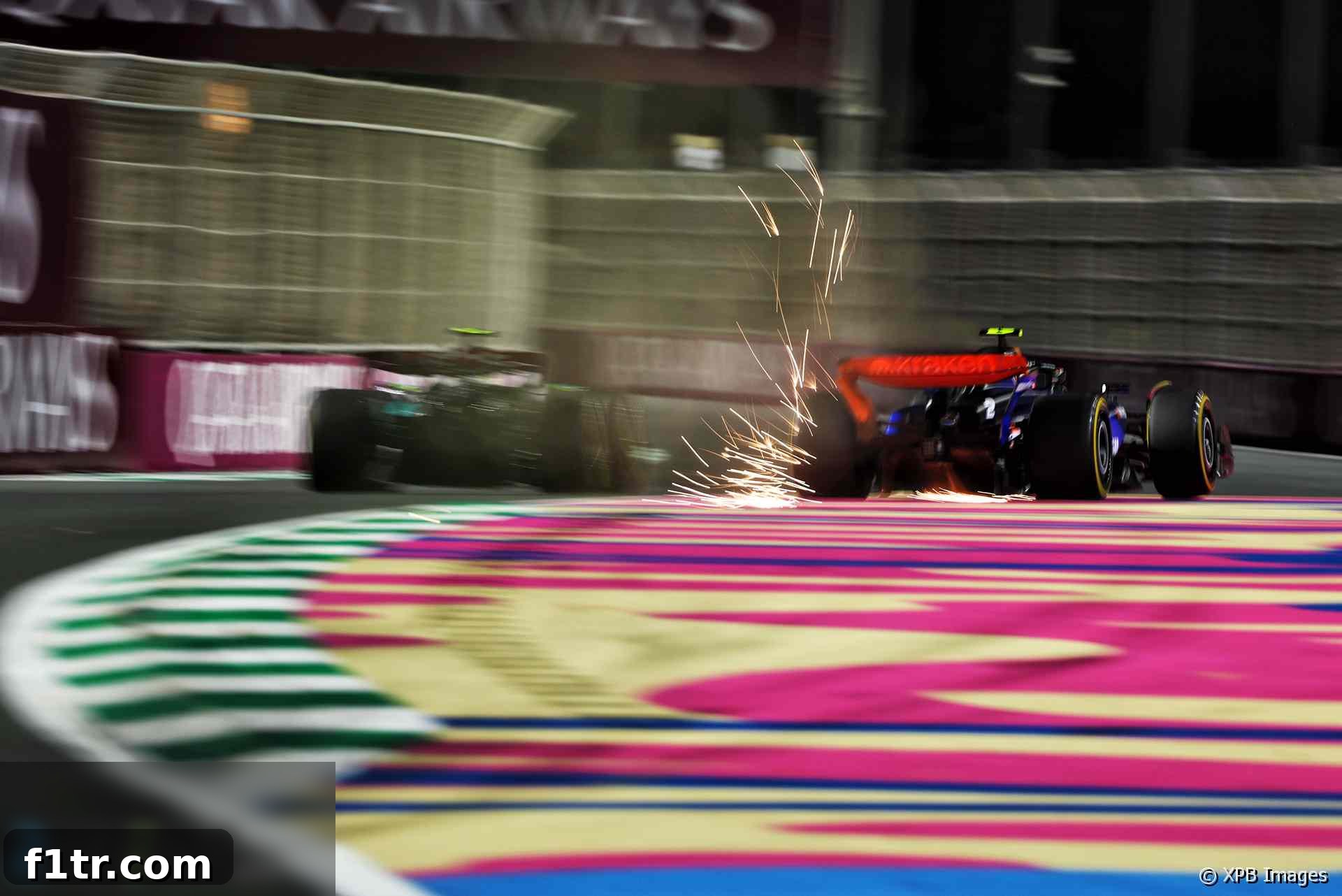
A recent incident at the Saudi Arabian Grand Prix saw Mercedes-AMG Petronas Formula One Team incur a significant penalty following a perilous near-miss involving seven-time world champion Lewis Hamilton and Williams driver Logan Sargeant during the second practice session. The team was fined €15,000 (approximately £12,812) by the race stewards, citing a “serious failure” in their operational protocols. Concurrently, Hamilton himself received a formal warning for his role in the dangerous encounter, narrowly averting what could have been a catastrophic high-speed collision on the challenging Jeddah Corniche Circuit.
The incident unfolded early in the highly anticipated second practice session in Jeddah, a crucial period for teams to fine-tune their setups and for drivers to push the limits of their machinery. Hamilton, having just completed a flying lap, began to slow down. His intention was to create space and allow Carlos Sainz Jnr, who was approaching behind him, to pass. This maneuver, however, took place through the notoriously fast and blind sequence of Turns 10, 11, and 12 – a critical section at the conclusion of the first sector of the track. Unbeknownst to Hamilton, Logan Sargeant was rapidly closing in from behind, engaged in a push lap after abandoning an earlier attempt to set a quick time.
As Sargeant arrived at this high-speed corner complex, preparing to overtake both Hamilton and Sainz, he found Hamilton’s Mercedes unexpectedly positioned on the racing line. The rapid difference in speed and Hamilton’s trajectory forced Sargeant into immediate evasive action. To avoid a direct collision with the slowing Mercedes, the young American driver had to abruptly steer to the outside of Turn 11, taking to the kerb and narrowly missing disaster. This split-second decision by Sargeant highlighted the perilous nature of the situation and the immense pressure drivers face on circuits with limited visibility and high speeds.
Carlos Sainz Jnr, who had a clear view of the unfolding incident from his position behind Hamilton, immediately reported the dangerous situation to his Ferrari team over the radio. His words underscored the severity of the moment: “What Hamilton did there was super-dangerous.” Sainz’s candid observation from within the cockpit provided a critical real-time perspective that later contributed to the stewards’ assessment of the incident.
Following the session, the race stewards launched a thorough investigation. They reviewed telemetry data, onboard camera footage from all involved cars, and conducted interviews with both Lewis Hamilton and Logan Sargeant, as well as representatives from their respective teams. After careful deliberation, the stewards concluded that Hamilton had indeed impeded Sargeant, forcing the Williams driver to take potentially life-saving evasive action. The official statement from the stewards emphasized the gravity of the situation, stating, “Had that not been done, there would have been a serious, high-speed crash.” This stark assessment underlined the very real danger posed by the communication breakdown that led to the incident.
The primary culpability for the near-miss was placed on the Mercedes team. The stewards explicitly stated that Mercedes “failed to warn their driver of the fact car two [Sargeant] was arriving on a fast lap.” This oversight was deemed a critical operational error. The report elaborated on why this failure was so severe, particularly on the Jeddah circuit: “That was a serious failure on the part of the team particularly given the speeds on this circuit and the nature of turn 11, which is at the end of a series of high speed corners where driver visibility is impaired.” The unique characteristics of the Jeddah Corniche Circuit, with its labyrinthine layout, high average speeds, and numerous blind corners, amplify the risks associated with miscommunication and improper spatial awareness during practice sessions. Teams are expected to maintain constant vigilance and provide drivers with precise, real-time information regarding surrounding traffic, especially when drivers are either on hot laps or backing off.
Regarding Lewis Hamilton’s individual consequence, the formal warning he received carries less weight than a reprimand. Unlike reprimands, which accumulate over the course of the Formula 1 season and can lead to grid penalties or even race bans if a driver collects too many, warnings do not contribute to such a points system. This means that while the warning serves as an official caution and a record of his involvement in the incident, Hamilton is not currently at risk of incurring further penalties should he receive additional warnings later in the championship. This distinction highlights the stewards’ belief that while Hamilton was involved, the primary responsibility for the dangerous situation lay with his team’s failure to provide adequate communication.
This incident also brought to light a historical precedent at the very same circuit. Mercedes had previously been fined a higher amount, €25,000, for another near-miss involving Hamilton at the Jeddah Corniche Circuit just three years prior. In that 2021 incident, Haas driver Nikita Mazepin was forced to take drastic action to avoid colliding with Hamilton’s Mercedes at Turn 8, a similar high-speed section of the track. On that occasion, Hamilton himself also received a reprimand, signifying a slightly more severe judgment against the driver than the warning issued in the recent Sargeant incident. The comparison between these two events underscores the persistent challenges of managing traffic on the high-speed, walls-lined street circuit and the continuous need for impeccable team communication and driver awareness in such demanding environments. The higher fine in 2021 might suggest a greater degree of team responsibility or a slightly different context in the previous incident, but both serve as stark reminders of the inherent dangers in Formula 1 if protocols are not rigorously followed.
The Saudi Arabian Grand Prix remains one of the most exhilarating yet challenging venues on the F1 calendar. Its ultra-fast nature, coupled with its street circuit characteristics, demands absolute precision from both drivers and teams. Incidents like the one between Hamilton and Sargeant serve as critical learning opportunities, reinforcing the paramount importance of safety protocols, clear team-to-driver communication, and comprehensive situational awareness. As Formula 1 continues to push the boundaries of speed and technology, the commitment to driver safety and fair play remains at the core of its regulations, ensuring that the thrilling spectacle on track doesn’t compromise the well-being of its competitors. Such penalties and warnings are not merely disciplinary actions but essential components of maintaining the highest safety standards in elite motorsport.
2024 Saudi Arabian Grand Prix Insights
Delve deeper into the events and storylines surrounding the 2024 Saudi Arabian Grand Prix with these related articles:
- Bearman’s 2024 Jeddah debut performance makes him ‘feel like an absolute idiot’
- Vowles being patient with Sargeant but expects to see “progress”
- “So I’ve got nothing to worry about?” – The best unheard team radio from Jeddah
- “Shock” of poor start to season showed need for change at Alpine – Famin
- “My tyres are dying”: Stroll’s short-lived struggle until he hit the wall
Browse all 2024 Saudi Arabian Grand Prix articles