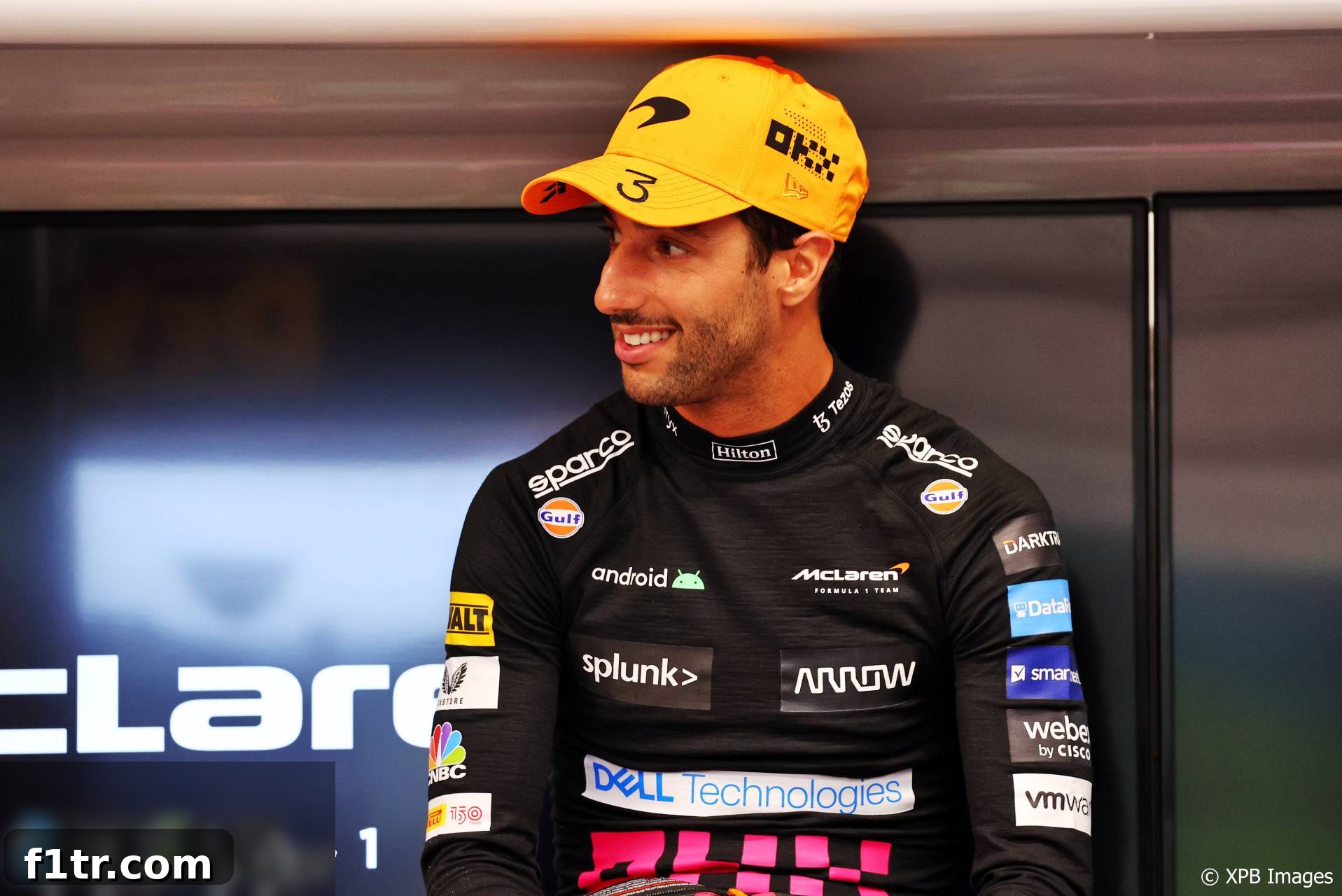
The high-stakes world of Formula 1 driver movements is rarely short on intrigue, and the lead-up to the 2023 season proved no exception. Haas F1 Team Principal Guenther Steiner, known for his direct approach, recently confirmed that he had indeed extended an offer to seasoned campaigner Daniel Ricciardo regarding a potential drive for the upcoming year. This revelation sheds light on the intense speculation surrounding Ricciardo’s future and the various options he explored, or declined to explore, during a pivotal phase of his career.
The American outfit ultimately announced today its decision to bring Nico Hulkenberg back to a full-time F1 race seat, replacing Mick Schumacher. However, Steiner’s comments indicated that the team cast a wider net in their search for the ideal driver to partner Kevin Magnussen. The pursuit of an experienced hand, capable of extracting consistent performance and guiding the team’s development, was clearly a top priority for Haas after a season that saw moments of promise alongside periods of inconsistency.
The move to approach Ricciardo came at a critical juncture for the popular Australian driver. His second season with McLaren had been particularly challenging, characterized by a stark performance disparity between himself and teammate Lando Norris. This ultimately led to McLaren’s decision to terminate Ricciardo’s contract a year early, setting him free to seek other opportunities for 2023. Steiner’s foresight meant his initial outreach to Ricciardo occurred even before this official announcement in August, highlighting the proactive nature of team principals in the ever-shifting F1 driver market.
Speaking to media outlets, including RaceFans, in Abu Dhabi, Steiner elaborated on the timing: “At the beginning I reached out, actually before the McLaren thing happened. I reached out to see what he was doing next year. But then we didn’t go anywhere.” This early engagement underscores the rapid pace at which F1 teams operate, often exploring various avenues long before any official announcements are made public. For Haas, evaluating a driver of Ricciardo’s caliber, despite his recent struggles, would have been a natural step in their strategic planning. Ricciardo, a proven race winner and one of the sport’s most marketable personalities, could have offered a significant boost to the team’s profile and on-track performance, assuming he could rediscover his form.
However, the decision to sign Ricciardo was fraught with complexity. Despite his undeniable race-winning pedigree, including eight Grand Prix victories and numerous podium finishes, Steiner candidly admitted that hiring him after a largely disappointing two seasons at McLaren would present a significant gamble for any team. The sole exception to his struggles at McLaren was his unexpected and triumphant victory at the 2021 Italian Grand Prix at Monza, a moment that briefly rekindled hopes of a resurgence but ultimately proved to be an anomaly rather than a turning point.
“Daniel this year obviously he didn’t do well otherwise he would be still at McLaren next year,” Steiner observed with his characteristic bluntness. “So I think we have to consider that one as well. We would have known that in the moment it’s not his height of his career. And I still don’t get it because I think he’s a very good driver because he won races with Red Bull, he was very good, and this year it just didn’t come together.” Steiner’s remarks reflect a common sentiment within the paddock: a recognition of Ricciardo’s past achievements coupled with bewilderment at his recent dip in form. The challenge for any prospective team would be to understand the root cause of these struggles and, more importantly, whether they could provide an environment conducive to his return to peak performance.
The “risk” factor was a prominent consideration for Haas. Taking on a driver whose confidence might be shaken and who has openly struggled to adapt to a particular car philosophy presents both potential rewards and considerable challenges. “So if you take somebody like this you are again taking the risk of can you bring him back or not?” Steiner questioned, articulating the dilemma faced by many teams. Haas, operating on a more constrained budget compared to top-tier teams, needed a driver who could hit the ground running and deliver consistent points, minimizing the learning curve and adaptation period. While Ricciardo’s experience is vast, the process of ‘bringing him back’ to his former glory could have been a lengthy and costly endeavor, potentially diverting resources and focus from other critical areas of team development.
From Ricciardo’s perspective, a move to Haas might not have aligned with his immediate career aspirations. After being released from a competitive midfield team like McLaren, a switch to a team that frequently battles at the back of the grid could have been perceived as a significant step backward. Throughout the speculation surrounding his future, Ricciardo had expressed a strong desire to either secure a competitive seat or take a sabbatical, potentially embracing a reserve driver role with a top team, rather than simply accepting any available F1 drive. This approach suggested a focus on long-term goals and a strategic pause to recalibrate, rather than rushing into a less competitive environment.
“He never spoke out,” Steiner said of Ricciardo’s lack of follow-up on the initial approach, underscoring that the interest was primarily one-sided from Haas’s perspective. It highlights Ricciardo’s clear preference for his eventual decision, which saw him sign a third-driver role with Red Bull Racing for 2023, offering him a chance to remain immersed in the F1 environment, contribute to development, and potentially position himself for a future full-time return without the immediate pressure of an uncompetitive race seat. This decision signaled a different path, one focused on recovery and strategic positioning rather than immediate competition in the lower midfield.
Adding a touch of humor to the exchange, Steiner couldn’t resist a playful jab at Ricciardo, referencing an on-track incident: “He still doesn’t speak with me, you know? And he better [not] after last weekend when he crashed into us,” Steiner quipped, his characteristic grin suggesting it was all in good spirits. “That’s it, I don’t answer his phone call anymore.” This light-hearted moment, coming after Ricciardo’s collision with Kevin Magnussen’s Haas at the Brazilian Grand Prix, illustrates the camaraderie and playful rivalries that often exist between teams and drivers, even amidst fierce competition and serious contract negotiations. It provided a glimpse into the human element of Formula 1, where professional dealings are sometimes interspersed with personal interactions and good-natured banter.
Advert | Become a RaceFans supporter andgo ad-free
Ultimately, Haas’s decision to bring Nico Hulkenberg into the fold speaks volumes about their strategic direction. Hulkenberg, a driver with vast experience and a reputation for reliability and consistent performance, particularly in his previous ‘super-sub’ roles, offered Haas a known quantity with a lower perceived risk. His familiarity with various F1 eras and his consistent track record, despite never securing a podium, made him an attractive candidate for a team looking to stabilize its performance and provide valuable feedback for car development. This choice reflected a pragmatic approach, prioritizing stability and proven capability over the higher-risk, potentially higher-reward gamble of a Ricciardo revival. The comparison between Hulkenberg’s steady career and Ricciardo’s recent turbulence undoubtedly played a role in Haas’s final assessment, leading them to conclude that Hulkenberg was the better fit for their immediate goals and budget constraints, especially given the desire for a veteran presence alongside Kevin Magnussen.
The F1 driver market is a relentless ecosystem, where careers can pivot dramatically in a single season. Guenther Steiner’s proactive approach to Daniel Ricciardo, and Ricciardo’s subsequent decision to decline a race seat in favor of a reserve role, underscore the complex blend of performance, strategy, finance, and personal ambition that shapes the grid. While Ricciardo embarks on a new chapter with Red Bull, Haas moves forward with a revamped and experienced lineup, signaling their intent for a more competitive and consistent 2023 season. The narrative of potential comebacks and strategic gambles will continue to define the sport, ensuring that the driver market remains a captivating subplot within the Grand Prix racing drama.
2022 Abu Dhabi Grand Prix
- Norris dissatisfied with solitary podium finish: “One isn’t enough”
- Verstappen achieves most dominant title win since Vettel in 2013
- Magnussen’s experience makes him ‘positive’ ousted Schumacher can return to F1
- Overtaking still difficult at Yas Marina despite 2021 track changes, say drivers
- Depressing to consider points lost says Gasly after AlphaTauri slump to ninth
Browse all 2022 Abu Dhabi Grand Prix articles