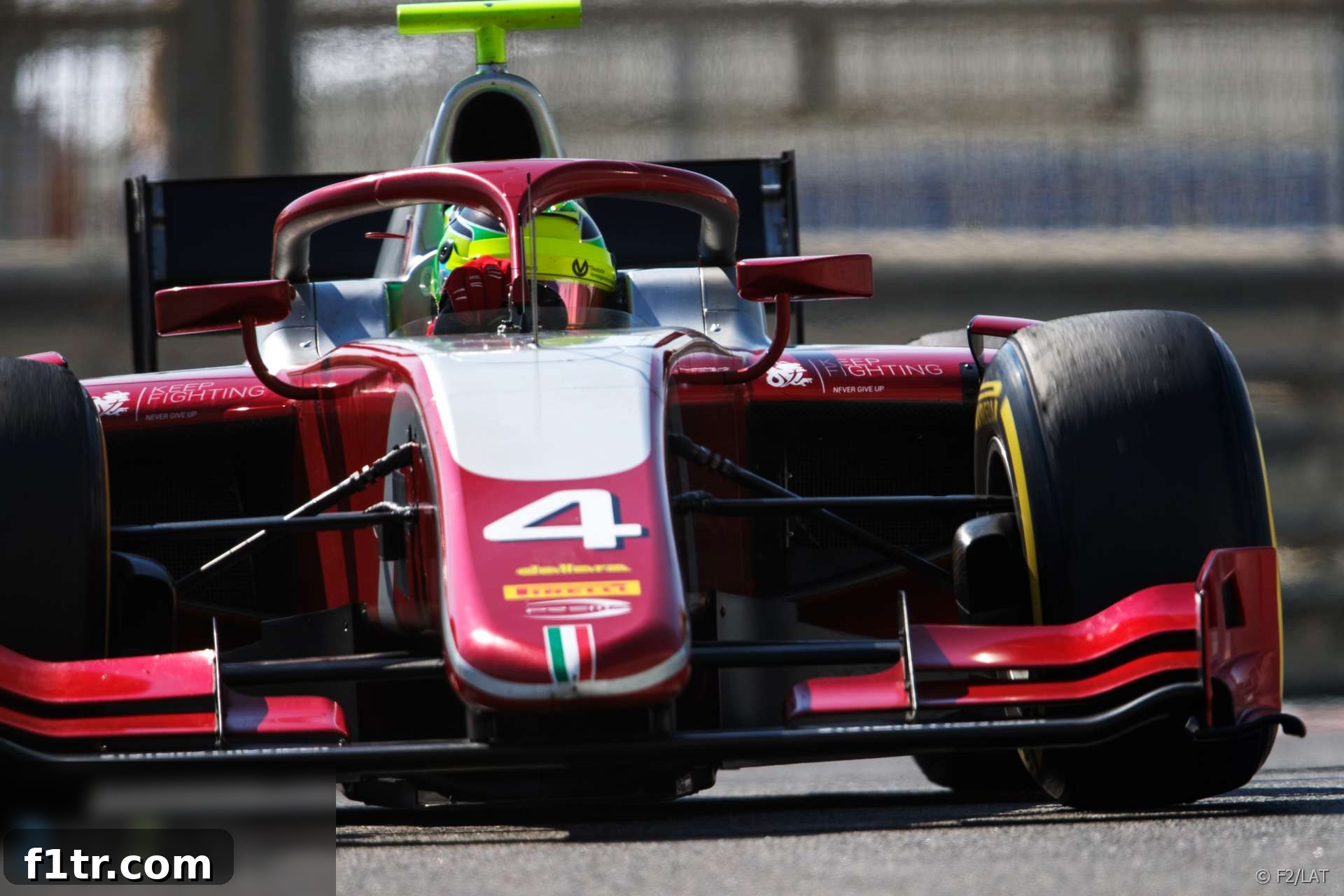
Mick Schumacher’s Pivotal Path to Formula 1: Navigating the Superlicence Challenge in F2
Mick Schumacher, bearing arguably the most iconic surname in motorsport, recently took a monumental stride closer to emulating his legendary father Michael and esteemed uncle Ralf in Formula 1. The racing world buzzed with anticipation as Ferrari officially welcomed him into its prestigious Driver Academy, a clear indicator of the Scuderia’s long-term faith in his potential. This move places the young German talent firmly on the radar for a future F1 seat, igniting hopes among fans eager to see the Schumacher name return to the pinnacle of motorsport.
At just 19 years old, Schumacher had already demonstrated sufficient prowess to earn an F1 Superlicence, as recognised by the FIA. His dominant performance in the European F3 championship last year, where he clinched the title, pushed him beyond the crucial threshold of 40 Superlicence points required for an F1 graduation. This achievement underscores his natural talent and rapid development through the junior categories, marking him as a genuine contender for a spot in the elite series.
However, instead of rushing into F1 at the earliest opportunity, a path taken by some of his recent F3 predecessors like Lance Stroll, Schumacher has opted for a more measured approach. He has chosen to follow in the footsteps of Stroll’s successor, Lando Norris, by progressing to Formula Two. This strategic decision to hone his skills in F1’s primary feeder series is widely seen as a sensible course of action for long-term development, allowing him to adapt to heavier, more powerful cars and complex racing dynamics before making the ultimate leap.
While potentially beneficial in the long run, this choice immediately places Schumacher under considerable pressure. The unique regulations surrounding the Superlicence dictate that points are only valid for three seasons. This means the 20 points Schumacher accumulated during his impressive 2016 campaigns – securing two second-place finishes in both German and Italian F4 – will not count towards a potential F1 drive in 2020. This looming deadline creates a high-stakes scenario where performance in his debut F2 season becomes absolutely critical for his immediate F1 aspirations.
Mick Schumacher Superlicence Points: A Critical Overview
| Year | Points | Series |
|---|---|---|
| 2016 | 10 | 2nd in German F4 |
| 2016 | 10 | 2nd in Italian F4 |
| 2017 | 0 | 12th in European Formula Three |
| 2018 | 30 | 1st in European Formula Three |
NB. Schumacher’s third in the 2016-17 MRF Challenge did not earn him Superlicence points
Given that Schumacher scored no Superlicence points in 2017, the imperative for his 2019 F2 season is stark: he must accumulate at least 10 points to maintain eligibility for an F1 car in 2020. To achieve this, he will need to secure at least a sixth-place finish in the F2 championship standings. Falling short could jeopardize his chances of making his F1 debut the following year, potentially forcing him to seek additional points through other eligible series, such as the Macau Grand Prix where an extra five points are available for a top-three finish – an unnecessary distraction he would surely prefer to avoid.
The question of how likely Schumacher is to meet this target hangs heavily over his debut F2 season. He faces a multitude of unknowns as he steps into F1’s premier junior series. Foremost among these is mastering a brand-new car, the Dallara F2 2018, which many of his rivals already familiarized themselves with during its introduction the previous year. This machine, with its turbocharged engine, significant downforce, and demanding chassis, represents a substantial step up from the F3 car he piloted to glory. The learning curve will be steep, requiring quick adaptation and a deep understanding of its nuances.
Furthermore, this will be Schumacher’s first encounter with the unique characteristics of Pirelli’s control tyres, which are notoriously challenging to manage. These tyres are vastly different from the Hankooks he became accustomed to in F3, known for their sensitivity to temperature and degradation. Successful F2 drivers are often those who master tyre management, balancing raw pace with strategic preservation over a race distance. This aspect of racing demands precision, experience, and a nuanced understanding that will test Schumacher’s adaptability.
Despite these significant challenges, Schumacher benefits from crucial elements of continuity and support. His decision to remain with Prema Racing, the team with whom he conquered European F3, offers a stable and familiar environment. Prema is widely regarded as one of the most successful and professional outfits in the junior categories, boasting an unparalleled track record. This continuity minimizes the number of new variables, allowing Mick to focus primarily on adapting to the car and tyres rather than also integrating into a new team culture.
Prema’s history at this level speaks volumes about their capability to nurture champions. The Lawrence Stroll-owned team guided both Pierre Gasly and Charles Leclerc to championship success in its first two seasons in the series. This pedigree instills confidence that Schumacher will receive the best possible technical support, engineering insight, and strategic guidance throughout his campaign. The team’s proven ability to extract maximum performance from its drivers and cars will be an invaluable asset in his quest for F2 glory and Superlicence points.
Within the Prema fold, Schumacher is expected to set the benchmark, particularly against his teammate Sean Gelael, who has historically struggled to consistently score points. This provides Mick with a clear opportunity to establish himself as the team leader and demonstrate his superior pace. Moreover, the 2019 F2 grid presents a slightly altered landscape compared to the previous year. Four of last year’s top five contenders have moved on to bigger things: George Russell, Lando Norris, and Alexander Albon have all graduated to Formula 1, while Artem Markelov’s promising career faced unfortunate derailment following personal circumstances. Furthermore, his previous rival, Dan Ticktum, has been placed by Red Bull in Japan’s Super Formula championship, removing another strong competitor from the F2 grid.
Nevertheless, the F2 grid remains fiercely competitive, featuring a host of experienced and talented drivers who will provide a much tougher benchmark for Schumacher. Seasoned contenders such as Sergio Sette Camara, Nyck de Vries, Jack Aitken, and Louis Deletraz have accumulated significant mileage and experience in the series. These drivers are not only quick but also understand the intricacies of F2 racing, from qualifying strategy to race pace management and tyre preservation. Their presence ensures that any success Schumacher achieves will be hard-earned and thoroughly deserved. With several vacant slots still remaining on the 20-car grid, the final line-up promised to be packed with hungry talents all vying for F1’s attention.
The 2019 Formula 2 season represents a pivotal year in Mick Schumacher’s burgeoning career. A strong debut, marked by consistent performance and a solid championship finish, could rapidly accelerate the bearer of F1’s most famous surname towards an F1 debut a little over 12 months from now. Such a performance would not only secure his Superlicence points but also solidify his standing within the Ferrari Driver Academy, potentially opening doors to F1 seats with Ferrari-affiliated teams. However, if he fails to hit the ground running, struggles with the car, or falls short of the Superlicence point target, making that dream F1 debut in the near future could become significantly trickier and require an extended, more arduous path. The world of motorsport watches keenly as Mick Schumacher embarks on this critical chapter, carrying the weight of expectation and the legacy of a legend.