Force India Reinstates Team Orders Following Ocon and Perez Singapore Grand Prix Collision
In a decisive move following a costly first-lap collision at the Singapore Grand Prix, the Sahara Force India Formula 1 team has once again reimposed stringent team orders on its two ambitious drivers, Esteban Ocon and Sergio Perez. This critical directive underscores the team’s determination to prioritize championship points, especially amidst their ongoing battle for survival and recovery in the 2018 Formula 1 season.
The Costly Singapore Grand Prix Incident
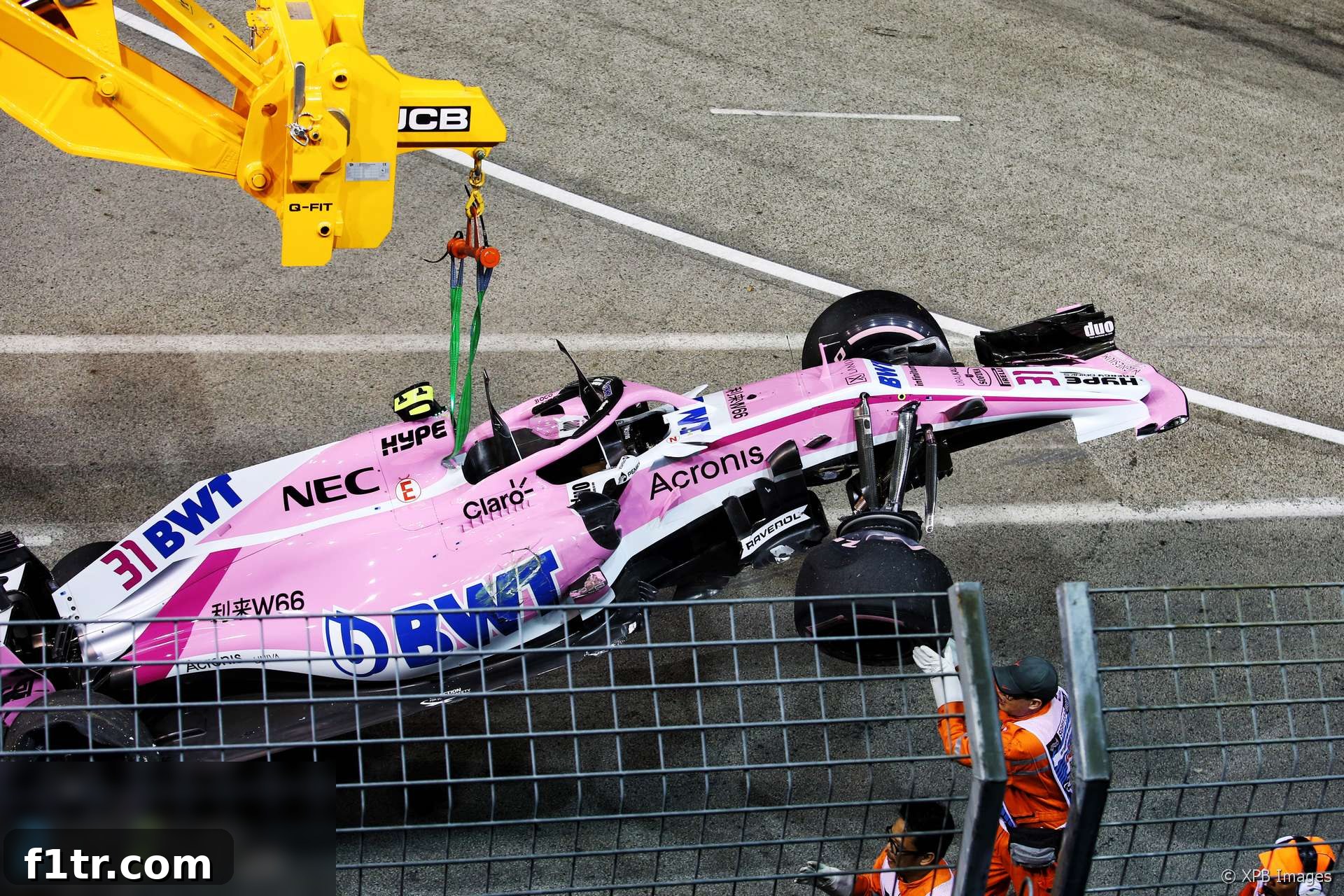
The incident that necessitated this renewed disciplinary action occurred during the opening moments of the Singapore Grand Prix, a highly demanding street circuit known for its unforgiving nature. As the Force India duo navigated the tight and intricate Turn Three on the very first lap, their cars made contact. The impact was severe enough to send Esteban Ocon’s car forcefully into the circuit wall, causing irreparable damage and forcing his immediate retirement from the race.
This early exit for Ocon represented a significant blow to the team, squandering what had promised to be a strong points-scoring opportunity. Both drivers had demonstrated impressive pace in qualifying, securing top-ten grid positions for their VJM11 chassis. The potential for a valuable double-points finish, crucial for a team striving to climb the constructors’ standings, vanished instantly due to this avoidable intra-team clash. While Sergio Perez continued his race, the shadow of the collision loomed large, culminating in a deeply frustrating day for the entire Force India operation. Team Principal Otmar Szafnauer’s immediate reaction summed up the collective sentiment, describing the race as “extremely disappointing” and emphasizing the severe repercussions of the incident.
A Recurrent Theme: The History of Ocon and Perez’s Intense Rivalry
The Singapore collision was not an isolated occurrence but rather the latest episode in a frequently contentious and high-profile rivalry between Esteban Ocon and Sergio Perez. Their competitive dynamic reached a boiling point during the 2017 Formula 1 season, where a series of on-track clashes repeatedly cost Force India valuable championship points and damaged the team’s reputation for consistency.
Key moments of their prior conflicts include the 2017 Azerbaijan Grand Prix in Baku, where both drivers made contact while fighting for a podium position, ultimately costing the team a guaranteed strong finish. Further incidents followed at the Belgian Grand Prix, where their aggressive wheel-to-wheel battles led to multiple collisions during the same race, provoking widespread criticism from team management and the wider F1 community. These escalating tensions directly led to the initial imposition of strict “rules of engagement” after the 2017 Belgian Grand Prix, which effectively prohibited them from directly racing against each other. This measure was successful in preventing further self-inflicted damage and helped the team secure a commendable fourth place in the constructors’ championship.
However, entering the 2018 season, the restrictions were gradually eased, a decision likely influenced by the desire to allow both talented drivers the freedom to compete and showcase their abilities. Unfortunately, this relaxation proved to be a short-lived experiment. The Singapore debacle served as a stark and painful reminder of the underlying intensity of their rivalry, forcing the team to revert to a more controlled and disciplined approach to intra-team racing. This history underscores the difficult balance team management must strike between fostering competition and ensuring the team’s collective success.
Otmar Szafnauer’s Firm Stance and the Team’s Collective Frustration
Team Principal Otmar Szafnauer did not hesitate to convey the gravity of the situation following the Singapore incident. His description of the race as “extremely disappointing” highlighted the deep frustration felt throughout the Force India organization. He was unequivocal in his assessment, stating, “It’s unacceptable for team mates to hit each other and it has cost us dearly.” This direct and forceful condemnation emphasized not only the physical damage to Ocon’s car but also the substantial financial and sporting costs associated with such an avoidable error.
Szafnauer further elucidated the cause of the collision, noting that the drivers “didn’t leave each other enough room and the contact put Esteban into the wall.” This detailed observation pointed towards either a lack of spatial awareness or an overly aggressive maneuver from one or both drivers, culminating in the catastrophic outcome. His statements reflect a leadership team that had reached its tolerance limit for internal conflicts, especially given the precarious financial and championship position the team found itself in during the 2018 season.
The team principal’s resolve to take immediate action was clear and firm. His confirmation that the “rules of engagement” from 2017 would be definitively reinstated ahead of the upcoming Russian Grand Prix served as a non-negotiable directive. This decision, though potentially unpopular with the drivers who naturally thrive on competition, signifies the team’s unwavering commitment to its collective goals. It places the team’s championship aspirations and financial stability firmly above individual driver ambitions, particularly during a period of immense vulnerability and intense pressure to perform.
The Dire Context: Force India’s Challenging 2018 Season and the Fight for Survival
The urgency behind Force India’s decision to reimpose team orders is inextricably linked to the extraordinary challenges faced by the team during the 2018 Formula 1 season. The year had been marked by severe financial distress, which ultimately led to the team being placed into administration during the summer break. This unprecedented situation resulted in the team effectively being reborn as a “new entry” under the name Racing Point Force India. The most devastating consequence of this administrative restructuring was the forfeiture of all championship points accumulated by the original Force India entity prior to the summer break. This meant that despite a solid first half of the season, the team was forced to restart its constructors’ championship campaign from zero points.
Beginning anew with no points midway through the season placed immense pressure on every single race outcome. The team responded admirably to this adversity, demonstrating exceptional resilience and performance by scoring strongly in subsequent races, including the Belgian and Italian Grand Prix. These strong showings highlighted the inherent competitiveness of their car and the talent of their drivers, enabling them to rapidly regain ground in the championship standings. The Singapore Grand Prix was thus viewed as another crucial opportunity to add significant points and solidify their recovery. The collision, therefore, was not merely a missed opportunity but a deeply frustrating setback to their hard-fought efforts.
Szafnauer perfectly articulated this frustration, stating, “This disastrous race is all the more frustrating when you consider the speed we showed in qualifying and the opportunity that has passed us by.” For a team fighting tooth and nail for its very survival and striving to regain a respectable footing in the constructors’ championship, such self-inflicted wounds are simply intolerable. Every point earned is vital, not only for their immediate championship standing but also for the crucial financial benefits tied to higher championship positions, which are absolutely essential for a team recently rescued from the brink of collapse.
Implications of Reinstated Team Orders for Drivers and Team
The reinstatement of team orders carries profound implications for both Esteban Ocon and Sergio Perez, as well as for the Force India team’s strategic approach for the remainder of the season. For the drivers, it signals a significant curtailment of their freedom to race. While the innate competitive drive is a fundamental characteristic of every Formula 1 driver, these new rules impose a disciplined approach, requiring them to maintain position or adhere to specific instructions, even if it means sacrificing an opportunity to overtake a teammate. This situation can be particularly challenging for ambitious young talents like Ocon, who is actively seeking to impress potential future employers, and for seasoned professionals like Perez, who consistently strives to maximize his individual performance and secure his position within the sport.
From the team’s perspective, these orders, while potentially unpopular, are a necessary and pragmatic evil. They unequivocally prioritize the collective good – securing vital constructors’ points and the associated prize money – over the individual aspirations and glory of their drivers. In Force India’s precarious financial state, every point directly influences their operational budget, their ability to develop the car, and ultimately, their long-term survival in the ultra-competitive world of Formula 1. The decision reflects a strategic pivot towards ensuring stability and guaranteed points, even if it means sacrificing some of the on-track excitement of direct intra-team battles.
The ongoing challenge for Force India will be to effectively manage and enforce these orders. Clear communication, consistent application, and transparent accountability will be paramount to prevent further dissent or misunderstandings between the drivers and the pit wall. While this approach may dampen the spectacle of direct internal competition, it is a calculated and pragmatic move designed to secure the team’s future and prevent any recurrence of the costly Singapore debacle. The psychological impact on the drivers, however, will require careful monitoring by the team to ensure that morale remains high despite the imposed restrictions.
The Road Ahead: Russia and Beyond for Racing Point Force India
With the Russian Grand Prix at Sochi swiftly approaching, the newly imposed team orders will be immediately put to the test. This particular race, like all others on the demanding F1 calendar, presents its own unique set of challenges and opportunities for scoring crucial points. For Force India, the directive will be crystal clear: drivers must operate cleanly, maximize their individual car performance, and under no circumstances engage in contact with their teammate. This disciplined approach is expected to guide their race strategy not only in Russia but throughout the remaining races of the 2018 F1 season.
The broader outlook for Racing Point Force India involves a continuous and determined fight to climb as high as possible in the constructors’ standings. Having been forced to restart from zero points, every position gained translates into significant financial rewards, which are absolutely vital for the team’s long-term stability and its ability to develop under its new ownership. The team’s focus will shift from allowing drivers absolute freedom to ensuring a highly collaborative and unified effort to secure the highest possible finishing positions for both cars in every Grand Prix.
As Szafnauer aptly concluded, “These painful lows are part of racing and it’s fair to say that there are very few positives to take from tonight apart from the car pace. We will have some discussions behind closed doors and will learn from what happened so that we can become stronger as a team.” This sentiment highlights a team deeply committed to introspection and continuous improvement, determined to transform a negative experience into a catalyst for a more unified and effective future. The hope is that the renewed team orders will provide the necessary framework for Force India to translate its undeniable car pace into consistent, unhindered championship points, ensuring a more stable and successful path forward.
Related Articles: 2018 F1 Season Insights
- F1 feared “death knell” for Drive to Survive after Ferrari and Mercedes snub
- McLaren staff told us we were “totally crazy” to take Honda engines in 2018 – Tost
- ‘It doesn’t matter if we start last’: How Red Bull’s junior team aided Honda’s leap forward
- Honda’s jet division helped F1 engineers solve power unit problem
- McLaren Racing losses rise after Honda split
Browse all 2018 F1 season articles