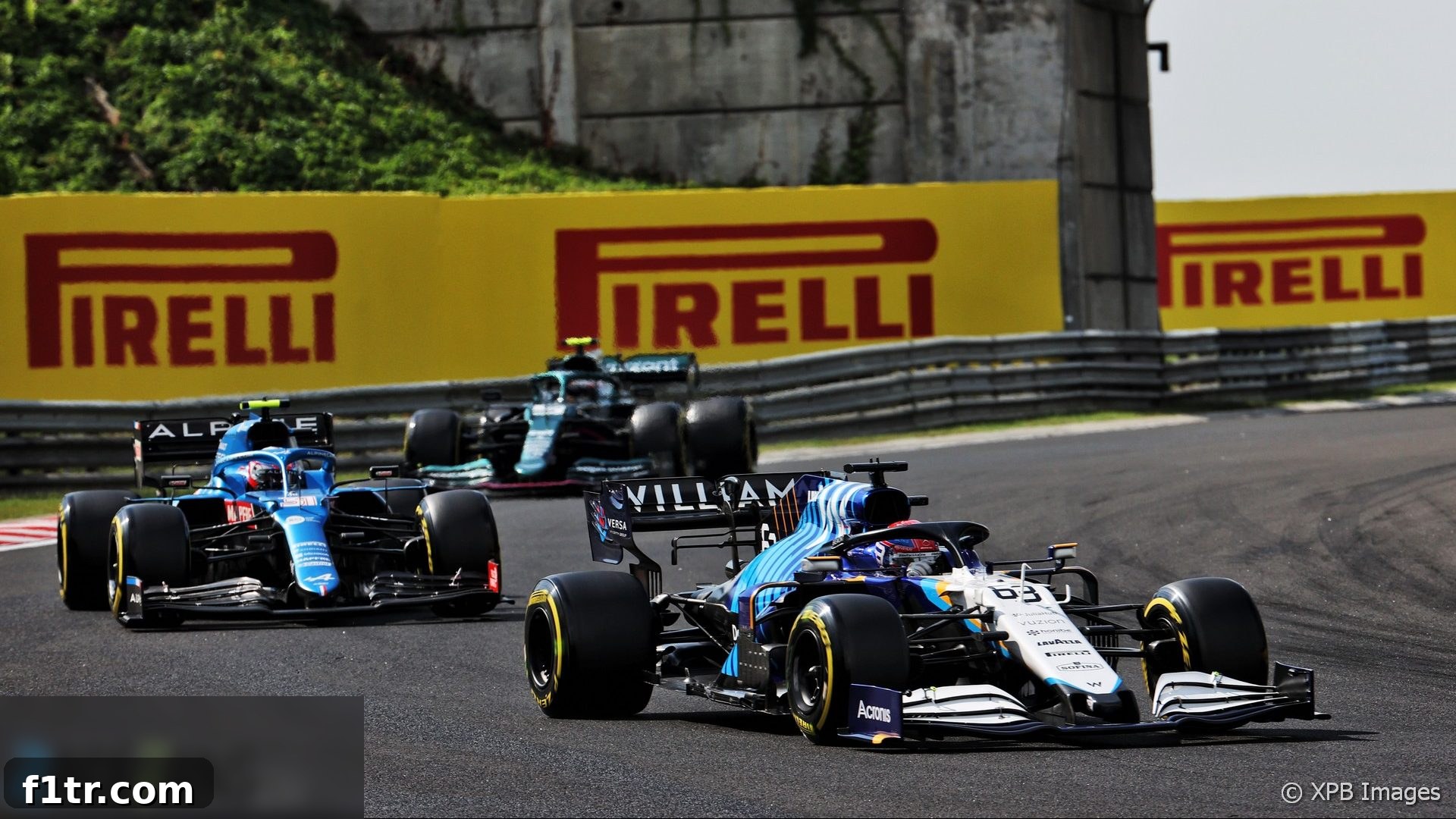
In a high-stakes moment during the Hungarian Grand Prix, George Russell found himself at the center of a dramatic pit lane incident that could have easily cost him dearly. Yet, thanks to the swift, decisive action of his Williams team and what Russell himself described as the FIA’s “common sense,” the young British driver emerged without penalty, sparking a significant discussion about quick thinking and regulatory interpretation in Formula 1.
The incident unfolded during one of the most chaotic moments of the race – a full-field pit stop following a red flag restart. With the track drying rapidly, nearly every car on the grid, with the notable exception of Lewis Hamilton, dove into the pit lane simultaneously to swap their intermediate tires for slick compounds. This mass exodus into the tight confines of the pit lane created a unique and intensely pressurized scenario, where fractions of a second and strategic positioning could make or break a race.
Russell, who had initially entered the pits in eighth position, spotted what he perceived as a golden opportunity to gain valuable track positions. Formula 1 regulations clearly stipulate that drivers must leave the pit lane in the order they arrive at the exit, a rule designed to maintain fairness and prevent dangerous jostling. As the cars ahead of him dutifully formed a queue at the pit lane exit, Russell observed his Williams pit box’s advantageous location – positioned closest to the exit point. In a bold, instinctive move driven by competitive instinct, he steered his car directly towards the exit, bypassing several competitors to his left, including Esteban Ocon, who was at the very front of the waiting line.
A moment of hesitation, however, soon followed his audacious maneuver. Unsure of the legality of his action, Russell radioed his race engineer, James Unwin, asking, “Can I go to the front of the queue?” But the speed of F1 decision-making meant that by the time Unwin delivered a clear “negative” response, the pit lane exit light had already illuminated green. Russell, reacting to the signal, accelerated out onto the track, temporarily leading the pack of cars emerging from the pits.
It was at this critical juncture that the Williams team’s rapid and astute response proved invaluable. Before any official intervention from race control, and even before Russell had reached the chicane at turns six and seven, he was instructed to relinquish the positions he had gained. This immediate self-correction was a testament to the team’s understanding of the regulations and their strategic foresight in mitigating a potential, and likely severe, penalty.
| Russell | What can I do? Can I go to the front of the queue? |
| Unwin | Negative. |
| Unwin | Give up the position to get behind Alonso. You need to drop back five cars, at least five cars. You need to be behind Alonso, ahead of Raikkonen. |
| Russell | Yeah copy. |
| Unwin | There’s Latifi, then Tsunoda, then Sainz, then there’s a three-second gap to Alonso |
| Unwin | Need to let Alonso through. |
| Russell | Yeah I’m going to let them all by. |
| Unwin | So you’ve got three in a group, then it’s Alonso, then there’s a gap between Alonso and Raikkonen, that’s where we need to be. Okay, so Alonso with you now. |
| Unwin | You’ve got a one second gap between Alonso… okay you’re in the right position now, you’re in the right position. |
| Russell | Copy, copy. |
The radio transcript vividly illustrates the high-pressure communication between Russell and Unwin. The detailed instructions to drop back, specifically naming drivers like Alonso, Raikkonen, Latifi, Tsunoda, and Sainz, highlighted the precise calculation required to restore the correct running order. Russell wasted no time in complying, demonstrating his professionalism and commitment to fair play. He seamlessly reintegrated into what Williams’ strategists quickly determined was his rightful place, all before the cars had even reached the pit lane entrance again.
Post-race, Russell publicly expressed his profound gratitude to the FIA for their pragmatic approach. He acknowledged the uniqueness of the situation, with “everybody queuing up in the pit lane,” and confessed to seeing an “opportunity” he felt compelled to seize. His relief was palpable, stating, “I’m glad that we were allowed just to hand the position back and that just shows a bit of common sense really.” This sentiment underscored a widely held view among fans and competitors that, in certain exceptional circumstances, flexibility and a recognition of intent can temper strict enforcement of the rules, particularly when self-correction occurs.
However, it was crucial to clarify the exact sequence of events, especially as some television commentators had mistakenly implied the FIA had directly instructed Russell to give the places back. Formula 1 Race Director Michael Masi subsequently clarified that the initiative to correct the error came entirely from the Williams team. “The team came across immediately and said ‘we’ve made a mistake, we’re going to drop back behind Fernando’,” Masi confirmed. “It was actually at the team’s initiation.” This distinction is vital, as it highlights the integrity and proactive self-policing within the Williams garage, which ultimately swayed the regulatory body’s decision not to impose a penalty.
An interesting nuance in the resolution was that Russell did not, in fact, drop behind every single car that had initially reached the pit lane exit before him. Kimi Raikkonen, for instance, had left the pits ahead of Fernando Alonso but ran wide at turn three, allowing Alonso to pass him. Williams specifically instructed Russell to let Alonso through but not Raikkonen, indicating a precise recalculation of positions based on real-time track events, not just the pit lane queue. Despite this slight variation from a perfect reinstatement of the original order, Masi indicated his satisfaction with Williams’ handling of the situation.
Masi elaborated on the governing principle: “Effectively they should start in the order in which they arrive at the pit exit.” He acknowledged the unique challenge posed by Williams’ pit stop position being so close to the pit exit at the Hungaroring, which contributed to Russell’s initial misjudgment. Crucially, Masi confirmed that had Williams not proactively told Russell to cede the positions, he would have bypassed race control and referred the matter directly to the stewards for investigation. “I would have referred that straightaway,” he stated, underscoring the severity of such an infringement if left uncorrected by the team.
This incident serves as a compelling case study in the dynamic world of Formula 1, showcasing the delicate balance between a driver’s competitive instinct, a team’s strategic acumen, and the FIA’s regulatory oversight. George Russell’s momentary lapse, quickly rectified by his team, highlighted the intense pressure of race conditions and the vital importance of understanding and adhering to the sport’s complex rulebook. It also provided a moment of appreciation for “common sense” in a sport often criticized for its rigid application of penalties, ultimately allowing the race to proceed without undue post-race controversy for this particular infraction.
Quotes: Dieter Rencken
2021 F1 season
- Masi ‘basically gifted the championship’ to Verstappen says 2021 FIA steward Sullivan
- Las Vegas race backers looking to extend F1 deal beyond 2025
- Why Mercedes put ‘a reminder of joy and pain’ on display in their factory lobby
- Verdict on error in GT race suggests Mercedes would have lost 2021 Abu Dhabi GP appeal
- Title ‘stolen’ from Mercedes made us ‘underdogs people cheer for’ – Wolff
Browse all 2021 F1 season articles