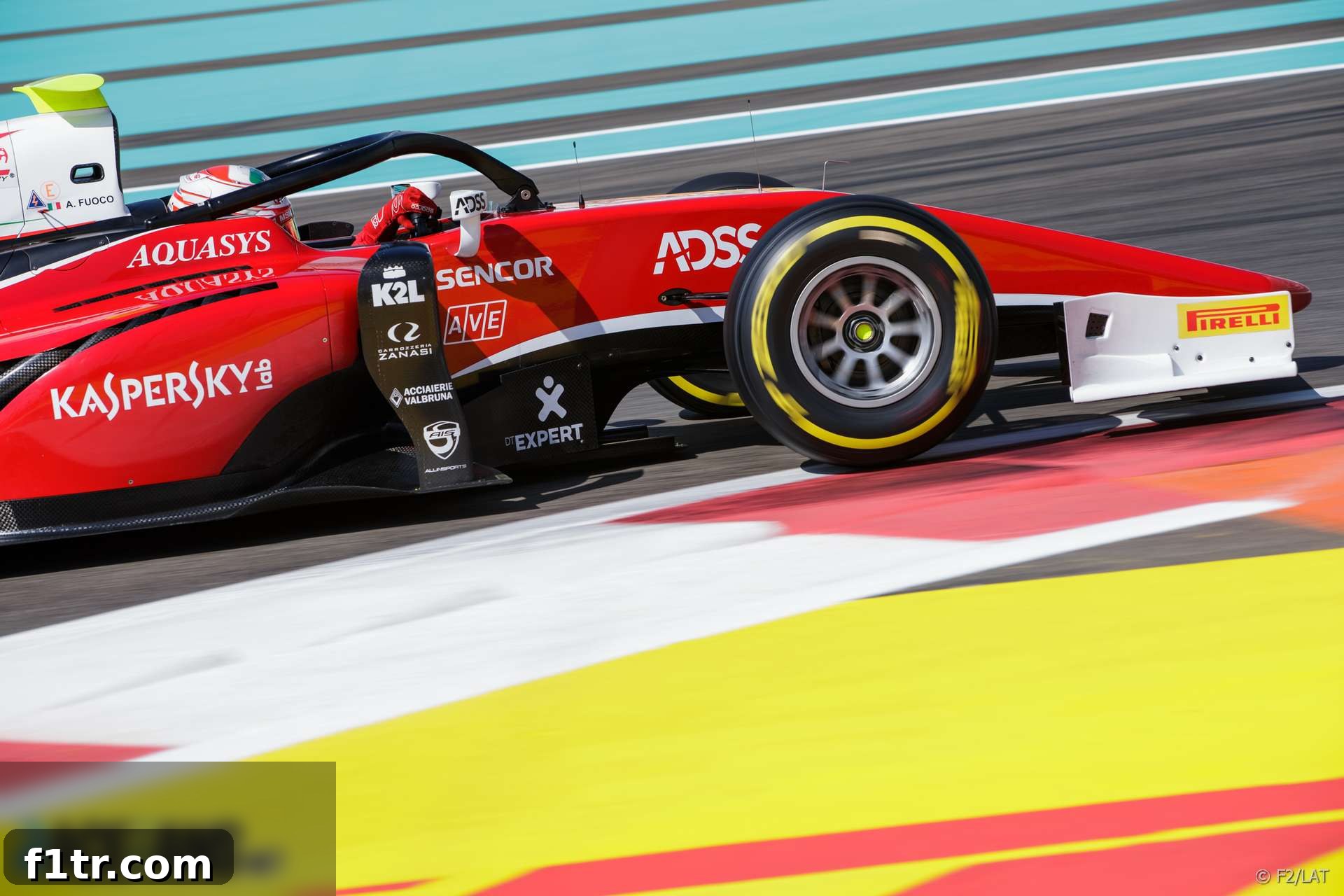
The 2018 Formula Two season concluded with a dramatic and unforgettable sprint race in Abu Dhabi, delivering a thrilling finale marked by unexpected twists and high stakes. Antonio Fuoco emerged victorious, claiming his second win of the year in a race that saw an unprecedented and widespread DRS system failure impact the entire field. This technical glitch significantly altered the race’s dynamic, transforming it into a true test of raw driving skill and strategic acumen rather than relying on the usual overtaking aid.
While the main championships had already been decided in yesterday’s feature race—George Russell securing the drivers’ title and Carlin clinching the teams’ trophy—the battle for runner-up positions in the standings remained fiercely contested. It was a race where every point mattered, particularly for young talents vying for future opportunities in motorsport’s higher echelons.
One of the most compelling narratives heading into the sprint race was the intense struggle for second place in the drivers’ championship between Lando Norris and Alexander Albon. Compounding the pressure, Nyck De Vries also had his sights set on securing third place, making for a fascinating three-way fight. For Norris, the aspiring 2019 McLaren F1 driver, this race represented more than just championship points; it was an opportunity to break a frustrating winless streak that had extended back to the second race of the year, a personal goal that added an extra layer of determination to his performance.
A Chaotic Start Sets the Tone
The final race of the season began with an immediate burst of drama, even before the lights went out. The formation lap itself proved to be a harbinger of the unpredictable events to come. Arjun Maini, who had been involved in a collision with Nicolas Latifi in yesterday’s feature race, stalled his car, forcing another complete tour of the Yas Marina Circuit before the grid could properly form. The chaos didn’t end there; Sergio Sette Camara, whose car had also failed to get away yesterday, stalled on the revised formation lap. In a bizarre turn of events, Latifi, once again, stalled on the grid when the race was finally set to begin. Miraculously, he managed to avoid contact this time, but the triple stalling incident created an unusually tense and delayed start, leaving both drivers and teams on edge.
As the race finally got underway, Antonio Fuoco made an excellent start, immediately seizing the lead. However, the early laps quickly descended into further mayhem. On lap two, Sean Gelael, attempting an overtake on rookie Niko Kari, misjudged his braking. He locked up his wheels, making heavy contact with the back of Kari’s car. The resulting impact sent both cars into a colossal spin, also collecting Tadasuke Makino in the process. All three drivers were eliminated from the race in a spectacular and unfortunate incident that brought out the Virtual Safety Car (VSC) for the subsequent two laps. The VSC period neutralized the field, allowing marshals to safely clear the debris and stranded vehicles, but further disrupting the race’s rhythm.
The eliminations continued shortly after the VSC period concluded. By lap four, Arden’s Dan Ticktum was forced to retire, reporting a gearbox failure to his team over the radio. With five cars already out of contention in the opening stages, the sprint race was rapidly shaping up to be a true “race of attrition,” where simply finishing would be an accomplishment for many, and reliability would prove as crucial as raw pace.
The Unprecedented DRS Failure: Redefining Strategy
As the race progressed, a significant and unforeseen technical issue began to dominate discussions in the pit lane and amongst the drivers. George Russell, having started eighth on the reverse grid, was steadily making his way through the field, showcasing the pace that had earned him the championship. By lap 10, he had caught up to Lando Norris, putting himself within DRS range. However, his team relayed critical information over the radio: the Drag Reduction System (DRS) was entirely unavailable to any driver on the grid. This was an unprecedented and widespread failure that would persist until the very end of the race.
DRS, a movable rear wing element, is a vital overtaking aid designed to reduce aerodynamic drag on specific sections of the track, allowing a following car to gain a speed advantage and make passes easier. Its complete absence on a circuit like Yas Marina, known for its long straights and specific DRS zones, fundamentally reshaped the race. Overtaking, usually facilitated by DRS, suddenly became immensely more challenging, requiring drivers to rely purely on slipstream, late braking, and daring maneuvers. This shift effectively neutralized much of the remaining eleven laps, as gaps became harder to close and positions were more firmly held.
With DRS out of the equation, tyre management became an even more critical factor, especially on the scorching Abu Dhabi track. Drivers had to meticulously balance pace with tyre degradation, knowing that a misstep could lead to a significant performance drop with no easy way to recover lost ground through a DRS-assisted overtake. This forced a more conservative approach from many, transforming what might have been an aggressive sprint into a more measured, chess-like battle.
Mid-Race Tensions and Strategic Plays
Throughout the middle phase of the race, Antonio Fuoco maintained his lead, largely unchallenged. The combination of early retirements and the DRS failure meant that building a significant gap was achievable, and defending it became a primary objective for the front-runner. Behind him, however, the fight for positions was intense, albeit visually less dramatic due to the lack of DRS-assisted passes.
Artem Markelov, known for his aggressive driving style, was particularly animated in his attempts to pass Louis Deletraz. Repeatedly pushing the limits, Markelov found himself running wide and having multiple “off-track adventures” as he tried to force a way through. His team, concerned about potential penalties, had to issue a stern warning over the radio, telling him to “keep cool” or face a reprimand. He had narrowly avoided a stewards’ investigation for his robust driving, highlighting the fine line drivers had to tread in this challenging, DRS-less environment.
The middle sector of the race became a testament to driver skill and patience. Without the artificial boost of DRS, drivers had to exploit every millimeter of track, master their braking points, and perfectly execute slipstream moves. This often meant enduring sustained periods behind rivals, waiting for the precise moment or a slight error from the car ahead.
A Grandstand Finish: Championship P2 Decided
Despite the strategic constraints imposed by the DRS failure, the race saved its most thrilling moments for the very end, culminating in a dramatic penultimate and final lap that had significant championship implications. As the checkered flag loomed, the battle for second place in the drivers’ championship intensified. Alexander Albon, knowing he needed every possible point, mounted a valiant effort on the penultimate lap. He managed to execute a crucial overtake on his rival Ghiotto for eighth position, a move that showcased his determination to hold onto his hard-won second place in the standings, especially after losing the lead to George Russell yesterday.
However, the spotlight ultimately fell on Lando Norris, who delivered a sensational performance on the very final lap. With a surge of renewed determination, Norris made a decisive move on Roberto Merhi, expertly passing him to secure not only second place on the podium but, crucially, second place in the overall drivers’ championship standings. This dramatic last-lap overtake cemented his position as the vice-champion, a remarkable achievement for the young British driver.
The significance of this result for Norris cannot be overstated. Not only did he end his prolonged winless streak with a podium finish, but he also clinched a prestigious second place in the championship, narrowly fending off Albon in a season-long battle. His celebration reflected this triumph; after crossing the finish line, Norris performed a spectacular ‘stoppie’ in front of his Carlin team, a fitting and flamboyant end to a challenging yet successful season. It was a moment of pure joy and relief, marking a significant milestone in his nascent career before his eagerly anticipated step up to Formula 1.
Antonio Fuoco’s victory, while impressive, was somewhat overshadowed by the championship drama and the unique technical challenge that defined the race. His consistent pace and faultless drive under pressure earned him a well-deserved win, bringing the curtain down on a memorable Formula Two season.
Advert | Become a RaceFans supporter andgo ad-free
Formula Two
- Formula 2 to debut in Miami and Montreal after Iran war cancellations
- Ex-McLaren junior Dunne’s move to Alpine finally confirmed
- Schumacher says his IndyCar feels like ‘an F2 car, just with better tyres’
- The Formula 2 team with an older driver line-up than almost half the F1 grid
- FIA to award more F1 superlicence points to IndyCar drivers from 2026
Browse all Formula 2 articles